My choices are noted with a ★. Historical Oscar winners are noted with a ✔. A historical winner who won in a different category is noted with a ✱.
Lot of good choices this year. Taxi Driver is one of Martin Scorsese's most celebrated films, and for reasons I can't put my finger on, All the President's Men seems more relevant than ever. But I'm going with Network, a scathing look at television and our obsession with celebrity and novelty which was considered pretty far out there back in its day but which plays more like a documentary now.
By the way, this coming Saturday, March 23, is the tenth anniversary of the Mythical Monkey. I'll be celebrating by taking a well-deserved nap. You're welcome to join me (but only if you're Katie-Bar-The-Door).
My choices are noted with a ★. Historical Oscar winners are noted with a ✔. Best foreign-language picture winners are noted with an ƒ.
Sorry I'm running late today. It was a busy week on the cancer front. I'll try to blog ahead a couple of months so there'll be no future disruptions of service ...
My choices are noted with a ★. Historical Oscar winners are noted with a ✔. Best foreign-language picture winners are noted with an ƒ.
I suppose One Flew Over the Cuckoo's Nest is Jack Nicholson's most famous performance, but I think Chinatown is his best — and it's not close.
As for Roman Polanski, he presents me with a bit of a philosophical conundrum. On the one hand, I think Chinatown is the best movie of 1974 (and maybe of the decade). On the other hand, I also think Polanski, the film's director, is a morally-reprehensible human being who should spend the rest of his natural life in an American jail. Can I hand him an award for what showed up on the screen without also making myself complicit in his crime?
I've written about cognitive dissonance before (here) — that uncomfortable feeling caused by holding two contradictory ideas simultaneously:
The farther I get into blogging about movies and their history, the clearer it becomes that the people who made great movies weren't necessarily great people, and certainly what you see on the screen doesn't reflect what you would have seen in their private lives. John Ford was an insufferable bastard, Henry Fonda was a terrible father, Woody Allen married his girlfriend's daughter. ... Jane Greer, on the other hand, was as sweet as chess pie, as loyal as a faithful dog and as brave as your average Marine, but that doesn't mean she wasn't absolutely riveting as the murderous femme fatale Kathy Moffit in the noir classic, Out of the Past.
There are any number of ways you can handle unpleasant information about the people who make movies. My father refused to watch Jane Fonda because of her politics; my mother-in-law wouldn't watch John Wayne because of his. Which is a pity from the point of view of the movie fan because it means you miss out on Klute and The Searchers ...
You can also go the other way and excuse behavior of your heroes you would never forgive of your enemies. Thus you'll find plenty of petitions seeking to free Roman Polanski despite committing a crime you'd insist your neighbor be buried for. Our brains are hard-wired that way, or so scientists tell us, something to remember the next you (or I) want to beat someone senseless for taking a position we don't agree with. There's not much future for the republic if we're forever choosing to behave like territorial pack animals.
In writing this blog, I have opted for a third way. I have in the past and will continue in the future to distill out the professional from the personal, the on-screen persona from the private one, and though I have written about both, and will continue to do so, I've been choosing awards and reviewing movies strictly based on the former. Some of the winners have been creeps and some have been saints, but all of them have done something on screen that I think is worth your time and attention.
It's either that or stop writing about movies altogether. But then anything you write is guaranteed to offend somebody. After all, I imagine there are still some people out there who insist the world is flat. You can't please everybody.
That was true when I wrote it ten years ago. If anything, it's even more true now.
My choices are noted with a ★. Historical Oscar winners are noted with a . Best foreign-language picture winners are noted with an ƒ. A historical winner who won in a different category is noted with a ✱.
Note: Tatum O'Neal won best supporting actress for Paper Moon despite being on screen for all but something like 3 minutes of the movie, so I put her in the lead category where she belongs.
My choices are noted with a ★. Historical Oscar winners are noted with a ✔. Best foreign-language picture winners are noted with an ƒ.
I've seen Stacy Keach on the stage twice, as Macbeth and as King Lear, both in Washington, D.C., where he was performing with the Shakespeare Theatre Company. Damn fine actor. As Macbeth, he was terrific — intense, unhinged, and often scary. As the latter, he was frequently naked — also pretty scary. But he nailed it. Lear, that is.
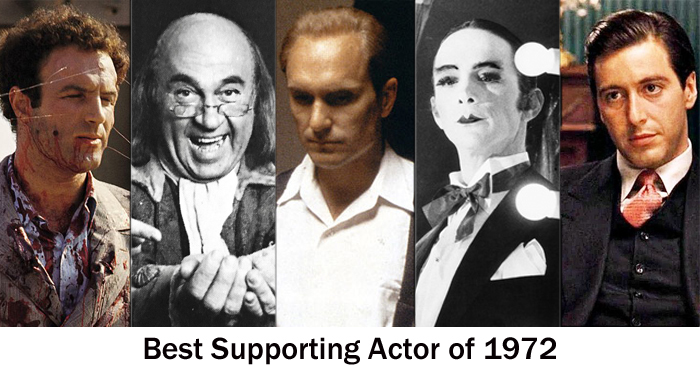
By the way, I wonder how many people remember now that Cabaret won 8 Oscars — including best director and best supporting actor — to The Godfather's 3? Talk about two movies whose reputations have completely flipped over time.
My choices are noted with a ★. Historical Oscar winners are noted with a ✔.
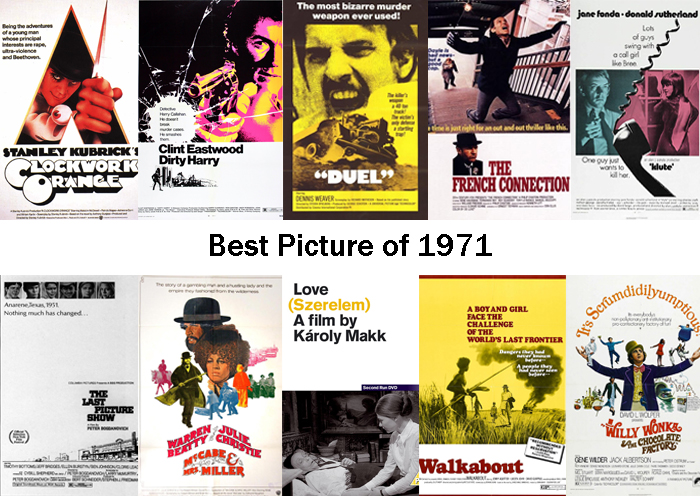
Two of the best movies of the year — Brian's Song and Steven Spielberg's Duel — were actually made for television. But both were also given world-wide theatrical releases, and while that doesn't make them Oscar eligible, it makes them alternate Oscar eligible. Thus, their presence here.
Hey, I don't make the rules, I just live by them. Direct all complaints to the blog-typing sock monkey.
My choices are noted with a ★. Historical Oscar winners are noted with a ✔. Best foreign-language picture winners are noted with an ƒ.
The crop of actresses was so bad in 1970, Ali MacGraw got an Oscar nomination for Love Story — and you can't even say for sure that somebody better got snubbed as a result. Probably the worst year for actresses ever.
Named for Katie-Bar-The-Door, the Katies are "alternate Oscars"—who should have been nominated, who should have won—but really they're just an excuse to write a history of the movies from the Silent Era to the present day.
To see a list of nominees and winners by decade, as well as links to my essays about them, click the highlighted links:
Remember: There are no wrong answers, only movies you haven't seen yet.
The Silent Oscars
And don't forget to check out the Silent Oscars—my year-by-year choices for best picture, director and all four acting categories for the pre-Oscar years, 1902-1927.
Look at me—Joe College, with a touch of arthritis. Are my eyes really brown? Uh, no, they're green. Would we have the nerve to dive into the icy water and save a person from drowning? That's a key question. I, of course, can't swim, so I never have to face it. Say, haven't you anything better to do than to keep popping in here early every morning and asking a lot of fool questions?









 Posts
Posts

