As the silent era drew to a close, Lillian Gish — one of the day's greatest film stars (second only to Mary Pickford in my book) — was in need of a hit to re-establish her relevance at time when the movie-going public had flipped out for flappers and jazz singers, flying aces and all-American heroes.
Gish had starred in a string of hits for D.W. Griffith a decade earlier but by 1928, she, like her fellow stars Douglas Fairbanks, Mary Pickford and John Gilbert, had hit the commercial skids.
With contractual control over choice of material, screenplay, co-stars and director, and a $400,000 salary to play around with, Gish opted to make The Wind, a complex psychological drama about a frontier woman whose repressed desires slowly drive her insane, leading to death and tragedy.
Scripted by Frances Marion and directed by a pioneer of the Swedish film industry, Victor Sjöström, The Wind was a critical success — and a box-office bomb.
Gish would make just two more movies — neither a hit — before disappearing from Hollywood for a decade.
The Wind is the story of Letty (Gish) who is forced to live with her sister and brother-in-law in the forbidding environment of the frontier West. Already enduring the ever-present danger of the Texas prairie's howling wind and sandstorms, where men are killed and wild horses driven mad, the threat of an unmarried woman living in close quarters with a man proves too much for the tight-knit social order she has invaded.
Letty has a choice — enter into a loveless marriage or wander homeless in the empty prairie. Of course, she opts for marriage, but she would have done just as well choosing certain death.
Like Catherine Denueve in Roman Polanski's horror classic Repulsion, Letty's repressed desire slowly drives her insane.
In playing Letty, Gish had chosen to subvert her established screen image. For years, as D.W. Griffith's favorite actress, she had played the passive victim of any variety of men looking to relieve her of her treasured virginity. In The Wind, she finally takes up a gun and kills her would-be rapist. After all those years of playing the passive victim, the moment is liberating.
The screenplay initially envisioned a dark ending where an insane Letty wanders into a sand storm to be consumed by the desert, but when studio heads saw the initial cut, they insisted on a happy ending. The cast and crew reluctantly shot a new ending but as it turned out, it didn't much matter. Audiences rapidly acquiring a taste for talkies weren't interested in silent movies anymore or, for that matter, Lillian Gish whom they regarded as a relic of a previous age.
Silent actress turned film historian Louise Brooks also believed there was a concerted Hollywood effort to destroy Lillian Gish's reputation and box-office appeal and that a box office flop was exactly what the studio was hoping for.
It was a simple matter of economics, wrote Brooks in Lulu in Hollywood. Gish was making $400,000 a year and had complete creative control of her career. Emerging star Greta Garbo was making $16,000 and was wholly dependent on the studio to solve the visa problems that would allow her to work. Brooks lays out evidence of the studio's manipulation and then posits Gish's bosses were tired of paying big money to an actress with the power to map her own career when it could pay a younger actress a lot less money to do exactly what they wanted.
Ironically, the studio eventually did to Garbo what it had done to Gish — undercut her career when cheaper actresses came along.
In time, Gish would rebound, returning to the movies during World War II, receiving an Oscar nomination for Duel in the Sun in 1946.
Her best remembered work would come in 1955's gothic noir masterpiece, The Night of the Hunter, where she played a shotgun-toting granny squaring off against Robert Mitchum's homicidal con man preacher.
"She might look fragile," said screenwriter Frances Marion, "but physically and spiritually she was as fragile as a steel rod. Nobody could sway her from her self-appointed course. With a Botticelli face, she had the mind of a good Queen Bess, dictating her carefully thought-out policies and ruling justly, if firmly."
In 1971, Gish received an honorary Oscar in recognition of her "superlative artistry and ... distinguished contribution to the progress of motion pictures." She worked steadily into her nineties and passed away in 1993, just shy of her one hundredth birthday.
Our Dancing Daughters was the first movie written specifically for Joan Crawford and it made her a star. It's the story of a rich, wild girl (Crawford) with an addiction to short dresses and the Charleston who loses the love of her life to an even richer, wilder girl (Anita Page, also in a star-making role), all while soaking up Jazz and bootleg booze in fabulous art Deco palaces that could only have existed on the set of an MGM movie.
None of this is meant to be taken seriously — just another Hollywood studio clucking its tongue at girls gone wild even as it exploited the phenomenon to rake in box office bucks.
What's not to like?
Although technically the film's lead, Crawford winds up playing second fiddle to Page.
Although she had only just celebrated her eighteenth birthday when the movie hit the theaters, Page is absolutely convincing in her ruthless pursuit of the man, first putting on an act of virginal innocence to entice him then exploiting him to the hilt after she lands him.
In the movie's penultimate scene, Page is drunk, evil and standing at the top of a staircase. No prizes for guessing what happens next.
"Our Dancing Daughters was my picture," Page said years later. "I say that because I did the acting. Joan Crawford danced her way through it. I acted my way through it."
Our Dancing Daughters was one of a series of Hollywood movies seeking to both exploit and condemn the Jazz Age flapper phenomenon. The script called for an undercurrent of tension between Page and Crawford and, boy, is there ever.
Years later, Page claimed Crawford physically assaulted her on the set but the mutual hatred didn't hurt their on-screen chemistry any. In fact, despite their mutual loathing, Page and Crawford made two more movies together, Our Modern Maidens and Our Blushing Brides, trading the good girl/bad girl roles back and forth, to great commercial, if not artistic, effect.
Page also starred in the year's Oscar winner for best picture, The Broadway Melody, and received over ten thousand fan letters a week, including nearly a hundred from fascist dictator Benito Mussolini who was infatuated with the young actress.
"Are you starting to believe your own publicity?" director Harry Beaumont asked Page during the filming of one of their six pictures together.
"Of course," she said, "Aren't you?"
In addition to The Broadway Melody and the Joan Crawford flapper trilogy, Page appeared in films with Lon Chaney, Buster Keaton and Clark Gable.
Page's final movie for MGM was 1932's Prosperity, starring Marie Dressler and Polly Moran. On the outs with studio head Louis B. Mayer after twice refusing to sleep with him (the second proposition made in the presence of Page's mother), Page served out the remaining years of her MGM contract on loan to poverty row studios, making such low-budget bombs as Jungle Bride and Hitch Hike To Heaven.
It was an ignominious end for an actress who just a couple of years before had been second only to Greta Garbo as the studio's top draw.
Page left Hollywood and married Navy flyer Herschel House in January 1937.
After his death, she began to make films again, mostly low-budget fare such as The Crawling Brain and Witchcraft XI.
On the 75th anniversary of the founding of the Academy of Motion Picture Arts and Sciences, Page received a standing ovation at a special screening of The Broadway Melody. She was the last surviving attendee of the first Oscar ceremony and died in 2008 at the age of ninety-eight.
1929's Piccadilly opens on a love triangle — a nightclub dancer (Gilda Gray) in love with the club's owner (Jameson Thomas) while fending off the advances of her handsome dance partner (Cyril Ritchard). The club is packed every night, the men to leer at Gray, the women to lust over Ritchard, and a young Charles Laughton to slobber over the wine and a variety of fancy cheeses.
If that's not complicated enough, into this mix comes a sensational new act — a scullery maid turned dancer (Anna May Wong) — and overnight, what was once new is now old hat.
And that includes the boss's affections. He tracks Wong down to her room in back of a Chinese restaurant in Limehouse and the sparks fly.
I'd never heard of Gray or Ritchard, and I only knew Thomas as the "nose twitcher" in Mr. Deeds Goes to Town, but Wong was a veteran of both the silent and early sound eras, and this is one of her best performances. In a supporting role, she steals the movie, turning what at first plays like a dull backstage romance into a tragedy of race, class and social manners, with Wong and the owner not welcome in his world, not welcome in hers.
That a silent film should deal so frankly with such subject matter will come as a surprise to no one familiar with the medium. Motion pictures of the era were considered adult fare and frequently dealt with themes — adultery, abortion, homosexuality, racism — that would soon become verboten under 1934's Production Code.
Not until the 1960s would Hollywood again wade into the shark-infested waters of such mature topics, and (I would argue) tentatively at that.
Wong made a name for herself in 1922's The Toll of the Sea, Hollywood's first technicolor feature. Ten years later, she would more than hold her own against the legendary Marlene Dietrich in Shanghai Express.
But the racism of the era largely relegated her talent to minor parts in forgettable movies with lead roles going to the likes of Helen Hayes and Myrna Loy in "yellow face."
In fact, Irving Thalberg rejected Wong for the lead in The Good Earth — based on Pearl Buck's award-winning novel about Chinese peasants — because she didn't fit his idea of what a Chinese woman should look like. He opted to cast German-born Luise Rainer instead.
Ironically, Wong also found disfavor among Chinese-Americans for playing stereotypical Asians on screen.
Wong left Hollywood in the early '40s and passed away in 1961 at the age of 56.
In 2022, the United States Mint included Wong as part of its American Women Quarters Program, the first Asian-American so honored. The following year, Mattel created an Anna May Wong doll for Asian American and Pacific Islander Heritage Month.
Fun note: For the opening credits, the producers slapped ads on the sides of double decker buses featuring the names of the movie, director, producer, writer, and stars. The opening credits literally drive past the camera through London's West End traffic.
Beggars of Life is the story of a teenage girl (Louise Brooks) who kills her stepfather in order to avoid being raped. Disguising herself as a young boy, she escapes with a passing vagrant (Richard Arlen, co-star of the first movie to win the Oscar for best picture, Wings) only to fall into the hands of Oklahoma Red (Wallace Beery), the ruthless leader of a "hobo jungle" who wants the girl for himself.
The story by novelist Jim Tully was based on his own experiences riding the rails during a period of unemployment and homelessness. Well before the Depression would acquaint much of this film's audience with the life they were seeing on screen, Tully hoped to demythologize poverty, showing, for example, the brutality of "hobo jungles" and the ruthless treatment of the poor at the hands of arbitrary authorities.
Although the film stars the now-legendary Brooks, the screen really belongs to Wallace Beery. He makes his first appearance during the movie's second act, arriving at the camp singing and carrying a keg of beer on his shoulder (some prints have Beery's growling singing voice on the soundtrack of this otherwise silent movie, others do not).
Beery discovers Brooks, who has disguised herself as a boy, is a fugitive with a $1000 bounty on her head. Beery helps her escape from the others and from the police, but whether it's an act of altruism or pure self-interest becomes the central question of the film.
Even with the lovely Louise Brooks on screen, Beery is the one your eyes are drawn to.
This phenomenon — the supporting performance that makes you forget the rest of the movie — was typical of Beery's career. Admittedly, sometimes he could be a distraction, but here he breathes life into a story that had threatened to grind to a halt.
Co-star Louise Brooks was blunt in her criticism of the movie: "[William Wellman] directed the opening sequence with a sure, dramatic swiftness that the rest of the film lacked."
But of Beery, Brooks said, "His Oklahoma Red is a little masterpiece."
She's right. Beery plays Oklahoma Red as complex man rather than as a stock villain and watching his internal contradictions play out is the main reason to track down this film. It's probably his most overlooked performance in a career that included starring roles in Grand Hotel, Dinner At Eight, Treasure Island and Min And Bill, and Oscar nominations for The Big House and The Champ, the latter a winner for Beery in 1931.
But Brooks was also right about the film overall. The action is repetitive, the acting outside that of Beery and Brooks is amateurish and for a movie inspired by a desire to show what riding the rails was really like, its insights sometimes feel shallow and cliched.
Still, Brooks is very good in the movie and her performance brought her to the attention of German director P.W. Pabst.
The story of a girl from the country who makes it big in Hollywood was a staple of the silent era — see, e.g., A Girl's Folly, Souls for Sale, The Extra Girl, Ella Cinders — so much so that when Marion Davies (with King Vidor directing) spoofed the genre in the 1928 silent comedy Show People, everybody in town was in on the joke.
Look for cameos from just about everybody who was anybody including Douglas Fairbanks, Charlie Chaplin, John Gilbert and even Marion Davies and King Vidor as themselves.
While she is mostly remembered now as the inspiration for the no-talent opera singer in Orson Welles's Citizen Kane — a grossly unfair characterization if that's what Welles really thought of her — Marion Davies was actually a very good comedic actress and this movie was the best showcase of her talent.
Flicker Alley is currently promoting The Best Arbuckle/Keaton Collection, Vol. 1 &2 which will be available as a manufacture-on-demand DVD in March. As always, the Monkey encourages his readers to explore the wonderful world of silent movies. This would be a good place to start.
The Flicker Alley titles on my shelf, all of them definitive and essential:
I've been on the road for most of February and only this morning heard about the Buster Keaton Blogathon ongoing at Silent-ology. I cobbled together this contribution from some previous posts.
Of all the developments that made 1917 such a landmark year in film—the industry-wide adoption of what is now known as "classical continuity editing," Mary Pickford's emergence as the most powerful woman in Hollywood history, Charlie Chaplin's maturation as an artist—perhaps the happiest for movie fans today was the big screen debut of the greatest film comedian of all time, Buster Keaton.
That Buster Keaton is only now arriving on the scene may come as a bit of a surprise to those of us who naturally think of Keaton as a contemporary of Chaplin—certainly we frame the debate "Chaplin versus Keaton" in those terms—but the fact is, Chaplin was already an international star with sixty films to his credit (including forty he directed himself) before Keaton ever set foot in a film studio. And although Keaton would brilliantly subvert most of the rules of early film comedy in a brief but prolific run between 1920 and 1928, it was by and large Chaplin who had established those rules, a fact that Keaton himself later conceded.
Which is not to say Keaton was an amateur when he joined Roscoe Arbuckle during the filming of The Butcher Boy in early 1917. He had been performing on the vaudeville stage with his parents from the age of four as part of a rough and tumble "knockabout" comedy act.
"I'd just simply get in my father's way all the time," Keaton said, "and get kicked all over the stage. But we always managed to get around the [child labor] law," he added, "because the law read: No child under the age of sixteen shall do acrobatics, walk wire, play musical instruments, trapeze—and it named everything—but none of them said you couldn't kick him in the face."
Legend has it he was dubbed "Buster" when escape artist Harry Houdini saw the infant Keaton take a fall down a flight of stairs and bounce up unharmed. Whether he was born with it, or developed it doing routines with his father, if Keaton wasn't the most talented pratfall artist in movie history, I'd like to see the guy who survived long enough to be a better one. He did stunts that rivaled those of Douglas Fairbanks, and when he was done, he doubled for his co-stars and did their stunts, too.
"The secret," he once said, "is in landing limp and breaking the fall with a foot or a hand. It's a knack. I started so young that landing right is second nature with me. Several times I'd have been killed if I hadn't been able to land like a cat."
In early 1917, Keaton was booked into New York's Winter Garden for a series of shows when he bumped into Roscoe Arbuckle while strolling down Broadway.
For those of you who only know Arbuckle—"Fatty" to his fans, "Roscoe" to his friends—through the tabloid scandal and subsequent trial that (despite his acquittal) ended his career, you're missing out on one of the greatest comedic actor-directors of the silent era. Although I wouldn't put him in the same league as "the three geniuses"—Chaplin, Keaton and Harold Lloyd—Arbuckle was, in terms of his popularity and impact, the best of the rest, the very top of the second tier of comedians that included Mabel Normand, Charley Chase, Harry Langdon, Ford Sterling and Max Linder.
Mark Bourne in his review of the Arbuckle/Keaton collection for The DVD Journal suggested that Arbuckle was to his biggest commercial rival, Charlie Chaplin, what Adam Sandler is these days to Woody Allen, "less artistic and sophisticated by miles, but nonetheless obviously skilled and unquestionably popular with his own characteristic wacky and raucous manner."
The collaboration between Keaton and Arbuckle was to prove pivotal for Buster.
"Arbuckle asked me if I'd ever been in a motion picture," Keaton told Kevin Brownlow in 1964. "I said I hadn't even been in a studio. He said, 'Come on down to the Norma Talmadge Studio on Forty-eighth Street on Monday. Get there early and do a scene with me and see how you like it.' Well, rehearsals [at the Winter Garden] hadn't started yet, so I said, 'all right.' I went down and we did it."
That first scene, in the Arbuckle short comedy The Butcher Boy, ends in one of the best of Keaton's early gags. At the 6:25 mark of the film, Keaton wanders into the country store where Arbuckle works as a butcher and by the end of the scene, Keaton's trademark porkpie hat is full of molasses and the store is a wreck.
"The first time I ever walked in front of a motion picture camera," he said, "that scene is in the finished motion picture and instead of doing just a bit [Arbuckle] carried me all the way through it."
It's a terrific sequence, but it's as notable for what isn't in it as what is—Keaton does not wear an outrageous costume or wild facial hair, nor does he indulge in the over-the-top reactions and shameless mugging common to the era. He's just a thoroughly average American—albeit, one who can take a swipe at Al St. John, do a 360º spin in mid-air and wind up flat on his back—who has somehow wandered in off the street and found himself thrust into the insanity of a two-reel silent comedy.
Keaton's understatement was the antithesis of the Mack Sennett approach, and was so wholly original, it constituted something of a revolution. Audiences and critics alike instantly took note, if not always approvingly.
"The deadpan was a natural," Keaton said. "As I grew up on the stage, experience taught me that I was the type of comedian that if I laughed at what I did, the audience didn't. Well, by the time I went into pictures when I was twenty-one, working with a straight face, a sober face, was mechanical with me.
"I got the reputation immediately [of being] called 'frozen face,' 'blank pan' and things like that. We went into the projection room and ran our first two pictures to see if I'd smiled. I hadn't paid any attention to it. We found out I hadn't. It was just a natural way of acting."
But deadpan, as any Keaton fan can tell you, isn't synonymous with inert, and as film historian Gilberto Perez has noted, Keaton was able to show us a face, "by subtle inflections, so vividly expressive of inner life. His large deep eyes are the most eloquent feature; with merely a stare he can convey a wide range of emotions, from longing to mistrust, from puzzlement to sorrow."
Keaton's next film with Arbuckle, The Rough House, is one of their best. Not only does it feature some of the best gags of Arbuckle's career—the dancing dinner rolls, trying to douse a raging fire with a teacup, squeezing out a bowl of soup with a sponge—but many film historians also now list Keaton as its uncredited co-director.
"The first thing I did in the studio," he told Robert and Joan Franklin in 1958, "was to tear that camera to pieces. I had to know how that film got into the cutting-room, what you did to it in there, how you projected it, how you finally got the picture together, and how you made things match. The technical part of pictures is what interested me."
Keaton and Arbuckle made three more comedies in 1917, His Wedding Night, Oh Doctor! and Coney Island. Each features an aspect of Keaton rarely seen after.
In the first, Keaton plays a milliner's delivery boy and winds up in drag as he models a wedding dress. Mistaking him for the bride, Al St. John kidnaps Keaton and hauls him off to the preacher at gunpoint.
In Oh, Doctor!, he plays Arbuckle's little boy, a reprise of the sort of comedy Keaton and his father Joe had done for years on stage, and pulls off a stunt you have to see to believe—Arbuckle smacks him, Keaton tumbles backwards over a table, picks up a book as he falls, and lands upright in a chair, with the book on his lap as if he's been there all along, reading comfortably.
And while Coney Island is mostly an excuse to watch Arbuckle caper around Luna Park—its plot of men wooing women on park benches is a throwback to the Keystone comedies—the film is worth seeking out for two reasons: one, for its documentary footage of Coney Island nearly one hundred years ago, and two, a rare chance to see Buster Keaton smile!
The smile notwithstanding, in terms of his look, his acting style, his fearless physical stunts and his fascination with technology, the basic Keaton was already on full display in these early two-reel comedies. He had only to add the context—that of a rational man enmeshed in the machinery of a universe that exists only to achieve absurd ends—for his unique brand of humor to reach its full flower.
In 1918, Keaton made five more two-reel comedies with Arbuckle before shipping off to France to serve in the army during World War I. Although not credited as such, by this time Keaton was working as the assistant director when Arbuckle, the credited director, was in front of the camera.
"You fell into those jobs," Keaton said later. "He never referred to me as the assistant director, but I was the guy who sat alongside of the camera and watched scenes that he was in. I ended up just practically co-directing with him."
The new balance in their collaboration showed up in front of the camera as well. In the first three films of 1918, he and Arbuckle are equal partners, more Laurel and Hardy—with Keaton as a thin straight man and Arbuckle a rotund goof—than the star/supporting player dynamic of 1917. The first film of the year, Out West is a parody of the Western genre, popular at the time, with Arbuckle playing a drifter riding the rails who winds up working for Keaton as an uncharacteristically tough saloon owner. Parody would soon prove to be one of Keaton's trademarks—indeed, his two-reeler The Frozen North in 1922 was such a savage parody of William S. Hart's "good bad guy" westerns that Hart refused to speak to Keaton for two years.
Next up was The Bell Boy, the story of two Stooge-like bellhops in a shabby hotel. The horse-drawn elevator is pure Keaton who was always fascinated by machines, and built several movies around them, culminating in his classic train picture, The General.
The film that followed, Moonshine, is the most Keatonesque of all his collaborations with Arbuckle. Ostensibly the story of a pair of inept revenuers (Keaton and Arbuckle) hot on the trail of West Virginia bootleggers, this is really a movie about movies, with the title cards constantly breaking the fourth wall to explain the filming process. "Look, this is only a two-reeler," one says, "We don't have time to build up to love scenes." Opening up the mechanics of movie making for laughs was a Keaton trick he would revisit time and again, culminating with Sherlock Jr. in 1924 when a projectionist gets sucked into the film itself.
The next two shorts, Good Night, Nurse and The Cook, both came out after Keaton had shipped out for the European war and his contributions look hasty, as if he filmed a couple of scenes for both, leaving the main plot for Arbuckle to flesh out later. Still, they're both worth a look, particularly The Cook which was thought to be lost for decades until rediscovered in Norway in 1999.
After a year in the Army left Keaton deaf in one ear, he went right back to making short films with Arbuckle. The first of them, Back Stage, is a traditional "hey kids, lets put on a play" story with one extraordinary scene—anticipating Keaton's most famous stunt in 1928's Steamboat Bill Jr., a house falls on Arbuckle only to miss him thanks to an open second floor window. Here, the house is only a cardboard stage prop and, unlike that latter example which might have killed Keaton, nobody is in danger, but seeing this early attempt at a famous gag is a bit like finding a preliminary sketch of Picasso's Guernica on the back of a cocktail napkin.
There were two more shorts, The Hayseed in 1919 and The Garage in 1920, after which Arbuckle left to make full-length feature films, but not before leaving the keys to the studio to Keaton. With Arbuckle's public blessing, Keaton began to direct films of his own.
Katie-Bar-The-Door is out of town again — ongoing family issues — so my pal Mister Muleboy and I met at the AFI-Silver yesterday afternoon to take in the 1922 version of Robin Hood starring one of our favorite silent stars, Douglas Fairbanks.
I looked it up: this was my twenty-sixth Douglas Fairbanks movie. That doesn't make me an expert, but I do think I have a solid feel for the man's work.
You do know who Douglas Fairbanks was, right? The star of forty-eight movies, including some of the greatest action films of all time, Fairbanks was a superstar before the word existed, and along with Chaplin and his wife Mary Pickford, one of the three highest-paid and most-popular actors of his day. On his honeymoon with Pickford, Fairbanks and his bride drew crowds of 300,000 in Paris and London. At home in their mansion, dubbed "Pickfair," the two threw lavish parties and routinely entertained the world's most sought-after celebrities. To receive an invitation to Pickfair was to receive the social blessing of Hollywood royalty.
Certainly no one of his era, maybe no one ever, enjoyed stardom more than Fairbanks did.
But Fairbanks was more than just a regular feature of the gossip columns and party circuit. He was also a fine actor and created the modern action hero in a series of swashbuckling adventures showcasing an infectious joie de vivre and extraordinary flare for stunt work.
He practically invented the action-hero genre in film with 1920's The Mark of Zorro. Admittedly, his Don Diego Vega—Zorro to you—had no supernatural or extraterrestrial powers, ala Superman or the Hulk, but he was the first film hero with a secret identity and hideaway, a costume, a mask, a sidekick and a backstory, not to mention a compulsion to carve a "Z" on the anatomy of oppressors and evildoers while fighting for truth, justice and the old Spanish California way.
He followed up that groundbreaking triumph in 1921 with The Three Musketeers, his first pure swashbuckler. (Read my review here.) The following year, looking to follow up with a similar sort of fun action-filled yarn, he again turned to one of the great fables, this time the adventures of Robin Hood.
If the Robin Hood legend were a song, we'd call it a chestnut, with every generation taking it up and putting its own particular spin on it. Given that there have been something like a hundred filmed versions of the Robin Hood legend, with everybody from Errol Flynn to Daffy Duck playing the title role, I'll assume I don't need to tell you the basic plot: of how Prince John took advantage of Richard the Lionhearted's absence during the Crusades to seize the English throne, and how a nobleman, here named the Earl of Huntingdon (Fairbanks), took up arms against him.
Instead, I'll concentrate on how Fairbanks and his merry band chose to interpret the source material.
As was always the case with a Douglas Fairbanks movie, the technical support was first-rate. The sets and costumes are terrific, with a full-sized castle set (no, that's not a matte painting) that must have filled the studio backlot. Arthur Edeson, who would later lens All Quiet on the Western Front, Frankenstein, The Maltese Falcon and Casablanca, provides his usual stellar cinematography.
Allan Dwan, who wound up directing twelve Fairbanks movies, and 400 more besides, helmed the proceedings.
Yet for all the money lavished on the production, this is a strangely non-canonical take on the Robin Hood legend — no archery contest, no battle on the bridge between Robin and Little John, Friar Tuck reduced to a single closeup and title card, and the final fight between Robin and Guy of Gisbourne over in two blinks of an eye.
Instead, the movie focuses on Robin's friendship with Richard the Lionhearted, starting on the eve of the Crusades and carrying through all the twists and turns of the relationship — including a betrayal of a basic trust — right on through to Richard banging on the door of Robin's honeymoon chamber begging for entry after the wedding.
Is this the only Robin Hood with a fairly explicit homoerotic subtext? Maybe. Our hero prefers wrestling and horseplay with men to the attentions of women, of whom he confesses to be "afeared," and even his interest in the Lady Marian seems more paternal than passionate. Such a reading tends to cast the subsequent Crusades and the Merry Men of Sherwood Forest in a wholly different light.
I have to assume the effort to subvert the Robin Hood story was on purpose. It's not like some screenwriting weisenheimer slipped one past Fairbanks — Fairbanks was the screenwriter, credited as he often was as Elton Thomas (he was born Douglas Elton Thomas Ullman). Not to mention, he was also the producer, owned the production company and the distribution company. Nobody mucks with a man of such power and lives to eat lunch in Hollywood ever again.
But given that Fairbanks himself chose to abandon the traditional Robin Hood story for something else, we have to lay the blame squarely at his feet when the story grinds to a halt forty minutes in and idles in neutral for the next hour.
I also have to say the acting was a bit of a disappointment — not that of Fairbanks himself, mind you, whose enthusiasm was as infectious as ever — but that of the rest of what should have been a strong supporting cast.
As played by that über-ham, Wallace Beery, King Richard is a loutish buffoon hardly worthy of the respect and loyalty he commands, eating Henry the Eighth-sized turkey legs, bellowing and banging his fist, and otherwise accomplishing very little.
I also have a problem with the film's Guy of Gisbourne — what I'll forever think of as the Basil Rathbone role. Paul Dickey, in what turned out to be the only movie role of his career, is a frozen-faced fish who never proves a credible threat to Fairbanks. He's no swordsman with either the blade or the ladies, and though he has broad shoulders, not for one minute did I believe he could best Fairbanks at anything.
Sam De Grasse — one of the great supporting actors of the silent era — is a better villain, with his Prince John a would-be disciple of the Marquis de Sade, seizing the kingdom mostly so he can torture women who predictably refuse his sexual advances. But Alan Hale, who would play Little John again in the 1938 classic The Adventures of Robin Hood, is largely wasted here, and Enid Bennett, an Australian stage actress who appeared in 52 films between 1916 and 1941, is a pretty enough Lady Marian but gives ample evidence as to why she never became a star.
I can't say what you might think of this Robin Hood. Fairbanks's fans loved it, making it the top grossing movie of 1922. It ranks third among his features on the Internet Movie Database with a rating of 7.7. And the audience at the AFI seemed to enjoy it, although I'm not sure gales of laughter during the climatic battle is what Fairbanks would have had in mind.
But my opinion is that it's not good Robin Hood and it's not good Fairbanks.
Looking at it in the context of his career, however, Robin Hood is an example of an artist in transition. In terms of the all-important action sequences, Fairbanks was trying to add stylized movement and rhythm to his usual athleticism to create a sort of swashbuckling ballet. For the story, he was groping for something beyond mere plot, reaching for the mythic. He even makes a stab at playing a three-dimensional character instead of his usual innocent hero, a course that would see him afterwards play a thief, a pirate and eventually a true anti-hero in 1927's The Gaucho.
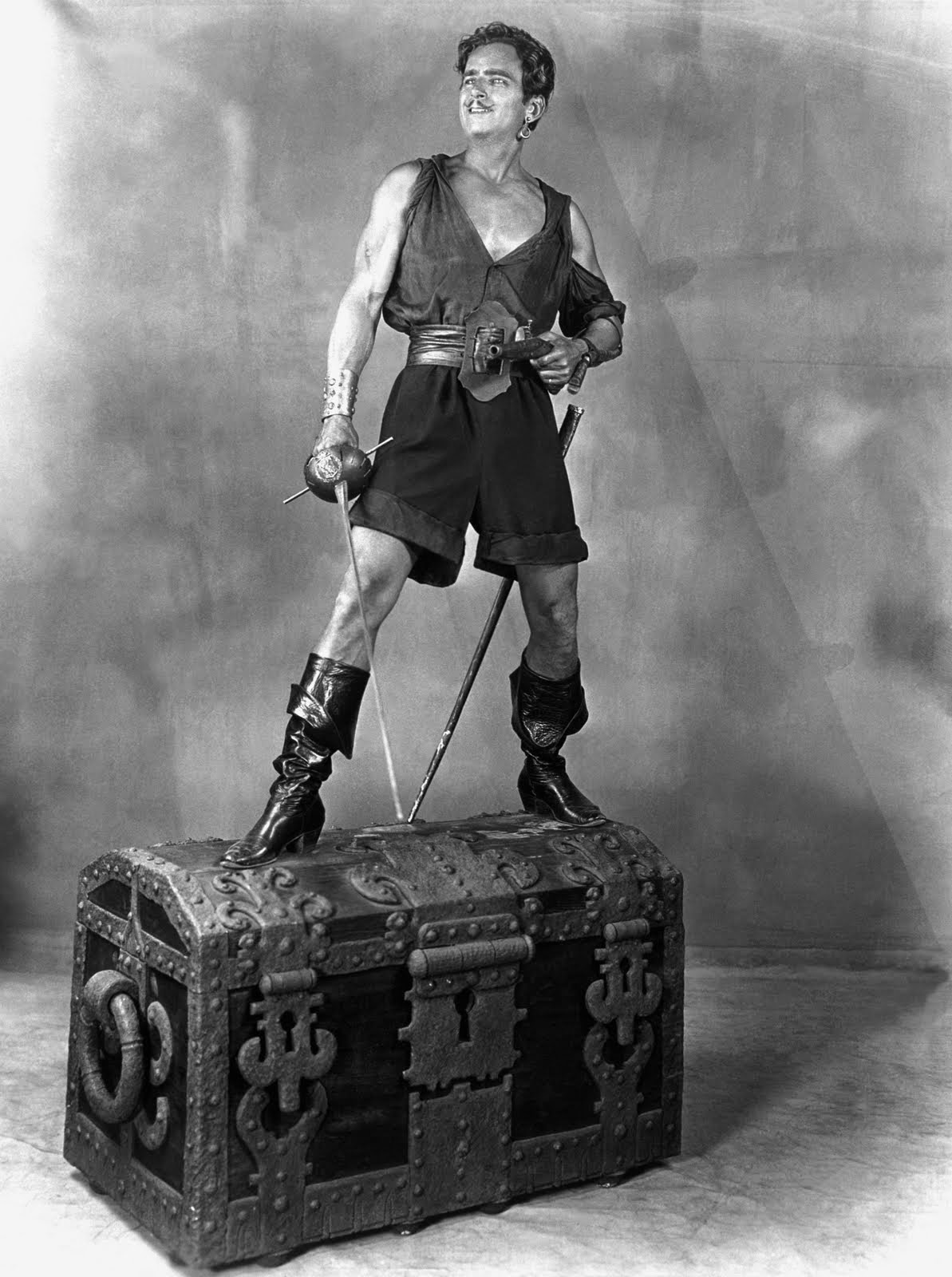
He failed on all three counts here but he would succeed spectacularly in his next two features — The Thief of Bagdad (1924) and The Black Pirate (1926), arguably the two greatest action-adventure films of the silent era and certainly the best work Fairbanks would ever produce.
That would make Robin Hood a noble failure, or at the very least, a necessary one. No matter what romantic notions we might have about the matter, artists aren't born, they're made, and sometimes you have to step wrong before you learn how to step right.
Note: The AFI-Silver's presentation of Robin Hood (1922) is part of its Silent Cinema Showcase which runs through November 23 (click here for the schedule). Hesperus provided top-notch live musical accompaniment with a score based on the medieval music of Robin Hood's era, performed on historically-appropriate instruments — lutes, recorders and strings. There were even a few songs sung, ancient ballads about the man who robbed from the rich and, well, you know the rest. Overall, a fine afternoon.
Named for Katie-Bar-The-Door, the Katies are "alternate Oscars"—who should have been nominated, who should have won—but really they're just an excuse to write a history of the movies from the Silent Era to the present day.
To see a list of nominees and winners by decade, as well as links to my essays about them, click the highlighted links:
Remember: There are no wrong answers, only movies you haven't seen yet.
The Silent Oscars
And don't forget to check out the Silent Oscars—my year-by-year choices for best picture, director and all four acting categories for the pre-Oscar years, 1902-1927.
Look at me—Joe College, with a touch of arthritis. Are my eyes really brown? Uh, no, they're green. Would we have the nerve to dive into the icy water and save a person from drowning? That's a key question. I, of course, can't swim, so I never have to face it. Say, haven't you anything better to do than to keep popping in here early every morning and asking a lot of fool questions?






 Posts
Posts

