skip to main |
skip to sidebar

But she was a gifted actress — Buster Keaton often called her "the greatest character comedienne I ever saw" — and for a brief time, from 1931 until her death in 1934, Marie Dressler was the most popular actress in America.
Dressler got her start as part of Mack Sennett's stable of comic actors that included Charlie Chaplin, Roscoe "Fatty" Arbuckle, Mabel Normand, Gloria Swanson and the Keystone Kops.
In 1914, she starred in history's first feature-length comedy, Tillie's Punctured Romance, which also starred Chaplin in one of his earliest roles.
By the end of World War I, though, Dressler had pretty much disappeared from the movies.
Reduced to working as a maid, Dressler later admitted she found the fall from stardom so devastating, she seriously considered suicide.
But back when she was still a star, Dressler had befriended a young, struggling writer from San Francisco named Frances Marion, and when their roles were reversed and Marion was the top writer in Hollywood and Dressler was out of pictures altogether, Marion remembered her old friend and began including parts for her in various comedies.
When Marion was adapting the Eugene O'Neill play Anna Christie as the vehicle for Greta Garbo's sound debut, she expanded the part of an over-the-hill hooker specifically with Dressler in mind.
It was a pivotal opportunity for Dressler and proved to be her comeback role.
In the film, Dressler steals every scene she shares with the more-celebrated Garbo. To be sure Dressler possessed a theatrical talent that straddled the divide between the silent and modern eras, but I distinguish in my mind between an actor who chews scenery (Garbo, still relying on exaggerated, silent film techniques) and a character who chews scenery (Dressler's self-described "wharf rat" who hides her pain beneath a swaggering pose of indifference).
Garbo eventually shed the exaggerated techniques that had served her well during the silent era and mastered the subtleties of the new sound medium. But not before Dressler had bested her in their one head-to-head outing.
Dressler starred in a dozen movies over the next three years, including Min and Bill (another Frances Marion screenplay) which won her an Oscar.
In Min and Bill, a comedy-drama also starring Wallace Beery and Marjorie Rambeau, Dressler plays a dockside innkeeper who is raising the daughter of a prostitute as her own. As the girl grows up, Min (Dressler) does everything she can to protect the girl, eventually sacrificing herself for the girl's happiness.
The final shot of a deeply-conflicted Min — I'll let you discover the movie's plot twists on your own time — is the best acting of Dressler's career.
The film was a huge hit, and at a time when Norma Shearer, Marlene Dietrich and Joan Crawford were plying their trade, Dressler became the biggest star in Hollywood.
Emma secured her a second Oscar nomination, and the classic dramedy Dinner at Eight gave Dressler her best-known role, that of an aging stage actress reduced to begging favors of her closest friends.
Even people who don't know Dressler's name remember her in that film's last scene with up-and-coming Jean Harlow.
"I was reading a book the other day," says Harlow as the unforgettable social-climbing vamp, Kitty Packard.
"Reading a book?" says Dressler after the greatest double take in movie history.
"Yes. It's all about civilization or something. A nutty kind of a book. Do you know that the guy says that machinery is going to take the place of every profession?"
Dressler looks Harlow up and down and then says, "Oh, my dear, that's something you need never worry about."
A year later, Dressler was dead of cancer. She was 66.

Gish had starred in a string of hits for D.W. Griffith a decade earlier but by 1928, she, like her fellow stars Douglas Fairbanks, Mary Pickford and John Gilbert, had hit the commercial skids.
With contractual control over choice of material, screenplay, co-stars and director, and a $400,000 salary to play around with, Gish opted to make The Wind, a complex psychological drama about a frontier woman whose repressed desires slowly drive her insane, leading to death and tragedy.
Scripted by Frances Marion and directed by a pioneer of the Swedish film industry, Victor Sjöström, The Wind was a critical success — and a box-office bomb.
Gish would make just two more movies — neither a hit — before disappearing from Hollywood for a decade.
The Wind is the story of Letty (Gish) who is forced to live with her sister and brother-in-law in the forbidding environment of the frontier West. Already enduring the ever-present danger of the Texas prairie's howling wind and sandstorms, where men are killed and wild horses driven mad, the threat of an unmarried woman living in close quarters with a man proves too much for the tight-knit social order she has invaded.
Letty has a choice — enter into a loveless marriage or wander homeless in the empty prairie. Of course, she opts for marriage, but she would have done just as well choosing certain death.
Like Catherine Denueve in Roman Polanski's horror classic Repulsion, Letty's repressed desire slowly drives her insane.
In playing Letty, Gish had chosen to subvert her established screen image. For years, as D.W. Griffith's favorite actress, she had played the passive victim of any variety of men looking to relieve her of her treasured virginity. In The Wind, she finally takes up a gun and kills her would-be rapist. After all those years of playing the passive victim, the moment is liberating.
The screenplay initially envisioned a dark ending where an insane Letty wanders into a sand storm to be consumed by the desert, but when studio heads saw the initial cut, they insisted on a happy ending. The cast and crew reluctantly shot a new ending but as it turned out, it didn't much matter. Audiences rapidly acquiring a taste for talkies weren't interested in silent movies anymore or, for that matter, Lillian Gish whom they regarded as a relic of a previous age.
Silent actress turned film historian Louise Brooks also believed there was a concerted Hollywood effort to destroy Lillian Gish's reputation and box-office appeal and that a box office flop was exactly what the studio was hoping for.
It was a simple matter of economics, wrote Brooks in Lulu in Hollywood. Gish was making $400,000 a year and had complete creative control of her career. Emerging star Greta Garbo was making $16,000 and was wholly dependent on the studio to solve the visa problems that would allow her to work. Brooks lays out evidence of the studio's manipulation and then posits Gish's bosses were tired of paying big money to an actress with the power to map her own career when it could pay a younger actress a lot less money to do exactly what they wanted.
Ironically, the studio eventually did to Garbo what it had done to Gish — undercut her career when cheaper actresses came along.
In time, Gish would rebound, returning to the movies during World War II, receiving an Oscar nomination for Duel in the Sun in 1946.
Her best remembered work would come in 1955's gothic noir masterpiece, The Night of the Hunter, where she played a shotgun-toting granny squaring off against Robert Mitchum's homicidal con man preacher.
"She might look fragile," said screenwriter Frances Marion, "but physically and spiritually she was as fragile as a steel rod. Nobody could sway her from her self-appointed course. With a Botticelli face, she had the mind of a good Queen Bess, dictating her carefully thought-out policies and ruling justly, if firmly."
In 1971, Gish received an honorary Oscar in recognition of her "superlative artistry and ... distinguished contribution to the progress of motion pictures." She worked steadily into her nineties and passed away in 1993, just shy of her one hundredth birthday.
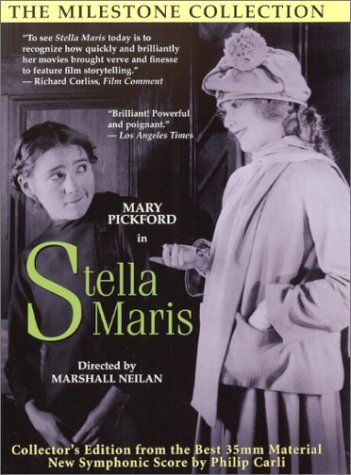
In honor of Mary Pickford's 120th birthday today, here is my long-delayed review of her masterpiece, Stella Maris.
 After the critical and commercial triumphs of 1917 made her the most popular—and most powerful—actress in the world (read the story here), Mary Pickford declined to rest on her laurels. Instead, she opted for an even more ambitious project, a dual role that would push the boundaries of both special effects technology and her talent as an actress. The resulting film, Stella Maris, the story of an orphan girl struggling to find love and acceptance in a cruel and indifferent world, was a resounding success with both audiences and critics, and ensured Pickford's place as the most popular actress of the silent era.
Based on a novel by William J. Locke, with a screenplay from the legendary Frances Marion, Stella Maris is a story very much in the tradition of Charles Dickens—and if you regard Dickens as highly as I do, you know that's not a bad thing—filled with melodrama, improbable coincidences, shameless moralizing, biting social commentary, and grim depictions of alcoholism, child abuse and grinding poverty.
Unlike most of Dickens, though, there's no happy ending, at least not for the character we care most about, and while some might call Stella Maris a hokey Victorian melodrama, it's a hokey Victorian melodrama of the first water, a riveting story from beginning to end, and featuring the best performance of Mary Pickford's career.
 The film opens on the first of Pickford's two roles, the eponymous Stella Maris. Orphaned in childhood and paralyzed by a mysterious ailment, the beautiful, cheerful Stella lives in a carefully-constructed fantasy world created by a wealthy aunt and uncle, "unaware of sorrow, poverty or death." Her aunt and uncle, a houseful of servants, a dog (played by "Teddy" courtesy of the Mack Sennett studios) and most importantly, a distant cousin, John Risca (Conway Tearle), attend to Stella's every need while cautiously sheltering her from life's harsh realities.
 Although Stella was a typical Pickford role—the plucky, perky girl with the curls that America had fallen in love with—the movie is really about Pickford's second character, Unity Blake, an "ugly duckling" with no swan in her future.
In stark contrast to Stella's life of sheltered luxury, Unity has grown up in a grim orphanage, unwanted and unloved, and inured to life's disappointments. She knows that, the old cliche notwithstanding, God frequently doles out more trouble than we can handle, and seemingly for no other reason than a perverse indifference to what human beings call fairness. Through the course of the story, Unity learns many of life's harshest lessons: pretty people flock together; character doesn't trump position, power or money; and regardless of how well we play the hand we're dealt, the game ends the same for everybody—just sooner for some than for others.
 From its earliest scenes, the film symbolically establishes Unity as a Christ-figure—note how she is photographed through a sanctuary rood screen, her praying figure framed by a cutout of the cross—and she is the essence of innocence and purity made to suffer for our sins. But if she were only an allegory, Unity would quickly become an insufferable bore. Instead, she's a heartbreakingly three-dimensional girl, hard-working but mischievous, an ugly duckling with a lovely soul, as hopeful as her situation is hopeless.
The lives of Unity and Stella intersect through the man they both come to love, John Risca, who is not only Stella's cousin but who also adopts Unity as a housemaid-servant for his abusive, alcoholic wife. Played with exquisite cruelty by Marcia Manon, Unity's new stepmother goes out of her way to snuff out what light remains in the orphan girl's eyes. Only John's kindness keeps her going.
 One of Unity's most poignant scenes is when caressing John Risca's hat and coat, she imagines a romance that will never be, a scene that the staff of the Mary Pickford Institute for Film Education compared to the famous "jacket scene" in the Oscar-winning The Artist. "Mary Pickford's moment is even more affecting, because we know that unlike Peppy Miller, little Unity's dream of romance is doomed from the start, and we fear she will never get her happy ending."
That the result is riveting and moving rather than dreary and overwrought is a testament to Pickford's performance.
To create the character of Unity, Pickford's teeth were darkened, her trademark curls slicked down and pulled into a tight bun, her clothes suitably drab and tattered. But it was the actress's body language and facial expressions that made the transformation from "Little Mary" to Unity so effective. Her back curved from malnourishment, Pickford's Unity carries herself like a dog who's been beaten too much. Her eyes are downcast and look at the world sidewise, and she flinches from very human contact, revealing the years of verbal and physical abuse, and the constant disappointment she has endured.
The transformation is complete yet subtle, and utterly convincing.
 "To test the Unity make-up," wrote Felicia Feaster for Turner Classic Movies, "Pickford wandered the studio under the pretense of finding work as a cleaning lady. She was delighted when she discovered that no one recognized her."
To allow Mary Pickford to appear on screen as Stella and Unity simultaneously, director Marshall Neilan and cinematographer Walter Stradling used a "split-screen" technique, exposing one side of the film then the other, to allow the same actor to play two roles in the same scene, a common enough technique now, but here one of the earliest examples if its use in a feature film. (Georges Méliès used both double exposure and matte shots to interact with himself in such early short films as Un homme de tête (1898), Le portrait mystérieux (1899) and L'homme orchestre (1900), while Lois Weber used split-screen in 1913's Suspense to show two people having a phone conversation at the same time.)
 For a tale with its feet planted so firmly in the 19th century, it's ironic that Stella Maris should rely so heavily on the most cutting-edge technology that the 20th century then had to offer.
Upon its release in January 1918, the film was an immediate hit with both critics and audiences. Variety called the performance "a revelation," the Los Angeles Times deemed it "brilliant, powerful and poignant" and studio chief Adolph Zukor, who was initially horrified when he visited the set, later called Stella Maris "the most remarkable thing which Mary Pickford has ever done for the screen."
More recently, Dean Thompson at Silents Are Golden wrote, "It is the valiant, hesitant, tender, scrappy figure of Unity Blake, played with truth and immediacy by the most famous and beautiful film star of her day, that stays with us, haunting us still. Mary Pickford, the actress occasionally hidden by the towering figure of 'America's Sweetheart,' could have no finer testimonial to her talent."
Stella Maris was the top grossing movie of 1918.
 For director, Marshall Neilan, Stella Maris represented something of a peak. Although he directed three more Pickford films and would continue to direct into the sound era, Neilan suffered from acute alcoholism that often left him unable to work. In fact, on at least one of their collaborations, Pickford is alleged to have directed the entire film (uncredited) while the chronically intoxicated Neilan watched in amusement. In 1933, she gave him one last chance to direct, Secrets which turned out to be her final film, but quickly replaced him with Frank Borzage when Neilan couldn't function on set. He died in 1958.
Pickford, meanwhile, followed up Stella Maris with an unbroken string of hits—Amarilly of Clothes-Line Alley, M'Liss, Daddy-Long-Legs, Pollyanna, Suds, a remake of Tess of the Storm Country, Sparrows (the last of her little girl roles and one of her best), and My Best Girl (which I wrote about here), before winning the Oscar as best actress for 1929's Coquette.
She retired in 1933, another silent victim of the sound era's changing tastes.
 As I recently wrote, Mary Pickford "was, pound-for-pound, the most powerful woman in Hollywood history, simultaneously an international superstar, a studio owner, a producer, a de facto director, an Oscar winner, and the queen of the Hollywood social scene." Stella Maris didn't feature Pickford most typical performance, but it was her greatest.
Stella Maris is my pick for the best movie of 1918.
"That's Typing" Tuesday, in which I share unpolished, unpublished writings from my vast store of unpolished, unpublished writings. On Tuesdays.
 My post about Anita Loos yesterday inspired this additional thought: that during the silent era, Hollywood was a wide-open town as far as opportunities for women were concerned. Not just limited to the latest pretty face, women had a chance to direct, produce and especially write—hell, Mary Pickford owned her own studio and distribution company.
 Indeed, I've read that more than half the screenwriters in Hollywood during the silent era were women—certainly the good ones were: in addition to Anita Loos, there was Frances Marion (who'd later win two Oscars), Jeanie Macpherson (who wrote all the good movies Cecil B. DeMille ever made) and June Mathis (who made Rudolph Valentino a star and later adapted Ben-Hur for the screen).
 When the sound era forced studios to build thousands of new theaters and then the Great Depression soon after decimated the marketplace, Hollywood's moguls were forced to borrow millions of dollars to keep their studios afloat. Much like today, these money men were more interested in seeing a return on their investment than they were in art, experimentation or newfangled ideas (even the ones that worked). Powerful women made them nervous and women in the workplace, generally, smacked of unorthodox business practices, so women were out—no more Lois Weber's, no more Alice Guy's.
Because let's face it: nobody fears the future quite like a man with money.
 And Kathryn Bigelow's Oscar (The Hurt Locker) notwithstanding, Hollywood's women have never really recovered, at least not in terms of the percentages working in high places. Something to think about the next time you congratulate yourself for being smarter than your grandparents.
 PICTURE
winner: The Chaplin Mutuals (Easy Street, The Cure, The Immigrant and The Adventurer) (prod. Charles Chaplin)
nominees: The Poor Little Rich Girl (prod. Adolph Zukor); Rebecca Of Sunnybrook Farm (prod. Mary Pickford); Terje Vigen a.k.a. A Man There Was (prod. Charles Magnusson); Umirayushchii Lebed a.k.a. The Dying Swan (prod. Aleksandr Khanzhonkov)
Must-See Movies: The Adventurer; The Cure; Easy Street; The Immigrant; The Poor Little Rich Girl
Recommended Films: The Butcher Boy; Coney Island; Down To Earth; His Wedding Night; Oh Doctor!; Reaching For The Moon; Rebecca Of Sunnybrook Farm; A Romance Of The Redwoods; The Rough House; Terje Vigen a.k.a. A Man There Was; Umirayushchii Lebed a.k.a. The Dying Swan; Wild and Woolly
Of Interest: Das Fidele Gefängnis a.k.a. The Merry Jail; Furcht; The Heart Of Texas Ryan a.k.a. Single Shot Parker; A Modern Musketeer; Over The Fence; Straight Shooting; Teddy At The Throttle
ACTOR
winner: Charles Chaplin (The Chaplin Mutuals) (Easy Street, The Cure, The Immigrant and The Adventurer)
nominees: Roscoe Arbuckle (The Roscoe Arbuckle Comedy Shorts); Harry Carey (Straight Shooting and Bucking Broadway); Elliott Dexter (A Romance Of The Redwoods); Douglas Fairbanks (Wild and Woolly, Down To Earth and Reaching For The Moon); William Farnum (A Tale Of Two Cities)
ACTRESS
winner: Mary Pickford (The Poor Little Rich Girl and Rebecca Of Sunnybrook Farm)
nominees: Vera Karalli (Umirayushchii Lebed a.k.a. The Dying Swan); Doris Kenyon (A Girl's Folly); Ossi Oswalda (Das Fidele Gefängnis a.k.a. The Merry Jail)
DIRECTOR
winner: Charles Chaplin (The Chaplin Mutuals) (Easy Street, The Cure, The Immigrant and The Adventurer)
nominees: Yevgeni Bauer (Umirayushchii Lebed a.k.a. The Dying Swan); Victor Sjöström (Terje Vigen a.k.a. A Man There Was); Maurice Tourneur (The Poor Little Rich Girl)
SUPPORTING ACTOR
winner: Buster Keaton (The Roscoe Arbuckle Comedy Shorts)
nominees: Eric Campbell (The Chaplin Mutuals) (Easy Street, The Cure, The Immigrant and The Adventurer); Sam De Grasse (Wild And Woolly)
SUPPORTING ACTRESS
winner: Edna Purviance (The Chaplin Mutuals) (Easy Street, The Cure, The Immigrant and The Adventurer)
nominees: Bebe Daniels (The Harold Lloyd Comedy Shorts); June Elvidge (A Girl's Folly); ZaSu Pitts (A Little Princess); Florence Vidor (A Tale Of Two Cities)
SCREENPLAY
winner: Frances Marion, from a play by Eleanor Gates (The Poor Little Rich Girl)
nominees: Anita Loos and John Emerson, story by Horace B. Carpenter (Wild and Woolly); Frances Marion, from a play by Charlotte Thompson and a novel by Kate Douglas Wiggin (Rebecca of Sunnybrook Farm)
SPECIAL AWARDS
George James Hopkins (Cleopatra) (Costume Design)
A Landmark Year
In the last decade of the 19th century, if you wanted to make a movie, you pretty much had to build a camera from scratch. In the first decade of the 20th century, all you had to do was buy a camera and point it at something. In either case, the product on the screen was primitive, amateurish, and with a few notable exceptions, barely distinguishable from the sort of home movies you might find these days on YouTube—except maybe not as good.
But by 1917, as film's third decade came to a close, movies had evolved into a purely professional medium. The moguls who would dominate film's Golden Age, men such as Louis B. Mayer, Adolph Zukor and Jack Warner, among others, were already running Hollywood studios. With the screen debut of Buster Keaton in April 1917, the stars who would dominate the Silent Era—Chaplin, Fairbanks, Pickford, Gish, Chaney and even Valentino (indeed, all but Garbo and Clara Bow)—were present and accounted for.
 Perhaps most importantly, the movie industry as a whole had settled once and for all on a film "language"—the methods by which directors, editors, cinematographers and actors conveyed action and information to evoke an emotional response in their audience. Since the middle of the century's first decade, directors such as D.W. Griffith had been experimenting with intercutting between different locations to show simultaneous action—for example, a thief breaking into a home, the frightened woman inside it, her savior riding to the rescue. But intercutting within the same location—to establish, say, a room and the players in it, then cutting to close-ups of the various actors as the action focused on them, all while keeping clear where each actor is in relation to each other—was relatively rare before 1917, with directors still relying heavily on what is referred to as a "tableaux" or "proscenium arch" technique, where the camera stayed locked in place and the entire set and all the actors remained visible throughout the scene.
By 1917, however, it seemed that (in America at least) every director was using set-ups and close-ups and intercutting—what is called classical Hollywood continuity editing—and what was once rare was now so commonplace, it was taken for granted.
 Which is to say that, visually- and narratively-speaking at least, movies from 1917 are indistinguishable from what directors now turn out every day on television and in theaters, and from this point forward, as a critic you can no longer shrug off a film's technical incompetence as an inevitable consequence of its age.
While the production of a film hadn't yet hardened into the assembly-line approach of the studio system, and while innovators such as Orson Welles would come along to shake things up, for all intents and purposes, film's frontier was closed.
Click here to continue to Part Two, "Little Mary Takes Charge."
 I promised to update my thumbnail reviews of Douglas Fairbanks films after I got hold of the last two movies. Well, American Aristocracy showed up in the mail just in time for my birthday and I have added my review.
In case you don't feel like scrolling back down the page for the original post, this is what I said:
American Aristocracy
Written by Anita Loos, who along with Frances Marion was then in the process of turning title writing into an art form, the tenth Douglas Fairbanks movie of 1916 begins as a satire of what passes for an aristocracy in a nation of over-glorified shopkeepers, with a seaside gathering of bean barons and milk kings dedicated to the proposition that wherever you go, there you'll find someone you can feel superior to—and thus, the wives of distillers can snub the wives of brewers as "social climbers."
"We ain't got any time for upstarts!"
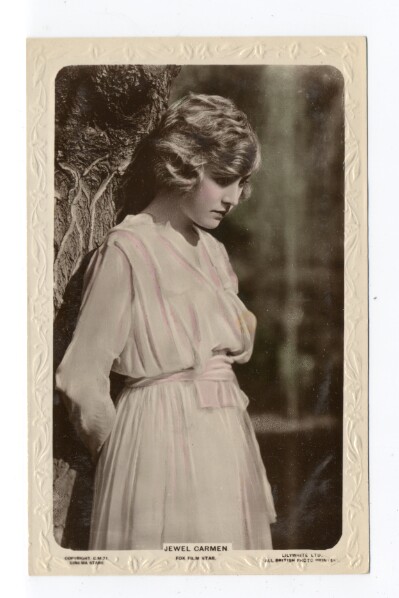
 Into this mix arrives Cassius Lee (Fairbanks), an amateur entomologist hot on the trail of the migratory caterpillar. Lee winds up involved with the heiress to the Hicks' Hatpin fortune (played by Jewel Carmen at the peak of her short-lived career) as well as gunrunners smuggling weapons to Mexico during that country's civil war (presumably to be used against the American forces who had intervened in the conflict). But, of course, this is all just an excuse to show off Fairbanks's athletic prowess and we don't get cheated as he scales buildings, springs into moving cars and swings from telephone wires.
Gotta love a man able to leap both porters and park benches in a single bound.
★★★
 If she'd just been another pretty face, a cut flower from yesterday's bouquet, she would have been forgotten long ago, one of the thousands of beauties who for a brief season capture the fancy of the paparazzi and the tabloids and the fickle paying public and then quickly fade from our memory. But more than just a platinum blonde beauty, Jean Harlow also possessed an unexpected gift for comedy and self-parody, and as the pre-Code era drew to a close, she became not only America's premier sex symbol but one of its premier actresses as well.
Of what I would call the five essential performances in her career—Red-Headed Woman, Red Dust, Dinner At Eight, Bombshell and Libeled Lady—three of them were released during the award year that ran from August 1, 1932 to the end of 1933, and she's my choice for the best actress in a comedy or musical.
The Girl From Missouri
 Born to a Kansas City dentist and the daughter of a wealthy real estate developer, Harlean Harlow Carpenter tried out for the movies on a dare, got the job and later signed with the Hal Roach Studios. Working under her mother's maiden name, Jean Harlow played the "swanky blonde" in four Laurel and Hardy comedy shorts and appeared in uncredited bit roles in more than a dozen movies (including City Lights) before Howard Hughes cast her in Hell's Angels. Hughes epic about World War I flying aces proved to be Harlow's big break. Although she was as skittish as a newborn foal, barely able to speak her lines, the public immediately responded to her beauty—the expressions "platinum blonde" and "blonde bombshell" were coined to describe her—and she soon landed better parts, including that of James Cagney's love interest in William Wellman's The Public Enemy, a part initially intended for Louise Brooks.
On the set, Cagney couldn't help but notice that Harlow never wore undergarments and asked her, "How do you hold those things up?"
"I ice them," she answered matter-of-factly.
 She played a similar kind of role—the beautiful, unobtainable society girl—in Frank Capra's comedy Platinum Blonde (retitled from Gallagher to capitalize on Harlow's popularity) and while critics called the performance no better than "competent," the public was already clamoring for more.
Directors clearly had no idea what to do with Jean Harlow in these early efforts and mostly she stood around, serving as a symbol of something the hero thinks he wants and learns the hard way that he doesn't. The bombshell image may have packed the theaters with the curious and the salivating, but it blinded directors and producers to her talent.
 "The newspapers sure have loused me up," she complained cheerfully, "calling me a sexpot! Where'd they ever get such a screwy idea?"
"One look at Harlow," screenwriter Frances Marion replied in print, "and whether you were male or female you could get no other idea; she was the Scylla and Charybdis of sex, from her provocative come-hither expression to the flowing lines of her beautifully proportioned body."
Red-Headed Woman and Red Dust: Red-Hot Harlow
 It was MGM's legendary producer Irving Thalberg who determined to mold a screen image for Harlow beyond that of sex symbol. Thalberg bought Harlow's contract from Howard Hughes and cast her in the screen adaptation of Red-Headed Woman, Katharine Brush's racy novel about a woman who sleeps her way into high society. F. Scott Fitzgerald took the first crack at the screenplay, but couldn't solve the puzzle of how to make the audience like a character he himself didn't approve of, and it was instead Anita Loos, a veteran screenwriter and author of Gentlemen Prefer Blondes, who drafted the final screenplay.
Although Harlow's Lillian Andrews is a manipulative gold digger—she seduces her married boss, poor sap, and breaks up his marriage—there was a sincerity to Lil's transparent scheming, and with Harlow serving up the brassier bits with humor and wounded pride, audiences found themselves rooting for her. The result was one of the biggest hits of 1932.
 It was a remarkably nuanced performance from an actress who before this had always shown more leg than promise. Variety summed up the general reaction: "Jean Harlow, hitherto not highly esteemed as an actress, gives an electric performance."
Next up was an even better vehicle for Harlow, one that would both display her talent for comedy and pair her with fast-rising star Clark Gable.
 Based on a failed stageplay, MGM had purchased Red Dust as a vehicle for Greta Garbo and John Gilbert, the studio's two biggest stars of the silent era. Once the couple's relationship ended, however, Garbo backed out and Thalberg cast Harlow to replace her. While adapting the play for the screen, writer John Lee Mahin recommended that Thalberg replace Gilbert with Gable, and his suggestion proved to be an inspired one. Harlow and Gable had an undeniable chemistry on screen and ended up making six pictures together, including Harlow's last, Saratoga.
Clark Gable is Dennis Carson, the overseer of a rubber plantation deep in the jungles of French Indochina. As the movie opens, Carson is on edge—production is behind schedule, his crew chief (Donald Crisp) is a drunk, and if that weren't enough to worry about, a prostitute on the run from the law decides to hide out in Carson's bed.
 "You've got your yearly case of nerves," says his friend and mentor (Tully Marshall). "Why don't you go down to Saigon and blow the lid off. ... As a matter of fact, what came up from Saigon isn't so bad looking."
"I've been looking at her kind," Carson sneers, "ever since my voice changed."
 But as Carson notes, the prostitute, Vantine (Harlow), is a "cute little trick" and she makes him laugh and, well, she's there and why not. Things get a bit complicated when she falls for him, but Carson is oblivious and at the end of the month, he puts her on the boat and hands her a wad of cash she doesn't want. "It isn't half enough," he tells her as her eyes fill with tears. "And when I get down to Saigon, there'll be plenty more." Harlow is terrific in this scene as we glimpse Vantine's vulnerability while never letting down the guard a woman of her profession would necessarily have developed.
And then things really do get complicated. As Vantine gets on the boat, Barbara Willis (Mary Astor) gets off it, and though she's the wife of his latest hire, Carson is immediately smitten. Mrs. Willis represents everything that he, as a poor kid with his nose forever pressed against the glass, has ever wanted and he sets out to seduce her.
 When the boat soon after runs aground and Vantine is thrown back into Carson's care, a worldly-wise Harlow immediately sizes up the situation. "What a pleasant little house party this is going to be." The women's rivalry is not just one of sex and love but of class, education and manners—everything Mrs. Willis takes for granted, everything Vantine has struggled to survive without—and this is where Harlow really hits her stride as an actress. As Vantine competes with Mrs. Willis (and Harlow with Astor) with gestures both subtle (a mocking description of a fictional blue-blooded background) and not so subtle (bathing in the company drinking water), Harlow is funny, bawdy, hurt, angry, and then as much as her Vantine wishes she weren't, compassionate, too, protecting her rival when she could just as easily destroy her.
 As the Movie Diva put it in her review of Red Dust, Harlow's "uniquely effortless vulgarity, humor and slovenliness create the rarest of Hollywood goddesses, the beautiful clown." It's one of the best performances of the pre-Code era.
The movie itself has been selected for preservation in the National Film Registry.
 Despite being known as a "man's director," Victor Fleming was remarkably adept at getting strong performances from actresses—Clara Bow in Mantrap, Judy Garland in The Wizard Of Oz, Vivien Leigh in Gone With The Wind—and he probably deserves more credit than he usually gets for establishing Harlow as an actress (he also directed her in Bombshell and Reckless). He liked to create onscreen the sort of women he preferred to spend time with in private—"resourceful, strong-willed and sexual," as David Denby put in The New Yorker (May 25, 2009).
Harlow's Vantine was all that and more.
[To read Part Two, click here.]
 Between Jackie Coogan's turn in Charlie Chaplin's 1921 comedy classic, The Kid, and the advent of box office phenomenon Shirley Temple in the early 1930s, no child star was bigger or better than "America's Boy," Jackie Cooper.
Born in 1922, Cooper broke into movies at the age of seven, working in the Our Gang comedies at the Hal Roach Studios for $50 a week. Cooper became a star just two years later when he landed the lead role in Skippy, a film version of the day's most famous comic strip. (So popular was the strip, in fact, that Skippy brand peanut butter was named for it—or was it? Strip creator Percy Crosby filed suit and won a decision in the U.S. Patent Court, yet seventy-six years later, Skippy is still my peanut butter of choice.)
 Skippy—the movie not the peanut butter—was the one where Cooper's uncle, director Norman Taurog, famously threatened to shoot Cooper's dog if the boy didn't cry on cue, then sent a production assistant outside with a gun loaded with blanks. Cooper heard the shot and predictably cried buckets. Only nine years old at the time, he's still the youngest actor to be nominated for an Oscar in a lead role.
Like most of us, he slept through the ceremony, although in his case, in Oscar-winner Marie Dressler's lap. "I was much more interested in not having to go to school that day than I was in the ceremony," he later admitted.
Cooper was even better a year later in the award-winning boxing movie, The Champ. Directed by King Vidor, The Champ is an unabashed tearjerker of the first water and turned Cooper and co-star Wallace Beery into the unlikeliest of screen teams. The pair made four feature-length movies together between 1931 and 1935.
 Beery won an Oscar playing an alcoholic, over-the- hill boxer with delusions of grandeur, the kind of guy who wins a horse for his son in a crap game, then promptly loses it back again—twice! When he's not gambling, he's hungover in a fleabag hotel room over a saloon, haunted by what might have been and fueled by pipe dreams of another shot at the title. Cooper is the champ's son, who even at nine years of age is a classic enabler. He adores his father but has been disappointed too many times to lie to himself anymore, even as he lies to the Champ.
Cooper more than holds his own in his scenes with the more experienced Beery, for example, in an early scene when fight promoters call his father a drunk and a "palooka." Eyes glistening with a mixture of rage, disappointment and humiliation, Cooper holds his defiant pose for a moment, then his shoulders slump and he turns away.
 "You don't believe what they said about me being drunk the night I lost the championship, do ya, Dink."
"No," says Cooper, slump shouldered, not looking at his father, and starting to clean up after him like he always does.
It's a formula that has served Hollywood well, right up to and including Mickey Rourke's 2008 comeback in The Wrestler, and won Frances Marion an Oscar for the screenplay, her second.
Cooper himself was rather dismissive of most of his early screen roles. "Very often on some of this stuff when I'd have to go to work. I'd just give the script a cursory glance. I had no training, and I was a quick study, so nobody knew how involved or not involved I was. But I look at that stuff now and I can see I wasn't involved, and I wasn't very good."
 Cooper and Beery made three more films together, including Treasure Island. "They kept me in short pants as long as they could," Cooper said of his days as a child actor, "until they were shaving the hair on my legs because it was beginning to photograph."
Ironically, because of his own experiences, Cooper grew up opposed to children working full-time as actors. "No amount of rationalization, no excuses, can make up for what a kid loses—what I lost—when a normal childhood is abandoned for a movie career.
His 1981 autobiography was entitled Please Don't Shoot My Dog.
 Cooper left Hollywood during World War II, serving in the United States Navy where he attained the rank of Captain. After the war, the transition from child star to adult performer was difficult for Cooper, but he eventually wound up in television, both as an actor and as a director. As the latter, he won two Emmys for directing episodes of MASH (one of the funny ones) and The White Shadow. Maybe his most famous movie role after childhood was that of Daily Planet editor Perry White in four Superman movies between 1978 and 1987.
Cooper retired in 1989. He has four children and lives in California.











 Posts
Posts

