skip to main |
skip to sidebar
D.W. Griffith's Intolerance that is, which is playing at the Smithsonian's Freer Gallery of Art on Saturday, March 9, 2013, at 3 p.m., I do believe. The Baltimore-based group Boister will provide live musical accompaniment. Admission is free.
Maybe Katie-Bar-The-Door and I will see you there.
In case you know nothing about it, Intolerance weaves four separate story lines—the life of Christ, the fall of Babylon, the massacre of the Huguenots, and a modern-day story about the victims of an overreaching reform movement—into a three-plus hour spectacle that might be the most ambitious movie ever made. Accounts vary as to how much of his personal fortune Griffith poured into the production—some say as much as $2 million, the most for any film before Gone With The Wind—but there's no question that this was the most lavish production of the silent era.
Or to put it another way, to show the sack of Babylon, Griffith basically built a full-scale replica of the ancient city on a Hollywood backlot and then laid siege to it.
 "Imagine," wrote Daniel Eagan in America's Film Legacy, "how audiences in [1916] must have reacted to the sight of walls and battlements four and five stories high, to courtyards set on three different levels and filled with hundreds of costumed extras, to visuals so expensive it's like they were filmed on and made out of gold."
 The film opens with the story of a modern-day reform movement determined to improve the spiritual life of the working class even if it kills them. Fueled by jealousy and financed by an autocratic mill owner, the reformers crush the life out of their would-be beneficiaries, particularly "the Dear One" (played so memorably by Mae Marsh), the embodiment of youthful joy and innocence. Only a crabbed, self-righteous hypocrite could find fault with someone so pure; that the reform movement's machinations lead to Dear One's fall is a testament to its destructive purposes.
To underscore the point, Griffith cuts to a scene from the life of Christ, that of a Pharisee praying in public so that others might better observe his piety. "Oh Lord, I thank thee that I am better than other men."
The film's third storyline focuses on the political intrigue in the court of King Charles IX that led to the massacre of Protestants in Paris in the late sixteenth century, while the fourth and final story, about the jealousy between rival religious factions that led to the sack of Babylon, rounds out Griffith's theme, a rousing condemnation of the humorless, meddling, Puritanical impulses that characterize so much of America's reformist zeal on both ends of the political spectrum. Watching it, I thought it was a pity that Griffith never directed a screen version of Sinclair Lewis's Elmer Gantry.
Structurally, Intolerance is as audacious as anything ever attempted on film—four simultaneous stories linked only by a common theme and the generally rising action—with the editing style growing more complex as the action in each story reaches its climax. The film's last half hour, with quick cross-cut shots between a marauding army, a racing car, a speeding train, the slaughter of the Huguenots and the crucifixion of Christ, has been described as a fugue, a concept borrowed from music where two or more voices entering successively and sung in either imitation or counterpoint to build on a common theme.
 Griffith's visual fugue later inspired Sergei Eisenstein and other Russian directors to develop the montage—quick shots cut rapidly together to condense several events or a lengthy period of time into a single short sequence.
Questions have persisted almost from the beginning as to Griffith's motives in making Intolerance. For years, historians assumed Intolerance was his apology for the racism of The Birth of a Nation, but more recently, biographers have suggested Griffith was lashing out at those who were looking for an apology. Personally, after watching it in the context of the times, Intolerance looks like the act of a supremely self-confident artist determined to top both himself and his chief competition, Cecil B. DeMille and Thomas H. Ince, who that year directed ambitious historical epics of their own, Joan the Woman and Civilization, respectively.
Whatever his motivations, Griffith succeeded brilliantly.
Which is not to say that all four of Griffith's stories are created equal. Christ's life, for example, gets the least amount of screen time, presumably because Griffith assumed his audience knew the story so well, he needed only reference a particular well-know incident to underscore a point he wanted to make in one of the other story lines.
Too, the story of Protestant-Catholic infighting in sixteenth century France isn't all that interesting even if it does result in a satisfyingly bloody slaughter by the film's end. Without a central figure as compelling as the Dear One or Babylon's Mountain Girl (Constance Talmadge), the court intrigue becomes a bit opaque, delving too deeply into the minutiae of history without giving us someone lovable to root for.
 But when it focuses on the modern and Bab- ylonian stories, the film soars. It's telling that in the role of the Dear One, Griffith cast Mae Marsh from his stable of performers instead of his usual go-to girl, Lillian Gish. For truly tragic suffering—and for an ideal of Victorian womanhood that existed only in Griffith's head—no one was better than Gish. But Marsh, with her kewpie doll face, bow-tie mouth and round, startled eyes, was better suited for a role that required joy, passion and an almost childlike innocence. Along with her work in Judith of Bethulia, The Birth of a Nation and Hoodoo Ann, this represents Marsh at the peak of her career.
 The film's most unforgettable performance—and for me, the best in any film in 1916—came from Marsh's co-star, Constance Talmadge. In the Babylonian sequence of Intolerance, she plays "the Mountain Girl," a pretty, perky, petulant teenage beauty who finds herself fighting against a palace conspiracy that threatens to topple the kingdom. Wide-eyed and gangly-limbed, Talmadge is as hyperactive as a puppy amped up on kibble and amphetamines, windmilling her way across the screen, and you can't take your eyes off her. Neither could audiences in 1916 and she quickly became a star.
"[I]t's a mark of her skill," Eagan wrote, "that she stands out in a segment filled with orgies, sacrifices, semi-nudity, wild animals, and wholesale destruction."
In short, if you're a connoisseur of mind-blowing cinema, watch this D.W. Griffith epic and consider your mind blown. See you tomorrow—maybe.
 One of my favorite of the early silent directors, Louis Feuillade, made a big splash in France with Fantômas, five interlinked feature films (each running between fifty and ninety minutes) based on a series of novels about the eponymous master criminal, one of film history's first anti-heroes. Feuillade alone of the great early directors anticipated the chief maladies of the coming century—violence, anxiety, paranoia, alienation—and even this century's scourge, terrorism.
His film serials Les Vampires, Judex and Tih Minh directly influenced filmmakers as diverse as Luis Buñuel, Fritz Lang and Alfred Hitchcock. Throw in the fact that Feuillade's films are extraordinarily entertaining—not just as film history but in a 21st century sense—and he winds up, along with Charlie Chaplin, as my favorite director of the first three decades of film history (1888-1918).

I can't help it—I never met a blogathon I didn't vow to skip yet spent so much time thinking about, I wound up writing for it by default.
Shadowplay (which bills itself as "The Willfully Eccentric Film Blog") (as opposed to this one where I strive daily for what Warren G. Harding dubbed "normalcy" and yet fail with bewildering regularity) (I mean seriously, dammit, have you ever met me? I'm about as quirky as a coatrack. And yet this site ends up filled with jibber jabber like this!)
(Um, where was I?) (Oh, yes.)
Shadowplay is hosting The Late Show Blogathon, which so far as I can tell—I can't actually find the original announcement—is a collection of essays about the last film of a director or actor or caterer or anybody else connected with movies. Which means, theoretically, I could write about my sole foray into film, back in 1982, when I held the camera for and acted in Pete Wilson's (or was it Dees Stribling's?) student film, Das Volkswagen.
But instead I find myself making notes for The Private Life of Don Juan, the last film of one of the Monkey's favorite silent film stars, Douglas Fairbanks.
I chose his last film because, unlike most actors who have little control over their choice of a final film project before they die, retire or simply peter out, Fairbanks specifically selected a vehicle to sum up—and blow up—his image and career before settling into a well-earned retirement.
Douglas Fairbanks: A Silent Legend
If you're reading this, I assume you know who Douglas Fairbanks was. He was arguably the most popular actor of the silent era, a superstar before the word existed, rivaled in terms of fame by Mary Pickford, Charlie Chaplin and no one else.
After starring in a series of athletic comedies between 1915 and 1919, Fairbanks practically invented the action-hero film genre with 1920's The Mark of Zorro. Admittedly, his Don Diego Vega—Zorro to you—had no supernatural or extraterrestrial powers, ala Superman or the Hulk, but he was the first film hero with a secret identity and hideaway, a costume, a mask, a sidekick and a backstory, not to mention a compulsion to carve a "Z" on the anatomy of oppressors and evildoers while fighting for truth, justice and the old Spanish California way.
Later, Fairbanks's Zorro would inspire Bob Kane as he created the comic book crime fighter, Batman.
Fairbanks followed up The Mask of Zorro with a series of the greatest swashbuckling action-adventure movies in history, the best of which are The Thief of Bagdad (1924) and The Black Pirate, an early Technicolor film from 1926. With the graceful and athletic Fairbanks at its heart, The Thief of Bagdad is as fluid as a ballet while at the same time serving up a rip-snorting yarn filled with the best special effects 1924 could offer. And simply put, The Black Pirate is the best pirate movie ever made.
In 1929, with talkies already well established, Fairbanks made his last silent movie and it proved to be the perfect cap to his action hero career. Set twenty years after the events of his 1921 hit, The Three Musketeers, The Iron Mask reunites d'Artagnan (Fairbanks) with Athos, Porthos and Aramis to rescue the rightful king of France from prison. The movie features plenty of action, as you would expect, but is also a touching buddy movie and commentary on retirement and even death. Fairbanks even recorded a spoken prologue, the first time his adoring fans ever heard him speak on film.
The Legend Becomes Fact
"When d'Artagnan bids farewell to his earthly existence in the final moments of The Iron Mask," Jeffrey Vance and Tony Maietta wrote, "Fairbanks also appears to be bidding farewell, not only to that character, but to Zorro, the Thief of Bagdad, the Black Pirate, and all the other romantic roles of his swashbuckling past. It would have been a superb swan song to his life and career ..."
Unfortunately, as is often the case with middle-aged men who have outlived their ability to delight those who once loved them, Fairbanks didn't have the good grace to immediately drop dead. Instead, he lingered for another decade, during which time he divorced, traveled extensively and, more to the point for our purposes, dabbled in talkies—four features plus a documentary, none of them successful box office performers.
The first of these talkies, The Taming of the Shrew, paired him with Mary Pickford for the first time as leads. Given that the couple was on the verge of divorce, it was a particularly catty choice, and while the film turned a profit, it didn't help either star's standing with the public. Reaching for the Moon was originally an Irving Berlin musical, but after a preview, all the songs (including one Fairbanks number) were excised. What was left wasn't worth the effort. Mr. Robinson Crusoe, with Fairbanks living alone on an island for a year on a bet, was a throwback to his pre-swashbuckling films of the World War I era, but moviegoers were not in the mood.
(I haven't seen the documentary, Around the World in 80 Minutes with Douglas Fairbanks, but it sounds like a forerunner of the "Pete Smith Specialties," with a trip around the Pacific Rim that is more comedic than informative.)
On their own merits, these films are not bad, but they don't hold up in comparison to his silent work. Audiences didn't much care for Fairbanks's voice, which was nasal and squeaky; and pushing fifty, he was too old for the energetic stunts audiences had loved him for. Worse, though, he was passe, too much associated with silent films to thrive in the new medium.
The Private Life of Don Juan
By 1933, Fairbanks was at loose ends. As he and Pickford drifted into semi-retirement, the combination of infidelity, general lack of purpose and the unaccustomed sting of box office failure cracked the fault lines in their marriage wide open. With free time now plentiful, Fairbanks longed to travel while Pickford preferred the Hollywood social life, and they laid eyes on each other only once that entire year.
Fairbanks turned his attention to the business of running United Artists, and in 1934 took on as a new partner British film producer Alexander Korda. The previous year, Korda had scored a major hit with The Private Life of Henry VIII, a comic look at the tangled love life of England's infamous royal Bluebeard. The film won Charles Laughton an Oscar, and won Korda a legion of admirers, among them Fairbanks.
The two men cast about for a follow-up project and came up with L'homme à la Rose, a play about Don Juan that had been a hit for Henry Bataille in 1920. Rather than a reverent or romantic look at the notorious libertine, the story mocks the legend, and mocks our obsession with fame and myth-making. If Don Juan is not quite up to Henry's standards, that doesn't mean it isn't a lot of fun, and it emerged over time as the one talkie worthy of inclusion on Fairbanks's lustrous resume.
The movie opens, symbolically enough, on a gushing fountain, before which a balladeer sings of the legend of the great lover, Don Juan. Women smile dreamily as their husbands scowl—what mere man could possibly hope to live up to such a standard?
None, of course. Not even Don Juan himself, as it turns out. Despite the appearance of a mysterious stranger in town, the real Don Juan (Fairbanks) is a weary, middle aged hypochondriac, with a spreading waistline and a waning libido. Whether he was ever worthy of the legend surrounding him is a matter up for debate, but there's no question his best days are behind him.
"Now when I sit down to play a quiet game with a lady," he laments, "I'm no longer sure of holding the cards."
Nicely put, and separate bathtubs weren't required.
Delivered in Fairbanks's thin, reedy voice, the confession is (perhaps unintentionally) hilarious, a bit like Woody Allen boasting of the "coiled sexual power of a jungle cat," but in a similar way is highly effective, for this is a movie about the seductive power of our imaginations. Even if the young women in the story could climb into a time machine and bed the Don Juan of legend, as their mothers claim to have done, the act would never be half as satisfying as the anticipation of it.
In the film, every woman wants to boast of having slept with Don Juan, but nobody really wants to meet him. As John Ford taught us in The Man Who Shot Liberty Valence, "When the legend becomes fact, print the legend."
Indeed, despite the careers to be made from claiming to have "kissed" Don Juan, there's only one woman who actually wants him, Dona Dolores (Benita Hume), his long-ago abandoned wife who has gleefully bought up his debts and threatens him with prison unless he comes home to her.
Don Juan prefers prison.
Not that there's anything wrong with Dolores—she's delightful. The problem is within Don Juan himself, because for him, sex and romance are not means to achieving intimacy but avoiding it, and far from revealing himself to his lovers, his practiced, rote wooing is a mask behind which he hides his increasingly bored, lonely self. Before the story is over—am I spoiling anything?—he will learn a valuable lesson, that when it comes to love, lasting triumph lies not in conquest but in surrender, particularly the surrender of posturing, pretenses, and even dignity, the happiest kind of surrender, without which real love, meaning and purpose is impossible.
In the meantime, though, Don Juan agrees to switch places with an aspiring Lothario, and when the lad is killed by a jealous husband, he is able to escape the burden of his legend at last. Turns out, though, he's not quite sure how to fill the hours once he's retired. The question of what a man wants to be when he grows up is apparently a lifelong one, and no easier to answer at fifty than it is at fifteen.
And un-retiring is even more problematic—no one wants to believe this middle aged has-been is the great lover of their memories.
Despite the underlying seriousness of its themes, there's no brooding or melancholy in the movie's tone—nor should there be. Death and decay are as inevitable as the setting of the sun, and the wise man faces an unpleasant but unavoidable task with laughter rather than tears.
Besides, that's why God invented gin and cracked ice.
A Farewell to a Fare-thee-well
Although it definitely plays as a valediction, the studio, London Films Productions, and the film's distributor, United Artists, billed Don Juan as a comeback. If that was indeed the plan, it didn't work —contemporary critics slammed Fairbanks ("the microphone is ruthlessly unkind to him," Andre Sennwald wrote for the New York Times in a typical review) and the picture flopped at the box office.
No doubt Fairbanks and Korda were surprised by the commercial failure of their finished film, but they probably shouldn't have been. While audiences don't mind laughing at a king, they're very rarely keen on laughing at themselves—and it's very much the audience and its worship of celebrity that's the subject of the film's derision. Nor do people much care to see that their heroes have feet of clay. That Fairbanks spent the entire film with his metaphorical shoes off must have been distressing to the few people who bothered to watch.
With the passage of time and the benefit of hindsight, though, Don Juan has proven itself to be an artistic success and a worthy final film for one of the silent era's greatest stars.
The screenplay is light and witty, the direction fast-paced, and the supporting performances, particularly those of Merle Oberon, Binnie Barnes and the aforementioned Benita Hume, very good. But mostly, of course, it's worth watching because Douglas Fairbanks spends the entire 89 minutes of the film's running time so gleefully—and ruthlessly—taking the piss out of himself. Even William Shatner, the master of self-parody, has never subjected himself to such lacerating onscreen introspection.
"When a man finds himself sliding downhill," Fairbanks said, "he should do everything to reach bottom in a hurry and pass out of the picture."
Don Juan was not the first movie to feature a self-referential commentary on a star's life—1933's Bombshell, for example, began as a comedy about Clara Bow but wound up as a comic examination of the life of its star, Jean Harlow. But Don Juan was one of the first to so thoroughly skewer its own star, to make his shortcomings the butt of the movie-length joke.
"[I]t is fair to say," wrote one film historian, "[Fairbanks] was a bit of a Don Juan himself, his marriage to Mary Pickford began as an affair and ended with one as well!"
In 2005, Jim Jarmusch used The Private Life of Don Juan as a jumping off point to tell his own story, Broken Flowers, of an aging Casanova (Bill Murray, playing a character named "Don," no less), referencing the 1934 film both explicitly (it's playing on the television in the opening scene) and later implicitly (in the way he staged a funeral scene).
Fairbanks didn't much enjoy filming Don Juan, largely for personal reasons that had nothing to do with the production itself. Shortly after arriving in London for the shoot, he began an affair with Lady Sylvia Ashley and was soon named as co-respondent in Lord Ashley's divorce suit. The British tabloids, the most vicious in the world, hounded Fairbanks day and night, the story crossed the Atlantic, and Pickford, who had always ignored Fairbanks's peccadilloes so long as they remained private, made Fairbanks acutely aware of her wrath.
That Lady Ashley had begun life not as an aristocrat but as Edith Louisa Hawkes, a chorus girl and lingerie model, only added fuel to the fire.
I've seen conflicting accounts of Fairbanks's feelings about the film. Some have suggested he hated the script—it "played to all his fears of getting old"—but others insist he was eager to address honestly his inability to live up to the legend he himself had created. Given that Fairbanks wasn't under contract to anybody but himself, and that he had tightly controlled his material and image from the beginning of his career, I'm inclined toward the latter view, with any ill-feelings on his part revisionist sour grapes after the film failed at the box office.
Either way, Fairbanks was self-aware enough or lucky enough to have chosen his own epitaph, not once but twice (remember The Iron Mask), a rare feat for any artist.
Film historian Sparrow Morgan calls The Private Life of Don Juan "the perfect final film for a great Hollywood swashbuckler." I wholeheartedly agree.
This is my contribution to the Universal Backlot Blogathon hosted by Kristen at Journeys in Classic Film.
 While many great films have come out of Universal Studios since its founding in 1912, the genre with it is most associated is and probably always will be horror. From silent era films starring Lon Chaney, to Bela Lugosi and Boris Karloff during the early sound era, right up to Drag Me To Hell and Shaun of the Dead in the 21st century, the Universal logo at the beginning of a film promises a viewer 90+ minutes of scary thrills and chills.
You no doubt have your own favorites, but I prefer the horror films of directors Tod Browning (Dracula) and James Whale (Frankenstein) who worked during the late silent and early sound eras. They didn't just work in the genre, they defined it, inventing many of the visual and narrative cliches we love and demand when we wait in the dark to be scared out of our wits.
As great and influential as those two directors were, however, it was their contemporary, the German Paul Leni, who might have been Universal's greatest director of horror. He was responsible for three of the best horror films of the silent era, Waxworks and The Man Who Laughed—both starring Conrad Veidt, who you may better know as Casablanca's Major Strasser—and this one, The Cat and the Canary, which like The Man Who Laughed was filmed on the Universal backlot.
The plot of The Cat and the Canary has been recycled so many times, I scarcely need describe it—an eccentric millionaire leaves a will stipulating it not be read until the twentieth anniversary of his death, a will which when read names his sweet niece Annabelle as sole heir, provided she survive a night in his spooky old mansion.
I spent a year in law school studying decedents' estates and trusts—wills, to you—and let me tell you, this is one nutty way to pass money from one generation to the next.
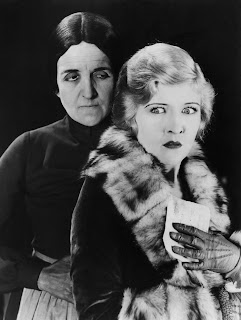 Add in a houseful of greedy relatives, a stormy night and the fact that the will itself has been tampered with—the old man's lawyer opens the safe for the first time in twenty years only to find a still-living moth flapping its wings inside—and you've got yourself the making of a nifty, old-fashioned ghost story.
The cast is populated with unknowns—other than Tully Marshall and Lucien Littlefield, I wasn't familiar with any of them—and the story itself is a hoary old chestnut, but with Leni's expert direction taking full advantage of Charles Hall's set design, the film is a treat from beginning to end, moving like lightning, and fun and spooky in a kids telling ghost stories on Halloween kind of way.
 The film is a fine example of what the Germans called "Expressionism"—an attempt to represent the world in subjective terms, that is to say, distorted to reflect an emotional state rather than an objective one—and as such films as The Cabinet of Dr. Caligari, Nosferatu and this one demonstrate, is well suited to evoking the heightened emotional state necessary for true horror.
 Working with Hall, who later created sets for Frankenstein, Dracula and Bride of Frankenstein, Leni designed a mansion that looks like a cross between Charles Foster Kane's Xanadu and Dracula's lair, a backlit castle more suited to Transylvania than the Hudson River valley, full of impossible corridors narrow yet three stories high with curtains billowing from open windows; massive doors that look like they were carved whole from ancient oaks; chairs big enough to seat Goliath; acres of cobwebs; hidden passages; secret panels; and all of it lit from below as if told by half-frightened, half-giggling kids with a flashlight during a sleepover.
 "I have tried to create sets so stylized that they evince no reality," Paul Leni explained in 1924. "[It] is not extreme reality that the camera perceives, but the reality of the inner event, which is more profound, effective and moving than what we see through everyday eyes."
Unfortunately, Leni died suddenly in 1929 at the age of forty-one, and his name and his films, along with most of the silent era, was quickly forgotten by a movie-going public hungry for the next big thing, talkies.
 But even if Leni himself has been forgotten, his influence hasn't. The film was a huge hit, critically and commer-cially, and has been remade at least five times, the best of them starring Bob Hope. It has also been copied and ripped off, in one form or another, too many times to count, including as The Old Dark House featuring Boris Karloff and Charles Laughton, The Laurel-Hardy Murder Mystery, with, yes you guessed it, Laurel and Hardy, and If a Body Meets a Body starring the Three Stooges.
But don't take my word for it—watch it here yourself, courtesy of the Internet Movie Database and Archive.org, and reflect as you do, just how many times you've seen it, even if you've never seen it.
This is my contribution to the Speechless Blogathon now underway at Eternity of Dreams.
 A contemporary of D.W. Griffith and Louis Feuillade, Abel Gance directed over fifty movies in a career that stretched from the silent era to 1972, but his reputation as one of France's greatest directors is founded on three silent movies, the epic bio-pic Napoleon (1927), 1923's La Roue ("The Wheel"), and this one, J'accuse! from 1919.
 Contrary to what you might expect if you know anything about French history, the novelist Émile Zola and/or the phrase "J'Accuse," this is not an early film version of the infamous Dreyfus Affair, in which a virulently anti-semitic French military court-martialed Alfred Dreyfus for selling secrets to the Germans without evidence of anything other than that he was Jewish (after Zola's essay "J'accuse!"—"I accuse!"—turned Dreyfus into a cause célèbre, an investigation revealed that another officer was guilty of the crime).
 Instead, Gance tells a fictional tale set during World War I, a conflict Gance served in, was wounded during and then returned to in order to film authentic combat scenes for the film. The story, such as it is, concerns itself with a poet who is in love with a girl who has been forced against her will into marriage to a wealthy brute. The husband (Séverin-Mars, who later managed to star in 1923's La Roue despite dying in 1921) is the kind of guy who leaves slaughtered deer carcasses bleeding on the dining room table while he beats his wife. The poet (Romuald Joubé) writes naive pastorales which he rapturously reads to his bedridden mother. And the girl (Maryse Dauvray, who looks like Florence Vidor but isn't) frets by the window.
Fortunately, war breaks out before the husband makes good an implied threat to kill his wife and the poet. Both men march off to war while the girl is sent to live in shame with her in-laws.
 And then in a series of improbable twists, the girl is taken captive by the advancing German army while the poet winds up as a lieutenant in command of a front line unit that includes the husband. When both men perform absurdly fanciful acts of heroism, mutual suspicion and resentment turns to grudging respect and even abiding friendship.
The rest of the movie's twists and turns I'll leave to you to discover except to say that I didn't really believe in any of them. Gance moves his characters around like chairs on an empty stage in service of a plot that strains credulity and a message that is so muddled I can only assume I know what it is.
 This is typical of the three films for which Gance is best know. Any individual image or sequence in a Gance movie is as beautiful as any you've ever seen, and the rapid cutting he employs strongly influenced the Russians (such as Sergei Eisenstein) who were busy developing the montage as a means of quickly compressing events that occur over a period of time or in many places at once.
The problem is, Gance gleefully piles up image on top of image until whatever point he was trying to make or mood he was trying to evoke is muddied at best. Gance is a jazz musician lost in a solo that goes on so long both you and he forget what he's trying to play.
 Fernando F. Croce of Slant magazine calls Gance's work "[f]ertile to a fault" and accurately complains that "Gance's ... experimental joyousness clashes with the film's disenchanted mood." Michael S. Gant writing for DVD Reviews notes that "Perhaps Gance, who, as silent-film historian Kevin Brownlow has written, thought of cinema 'not as a single art, but as a pantheon of all the arts,' couldn't constrain his creative fervor to fashion a coherent message." Even David Camak Pratt, an unabashed fan of the film writing for PopMatters admits "J’Accuse is a messy picture. The title (translating to I Accuse!), the director, and much of what has been written about the film insist that it is a pacifist manifesto. As such, it fails."
 It's like the first time I saw Napoleon, I marveled at the beauty and technical innovations (such as the use of a handheld camera) on display in a sequence where the little boy Napoleon takes charge of a snowball fight at school. And then the scene kept going and going, for eight-and-a-half minutes, and it began to dawn on me, "What the what?—Spielberg didn't take this long to show the invasion of Normandy!"
A sense of proportion is also the hallmark of a great artist (said the man who once wrote a 12,000 word blog post about the Marx Brothers).
 So J'accuse!—"I accuse"—who of what? Gance is a little unclear, pointing his finger at so many targets (French leaders, old men, unfaithful wives, the sun in the sky), and denouncing them for so many sins (war, rape, adultery, profiteering, but also of not proving worthy of the troops and their cause), that in the end I have to assume he's accusing his audience of that defect common to all human beings that makes unhappiness possible in a world of so much beauty. Which is a rather gross simplification of war's—any war's—causes, but then it's a rare artist who has ever analyzed his way to a deeply-felt response to the grim realities of war.
In that sense, J'accuse! reminded me of Thomas Ince's Civilization (1916), another ambitious film that tried and failed to explain war in cosmic terms. Not until directors narrowed their focus to real stories of the men who fought and died in the Great War did they produce such classics as The Big Parade and All Quiet on the Western Front, films that didn't need to gild the message that war is a barbarous pursuit.
 As for Gance in general and J'accuse! specifically, revel in the beauty of any given moment, admire and respect his influence on the craft of filmmaking, but abandon all hope ye who enter here looking for a coherent narrative.
Postscript To capture the authentic footage of combat that shows up in part three of J'accuse!, Gance traveled with the United States Army's 28th Infantry Division during the Battle of Saint-Mihiel in September 1918.
This is my contribution to the Summer Under The Stars Blogathon underway at Sittin' on a Backyard Fence. For those of you in the United States, you can see Broken Blossoms on Turner Classic Movies tomorrow morning, August 15, 2012, at 6 a.m. You can see two other Gish films mentioned in this post, Orphans of the Storm and Intolerance at 7:45 a.m. and 8 pm, respectively. A good day to set your DVRs. Or just skip work entirely.
 I've written about silent film director D.W. Griffith many times, both to praise him and to bury him, but I've been steadfast in my insistence that, love him or hate him, he was the most influential director of the silent era. "[W]hereas other directors simply parroted the techniques that worked on stage," I have written, "and wound up with actors in togas milling around in front of painted backdrops, Griffith seemed to understand from the outset that film presented its own unique set of problems and opportunities. By composing his actors within the frame, by relying on revealing actions rather than words and, especially, by juxtaposing images and events through editing, Griffith was able to create within his audience an emotional involvement in his stories."
In effect, Griffith invented a film "language" and in the process created what we today think of as the modern movie, a contribution to film history as important as the invention of the camera itself.
 If you're only going to see one D.W. Griffith movie in your life, Broken Blossoms starring Lillian Gish, Richard Barthelmess and Donald Crisp is the one to see. The Birth of a Nation is more (in)famous, Intolerance was more ambitious, and the nearly 500 shorts he made for Biograph between 1908 and 1913 were more influential. But in terms of a film that is moving, well-acted and accessible, that features all of Griffith's strengths without also suffering from his weaknesses, and let's be honest, that clocks in at a reasonable 88 minutes instead of 3-plus hours, Broken Blossoms is the only choice.
Not only was Broken Blossoms the best picture of 1919, it was arguably the best silent movie made in film's first three decades.
If you're familiar with Griffith's work, you know he often painted on large canvases, tackling entire historical eras on sets the size of small cities. But if Intolerance was Griffith's Sistine Chapel, Broken Blossoms is as small and intimate as a portrait by Vermeer.
 Based on Limehouse Nights, a collection of short stories by Thomas Burke set in the slums of London, Broken Blossoms is the story of Cheng Huan, a Chinese immigrant with naive dreams of teaching Buddha's philosophy of peace to those "sons of turmoil and strife," the barbarous Anglo-Saxons of England. "It is a tale of temple bells," says the opening title card, "sounding at sunset before the image of Buddha; it is a tale of love and lovers; it is a tale of tears."
If you've never seen a silent movie, particularly one from film's earliest days, Griffith's skill at introducing Cheng to his audience might escape your attention. Griffith's legacy is so ubiquitous, we don't even notice it anymore, but if you've ever seen a movie or a television show, you've seen Griffith's style. First he establishes the mise-en-scène—an establishing shot of a Chinese treaty port, cutting to a closer shot of a particular part of town, then even closer to a single street, followed by near documentary shots of people on the street—a traveling shot of three girls, shots of a father with his children, including an over-the-shoulder shot of their reaction to his kindness, then a cut to "sky-larking American sailors."
 The entire sequence takes a little more than ninety seconds, but with no more than the corner of a small set, and by my count some twenty extras, Griffith created the sense of a bustling foreign port town, both culturally diverse and completely alien to an American audience in 1919. Is it an important sequence? Only in the sense that it grounds the narrative in a reality that establishes the world Cheng moves in before we've even met him, a technique Griffith had invented while at Biograph and perfected in such films as The Birth of a Nation and Intolerance.
Now go and look at the beginning of a movie as great as, say, Casablanca, or a television show as mundane as C.S.I., and see what I mean about how Griffith's approach to storytelling is ubiquitous.
 Cheng is played by Richard Barthelmess, who was in the process of replacing Robert Harron as Griffith's go-to actor (just as Harron had replaced Henry Walthall). It may be a bit jarring for a modern audience to see Barthelmess, a white actor, in Asian makeup (actually just a rubber band around his forehead stretching his features tight across his skull) and perhaps it's a pity that Griffith didn't cast Sessue Hayakawa in the role, but I'll say two things in Griffith's defense and let it drop: 1) it was common practice in Hollywood for Caucasian actors, from Warner Oland to Paul Muni to (God help us) Mickey Rooney, to play Asians well into the 1960s, and 2) Richard Barthelmess gives the best performance of his career in this movie.
 Equally jarring, the film refers to Cheng as "the Yellow Man" throughout. But before your head explodes, let me point out that the term "Yellow Man" is used here both purposefully and ironically. As the film was being filmed, the United States was once again experiencing one of its periodic bouts of anti-immigrant xenophobia, this time directed at Asian-Americans, which the Hearst newspaper chain had dubbed "the Yellow Peril" and "the Yellow Terror." That Cheng, a modern-day Good Samaritan, turns out to be the film's most sympathetic and heroic character is a direct challenge to the prejudices of Griffith's audience. By using the racist term "Yellow Man" here, Griffith has set up his audience to do an about-face by the picture's end. Whether the device works or not, or is justified, is up to you, but be aware that it is a conscious artist choice.
Gish said later of Griffith, "He inspired in us his belief that we were working in a medium that was powerful enough to influence the whole world."
Cheng's mission to convert the heathen white man is preternaturally gentle, hopelessly naive, or both, and with a fade and an intertitle, Griffith leaps forward several years to the Limehouse District of London where Cheng is known only as a "Chink storekeeper." He's thinner, his back bent, his step slower, old now if not in years, then in spirit. The shot of Barthelemess standing against a wall with his head bowed, leg bent and arms wrapped around himself tells you everything you need to know about the intervening years—indeed, not only tells you what you need to know, but makes you feel it as well.
 It's a masterful shot that eliminates the need for a half-hour's worth of exposition, and when in subsequent posts I complain of Abel Gance's and Erich von Stroheim's inability to get to the point by showing a single telling detail, this is the sort of simple sequence to which I'm referring.
 Having established Cheng, Griffith then introduces us to Battling Burrows and his daughter Lucy, played by, respectively, future Oscar-winner Donald Crisp and Griffith's favorite actress, Lillian Gish. Burrows is a prizefighter, a drunk, a preening ape with a cauliflower ear, and a father so cruel to his illegitimate daughter that the critic for Variety threw up at a private preview of the film.
Nobody in Hollywood history has ever been better at playing pain and suffering than Gish, and here at last is a role that cuts right to the chase with no pretensions that she represented the flower of Victorian womanhood. No plucky Mary Pickford lass is she. Gish is a whipped dog, the very pantomime of defeat, working as a virtual slave to an abusive drunk who threatens her with the lash if she doesn't keep up a happy front, leading to perhaps the defining shot of Gish's great career—using her fingers to push the corners of her mouth into a grotesque, desperate approximation of a smile.
 A later scene where Burrows breaks down the door of a closet where Gish's Lucy is hiding was so harrowing that during its filming one passerby called in the police. "My God," Griffith told Gish afterwards, "why didn't you warn me you were going to do that."
"The case could be made," wrote Matthew Kennedy for Bright Lights Film Journal, "for Gish's character as the most pitiable creature the movies have ever seen." According to Felicia Feaster writing for TCM, "one critic of the day cheekily proposed a Society for the Prevention of Cruelty to Lillian Gish."
 The scene where she sits on a dock by the river, her knee bent, her shawl pulled around her narrow shoulders, echoes the one of Barthelemess resting against a wall, again not only short-circuiting the need for more exposition, but also linking the two characters in the viewer's mind before they have even met.
And meet they finally do. After Burrows beats her nearly to death, she stumbles through the streets of Limehouse until she reaches Cheng's doorstep. When he helps her, it is perhaps the first hint of kindness she's ever experienced—and responds with a genuine smile that touches Cheng's lonely heart. But a victim to the end, Lucy's hard-earned fear of men and her deeply-ingrained racism prevent her from fully embracing her salvation.
Those used to the epic scale and complex editing strategies of Griffith's best-known works will no doubt be surprised by the simplicity and delicacy of this chaste, tragic romance. The entire film takes place on a handful of modest sets with three main characters and as many supporting ones, yet the effect is deeper and more satisfying, at least to me, than anything else Griffith ever attempted. It's a virtuoso effort all the way around, with career turns by Barthelmess, Gish and Crisp, and the confident direction of a consummate artist.
 Griffith directed Broken Blossoms for Adolph Zukor at Paramount Pictures, but Zukor— who made a similar mistake with Mary Pickford—was appalled at what he saw and refused to release it. The story goes that an enraged Griffith returned the next day with $250,000 in cash and bought the film back on the spot. Thus, it became the first release through the newly-formed United Artists and fortunately for Griffith, it was both a critical and commercial success.
 Of the four main participants in Broken Blossoms, Lillian Gish went on the greatest success. After stellar performances in Way Down East and Orphans of the Storm, she left Griffith's employ, eventually landing at MGM where she signed a contract to make six pictures at $400,000 a year and with complete control over choice of cast, director and screenplay. While there, she made some of her best pictures, La Boheme, The Scarlet Letter and The Wind.
After the advent of sound pictures, Gish turned to radio and the stage, but eventually returned to Hollywood, earning an Oscar nomination for her supporting role in Duel in the Sun (1946). These days she may be best known as the shotgun-toting granny in the noir classic The Night of the Hunter. She received an honorary Oscar in 1971 "[f]or superlative artistry and for distinguished contribution to the progress of motion pictures." She died in 1993 at the age of 99.
 Donald Crisp went on to success not only as an actor but as a director as well, including co-directing the classic Buster Keaton comedy, The Navigator (in fact, his scenes in Broken Blossoms were filmed at night because he was directing a film of his own during the day). He worked steadily until his retirement in 1963, appearing in such films as Mutiny on the Bounty, Jezebel, Wuthering Heights, The Sea Hawk, National Velvet and Pollyanna. In 1942, he won the Oscar for his supporting performance in How Green Was My Valley.
 Richard Barthelmess proved to be one of the most popular actors during the silent era and for anyone looking to see him at his best, look not only at Broken Blossoms, but also at such films as Way Down East (1920) and The Enchanted Cottage (1924). In 1921, Barthelmess formed his own production company where he made one of his best received and remembered films, Tol'able David. Later he became one of the 36 founding members of the Academy of Motion Picture Arts and Sciences, and was nominated for the first Oscar for best actor (losing to Emil Jannings). His career went into a gradual decline during the sound era—maybe his best known sound role was as a pilot married to Rita Hayworth in Howard Hawks's Only Angels Have Wings—but he continued to work until 1942 when he joined the Navy Reserve. After the war, he lived comfortably on his real estate investments and died in 1963.
As for Griffith, I'm of the opinion that Broken Blossoms was his last completely-unqualified masterpiece. The bucolic fantasies and Victorian morality plays that would follow were wildly out-of-step with the tastes of audiences recently bathed in the blood of the Great War. The best of his remaining films, Way Down East and Orphans of the Storm, feature terrific performances (and in the case of the former, a concluding action sequence where Richard Barthelmess races across a disintegrating ice floe to rescue Lillian Gish just before she plunges over a waterfall—real ice, real waterfall, and two stars who were nearly killed), but the one is marred by heaps of cornpone humor, while the other, an epic retelling of the French Revolution, features some history lessons that, frankly, border on the ludicrous, even by Griffith's outlandish standards.
 "Griffith in 1919," wrote Roger Ebert in his Great Movie series, "was the unchallenged king of serious American movies (only C.B. DeMille rivaled him in fame), and Broken Blossoms was seen as brave and controversial. What remains today is the artistry of the production, the ethereal quality of Lillian Gish, the broad appeal of the melodrama ... [a]nd its social impact. Films like this, naive as they seem today, helped nudge a xenophobic nation toward racial tolerance."


 "Imagine," wrote Daniel Eagan in America's Film Legacy, "how audiences in [1916] must have reacted to the sight of walls and battlements four and five stories high, to courtyards set on three different levels and filled with hundreds of costumed extras, to visuals so expensive it's like they were filmed on and made out of gold."
 The film opens with the story of a modern-day reform movement determined to improve the spiritual life of the working class even if it kills them. Fueled by jealousy and financed by an autocratic mill owner, the reformers crush the life out of their would-be beneficiaries, particularly "the Dear One" (played so memorably by Mae Marsh), the embodiment of youthful joy and innocence. Only a crabbed, self-righteous hypocrite could find fault with someone so pure; that the reform movement's machinations lead to Dear One's fall is a testament to its destructive purposes.
 Griffith's visual fugue later inspired Sergei Eisenstein and other Russian directors to develop the montage—quick shots cut rapidly together to condense several events or a lengthy period of time into a single short sequence.
 But when it focuses on the modern and Bab- ylonian stories, the film soars. It's telling that in the role of the Dear One, Griffith cast Mae Marsh from his stable of performers instead of his usual go-to girl, Lillian Gish. For truly tragic suffering—and for an ideal of Victorian womanhood that existed only in Griffith's head—no one was better than Gish. But Marsh, with her kewpie doll face, bow-tie mouth and round, startled eyes, was better suited for a role that required joy, passion and an almost childlike innocence. Along with her work in Judith of Bethulia, The Birth of a Nation and Hoodoo Ann, this represents Marsh at the peak of her career.
 The film's most unforgettable performance—and for me, the best in any film in 1916—came from Marsh's co-star, Constance Talmadge. In the Babylonian sequence of Intolerance, she plays "the Mountain Girl," a pretty, perky, petulant teenage beauty who finds herself fighting against a palace conspiracy that threatens to topple the kingdom. Wide-eyed and gangly-limbed, Talmadge is as hyperactive as a puppy amped up on kibble and amphetamines, windmilling her way across the screen, and you can't take your eyes off her. Neither could audiences in 1916 and she quickly became a star.






 Posts
Posts

