skip to main |
skip to sidebar
A trio of bloggers are hosting this week's What a Character Blogathon: Outspoken & Freckled, Paula's Cinema Club, and Once Upon a Screen. The least I can do is offer up a trio of posts in their honor.
Today is a list of my favorite character actors from the silent era, tomorrow a similar list of silent era actresses, and on the blogathon's final day, silent supporting players who were better in the sound era.
For today's list, I've bypassed actors such as Sessue Hayakawa, William Powell and Wallace Beery who did a lot of supporting work but were also lead actors in their own right, and stuck strictly with the supporting players. (Powell and Beery will show up Monday.)
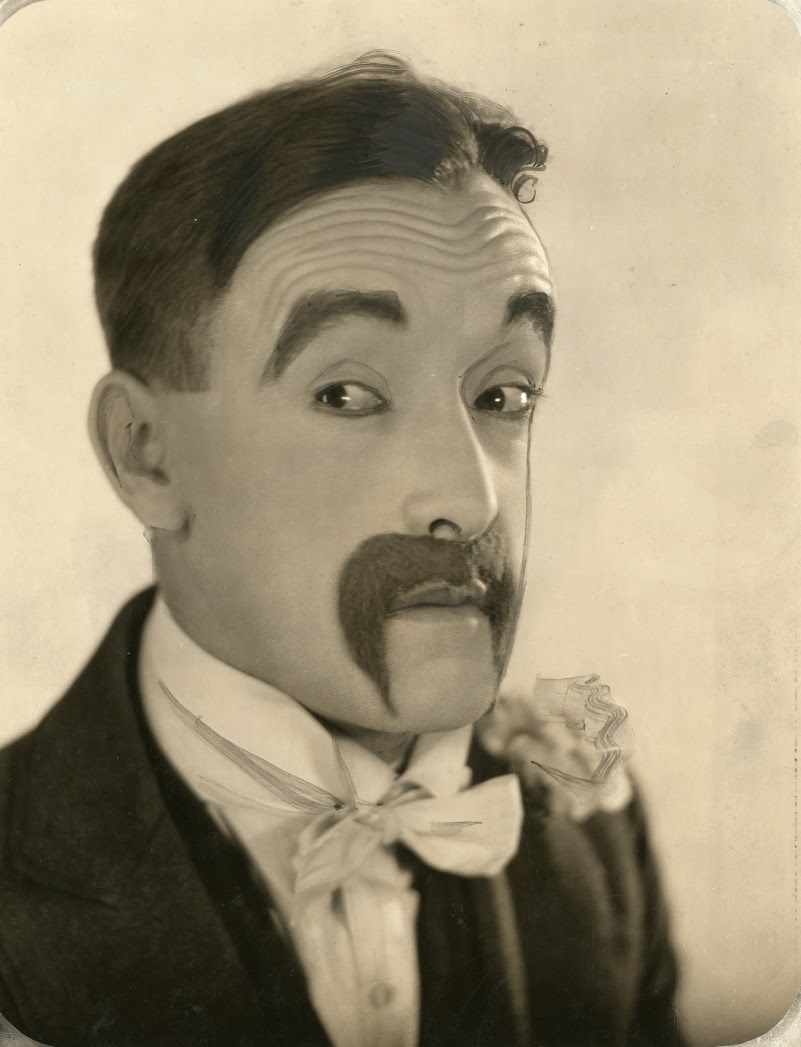
13. Snub Pollard—beginning his film career as one of the Keystone Kops, he made his name as a supporting player in the Hal Roach stable, playing the little guy with a droopy moustache in the early Harold Lloyd comedies, then later in Laurel and Hardy's silent shorts. In the sound era, he wound up playing Tex Ritter's sidekick Pee Wee in a series of Westerns.
12. Jackie Coogan—he really only served up one great performance in his career, but what a performance, as the foundling child in Charlie Chaplin's first feature film, The Kid. Grew up to play Uncle Fester on television's The Addams Family.
11. Marcel Lévesque—the rubber-faced comic relief in two of Louis Feuillade's greatest serials, Les Vampire and Judex. A great ham.
10. Rudolf Klein-Rogge—best known for his supporting work as the Inventor in Fritz Lang's dystopian sci-fi classic Metropolis, he was Lang's go-to bad guy, starring in the Mabuse films.
9.Eric Campbell—Chaplin's comic foil in eleven of the twelve Mutual films, including the two best shorts of Chaplin's career, Easy Street and The Immigrant. At 6' 5" and 300 pounds, he loomed over the diminutive Chaplin, giving the Tramp something solid to fight against. He died in an automobile accident in 1917.
8.Ernest Torrence—he played everything from St. Peter (The King of Kings) to Buster Keaton's father (Steamboat Bill, Jr.), and appeared in The Hunchback of Notre Dame, Clara Bow's Mantrap and John Gilbert's last silent film, Desert Nights.
7. Jean Hersholt—known for his pivotal role in Erich von Stroheim's Greed, he also excelled in the Ernst Lubitsch comedy, The Student Prince in Old Heidelberg, and later during the sound era as the grandfather in Shirley Temple's Heidi.
6.Donald Crisp—he won an Oscar for How Green Was My Valley, but to me, his best work was during the silent era, as Lillian Gish's viciously cruel father in Broken Blossoms and as Douglas Fairbanks's swashbuckling ally in The Black Pirate.
5.Sam De Grasse—best known for his work in the films of Douglas Fairbanks, he typically played a heavy, but with refreshing restraint and subtlety.
4. Al St. John—probably the best comic actor of the silent era who was never really a star in his own right, he worked with Roscoe Arbuckle, Buster Keaton, Charlie Chaplin, Mabel Normand, then during the sound era as the codger sidekick in B-Westerns starring the likes of Buster Crabbe, Lash La Rue and some guy named John Wayne.
3. Conrad Veidt—you know him as Major Strasser in Casablanca, but Veidt was at his best during the silent era, starting small with such classics as The Cabinet of Dr. Caligari and Waxworks, eventually starring in The Man Who Laughs, a film that inspired the character of the Joker in the Batman comics.
2. Theodore Roberts—a twinkly-eyed ham who made sinning look like so much fun in Cecil B. DeMille's sex comedies, yet he was equally convincing as the heavy in Joan the Woman and as Moses in The Ten Commandments. A stage actor who made his debut in 1880, he made 23 films with DeMille and appeared in 103 altogether.
1. Gustav von Seyffertitz—possibly the only actor to ever upstage the legendary Mary Pickford, his performance as the evil "baby farmer" in Sparrows ranks as one of the great fiends of the silent era. Mostly playing slippery, sly villains, he worked with everybody—DeMille, Barrymore, Garbo, Fairbanks, Valentino, Dietrich, von Sternberg, Marion Davies, Wallace Reid and, of course, Pickford—carving out a long career as the man you love to hate.
Tomorrow: My Favorite Character Actresses of the Silent Era.
This is my contribution to the Summer Under The Stars Blogathon underway at Sittin' on a Backyard Fence. For those of you in the United States, you can see Broken Blossoms on Turner Classic Movies tomorrow morning, August 15, 2012, at 6 a.m. You can see two other Gish films mentioned in this post, Orphans of the Storm and Intolerance at 7:45 a.m. and 8 pm, respectively. A good day to set your DVRs. Or just skip work entirely.
 I've written about silent film director D.W. Griffith many times, both to praise him and to bury him, but I've been steadfast in my insistence that, love him or hate him, he was the most influential director of the silent era. "[W]hereas other directors simply parroted the techniques that worked on stage," I have written, "and wound up with actors in togas milling around in front of painted backdrops, Griffith seemed to understand from the outset that film presented its own unique set of problems and opportunities. By composing his actors within the frame, by relying on revealing actions rather than words and, especially, by juxtaposing images and events through editing, Griffith was able to create within his audience an emotional involvement in his stories."
In effect, Griffith invented a film "language" and in the process created what we today think of as the modern movie, a contribution to film history as important as the invention of the camera itself.
 If you're only going to see one D.W. Griffith movie in your life, Broken Blossoms starring Lillian Gish, Richard Barthelmess and Donald Crisp is the one to see. The Birth of a Nation is more (in)famous, Intolerance was more ambitious, and the nearly 500 shorts he made for Biograph between 1908 and 1913 were more influential. But in terms of a film that is moving, well-acted and accessible, that features all of Griffith's strengths without also suffering from his weaknesses, and let's be honest, that clocks in at a reasonable 88 minutes instead of 3-plus hours, Broken Blossoms is the only choice.
Not only was Broken Blossoms the best picture of 1919, it was arguably the best silent movie made in film's first three decades.
If you're familiar with Griffith's work, you know he often painted on large canvases, tackling entire historical eras on sets the size of small cities. But if Intolerance was Griffith's Sistine Chapel, Broken Blossoms is as small and intimate as a portrait by Vermeer.
 Based on Limehouse Nights, a collection of short stories by Thomas Burke set in the slums of London, Broken Blossoms is the story of Cheng Huan, a Chinese immigrant with naive dreams of teaching Buddha's philosophy of peace to those "sons of turmoil and strife," the barbarous Anglo-Saxons of England. "It is a tale of temple bells," says the opening title card, "sounding at sunset before the image of Buddha; it is a tale of love and lovers; it is a tale of tears."
If you've never seen a silent movie, particularly one from film's earliest days, Griffith's skill at introducing Cheng to his audience might escape your attention. Griffith's legacy is so ubiquitous, we don't even notice it anymore, but if you've ever seen a movie or a television show, you've seen Griffith's style. First he establishes the mise-en-scène—an establishing shot of a Chinese treaty port, cutting to a closer shot of a particular part of town, then even closer to a single street, followed by near documentary shots of people on the street—a traveling shot of three girls, shots of a father with his children, including an over-the-shoulder shot of their reaction to his kindness, then a cut to "sky-larking American sailors."
 The entire sequence takes a little more than ninety seconds, but with no more than the corner of a small set, and by my count some twenty extras, Griffith created the sense of a bustling foreign port town, both culturally diverse and completely alien to an American audience in 1919. Is it an important sequence? Only in the sense that it grounds the narrative in a reality that establishes the world Cheng moves in before we've even met him, a technique Griffith had invented while at Biograph and perfected in such films as The Birth of a Nation and Intolerance.
Now go and look at the beginning of a movie as great as, say, Casablanca, or a television show as mundane as C.S.I., and see what I mean about how Griffith's approach to storytelling is ubiquitous.
 Cheng is played by Richard Barthelmess, who was in the process of replacing Robert Harron as Griffith's go-to actor (just as Harron had replaced Henry Walthall). It may be a bit jarring for a modern audience to see Barthelmess, a white actor, in Asian makeup (actually just a rubber band around his forehead stretching his features tight across his skull) and perhaps it's a pity that Griffith didn't cast Sessue Hayakawa in the role, but I'll say two things in Griffith's defense and let it drop: 1) it was common practice in Hollywood for Caucasian actors, from Warner Oland to Paul Muni to (God help us) Mickey Rooney, to play Asians well into the 1960s, and 2) Richard Barthelmess gives the best performance of his career in this movie.
 Equally jarring, the film refers to Cheng as "the Yellow Man" throughout. But before your head explodes, let me point out that the term "Yellow Man" is used here both purposefully and ironically. As the film was being filmed, the United States was once again experiencing one of its periodic bouts of anti-immigrant xenophobia, this time directed at Asian-Americans, which the Hearst newspaper chain had dubbed "the Yellow Peril" and "the Yellow Terror." That Cheng, a modern-day Good Samaritan, turns out to be the film's most sympathetic and heroic character is a direct challenge to the prejudices of Griffith's audience. By using the racist term "Yellow Man" here, Griffith has set up his audience to do an about-face by the picture's end. Whether the device works or not, or is justified, is up to you, but be aware that it is a conscious artist choice.
Gish said later of Griffith, "He inspired in us his belief that we were working in a medium that was powerful enough to influence the whole world."
Cheng's mission to convert the heathen white man is preternaturally gentle, hopelessly naive, or both, and with a fade and an intertitle, Griffith leaps forward several years to the Limehouse District of London where Cheng is known only as a "Chink storekeeper." He's thinner, his back bent, his step slower, old now if not in years, then in spirit. The shot of Barthelemess standing against a wall with his head bowed, leg bent and arms wrapped around himself tells you everything you need to know about the intervening years—indeed, not only tells you what you need to know, but makes you feel it as well.
 It's a masterful shot that eliminates the need for a half-hour's worth of exposition, and when in subsequent posts I complain of Abel Gance's and Erich von Stroheim's inability to get to the point by showing a single telling detail, this is the sort of simple sequence to which I'm referring.
 Having established Cheng, Griffith then introduces us to Battling Burrows and his daughter Lucy, played by, respectively, future Oscar-winner Donald Crisp and Griffith's favorite actress, Lillian Gish. Burrows is a prizefighter, a drunk, a preening ape with a cauliflower ear, and a father so cruel to his illegitimate daughter that the critic for Variety threw up at a private preview of the film.
Nobody in Hollywood history has ever been better at playing pain and suffering than Gish, and here at last is a role that cuts right to the chase with no pretensions that she represented the flower of Victorian womanhood. No plucky Mary Pickford lass is she. Gish is a whipped dog, the very pantomime of defeat, working as a virtual slave to an abusive drunk who threatens her with the lash if she doesn't keep up a happy front, leading to perhaps the defining shot of Gish's great career—using her fingers to push the corners of her mouth into a grotesque, desperate approximation of a smile.
 A later scene where Burrows breaks down the door of a closet where Gish's Lucy is hiding was so harrowing that during its filming one passerby called in the police. "My God," Griffith told Gish afterwards, "why didn't you warn me you were going to do that."
"The case could be made," wrote Matthew Kennedy for Bright Lights Film Journal, "for Gish's character as the most pitiable creature the movies have ever seen." According to Felicia Feaster writing for TCM, "one critic of the day cheekily proposed a Society for the Prevention of Cruelty to Lillian Gish."
 The scene where she sits on a dock by the river, her knee bent, her shawl pulled around her narrow shoulders, echoes the one of Barthelemess resting against a wall, again not only short-circuiting the need for more exposition, but also linking the two characters in the viewer's mind before they have even met.
And meet they finally do. After Burrows beats her nearly to death, she stumbles through the streets of Limehouse until she reaches Cheng's doorstep. When he helps her, it is perhaps the first hint of kindness she's ever experienced—and responds with a genuine smile that touches Cheng's lonely heart. But a victim to the end, Lucy's hard-earned fear of men and her deeply-ingrained racism prevent her from fully embracing her salvation.
Those used to the epic scale and complex editing strategies of Griffith's best-known works will no doubt be surprised by the simplicity and delicacy of this chaste, tragic romance. The entire film takes place on a handful of modest sets with three main characters and as many supporting ones, yet the effect is deeper and more satisfying, at least to me, than anything else Griffith ever attempted. It's a virtuoso effort all the way around, with career turns by Barthelmess, Gish and Crisp, and the confident direction of a consummate artist.
 Griffith directed Broken Blossoms for Adolph Zukor at Paramount Pictures, but Zukor— who made a similar mistake with Mary Pickford—was appalled at what he saw and refused to release it. The story goes that an enraged Griffith returned the next day with $250,000 in cash and bought the film back on the spot. Thus, it became the first release through the newly-formed United Artists and fortunately for Griffith, it was both a critical and commercial success.
 Of the four main participants in Broken Blossoms, Lillian Gish went on the greatest success. After stellar performances in Way Down East and Orphans of the Storm, she left Griffith's employ, eventually landing at MGM where she signed a contract to make six pictures at $400,000 a year and with complete control over choice of cast, director and screenplay. While there, she made some of her best pictures, La Boheme, The Scarlet Letter and The Wind.
After the advent of sound pictures, Gish turned to radio and the stage, but eventually returned to Hollywood, earning an Oscar nomination for her supporting role in Duel in the Sun (1946). These days she may be best known as the shotgun-toting granny in the noir classic The Night of the Hunter. She received an honorary Oscar in 1971 "[f]or superlative artistry and for distinguished contribution to the progress of motion pictures." She died in 1993 at the age of 99.
 Donald Crisp went on to success not only as an actor but as a director as well, including co-directing the classic Buster Keaton comedy, The Navigator (in fact, his scenes in Broken Blossoms were filmed at night because he was directing a film of his own during the day). He worked steadily until his retirement in 1963, appearing in such films as Mutiny on the Bounty, Jezebel, Wuthering Heights, The Sea Hawk, National Velvet and Pollyanna. In 1942, he won the Oscar for his supporting performance in How Green Was My Valley.
 Richard Barthelmess proved to be one of the most popular actors during the silent era and for anyone looking to see him at his best, look not only at Broken Blossoms, but also at such films as Way Down East (1920) and The Enchanted Cottage (1924). In 1921, Barthelmess formed his own production company where he made one of his best received and remembered films, Tol'able David. Later he became one of the 36 founding members of the Academy of Motion Picture Arts and Sciences, and was nominated for the first Oscar for best actor (losing to Emil Jannings). His career went into a gradual decline during the sound era—maybe his best known sound role was as a pilot married to Rita Hayworth in Howard Hawks's Only Angels Have Wings—but he continued to work until 1942 when he joined the Navy Reserve. After the war, he lived comfortably on his real estate investments and died in 1963.
As for Griffith, I'm of the opinion that Broken Blossoms was his last completely-unqualified masterpiece. The bucolic fantasies and Victorian morality plays that would follow were wildly out-of-step with the tastes of audiences recently bathed in the blood of the Great War. The best of his remaining films, Way Down East and Orphans of the Storm, feature terrific performances (and in the case of the former, a concluding action sequence where Richard Barthelmess races across a disintegrating ice floe to rescue Lillian Gish just before she plunges over a waterfall—real ice, real waterfall, and two stars who were nearly killed), but the one is marred by heaps of cornpone humor, while the other, an epic retelling of the French Revolution, features some history lessons that, frankly, border on the ludicrous, even by Griffith's outlandish standards.
 "Griffith in 1919," wrote Roger Ebert in his Great Movie series, "was the unchallenged king of serious American movies (only C.B. DeMille rivaled him in fame), and Broken Blossoms was seen as brave and controversial. What remains today is the artistry of the production, the ethereal quality of Lillian Gish, the broad appeal of the melodrama ... [a]nd its social impact. Films like this, naive as they seem today, helped nudge a xenophobic nation toward racial tolerance."








 Posts
Posts

