

Today is a list of my favorite character actors from the silent era, tomorrow a similar list of silent era actresses, and on the blogathon's final day, silent supporting players who were better in the sound era.
For today's list, I've bypassed actors such as Sessue Hayakawa, William Powell and Wallace Beery who did a lot of supporting work but were also lead actors in their own right, and stuck strictly with the supporting players. (Powell and Beery will show up Monday.)
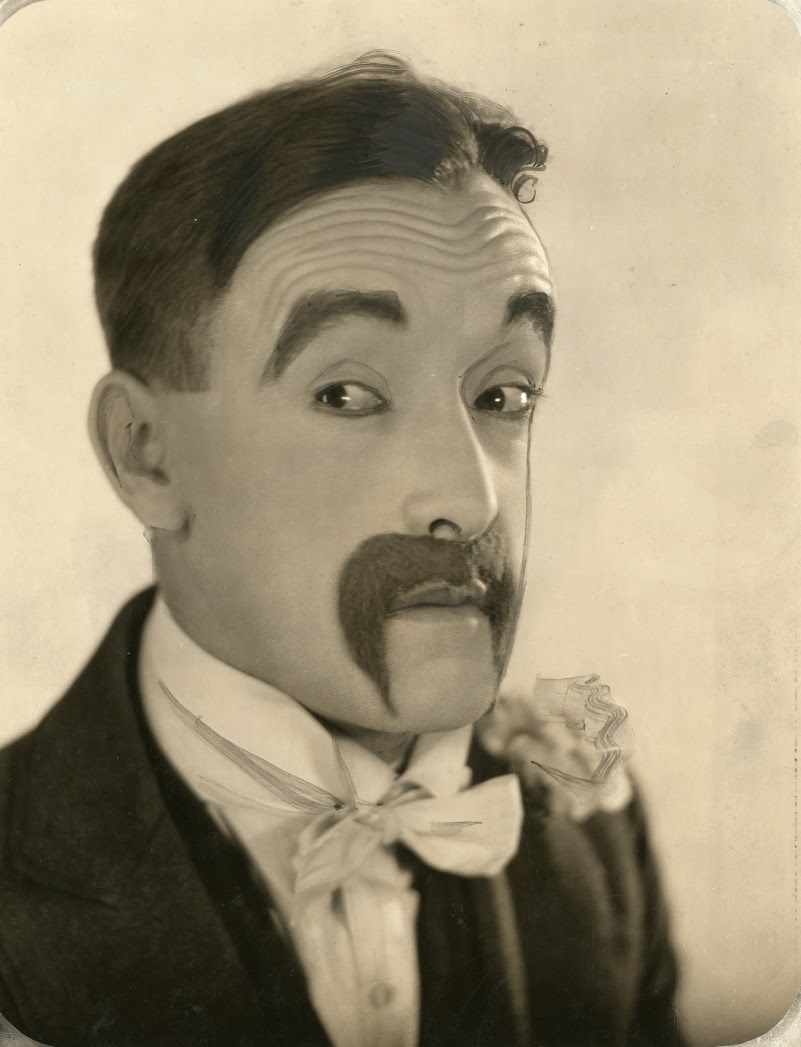
13. Snub Pollard—beginning his film career as one of the Keystone Kops, he made his name as a supporting player in the Hal Roach stable, playing the little guy with a droopy moustache in the early Harold Lloyd comedies, then later in Laurel and Hardy's silent shorts. In the sound era, he wound up playing Tex Ritter's sidekick Pee Wee in a series of Westerns.
12. Jackie Coogan—he really only served up one great performance in his career, but what a performance, as the foundling child in Charlie Chaplin's first feature film, The Kid. Grew up to play Uncle Fester on television's The Addams Family.

11. Marcel Lévesque—the rubber-faced comic relief in two of Louis Feuillade's greatest serials, Les Vampire and Judex. A great ham.

10. Rudolf Klein-Rogge—best known for his supporting work as the Inventor in Fritz Lang's dystopian sci-fi classic Metropolis, he was Lang's go-to bad guy, starring in the Mabuse films.

9.Eric Campbell—Chaplin's comic foil in eleven of the twelve Mutual films, including the two best shorts of Chaplin's career, Easy Street and The Immigrant. At 6' 5" and 300 pounds, he loomed over the diminutive Chaplin, giving the Tramp something solid to fight against. He died in an automobile accident in 1917.

8.Ernest Torrence—he played everything from St. Peter (The King of Kings) to Buster Keaton's father (Steamboat Bill, Jr.), and appeared in The Hunchback of Notre Dame, Clara Bow's Mantrap and John Gilbert's last silent film, Desert Nights.

7. Jean Hersholt—known for his pivotal role in Erich von Stroheim's Greed, he also excelled in the Ernst Lubitsch comedy, The Student Prince in Old Heidelberg, and later during the sound era as the grandfather in Shirley Temple's Heidi.

6.Donald Crisp—he won an Oscar for How Green Was My Valley, but to me, his best work was during the silent era, as Lillian Gish's viciously cruel father in Broken Blossoms and as Douglas Fairbanks's swashbuckling ally in The Black Pirate.

5.Sam De Grasse—best known for his work in the films of Douglas Fairbanks, he typically played a heavy, but with refreshing restraint and subtlety.

4. Al St. John—probably the best comic actor of the silent era who was never really a star in his own right, he worked with Roscoe Arbuckle, Buster Keaton, Charlie Chaplin, Mabel Normand, then during the sound era as the codger sidekick in B-Westerns starring the likes of Buster Crabbe, Lash La Rue and some guy named John Wayne.

3. Conrad Veidt—you know him as Major Strasser in Casablanca, but Veidt was at his best during the silent era, starting small with such classics as The Cabinet of Dr. Caligari and Waxworks, eventually starring in The Man Who Laughs, a film that inspired the character of the Joker in the Batman comics.

2. Theodore Roberts—a twinkly-eyed ham who made sinning look like so much fun in Cecil B. DeMille's sex comedies, yet he was equally convincing as the heavy in Joan the Woman and as Moses in The Ten Commandments. A stage actor who made his debut in 1880, he made 23 films with DeMille and appeared in 103 altogether.

1. Gustav von Seyffertitz—possibly the only actor to ever upstage the legendary Mary Pickford, his performance as the evil "baby farmer" in Sparrows ranks as one of the great fiends of the silent era. Mostly playing slippery, sly villains, he worked with everybody—DeMille, Barrymore, Garbo, Fairbanks, Valentino, Dietrich, von Sternberg, Marion Davies, Wallace Reid and, of course, Pickford—carving out a long career as the man you love to hate.

Tomorrow: My Favorite Character Actresses of the Silent Era.






 Posts
Posts

