Today is a list of my favorite character actors from the silent era, tomorrow a similar list of silent era actresses, and on the blogathon's final day, silent supporting players who were better in the sound era.
For today's list, I've bypassed actors such as Sessue Hayakawa, William Powell and Wallace Beery who did a lot of supporting work but were also lead actors in their own right, and stuck strictly with the supporting players. (Powell and Beery will show up Monday.)
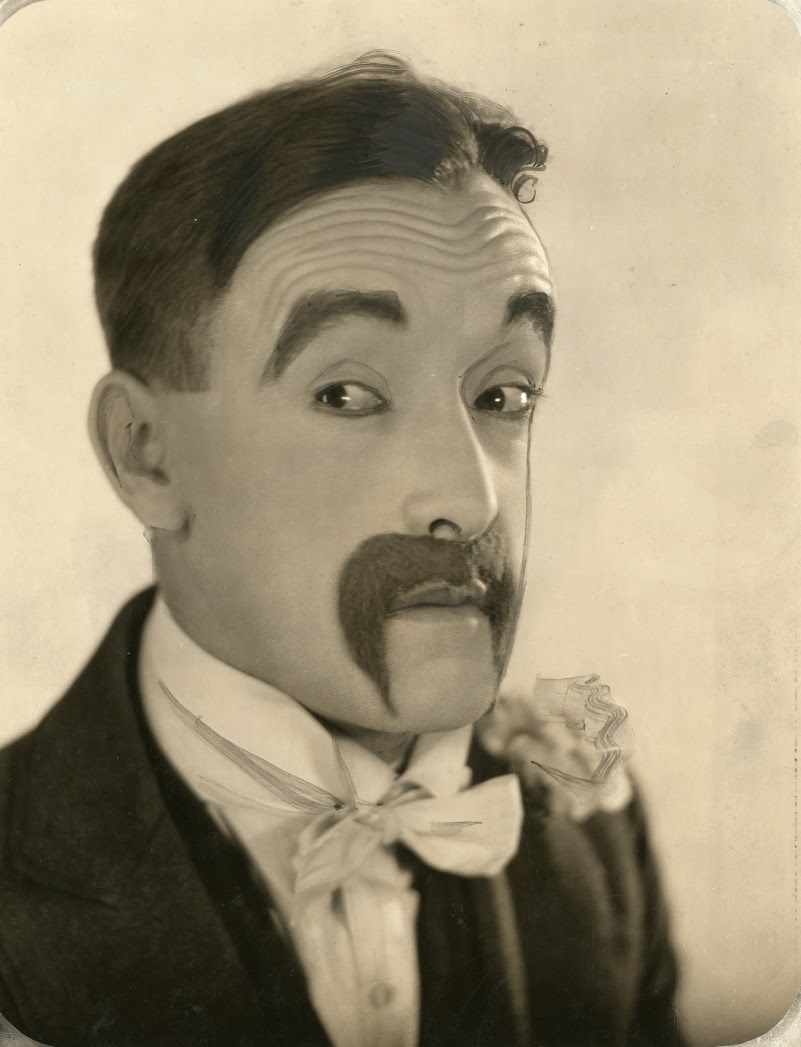
13. Snub Pollard—beginning his film career as one of the Keystone Kops, he made his name as a supporting player in the Hal Roach stable, playing the little guy with a droopy moustache in the early Harold Lloyd comedies, then later in Laurel and Hardy's silent shorts. In the sound era, he wound up playing Tex Ritter's sidekick Pee Wee in a series of Westerns.
12. Jackie Coogan—he really only served up one great performance in his career, but what a performance, as the foundling child in Charlie Chaplin's first feature film, The Kid. Grew up to play Uncle Fester on television's The Addams Family.
11. Marcel Lévesque—the rubber-faced comic relief in two of Louis Feuillade's greatest serials, Les Vampire and Judex. A great ham.
10. Rudolf Klein-Rogge—best known for his supporting work as the Inventor in Fritz Lang's dystopian sci-fi classic Metropolis, he was Lang's go-to bad guy, starring in the Mabuse films.
9.Eric Campbell—Chaplin's comic foil in eleven of the twelve Mutual films, including the two best shorts of Chaplin's career, Easy Street and The Immigrant. At 6' 5" and 300 pounds, he loomed over the diminutive Chaplin, giving the Tramp something solid to fight against. He died in an automobile accident in 1917.
8.Ernest Torrence—he played everything from St. Peter (The King of Kings) to Buster Keaton's father (Steamboat Bill, Jr.), and appeared in The Hunchback of Notre Dame, Clara Bow's Mantrap and John Gilbert's last silent film, Desert Nights.
7. Jean Hersholt—known for his pivotal role in Erich von Stroheim's Greed, he also excelled in the Ernst Lubitsch comedy, The Student Prince in Old Heidelberg, and later during the sound era as the grandfather in Shirley Temple's Heidi.
6.Donald Crisp—he won an Oscar for How Green Was My Valley, but to me, his best work was during the silent era, as Lillian Gish's viciously cruel father in Broken Blossoms and as Douglas Fairbanks's swashbuckling ally in The Black Pirate.
5.Sam De Grasse—best known for his work in the films of Douglas Fairbanks, he typically played a heavy, but with refreshing restraint and subtlety.
4. Al St. John—probably the best comic actor of the silent era who was never really a star in his own right, he worked with Roscoe Arbuckle, Buster Keaton, Charlie Chaplin, Mabel Normand, then during the sound era as the codger sidekick in B-Westerns starring the likes of Buster Crabbe, Lash La Rue and some guy named John Wayne.
3. Conrad Veidt—you know him as Major Strasser in Casablanca, but Veidt was at his best during the silent era, starting small with such classics as The Cabinet of Dr. Caligari and Waxworks, eventually starring in The Man Who Laughs, a film that inspired the character of the Joker in the Batman comics.
2. Theodore Roberts—a twinkly-eyed ham who made sinning look like so much fun in Cecil B. DeMille's sex comedies, yet he was equally convincing as the heavy in Joan the Woman and as Moses in The Ten Commandments. A stage actor who made his debut in 1880, he made 23 films with DeMille and appeared in 103 altogether.
1. Gustav von Seyffertitz—possibly the only actor to ever upstage the legendary Mary Pickford, his performance as the evil "baby farmer" in Sparrows ranks as one of the great fiends of the silent era. Mostly playing slippery, sly villains, he worked with everybody—DeMille, Barrymore, Garbo, Fairbanks, Valentino, Dietrich, von Sternberg, Marion Davies, Wallace Reid and, of course, Pickford—carving out a long career as the man you love to hate.
Tomorrow: My Favorite Character Actresses of the Silent Era.
As has been the case with nearly every technical innovation in the visual arts since the first man painted pictures on a cave wall, sex proved to be a key selling point in the marketing of the new motion picture technology to curious audiences. In 1896, just six years after Thomas Edison began his experiments with film, William Heise recorded May Irwin and John C. Rice recreating the kiss from their Broadway hit, The Widow Jones.
The resulting twenty second clip—called, appropriately enough, The Kiss—was the first such act ever recorded on film. The moralizing classes reacted with outraged spluttering; the paying public made it Edison's top grossing film of the year.
Other filmmakers quickly scrambled to sell their own take on this most important of human endeavors, as the resulting efforts serve as something of a Rorschach test for directors, writers, actors and the audiences themselves. Georges Méliès, for example, chose to titillate his audiences with suggestions of nudity. Russian, Italian, Swedish and Dutch directors offered up sex as a source of tragedy and misery. America's greatest director, D.W. Griffith, moralized, while his comic counterpart, Mack Sennett, guffawed. That Theda Bara—whose name was famously billed as an anagram of "Arab Death"—wound up representing both the allure and the danger of sex in the late 1910s tells you all you need to know about the state of the American psyche during the first world war.
But sex as something adults engage in without shame or embarrassment—well, not so much. We tend to assume, when think of it at all, that sophisticated sex in the cinema must have been the invention of Ernst Lubitsch. And while it's true Lubitsch was a master of the light touch when it came to the subject, he didn't really acquire that touch until 1924, with The Marriage Circle. Before that, he tended toward heavy costume dramas and broad farces.
Instead, the sophisticated sex movie was a creation from the most unlikely of sources—cinema's most famous purveyor of Bible epics and historical dramas, Cecil Blount DeMille.
Some of my readers—those reared on The Ten Commandments and The Greatest Show On Earth—might guffaw to read his name in the same sentence with "sophisticated" and "sex," but the fact is, beginning in 1918 with Old Wives For New, DeMille reeled off a series of "nervously brilliant, intimate melodramas" and "sly marital comedies" (Scott Eyman, Empire of Dreams) centering on the notion that grown ups engage in sexual relations and are glad that they do.
The son of a playwright and an acting teacher, DeMille began acting in New York at the age of nineteen and in little more than a decade became a successful Broadway director and producer. He also wrote several one-act operettas for producer Jesse L. Lasky and it was this association that led him into motion pictures. Lasky aspired to combine what he saw as the "high art" of theater with the money-making potential of mass-produced movies, and with the reluctant financial backing of his brother-in-law, Samuel Goldfish (later Goldwyn), Lasky teamed up with DeMille to found the Jesse L. Lasky Feature Film Company.
It was a grandiose gesture considering that neither man had ever made so much as a one-reel short before, but the two set off for the western United States to film a feature-length version of The Squaw Man, a popular stage play of the era. The two stopped first in Flagstaff, Arizona, but DeMille pictured wide open spaces rather than mountains for the wild west storyline, so they continued west until they settled in a sleepy village north of Los Angeles called "Hollywood."
Legend has it that they set up shop in a barn, but legend neglects to mention that L.L. Burns and Harry Reiver, a couple of established filmmakers with American Gaumont, had converted the barn into a studio nine months earlier. No matter. The Squaw Man was the first feature film ever made in Hollywood, and when it grossed $244,000 on an investment of $15,000, DeMille's future was assured.
Although DeMille's education as a film director consisted of a day spent at the Edison studios to see how the cameras worked, and watching Oscar Apfel "co"-direct The Squaw Man, he quickly demonstrated a grasp of the film medium superior to all but a few of his peers. In his biography Cecil B. DeMille's Hollywood, Robert S. Birchard notes that within a half-dozen movies of his first one, DeMille had moved the camera closer to his actors, "showing a greater reliance on personality and subtlety of performance," had picked up the pace of both individual scenes and his films as a whole, and, by using light and shadow in a groundbreaking way to accent (or obscure) aspects of the production, "set a much-imitated standard for visual excellence."
In all, DeMille directed thirty-seven movies between 1914 and early 1918, dipping into a variety of genres including Westerns, costume dramas and even a pair of Mary Pickford movies. The best of these early films was The Cheat, made in 1915 and featuring Sessue Hayakawa in a star-making role as an unscrupulous businessman who barters money for sex from a spoiled housewife and then brands her with an iron when she reneges on the deal.
As Simon Louvish notes in his biography Cecil B. DeMille: A Life in Art, The Cheat "electrified audiences, who were not accustomed to this degree of emotion in a tale dealing with rampant sexual desire ...."
These early films demonstrated DeMille's interest in melodrama, spectacle and lurid romance, which perhaps explains his interest in the subject of his thirty-eighth film, a popular novel called Old Wives For New (available free online here). Business partner Jesse Lasky pushed this story of a marriage that disintegrates in boredom, adultery and divorce to get DeMille "away from the spectacle stuff for one or two pictures and try to do modern stories of great human interest."
And since Lasky was the one footing the bill, DeMille chose to follow his advice. The studio bought the film rights for $6,500.
Although the novel's author, David Graham Phillips, was a pretty interesting character in his own right—a muckraking journalist who exposed the nexus between corporate money and the U.S. Senate, he was murdered by a man who believed Phillips had libeled his family—the novel itself was 495 pages of "clover" and "heaving bosoms," turning a tale that included adultery, murder, blackmail and skullduggery into something earnest and flowery and dull.
To adapt the novel, DeMille turned to his favorite writer—and favorite mistress—Jeanie Macpherson. During their long sexual and professional relationship, MacPherson worked on forty screenplays for DeMille, including such silent classics as The Cheat, Joan the Woman, Male and Female, The Affairs of Anatol, The Ten Commandments and The King of Kings.
To condense the sprawling tale, Macpherson reduced an episodic narrative spread out over decades into three tight acts with a single flashback to explain how the bored husband had ever fallen for his plump, drab, dowdy wife in the first place. She also added witty intertitles that transformed the melodrama into a sharp satire of upper-class manners.
As the film begins, oil baron Charles Murdock (Elliott Dexter) is on the verge of what we now call a mid-life crisis. While he's respected as a "genius" in the world of business, at home he's little more than a cipher—a human ATM machine to his kids, a nursemaid to his hypochondriac wife. He sits alone in his study, dejected, depressed, with only his dog for companionship.
Next, DeMille introduces us in shotgun fashion to the five supporting characters who will combine to remake Murdock's life—Sylvia Ashton as his not-so-pleasingly plump wife; Marcia Manon as a "painted lady;" Florence Vidor as Juliette Raeburn, a successful New York dressmaker, who, according to the intertitles, "was finally to cut the thread of his fate;" and two of the finest character actors of the silent era, Gustav von Seyffertitz as his "crafty" secretary; and Theodore Roberts as Murdock's dissolute business partner.
In each of these vignettes, DeMille shows a close-up of the character's hands—the wife picking through bon bons, the courtesan reaching for rouge—as if to say that a person is what he does not what he says, and no matter what he believes about himself or wants you to believe about him, his actions will always reveal his true character.
After following Murdock through his frustrating morning routine, DeMille treats us to the most cleverly edited sequence of the film, a flashback to Murdock's initial courtship of his wife that cuts back and forth between the young couple and his present-day wife bursting in on her husband's reverie, as if she's catching them in flagrante delicto—a remarkable show of faith on DeMille's part that, even though the classical Hollywood "style" had only become the industry standard the year before, his audience would understand what's going on.
Similarly, DeMille later uses lap dissolves and iris-shots-within-iris-shots to convey the content of Murdock's daydreams, trusting his audience to understand what he saying without spelling it out in clumsy intertitles or belabored scenes, a testament both to how quickly film had progressed in five years and how cutting edge DeMille really was. As a result, he's able to maintain a sprightly pace—and sweep past some of the story's more improbable twists.
Technical innovations aside, though, it was the substance of Old Wives For New that made the film so groundbreaking.
The married Murdock meets Juliette, fools her into believing he's a much younger—and unattached—man, and falls in love with her. Attempting to drown both the memory of Juliette and the misery of his domestic situation, Murdock follows his business partner into the champagne-soaked fleshpots of New York City, an excursion that leads to murder, scandal and divorce (a sequence of events that must have reminded audiences in 1918 of Stanford White's murder during a musical revue on the roof of Madison Square Garden).
In turning this set-up into a happy ending, DeMille essentially made a pre-Code film before there was a Code to subvert, dispensing with karma and moral judgment, and putting the fun back into sex, sin and every kind of bad behavior. People drink, lie, carouse and generally defy social mores, and not only suffer no consequences, they prosper. Murder goes unpunished, adultery is rewarded and divorce is presented as a sane and sophisticated solution to an unhappy marriage.
"In scene after scene," Birchard wrote, "Old Wives for New must have been startling for 1918 audiences." Photoplay condemned the film's "disgusting debauchery" and clucked that "Cecil B. DeMille, director, seemed to revel in the most immoral episodes."
Adolph Zukor was so shocked by the film's suggestion that divorce might be the appropriate end for some marriages that he held up its distribution, only relenting after positive reactions during audience testing.
Old Wives For New premiered on May 19, 1918, and Photoplay's sputtering outrage aside, the reviews were generally positive. "There are somewhat risqué situations in the story," The Motion Picture News wrote, "but these have been handled delicately. It is not a story that children will understand, and it is one that the prudes will consider a reflection on themselves. All in all, it is one of the most satisfactory pictures that has been shown on Broadway in months."
Variety praised DeMille's direction as "expert."
Financially, the picture did well, grossing nearly $300,000 on a budget of $66,000, but its impact on the culture was even greater, ushering in an era of adult-themed movies, including not only DeMille's own risque classics Male and Female and The Affairs of Anatol (adding Gloria Swanson to the mix), but also Chaplin's A Woman of Paris, Murnau's Sunrise and pretty much Lubitsch's entire oeuvre.
"Those who find it fashionable to denigrate [DeMille]," wrote Gene Ringgold and DeWitt Boden in The Films of Cecil B. DeMille, "ignore the high regard in which his work as a director was held by critics and film historians during those first years ... Among directors, only his name and those of D.W. Griffith and Alfred Hitchcock were really sufficient in themselves to attract top box-office trade."
Maybe in the long run, DeMille's primary contribution was in figuring out how to sell sex to American audiences that were both curious and squeamish. Here, he hit it directly; later he dressed it up in historical and Biblical epics that allowed his audiences to piously condemned the sin while lingering over every salacious detail. He let the public have its cake and eat it too, and was rewarded with forty-two years of unbroken commercial success—one of the longest and most profitable careers in Hollywood history.
His kind of films long ago went out of fashion, but don't kid yourself: DeMille was as instrumental during the silent era as Griffith and Chaplin in selling the habit of movie-going to American audiences, no small accomplishment.
It's quite possible that the best sup- porting per- formance of the year was turned in not by my choice (who I will not reveal just yet) but by Lewis Stone, remembered now mostly for his recurring role as Judge Hardy in the Andy Hardy movie series (or perhaps for speaking the famous final line of Grand Hotel: "People come, people go. Nothing ever happens.").
But Stone was also a very fine character actor and he received his only Oscar nomination in 1928-29 for his performance in the Ernst Lubitsch movie The Patriot. For contemporary accounts, Stone's role was probably more of a supporting one (the Oscars didn't distinguish between lead and supporting performances back then) and if it's as good as people eighty years ago thought it was, he'd be a very good choice for the Katie Award for best supporting actor.
Unfortunately, like many silent films, The Patriot long ago vanished, leaving only a few fragments and it's impossible to tell from the trailer I've posted here, which focuses on the lead actor, Emil Jannings, what Lewis Stone did that so enchanted audiences and critics alike.
Jannings, as you may recall, won the first Oscar for acting but in this trailer at least, he serves up more ham in three minutes than you'd find in one of those two pound sandwiches at the Carnegie Deli. As for Stone, except for a single mention, the trailer ignores him completely.
And while you might be okay with giving an award for a performance you have never and will never see, Katie-Bar-The-Door doesn't put up with that sort of nonsense and I answer to her, not to you. So I had to pass on Stone and The Patriot.
I gave serious thought to shoe-horning Lewis Stone into the award for his supporting performance in A Woman Of Affairs, the third movie pairing of Greta Garbo and John Gilbert, and the first of seven movies Stone made with Garbo. Stone was quite good in the thankless role of the family doctor and friend who stands around being wise while everyone behaves like a jackass, good enough to earn at least a nomination.
But in the end, the preposterous nature of the story, about a woman who destroys herself and everyone around her to protect the reputation of a man hardly worth protecting, undermines Stone's effort, leaving him hanging, as they say, like an elephant on a clothesline.
Stone starred in another Garbo movie in 1929, Wild Orchids, in which he plays a cuckolded husband who gets his revenge while on a tiger hunt with a Javanese prince. The New York Times called his performance "splendid," others have called it "solid," but quite frankly the story is even dumber than the one in A Woman Of Affairs (and I like Garbo). So a nomination for Stone, admiration for a long career that covered nearly forty years and a hundred and fifty movies, but no Katie.
Also missing in action, thanks to Hollywood's shoddy treatment of its own past, is Reginald Owen in The Letter. Readers of my generation may remember Owen best as Admiral Boom in 1964's Mary Poppins, but he was also a hard-working character actor and always worth a look come award time. Unfortunately, as I will discuss at greater length when I write about the brief life of Oscar-nominee Jeanne Eagels, The Letter is partially lost and what is left sits in a film archive, unavailable for viewing except for rare exhibitions—which is my way of saying I haven't seen it and am not likely to anytime soon.
Another possible nominee was veteran character actor Gustav von Seyffertitz for his role in Greta Garbo's The Mysterious Lady, but in the end his sole mode of acting, a holdover I suppose from the Silent Era, is to glower. He juts out his long, granite chin, beetles his eyebrows and glowers angrily. And then when watching other von Seyffertitz performances, I began to realize he glowers a lot. Like all the time. He was Hollywood's go-to guy for glowering. You want to hand out an award for glowering, von Seyffertitz was your man (okay, I like the word "glower"), but you want an actor with a bit of range, you look elsewhere.
I also considered Donald Calthrop who plays a twitchy little weasel in the first Alfred Hitchcock talkie, Blackmail. He's pretty good in it, but overall, it's not one of Hitchcock's better efforts and given that Hitchcock and his oeuvre will wind up being well-represented during the course of this blog, I didn't see any need to make more of Calthrop's performance than it deserves.
Which to my mind leaves two major contenders for the prize of best supporting actor of 1928-29, Ernest Torrence in Buster Keaton's comedy classic, Steamboat Bill Jr., and Wallace Beery in the movie that vaulted Louise Brooks to the first rank of American silent actresses, Beggars Of Life.
I'll talk about both of them in my next post and then bless one of them with a coveted Katie.
Named for Katie-Bar-The-Door, the Katies are "alternate Oscars"—who should have been nominated, who should have won—but really they're just an excuse to write a history of the movies from the Silent Era to the present day.
To see a list of nominees and winners by decade, as well as links to my essays about them, click the highlighted links:
Remember: There are no wrong answers, only movies you haven't seen yet.
The Silent Oscars
And don't forget to check out the Silent Oscars—my year-by-year choices for best picture, director and all four acting categories for the pre-Oscar years, 1902-1927.
Look at me—Joe College, with a touch of arthritis. Are my eyes really brown? Uh, no, they're green. Would we have the nerve to dive into the icy water and save a person from drowning? That's a key question. I, of course, can't swim, so I never have to face it. Say, haven't you anything better to do than to keep popping in here early every morning and asking a lot of fool questions?









 Posts
Posts

