I'm testing out a new polling device ahead of the 2014 Favorite Classic Movie Actress Tournament which begins in March. To say the Monkey has had trouble with blogger's polling widget in the past would be a polite understatement. So I'll be going with Polldaddy.com this time around.
At the same time, I've been kicking around the notion of creating a permanent poll on a separate page allowing readers to vote on alternate nominees for alternate Oscars. The polls at right are a sample of what you might see on such a page.
If you don't know anything about the movies of 1926, I encourage you to vote anyway. Ignorance has never stopped the Academy, why should it stop you?
If you've been following my blog for any length of time, you know I'm a big fan of Mary Pickford and have written about her many times (e.g., here, here, here and here).
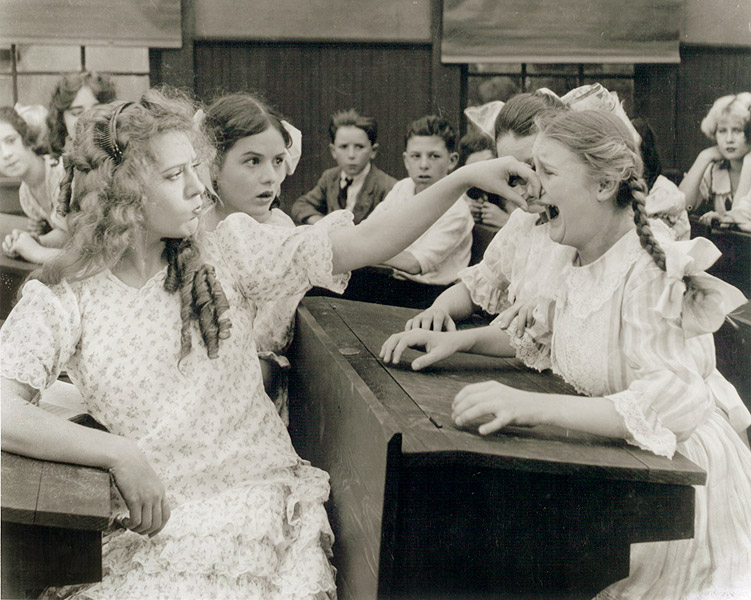
As part of its Silent Cinema Showcase, running from April 20 - May 4, the American Film Institute will be showing the 1926 Mary Pickford film Sparrows on Saturday, April 20, 2013, at its AFI Silver theater in Silver Spring, Maryland. The film will be presented with live musical accompaniment and begins promptly at 2 p.m.
In addition, film historian Christel Schmidt will be signing copies of Mary Pickford: Queen of the Movies, a collection of essays about the woman who, as I have written, is "pound for pound the most powerful woman in Hollywood history." The Monkey plans to be there, although I'm not sure whether I'll ask for Ms. Schmidt's autograph. Some people are a bit put off meeting a blog-typing sock monkey—maybe it's the fluffy stuffing, maybe it's the buttons for eyes.
Definitely will be buying the book, though. See you there.
Today is Mary Pickford's birthday. One of the greatest stars of the silent era, and pound-for-pound the most powerful woman in Hollywood history, Mary Pickford's work is indispensable for the film fanatic. If you've never seen a Mary Pickford movie and don't know where to begin, here are five films to get you started.
The Poor Little Rich Girl (1917)
An unprecedented blend of comedy and melodrama that worried the studio but delighted its star, the story of a girl whose wealthy parents neglect her while others prey on her could easily have become sentimental claptrap. Instead, Pickford's Gwendolyn is, by turns, impetuous, flighty and sullen, but also curious, kind and fun—in other words, a real girl. The film was one of the biggest hits of 1917 and is a National Film Registry selection.
Rebecca of Sunnybrook Farm (1917)
A cross between Charles Dickens and Louisa May Alcott, this story of a poor girl sent to live with a pair of maiden aunts is the most typical example of a Mary Pickford movie. Boasting plenty of comedy with a soupçon of pathos in the final act, Rebecca was Pickford's biggest hit yet.
Stella Maris (1918)
Based on a novel by William J. Locke, Stella Maris is a Victorian melodrama of the first water, the riveting story of two girls, one a rich shut-in sheltered from life's realities, the other, an ugly duckling orphan—both played by Pickford—whose paths intersect with tragic results. Variety called the performance "a revelation," the Los Angeles Times deemed it "brilliant, powerful and poignant" and studio chief Adolph Zukor later called it "the most remarkable thing which Mary Pickford has ever done for the screen." And they were right.
Sparrows (1926)
The other contender for Pickford's best movie, Sparrows is the harrowing tale of a group of backwoods orphans menaced by white slavers. In a sort of teenage take on Lillian Gish's gun-toting granny in 1955's The Night of the Hunter, Pickford attempts to lead her wards to safety while danger lurks at every turn—including the very real alligators director William Beaudine brought onto the set.
My Best Girl (1927)
In a rare adult role, Pickford plays a shop girl who falls in love with the owner's son. Played strictly for laughs, the result is a nifty little comedy, as fresh and light and funny as the actress who carries it on her back. As film critic Steve Vineberg says, the performance is "an extraordinary combination of spunk and delicacy." And as an added bonus, look for a brief, pre-stardom appearance by Carole Lombard as one of the shop girls.
Roger Ebert recently picked Buster Keaton's The General as the best silent movie ever made. City Lights notwithstanding, I agree.
As for why it shows up here in 1926, despite its 1927 American release, it premiered overseas in '26, and with Fritz Lang's Metropolis on the horizon, that's good enough for me.
Picture:The General (prod. Buster Keaton and Joseph M. Schenck) Actor: Charley Chase (Mighty Like A Moose) and Harry Langdon (The Strong Man) (tie) Actress: Greta Garbo (Flesh And The Devil) Director: Buster Keaton and Clyde Bruckman (The General) Supporting Actor: Sam De Grasse (The Black Pirate) Supporting Actress: Phyllis Haver (What Price Glory) Screenplay: Buster Keaton and Clyde Bruckman (screenplay); Al Boasberg and Charles Henry Smith (adaptation) (The General)
Katie-Bar-The-Door and I met Mister Muleboy and Michele at the AFI Silver Saturday afternoon to see Douglas Fairbanks in The Black Pirate. For those of you who loved The Artist, which won the Oscar as best picture of the year last night, The Black Pirate is a must-see—Jean Dujardin's George Valentin is very clearly modeled on the swashbuckling Fairbanks. They even have the same moustache!
Named for Katie-Bar-The-Door, the Katies are "alternate Oscars"—who should have been nominated, who should have won—but really they're just an excuse to write a history of the movies from the Silent Era to the present day.
To see a list of nominees and winners by decade, as well as links to my essays about them, click the highlighted links:
Remember: There are no wrong answers, only movies you haven't seen yet.
The Silent Oscars
And don't forget to check out the Silent Oscars—my year-by-year choices for best picture, director and all four acting categories for the pre-Oscar years, 1902-1927.
Look at me—Joe College, with a touch of arthritis. Are my eyes really brown? Uh, no, they're green. Would we have the nerve to dive into the icy water and save a person from drowning? That's a key question. I, of course, can't swim, so I never have to face it. Say, haven't you anything better to do than to keep popping in here early every morning and asking a lot of fool questions?




 Roger Ebert recently picked Buster Keaton's The General as the best silent movie ever made. City Lights notwithstanding, I agree.


 Katie-Bar-The-Door and I met Mister Muleboy and Michele at the AFI Silver Saturday afternoon to see Douglas Fairbanks in The Black Pirate. For those of you who loved The Artist, which won the Oscar as best picture of the year last night, The Black Pirate is a must-see—Jean Dujardin's George Valentin is very clearly modeled on the swashbuckling Fairbanks. They even have the same moustache!




 Posts
Posts


