skip to main |
skip to sidebar
The story of a girl from the country who makes it big in Hollywood was a staple of the silent era — see, e.g., A Girl's Folly, Souls for Sale, The Extra Girl, Ella Cinders — so much so that when Marion Davies (with King Vidor directing) spoofed the genre in the 1928 silent comedy Show People, everybody in town was in on the joke.
Look for cameos from just about everybody who was anybody including Douglas Fairbanks, Charlie Chaplin, John Gilbert and even Marion Davies and King Vidor as themselves.
While she is mostly remembered now as the inspiration for the no-talent opera singer in Orson Welles's Citizen Kane — a grossly unfair characterization if that's what Welles really thought of her — Marion Davies was actually a very good comedic actress and this movie was the best showcase of her talent.
Recommended.
Katie-Bar-The-Door is out of town again — ongoing family issues — so my pal Mister Muleboy and I met at the AFI-Silver yesterday afternoon to take in the 1922 version of Robin Hood starring one of our favorite silent stars, Douglas Fairbanks.
I looked it up: this was my twenty-sixth Douglas Fairbanks movie. That doesn't make me an expert, but I do think I have a solid feel for the man's work.
You do know who Douglas Fairbanks was, right? The star of forty-eight movies, including some of the greatest action films of all time, Fairbanks was a superstar before the word existed, and along with Chaplin and his wife Mary Pickford, one of the three highest-paid and most-popular actors of his day. On his honeymoon with Pickford, Fairbanks and his bride drew crowds of 300,000 in Paris and London. At home in their mansion, dubbed "Pickfair," the two threw lavish parties and routinely entertained the world's most sought-after celebrities. To receive an invitation to Pickfair was to receive the social blessing of Hollywood royalty.
Certainly no one of his era, maybe no one ever, enjoyed stardom more than Fairbanks did.
But Fairbanks was more than just a regular feature of the gossip columns and party circuit. He was also a fine actor and created the modern action hero in a series of swashbuckling adventures showcasing an infectious joie de vivre and extraordinary flare for stunt work.
He practically invented the action-hero genre in film with 1920's The Mark of Zorro. Admittedly, his Don Diego Vega—Zorro to you—had no supernatural or extraterrestrial powers, ala Superman or the Hulk, but he was the first film hero with a secret identity and hideaway, a costume, a mask, a sidekick and a backstory, not to mention a compulsion to carve a "Z" on the anatomy of oppressors and evildoers while fighting for truth, justice and the old Spanish California way.
He followed up that groundbreaking triumph in 1921 with The Three Musketeers, his first pure swashbuckler. (Read my review here.) The following year, looking to follow up with a similar sort of fun action-filled yarn, he again turned to one of the great fables, this time the adventures of Robin Hood.
If the Robin Hood legend were a song, we'd call it a chestnut, with every generation taking it up and putting its own particular spin on it. Given that there have been something like a hundred filmed versions of the Robin Hood legend, with everybody from Errol Flynn to Daffy Duck playing the title role, I'll assume I don't need to tell you the basic plot: of how Prince John took advantage of Richard the Lionhearted's absence during the Crusades to seize the English throne, and how a nobleman, here named the Earl of Huntingdon (Fairbanks), took up arms against him.
Instead, I'll concentrate on how Fairbanks and his merry band chose to interpret the source material.
As was always the case with a Douglas Fairbanks movie, the technical support was first-rate. The sets and costumes are terrific, with a full-sized castle set (no, that's not a matte painting) that must have filled the studio backlot. Arthur Edeson, who would later lens All Quiet on the Western Front, Frankenstein, The Maltese Falcon and Casablanca, provides his usual stellar cinematography.
Allan Dwan, who wound up directing twelve Fairbanks movies, and 400 more besides, helmed the proceedings.
Yet for all the money lavished on the production, this is a strangely non-canonical take on the Robin Hood legend — no archery contest, no battle on the bridge between Robin and Little John, Friar Tuck reduced to a single closeup and title card, and the final fight between Robin and Guy of Gisbourne over in two blinks of an eye.
Instead, the movie focuses on Robin's friendship with Richard the Lionhearted, starting on the eve of the Crusades and carrying through all the twists and turns of the relationship — including a betrayal of a basic trust — right on through to Richard banging on the door of Robin's honeymoon chamber begging for entry after the wedding.
Is this the only Robin Hood with a fairly explicit homoerotic subtext? Maybe. Our hero prefers wrestling and horseplay with men to the attentions of women, of whom he confesses to be "afeared," and even his interest in the Lady Marian seems more paternal than passionate. Such a reading tends to cast the subsequent Crusades and the Merry Men of Sherwood Forest in a wholly different light.
I have to assume the effort to subvert the Robin Hood story was on purpose. It's not like some screenwriting weisenheimer slipped one past Fairbanks — Fairbanks was the screenwriter, credited as he often was as Elton Thomas (he was born Douglas Elton Thomas Ullman). Not to mention, he was also the producer, owned the production company and the distribution company. Nobody mucks with a man of such power and lives to eat lunch in Hollywood ever again.
But given that Fairbanks himself chose to abandon the traditional Robin Hood story for something else, we have to lay the blame squarely at his feet when the story grinds to a halt forty minutes in and idles in neutral for the next hour.
I also have to say the acting was a bit of a disappointment — not that of Fairbanks himself, mind you, whose enthusiasm was as infectious as ever — but that of the rest of what should have been a strong supporting cast.
As played by that über-ham, Wallace Beery, King Richard is a loutish buffoon hardly worthy of the respect and loyalty he commands, eating Henry the Eighth-sized turkey legs, bellowing and banging his fist, and otherwise accomplishing very little.
I also have a problem with the film's Guy of Gisbourne — what I'll forever think of as the Basil Rathbone role. Paul Dickey, in what turned out to be the only movie role of his career, is a frozen-faced fish who never proves a credible threat to Fairbanks. He's no swordsman with either the blade or the ladies, and though he has broad shoulders, not for one minute did I believe he could best Fairbanks at anything.
Sam De Grasse — one of the great supporting actors of the silent era — is a better villain, with his Prince John a would-be disciple of the Marquis de Sade, seizing the kingdom mostly so he can torture women who predictably refuse his sexual advances. But Alan Hale, who would play Little John again in the 1938 classic The Adventures of Robin Hood, is largely wasted here, and Enid Bennett, an Australian stage actress who appeared in 52 films between 1916 and 1941, is a pretty enough Lady Marian but gives ample evidence as to why she never became a star.
I can't say what you might think of this Robin Hood. Fairbanks's fans loved it, making it the top grossing movie of 1922. It ranks third among his features on the Internet Movie Database with a rating of 7.7. And the audience at the AFI seemed to enjoy it, although I'm not sure gales of laughter during the climatic battle is what Fairbanks would have had in mind.
But my opinion is that it's not good Robin Hood and it's not good Fairbanks.
Looking at it in the context of his career, however, Robin Hood is an example of an artist in transition. In terms of the all-important action sequences, Fairbanks was trying to add stylized movement and rhythm to his usual athleticism to create a sort of swashbuckling ballet. For the story, he was groping for something beyond mere plot, reaching for the mythic. He even makes a stab at playing a three-dimensional character instead of his usual innocent hero, a course that would see him afterwards play a thief, a pirate and eventually a true anti-hero in 1927's The Gaucho.
He failed on all three counts here but he would succeed spectacularly in his next two features — The Thief of Bagdad (1924) and The Black Pirate (1926), arguably the two greatest action-adventure films of the silent era and certainly the best work Fairbanks would ever produce.
That would make Robin Hood a noble failure, or at the very least, a necessary one. No matter what romantic notions we might have about the matter, artists aren't born, they're made, and sometimes you have to step wrong before you learn how to step right.
Note: The AFI-Silver's presentation of Robin Hood (1922) is part of its Silent Cinema Showcase which runs through November 23 (click here for the schedule). Hesperus provided top-notch live musical accompaniment with a score based on the medieval music of Robin Hood's era, performed on historically-appropriate instruments — lutes, recorders and strings. There were even a few songs sung, ancient ballads about the man who robbed from the rich and, well, you know the rest. Overall, a fine afternoon.
An aerial view of Pickfair Studios, circa 1924. That's the set of the Douglas Fairbanks masterpiece The Thief of Bagdad in the foreground.
As always, click on the photo to biggie-size it.
Day 2 of Carole & Co.'s Great Silent Recasting Blogathon.
Today: Douglas Fairbanks, history's greatest swashbuckler as history's greatest swashbuckler, Indiana Jones.
Tomorrow: Ernst Lubitsch.
I've been busy working on the Great American Novel lately, so very little blogging, but here are two blogathons upcoming in November I can't resist: the Great Silent Recasting Blogathon (November 1-4) hosted by Carole & Co.; and the What A Character Blogathon (November 9-11) hosted by Outspoken & Freckled, Paula's Cinema Club, and Once Upon a Screen. In honor of the former, I'll be serving up posters for four modern movies I'd like to have seen made during the silent era; for the latter, three days of lists pertaining to my favorite silent character actors.
A couple of teasers, the first a movie I didn't include in the blogathon, Lillian Gish in Carrie, the second, my favorite silent actor who was quite a character but not a character actor:
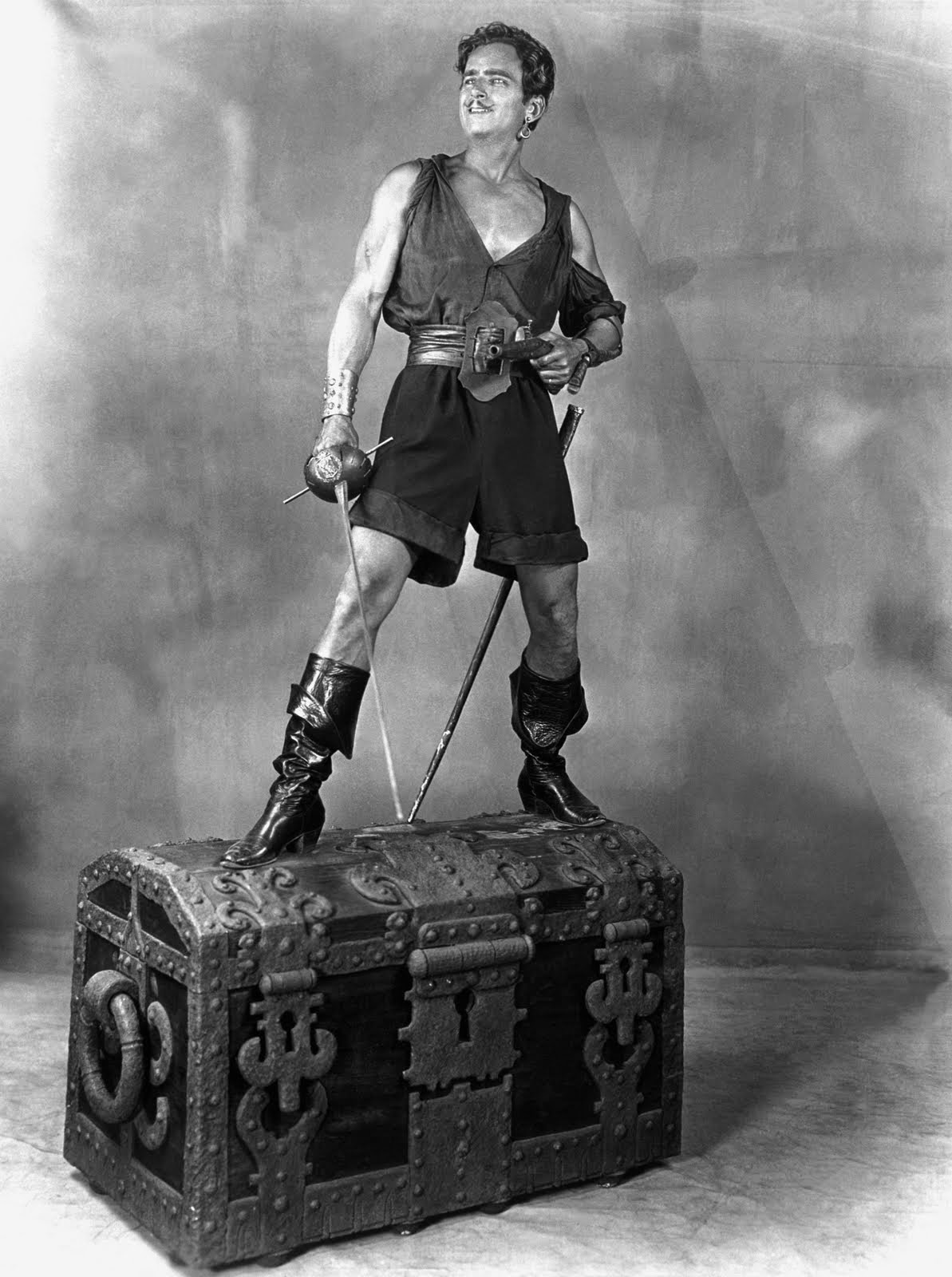
The painting of Lillian Gish is by Paul Lovering. I added the drop of blood. The latter is Douglas Fairbanks, Sr., of course.
See you in November.

The Monkey has spent most of the summer reading the collected works of Alexandre Dumas—or, more accurately, The Three Musketeers which is long enough to feel like the collected works of Alexandre Dumas. It's a sprawling epic, crammed to the gills with plots and subplots enough for a dozen novels.
Even if you haven't read it, you probably have some sense of the story: a young Frenchman named d'Artagnan pals around with three of the king's elite guardsmen—the musketeers Athos, Porthos and Aramis—wielding swords, battling bad guys, and getting into all sorts of scrapes. It's two tons of fun, with memorable heroes and villains, lots of action and pretty girls, and very little angst to slow you down.
No wonder movie makers have been so fascinated with it.
The first film version of the novel (a short fencing scene) appeared in 1898 and people have been retelling the story ever since. At 700+ pages, there's enough here to make any kind of movie you want—a historical romance, a swashbuckler, a buddy comedy, a political thriller, even a sex farce—and there are versions in French, English, Russian, Latvian and Dutch, feature-length versions, musical versions, television versions, and even one version starring Mickey Mouse, Donald Duck and Goofy—and that's just in the last ten years!
As a silent film fan, I'm most interested in the one starring the legendary Douglas Fairbanks. Released in 1921, this version of The Three Musketeers opts to emphasize the palace intrigue, specifically focusing on an episode from the first half of the book where Cardinal Richelieu—the real power behind Louis XIII of France—hopes to catch the queen in an affair with England's Duke of Buckingham, thus discrediting her and removing her as a counterweight to his influence on the king.
Riding to the rescue are d'Artagnan and the three musketeers.
Fairbanks had already established the conventions of the movie action hero with The Mark of Zorro in 1920, and after one last foray (The Nut, 1921) into the kind of modern comedy that had previously defined his career, Fairbanks spent the rest of the silent era making the lavish historical action-adventures he's now known for, beginning with The Three Musketeers.
It wouldn't take Fairbanks long to perfect the formula—The Thief of Bagdad, The Black Pirate and The Iron Mask are among the era's best films—but here, he was still figuring out the proper balance between swashbuckling and plot, in this case erring on the side of the latter. The long set-up introducing all the scheming court figures will serve only to tax the patience of some viewers without making what follows any clearer. The movie also tries to squeeze in as many incidents from the book as possible without necessarily investing any emotion in them or tying them together, dissipating the narrative momentum and proving once again that it's possible for a book adaptation to be too faithful.
At those moments, though, when it turns its attentions to d'Artagnan, the film takes off. A young rube from the country, he initially alienates Athos, Porthos and Aramis, but quickly wins them over with his bravery, ingenuity and superior swordsmanship. He falls in love with his landlord's niece who, as it turns out, is moonlighting as the queen's go-between to Buckingham, thus drawing d'Artagnan—and the three musketeers—into the royal intrigue.
When the time comes to act, all the bad guys in Paris can't stop him from succeeding.
Fairbanks, as usual, was in fine fettle. At thirty-eight, he was too old to play the twenty-one year old d'Artagnan, but once the swordplay begins, you don't care. With grace and gusto, he fends off a dozen men, scales walls, leaps through windows, and saves enough energy to woo the girl and outsmart the Cardinal. And his one-handed handspring to stab a man and save his friends ranks with his best stunts and is worthy of a man half his age.
Admittedly, he was not a subtle actor, but then he rarely played subtle characters, and d'Artagnan is no exception. While modern audiences may find Fairbanks's style amusingly outdated, the d'Artagnan he plays is an impetuous, inexperienced youth, untrained in the manners of an urban gentleman, unable to harness his raw emotions, and always looking in his youthful insecurity to pick a fight with anyone he thinks has looked at him wrong. A more subdued, modern style would only wind up highlighting the silliness of the storyline without adding to the fun.
As for the other actors, Adolphe Menjou is well-cast as the ineffectual Louis, and Nigel de Brulier is so good as Richelieu that he played him three more times, in 1929, 1935 and 1939. A long list of nobody-much plays the various female roles, including Mary MacLaren as Anne of Austria, Marguerite De La Motte as Constance Bonacieux and Barbara La Marr as Milady de Winter. The three musketeers wind up being minor characters in a film bearing their name, with Leon Barry playing Athos, George Siegmann as Porthos, and Eugene Pallette (yeah, the frog-voiced tub who played the father in My Man Godfrey and Friar Tuck in The Adventures of Robin Hood) as Aramis.
Director Fred Niblo (best known for the 1925 silent version of Ben-Hur) and cinematographer Arthur Edeson (All Quiet on the Western Front and Casablanca) made a good team, allowing us to easily follow the swordplay as well as using visuals rather than intertitles to reveal the character of Richelieu—showing, for example, his lurking shadow in the background as the king unwittingly sets the trap designed to ensnare the queen. (Richelieu sometimes also strokes a cat while devising his plans, decades before Ernst Blofeld, Don Corleone and Dr. Evil made it the signature move of the truly wicked.)
Edward M. Langley designed the sets; and Paul Burns and Edward Knoblock were responsible for the costumes.
The film was released in August 1921 to good reviews and a solid box office. Its $1.5 million gross placed it among the top earning films of the year, finishing behind only Rudolph Valentino's The Four Horsemen of the Apocalypse and Charlie Chaplin's The Kid.
Overall, this is not top shelf Fairbanks, but it's pretty good, and once you've seen The Mark of Zorro, The Thief of Bagdad and The Black Pirate, I can recommend this one as a worthwhile follow-up.
P.S. Fairbanks returned to the character of d'Artagnan in 1929 with his last silent film, The Iron Mask. Based on a pair of sequels to The Three Musketeers penned by Dumas himself, the second go-around is even better than the first and it proved to be the perfect cap to Fairbanks's swashbuckling career. You don't have to see The Three Musketeers before you see The Iron Mask, but doing so will add to the fun—and poignancy—of the latter.
(Subsequent to posting this earlier today, I decided to tie in my movie recommendations below with the Oscar-winning film The Artist which Thingy was watching when she gave me the Thingster Award.)

My blog pal Thingy over at Pondering Life has bestowed upon me the coveted Thingster Award. She was watching The Artist—the silent movie that won the Oscar for best picture in 2011—the other day and thought of yours truly.
"Mythical Monkey. The go to guy for great insight on the classics, and not so classic movies."
Thingy created the "Thingster Award" back in April. After winning the Liebster Blog Award, she wrote, "I came up with a scathingly brilliant idea. I shall give out my own awards at the end of each week to blogs I find especially appealing to me. You get no trophy, although, you can take the special banner I have made. I also assume many of you will never know of your special prize, for I shall not tell you. (I'm lazy that way)."
And she's been handing out the Thingster Award ever since.
Just not to me.

Now, I don't usually brood about this sort of thing, but every time she handed one out I thought, "Gee, I wish I had me one of those Thingster Awards." And now I do! To quote Mister Roberts, "I'd rather have it than the Congressional Medal of Honor" (you know, in my case because the Medal of Honor would require an act of extraordinary bravery and heroism, a hard thing to accomplish while sitting in front of a computer in the suburbs of Baltimore).

To return the favor, and since Thingy is apparently in a silent movie mood, here are five suggestions to follow up The Artist:
The Black Pirate—Jean Dujardin, the Oscar-winning star of The Artist, cheerfully acknowledged that he was channeling silent film legend Douglas Fairbanks, Sr., during his performance. So why not cut out the middle man and see Fairbanks for yourself. The Black Pirate is a swashbuckling classic, and if you have a Blu-Ray player, you can see the original color version.
Stella Maris—Remember the scene in The Artist where Peppy Miller fondles the jacket and imagines herself with the hero? That's a direct quote of a scene from the classic Mary Pickford melodrama, Stella Maris, my favorite of all of Pickford's films. There she plays two roles, and so convincingly that if you didn't know better, you'd swear it was two different actresses.
Show People—The story of an unknown girl from the country who makes it big in Hollywood was a staple of the silent era (see, e.g., A Girl's Folly, Souls for Sale, The Extra Girl and Ella Cinders), so much so that Marion Davies (with King Vidor directing) spoofed the genre with this 1928 classic comedy. Look for cameos from just about everybody who was anybody including Douglas Fairbanks, Charlie Chaplin, John Gilbert and even Marion Davies and King Vidor as themselves.
Flesh and the Devil—Speaking of John Gilbert, was his fall from box office grace with the coming of the sound age the inspiration for The Artist? Well, actually it could be any number of silent film greats, but if it was Gilbert, here's one of his best, a noirish romance pairing him with off-screen lover Greta Garbo.
Behind the Screen—And finally, a very funny behind-the-scenes look at the making of a Hollywood movie from the silent era's most popular comedy star, the legendary Charlie Chaplin.
Hope that's of use to you, Thingy, and once again, thank you very much for the award!
A list of silent movies on Turner Classic Movies this July. This is why God created the DVR. (All times Eastern Daylight Savings Time).
July 8
12:00 AM
The Thief Of Bagdad (1924)
An Arabian thief sets out on a magical adventure to win a beautiful princess.
Dir: Raoul Walsh Cast: Douglas Fairbanks, Snitz Edwards, Charles Belcher. BW-140 mins
July 10
6:30 AM
Bardelys the Magnificent (1926)
A notorious womanizer falls for the woman he has bet he can trick into marriage.
Dir: King Vidor Cast: John Gilbert, Eleanor Boardman, Roy D'Arcy . BW-90 mins
July 10
8:15 AM
The Show (1927)
In this silent film, a sideshow dancer secretly loves the show's amoral barker.
Dir: Tod Browning Cast: John Gilbert, Rene Adore, Lionel Barrymore. BW-76 mins
July 10-
9:45 AM
A Woman of Affairs (1928)
Prejudice keeps a free spirit from the man she loves, triggering a series of tragedies.
Dir: Clarence Brown Cast: Greta Garbo, John Gilbert, Lewis Stone. BW-91 mins
July 10
11:30 AM
Desert Nights (1929)
In this silent film, diamond robbers get caught in a violent sandstorm.
Dir: William Nigh Cast: John Gilbert, Ernest Torrence, Mary Nolan. BW-62 mins
July 15
12:00 AM
Seven Years Bad Luck (1921)
In this silent film, a man's attempts to avoid bad luck after he breaks a mirror lead straight to it.
Dir: Max Linder Cast: Max Linder, Thelma Percy, Alta Allen. BW-62 mins
July 15
1:15 AM
Seven Chances (1925)
To inherit a fortune, a man races to find a bride by 7 p.m.
Dir: Buster Keaton Cast: Buster Keaton, T. Roy Barnes, Snitz Edwards. BW-56 mins
July 21
10:00 PM
Modern Times (1936)
The Tramp struggles to live in a modern industrial society with the help of a young homeless woman.
Dir: Charlie Chaplin Cast: Charlie Chaplin, Paulette Goddard, Henry Bergman. BW-87 min.
July 22
12:00 AM
Mickey (1918)
An orphan brought up in a mining settlement is sent to New York to live with her aunt.
Dir: Richard Jones Cast: Mabel Normand, George Nichols, Wheeler Oakman. BW-74 mins
July 29
12:00 AM
Phantom (1922)
In this silent film, a store clerk risks his future to pursue his obsession with a beautiful, ghostly woman.
Dir: F. W. Murnau Cast: Alfred Abel, Lil Dagover, Aud Egede Nissen. BW-119 mins
That's films from such Monkey favorites as Douglas Fairbanks, John Gilbert, Max Linder, Charlie Chaplin, Mabel Normand and F.W. Murnau. Mark your calendars!
A while back after I wrote my thumbs-up review of the 1929 version of The Taming of the Shrew, starring Douglas Fairbanks and Mary Pickford, Erik Beck (of the Boston Becks) left a comment noting that he was working on an essay naming Shrew the worst movie of the 1929-30 Oscar season.
He was very polite about it—"we can disagree on films and still be friends," he wrote, "or as much as you can be friends with someone whose real name you don’t know and who lives 400 miles away"— and since he and I are the greatest alternate Oscar bloggers on the planet (well, anyway, named Erik Beck and Mythical Monkey), I offered to link to his review and to mine then let you, the readers, make up your own minds.
In a nutshell:
EB: "In 1928-29, Mary Pickford and Sam Taylor teamed up to make the worst film of the year, Coquette, which, sadly, won Pickford an Oscar. In 29-30, they added Pickford’s (by-now-estranged) husband, Douglas Fairbanks into the mix and made a film that was nearly as bad and ended up being a major nail in the coffin to the careers of both stars."
Read the full review here.
MM: "In little over an hour, Pickford and Fairbanks reduce Shakespeare to a Laurel and Hardy comedy—and I mean that as the sincerest of compliments. Sometimes we get so caught up in the iambic pentameter that we forget that Shakespeare was writing for the masses. He had a fondness for lowbrow humor and I think the Bard would have approved of the slapstick and irreverent staging."
Read the full review here.
The film is available for streaming from various sources, can be purchased on DVD and is even floating around on YouTube (although you didn't hear that from me). Have a look, come back and vote in the poll on the right-hand side of the blog.
Next in the Catching Up series: "The Singular Case of Roy J. Pomeroy's Missing Oscar"
As soon as I (read: Katie-Bar-The-Door) can figure out how to embed a poll other than the buggy blogspot poll gadget I've been using, you will have an opportunity to decide, as promised weeks ago, whether Erik Beck (of the Boston Becks) or the Mythical Monkey is closer to the truth when we call the 1929 version of The Taming of the Shrew, starring Douglas Fairbanks and Mary Pickford, either the worst movie of 1929 or a rollicking good fun comedy.
Maybe this evening. Tomorrow at the latest, I'd think.
By the way, I had no idea what Erik Beck looks like, so I made my best guess and went with the one above which I lifted from the internet. I hope it's the right one.
By 1929, silent movies were as dead as disco and even the biggest stars of that suddenly bygone era found themselves struggling to connect with audiences eager for the next big thing.
Mary Pickford and Douglas Fairbanks were no exception. Although they had enjoyed an unbroken string of box office hits dating back more than a decade—Pickford even had an Oscar on the mantle—Hollywood's first power couple faced the necessity of reinventing themselves as stars of the newfangled "all-talking" pictures.
It was an uphill battle all the way.

As I've written before, talkies were essentially a different medium from the silent movies that preceded them, related in the way that, say, poems and novels are related, but in the end requiring very different methods and skill sets, grounding pictures in an unforgiving reality, minimizing what were once strengths and revealing previously irrelevant limitations. John Gilbert was no longer a mythic lover but an ordinary man spouting cliched gibberish. Harold Lloyd no longer floated effortlessly up the sides of buildings but groaned and grunted as all too real bone and sinew waged a war against pitiless gravity. And Pickford and Fairbanks, who had made fortunes playing, respectively, tweener ingenues and swashbuckling supermen, suddenly became a middle-aged couple groping, like everybody else, for a way forward.
The different paths Fairbanks and Pickford chose at this point say a lot about what they thought about themselves and their careers.

Fairbanks, perhaps more than anyone in Hollywood history, loved being a star, and he loved playing the parts that had made him one. Though he was too old to swashbuckle anymore, he chose to continue playing exuberant, over-the-top men of action, essentially offering his fans what he had always given them, only now with sound.
Pickford, on the other hand, was determined to chart a new course, bobbing her hair and playing a tragic flapper in her first talking picture, Coquette. "I'm sick of Cinderella parts," she said, "of wearing rags and tatters. I want to wear smart clothes and play the lover."
Although Coquette succeeded in luring a curious public into theaters and won Pickford an Oscar—after she campaigned her heart out for it—the film hadn't placated the star's old fans or won her any new ones, and her future was still very much up in the air.

For her next picture—Fairbanks's talkie debut—Pickford chose The Taming of the Shrew, the Shakespearean comedy about a marriageable young man in search of a rich bride, even one as sharp tongued as Kate Minola. The picture boasted at least two firsts: it was the first all-talking version of a Shakespeare play, and it was the first time (not counting cameos and promotional shorts) that Fairbanks and Pickford had ever starred in a picture together.
And as long as you're not looking for a faithful interpretation of the original text, The Taming of the Shrew is pretty funny, and at 65 minutes, sprightly enough after a drink or two (I recommend the Mary Pickford cocktail) for a fun evening in front of the DVR.

If you're not familiar with the play, The Taming of the Shrew is the story of Petruchio (Fairbanks), a young man on the make looking to marry the richest maiden he can find—and right quick, because he's got important business to attend to. Unfortunately for him, the most readily-available woman is an ill-tempered shrew (Pickford) who cracks a whip, hisses and spits, and breaks lutes over the heads of hapless music teachers.
But Petruchio is unconcerned. He's certain he can curb her temper and break her to his will.
"I am as peremptory as she proud-minded;
And where two raging fires meet together
They do consume the thing that feeds their fury"
How Petruchio tames the shrew—or appears to—is the core of this truncated version of the play. And despite drawing dialogue from Shakespeare, it's largely a slapstick reading of the original text.

Director Sam Taylor, a veteran of Harold Lloyd's heyday, puts a whip in Pickford's hand, and a bigger one in Fairbanks's. He has Fairbanks show up for the wedding dressed in rags and wearing a boot on his head, eating an apple throughout the ceremony then throwing Kate on the back on his horse and heading home in a driving rain before the wedding feast has even begun. There's a pratfall in a pigpen, a soliloquy delivered to a dog, and roughhousing enough for a Three Stooges short.
In little over an hour, Pickford and Fairbanks reduce Shakespeare to a Laurel and Hardy comedy—and I mean that as the sincerest of compliments. Sometimes we get so caught up in the iambic pentameter that we forget that Shakespeare was writing for the masses. He had a fondness for lowbrow humor and I think the Bard would have approved of the slapstick and irreverent staging.

And if he didn't? Well, so what. This is a movie not a literature class, and Taylor's approach is largely a cinematic interpretation of the story, dispensing with heaps of speeches and instead showing what Shakespeare only describes, an approach that will no doubt upset the purists but which appeals to someone like me, a silent movie fan who sometimes find all the yammering chat projected on the big screen since 1927 not only noisy and maddening but unnecessary.
The scene with the dog, for example, is not just funny: by having Petruchio talk aloud to the dog and allowing Kate to overhear him, Taylor eliminates the need for a third character and several more expository speeches. It's not pure Shakespeare, but it is pure cinema, and at a time when Hollywood was in thrall to the talk-talk-talk of the Broadway stage, a refreshing development.
But for those of you who care, just how faithful is this version to the original Shakespeare? Well, it is faithful to the basic plot involving Kate and Petruchio, and the dialogue comes from the text, but the film dispenses with roughly 80% of the play—Kate's sister Bianca and her multiple suitors, the comedy of mistaken identity and the framing device of Christopher Sly and the merry pranksters who sport with him.

In fact, no matter what the opening credits say, this Shrew is actually based on David Garrick's eighteenth century adaptation Catherine and Petruchio, which reworked the original text into a one-act two-person scenario—it's all the meat with none of the bones.
Despite Shakespeare's standing as the greatest playwright of all time, many of his works are problematic and The Taming of the Shrew is no exception. Left unanswered in the original text is an explanation for Kate's behavior, especially her final capitulation which even in 1592 was considered pretty sexist. How a production handles her character will largely determine whether the play is a success or a failure.
This film version opts for what I would call a "feminist" interpretation. Kate is attracted to the first man she can't intimidate but doesn't really falls for him until she "combs his noodle with a three-legged stool" and mothers him back to consciousness.
And for his part, despite the rigid gender roles society has set for them, maybe he likes it that way.

What is the old saying—he chased her until she caught him? Shakespeare seems to be saying that romance is a battle of wills that only ends in true love when a man thinks he has prevailed and a woman knows that she has.
At least that's this film's interpretation.
Anyway.

Despite the equal billing, The Taming of the Shrew is more Fairbanks's film than Pickford's. Kate is a thankless role—blame Shakespeare—but though Pickford later expressed dissatisfaction with her performance and called the experience the worst of her life, she does with the part what she can, pouting beautifully, cracking a mean whip and, most importantly, turning the famous final speech into a winking bit of feminist subterfuge.
Fairbanks, on the other hand, was essentially playing a variation on his best roles, the larger-than-life, hale and hearty, well-met fellow who despite his oddball antics is a loveable guy. Petruchio requires an actor who can chew the scenery and make you like it, and Fairbanks does not disappoint. Despite behind-the-scenes tension that made for an unhappy production, Pickford admitted that Fairbanks's performance was one of the best of his career.

On a budget of $504,000, the film grossed a million dollars at the box office, but despite turning a profit, it didn't serve its essential purpose, to make its stars fashionable again. There were further attempts to crack the commercial cocoanut, but The Taming of the Shrew was the last box office success of either star's career. Pickford and Fairbanks separated soon after filming ended and divorced in 1936.








 Posts
Posts

