One of those films I really should write five thousand words about, The Kid was Charlie Chaplin's first feature-length film, a Dickensian-style dramedy about a tramp who finds an abandoned baby in the gutter and raises him as his own. Not only was it a box office blockbuster, it inspired Buster Keaton and Harold Lloyd to make features of their own.
We owe The Kid a lot.
This marked the first time Chaplin successfully mixed comedy and pathos. He'd made stabs at it in such shorts as The Tramp and The Vagabond, but here, he pulls it off. I rank it third on my list of favorite Chaplin films, behind City Lights and The Gold Rush.
As close to perfect as you're likely to get in this world. 5 stars out of 5.
I've written quite a bit about Chaplin in the past, especially here, and for those of you who care about these things, it struck me on this repeat viewing how much of The Kid is a re-working of Chaplin's earlier work. There's the story arc of a mother haunted by the loss of her child as in 1916's The Vagabond, a street fight with a bully on what looks like the same set as 1917's Easy Street, and the raising a foundling storyline from 1918's A Dog's Life (there a dog, here Jackie Coogan).
In The Kid, he stitches these subplot together to reach emotional highs and lows greater than the sum of the parts. Must-see.
A note on the viewing experience: Katie-Bar-The-Door and I saw this at the Meyerhoff in Baltimore with the BSO providing the live musical accompaniment based on Chaplin's own score. A word to the wise: the screen is up high, above the musicians, so unless you want to scrunch down in your seat and crane your neck for an hour and a half, buy seats in the mezzanine.
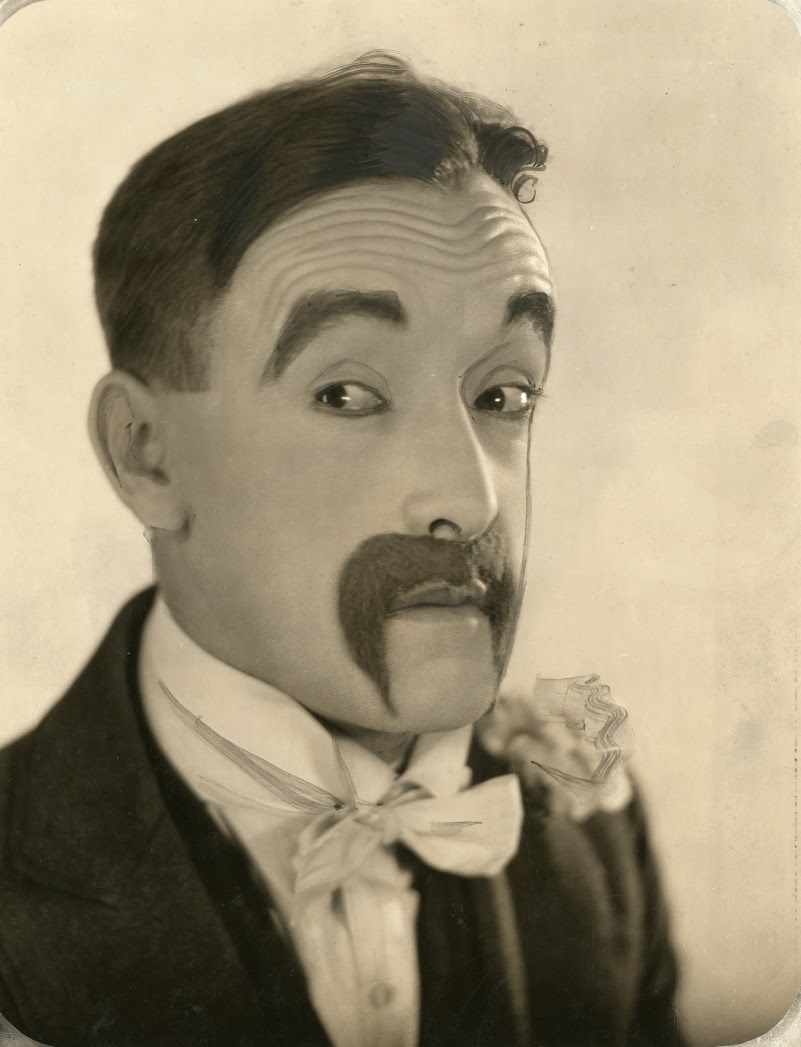
Today is a list of my favorite character actors from the silent era, tomorrow a similar list of silent era actresses, and on the blogathon's final day, silent supporting players who were better in the sound era.
For today's list, I've bypassed actors such as Sessue Hayakawa, William Powell and Wallace Beery who did a lot of supporting work but were also lead actors in their own right, and stuck strictly with the supporting players. (Powell and Beery will show up Monday.)
13. Snub Pollard—beginning his film career as one of the Keystone Kops, he made his name as a supporting player in the Hal Roach stable, playing the little guy with a droopy moustache in the early Harold Lloyd comedies, then later in Laurel and Hardy's silent shorts. In the sound era, he wound up playing Tex Ritter's sidekick Pee Wee in a series of Westerns.
12. Jackie Coogan—he really only served up one great performance in his career, but what a performance, as the foundling child in Charlie Chaplin's first feature film, The Kid. Grew up to play Uncle Fester on television's The Addams Family.
11. Marcel Lévesque—the rubber-faced comic relief in two of Louis Feuillade's greatest serials, Les Vampire and Judex. A great ham.
10. Rudolf Klein-Rogge—best known for his supporting work as the Inventor in Fritz Lang's dystopian sci-fi classic Metropolis, he was Lang's go-to bad guy, starring in the Mabuse films.
9.Eric Campbell—Chaplin's comic foil in eleven of the twelve Mutual films, including the two best shorts of Chaplin's career, Easy Street and The Immigrant. At 6' 5" and 300 pounds, he loomed over the diminutive Chaplin, giving the Tramp something solid to fight against. He died in an automobile accident in 1917.
8.Ernest Torrence—he played everything from St. Peter (The King of Kings) to Buster Keaton's father (Steamboat Bill, Jr.), and appeared in The Hunchback of Notre Dame, Clara Bow's Mantrap and John Gilbert's last silent film, Desert Nights.
7. Jean Hersholt—known for his pivotal role in Erich von Stroheim's Greed, he also excelled in the Ernst Lubitsch comedy, The Student Prince in Old Heidelberg, and later during the sound era as the grandfather in Shirley Temple's Heidi.
6.Donald Crisp—he won an Oscar for How Green Was My Valley, but to me, his best work was during the silent era, as Lillian Gish's viciously cruel father in Broken Blossoms and as Douglas Fairbanks's swashbuckling ally in The Black Pirate.
5.Sam De Grasse—best known for his work in the films of Douglas Fairbanks, he typically played a heavy, but with refreshing restraint and subtlety.
4. Al St. John—probably the best comic actor of the silent era who was never really a star in his own right, he worked with Roscoe Arbuckle, Buster Keaton, Charlie Chaplin, Mabel Normand, then during the sound era as the codger sidekick in B-Westerns starring the likes of Buster Crabbe, Lash La Rue and some guy named John Wayne.
3. Conrad Veidt—you know him as Major Strasser in Casablanca, but Veidt was at his best during the silent era, starting small with such classics as The Cabinet of Dr. Caligari and Waxworks, eventually starring in The Man Who Laughs, a film that inspired the character of the Joker in the Batman comics.
2. Theodore Roberts—a twinkly-eyed ham who made sinning look like so much fun in Cecil B. DeMille's sex comedies, yet he was equally convincing as the heavy in Joan the Woman and as Moses in The Ten Commandments. A stage actor who made his debut in 1880, he made 23 films with DeMille and appeared in 103 altogether.
1. Gustav von Seyffertitz—possibly the only actor to ever upstage the legendary Mary Pickford, his performance as the evil "baby farmer" in Sparrows ranks as one of the great fiends of the silent era. Mostly playing slippery, sly villains, he worked with everybody—DeMille, Barrymore, Garbo, Fairbanks, Valentino, Dietrich, von Sternberg, Marion Davies, Wallace Reid and, of course, Pickford—carving out a long career as the man you love to hate.
Tomorrow: My Favorite Character Actresses of the Silent Era.
Best Heartstring-Tugging Child
Let's just go back to the first truly great child performance in movies, Jackie Coogan in Charlie Chaplin's The Kid. If you don't get a little misty when Chaplin rescues him from the orphanage goons, your heart is made of stone.
Hard to believe that cute little tyke grew up to become this guy:
Yikes!
Best Performance With a Director Who Was Really Hard to Work With
You could interpret this question a couple of ways. William Wyler was notoriously difficult to work with—for example, once requiring Bette Davis to do forty takes of a scene in Jezebel where she did nothing but walk down a flight of stairs. Actors, though, knew that Wyler could see something they often couldn't so they put up with him and the result was that he still holds the record for directing the most Oscar-nominated and Oscar-winning performances (36 and 14, respectively).
Fritz Lang, on the other hand, was just an anal-retentive a-hole who would do things like delay production for five hours while he fiddled with a fake cobweb in the background. I get the impression actors succeeded in his films in spite of him rather than because of him. In which case, I choose Peter Lorre's performance in M as the best of the bunch.
Best Weird Thing James Franco Thought Would Be Interesting to Try
I confess I read this one and thought "Now who is James Franco again? Oh, right, the former fascist dictator of Spain." To which the answer is probably "Guernica."
But then I did a little research and found out that James Franco is some sort of an actor. Boy, he's made a lot of crap, hasn't he.
Best Portrayal of a Recovering Addict
He wasn't all that recovering and who knows about babies crawling along the ceiling, but I did very much enjoy Ewan McGregor's performance as a heroin addict who goes cold turkey in the 1996 British comedy Trainspotting. Highly recommended.
Best Surprisingly Grounded Performance in a Superhero Film
I'll probably get drummed out of some sort of bloggers club for this, but I'm not that big a fan of superhero movies. I hate the "with great power comes great responsibility" gibberish that movies like Spider-Man palm off on us. That, and the inevitable Kryptonite business.
And what is it with all the tights?
That said, I'm going with Will Smith in Hancock. Hancock is very much the kind of superhero I would be if I suddenly found myself thrust into that role—just your basic anti-social "leave me alone, why don't you people grow up" kind of superhero. Don't know that I'd become a homeless alcoholic, but I'd probably spend even more time talking to the dog than I already do.
Tomorrow: Quentin Tarantino, diseases, arm-waving, sadness and nudity.
Named for Katie-Bar-The-Door, the Katies are "alternate Oscars"—who should have been nominated, who should have won—but really they're just an excuse to write a history of the movies from the Silent Era to the present day.
To see a list of nominees and winners by decade, as well as links to my essays about them, click the highlighted links:
Remember: There are no wrong answers, only movies you haven't seen yet.
The Silent Oscars
And don't forget to check out the Silent Oscars—my year-by-year choices for best picture, director and all four acting categories for the pre-Oscar years, 1902-1927.
Look at me—Joe College, with a touch of arthritis. Are my eyes really brown? Uh, no, they're green. Would we have the nerve to dive into the icy water and save a person from drowning? That's a key question. I, of course, can't swim, so I never have to face it. Say, haven't you anything better to do than to keep popping in here early every morning and asking a lot of fool questions?








 Posts
Posts

