skip to main |
skip to sidebar
A great year in film history that needs no introduction—which is a good thing because I haven't written one.
PICTURE (Drama)
winner: Gone With The Wind (prod. David O. Selznick)
nominees: Goodbye, Mr. Chips (prod. Victor Saville); Gunga Din (prod. George Stevens); The Hunchback Of Notre Dame (prod. Pandro S. Berman); Only Angels Have Wings (prod. Howard Hawks); The Roaring Twenties (prod. Hal B. Wallis); Stagecoach (prod. John Ford); Wuthering Heights (prod. Samuel Goldwyn)
PICTURE (Comedy/Musical)
winner: The Wizard Of Oz (prod. Mervyn LeRoy)
nominees: Destry Rides Again (prod. Joe Pasternak); Mr. Smith Goes To Washington (prod. Frank Capra); Ninotchka (prod. Ernst Lubitsch); The Women (prod. Hunt Stromberg)
PICTURE (Foreign Language)
winner: La règle du jeu (The Rules Of The Game) (prod. Claude Renoir, Sr.)
ACTOR (Drama)
winner: Clark Gable (Gone With The Wind)
nominees: James Cagney (The Roaring Twenties); Robert Donat (Goodbye, Mr. Chips); Henry Fonda (Young Mr. Lincoln); Cary Grant (Gunga Din and Only Angels Have Wings); Laurence Olivier (Wuthering Heights); Basil Rathbone (The Hound Of The Baskervilles and The Adventures Of Sherlock Holmes)
ACTOR (Comedy/Musical)
winner: James Stewart (Mr. Smith Goes To Washington and Destry Rides Again)
nominees: Don Ameche (Midnight); Melvyn Douglas (Ninotchka); W.C. Fields (You Can't Cheat An Honest Man)
ACTRESS (Drama)
winner: Vivien Leigh (Gone With The Wind)
nominees: Ingrid Bergman (Intermezzo: A Love Story); Bette Davis (Dark Victory and The Old Maid); Irene Dunne (Love Affair); Merle Oberon (Wuthering Heights); Barbara Stanwyck (Union Pacific)
ACTRESS (Comedy/Musical)
winner: Judy Garland (The Wizard Of Oz)
nominees: Jean Arthur (Mr. Smith Goes To Washington); Claudette Colbert (Midnight); Joan Crawford (The Women); Marlene Dietrich (Destry Rides Again); Greta Garbo (Ninotchka)
DIRECTOR (Drama)
winner: John Ford (Stagecoach)
nominees: Victor Fleming (Gone With The Wind); Howard Hawks (Only Angels Have Wings); William Wyler (Wuthering Heights)
DIRECTOR (Comedy/Musical)
winner: Victor Fleming (The Wizard Of Oz)
nominees: Frank Capra (Mr. Smith Goes To Washington); Ernst Lubitsch (Ninotchka); Jean Renoir (La règle du jeu a.k.a. The Rules Of The Game)
SUPPORTING ACTOR
winner: Thomas Mitchell (Stagecoach, Only Angels Have Wings, Mr. Smith Goes To Washington, Gone With The Wind and The Hunchback Of Notre Dame)
nominees: Ray Bolger, Jack Haley and Bert Lahr (The Wizard Of Oz); Frank Morgan (The Wizard Of Oz); Robert Preston (Union Pacific); Claude Rains (Mr. Smith Goes To Washington)
SUPPORTING ACTRESS
winner: Hattie McDaniel (Gone With The Wind)
nominees: Olivia de Havilland (Gone With The Wind); Geraldine Fitzgerald (Wuthering Heights); Kay Francis (In Name Only); Margaret Hamilton (The Wizard Of Oz); Butterfly McQueen (Gone With The Wind)
SCREENPLAY
winner: Anita Loos and Jane Murfin, from the play by Clare Boothe (The Women)
nominees: Jean Renoir and Carl Koch (La règle du jeu a.k.a. The Rules Of The Game); Charles Brackett, Walter Reisch and Billy Wilder; story by Melchior Lengyel (Ninotchka); Sidney Buchman; story by Lewis R. Foster (Mr. Smith Goes To Washington)
SPECIAL AWARDS
"Over The Rainbow" (The Wizard Of Oz) music by Harold Arlen; lyrics by E.Y. Harburg (Song); Max Steiner (Gone With The Wind) (Score)
"That's Typing" Tuesday, in which I share unpolished, unpublished writings from my vast store of unpolished, unpublished writings. On Tuesdays.
 My post about Anita Loos yesterday inspired this additional thought: that during the silent era, Hollywood was a wide-open town as far as opportunities for women were concerned. Not just limited to the latest pretty face, women had a chance to direct, produce and especially write—hell, Mary Pickford owned her own studio and distribution company.
 Indeed, I've read that more than half the screenwriters in Hollywood during the silent era were women—certainly the good ones were: in addition to Anita Loos, there was Frances Marion (who'd later win two Oscars), Jeanie Macpherson (who wrote all the good movies Cecil B. DeMille ever made) and June Mathis (who made Rudolph Valentino a star and later adapted Ben-Hur for the screen).
 When the sound era forced studios to build thousands of new theaters and then the Great Depression soon after decimated the marketplace, Hollywood's moguls were forced to borrow millions of dollars to keep their studios afloat. Much like today, these money men were more interested in seeing a return on their investment than they were in art, experimentation or newfangled ideas (even the ones that worked). Powerful women made them nervous and women in the workplace, generally, smacked of unorthodox business practices, so women were out—no more Lois Weber's, no more Alice Guy's.
Because let's face it: nobody fears the future quite like a man with money.
 And Kathryn Bigelow's Oscar (The Hurt Locker) notwithstanding, Hollywood's women have never really recovered, at least not in terms of the percentages working in high places. Something to think about the next time you congratulate yourself for being smarter than your grandparents.
 Even if you don't know her name, chances are you know Anita Loos's work. Not only did she write the novel Gentleman Prefer Blondes and coin the phrase "Diamonds are a girl's best friend," she also shaped the careers of Douglas Fairbanks and Jean Harlow, wrote D.W. Griffith's epic masterpiece Intolerance, and in 1939 adapted The Women for the screen, the snarkiest chick flick ever produced.
Loos was born in 1888 to a pair of San Francisco newspaper publishers. "The family has always used the correct French pronunciation which is lohse. However, I myself pronounce my name as if it were spelled luce, since most people pronounce it that way and it was too much trouble to correct them."
 She began acting on the stage with her sisters at the age of nine, but always preferred writing and she not only wrote some of the plays she performed in, but also wrote a New York gossip column despite living in San Diego at the time. Loos broke into the movies in 1912 with the screenplay for The New York Hat, a D.W. Griffith short starring Mary Pickford in her last film for the Biograph Company. That same year she wrote The Musketeers of Pig Alley, which is now credited as the first gangster movie.
Over the next three years, she wrote more than fifty screenplays—including the titles to Griffith's masterpiece Intolerance—but made her biggest splash in 1916 when she wrote a series of screenplays for Douglas Fairbanks who was attempting to make the jump from Broadway to the movies. It was Loos who first saw the real-life Fairbanks as a born swashbuckler—fun, athletic and heroic—and screenplays such as American Aristocracy, The Matrimaniac and Wild and Woolly helped establish Fairbanks in the minds of the movie-going public as one of the silent era's greatest stars.
 Through this series of scripts, Loos (along with Mary Pickford's favorite writer, Frances Marion) turned movie intertitles—the dialogue and descriptions that pop up during silent movies—into an art form, transforming them from dull chapter titles into witty bon mots worth reading in their own right. When Fairbanks joined the Famous Players-Lasky film company, he brought Loos with him, paying her a salary of $500 a week.
It was on a trip west with Fairbanks and his entourage that Loos noticed the men on the train falling all over themselves to impress Fairbanks's latest costar, an empty-headed actress who was nevertheless blonde, a situation Loos (herself a brunette) deemed "palpably unfair." The novel inspired by the trip, Gentlemen Prefer Blondes, was a sensation, as were her stage and (1928) movie adaptations of it.
A fter a brief marriage in 1915, she married frequent writing partner John Emerson in 1919 and remained married to him until his death in 1956. Despite its longevity, the marriage was not a happy one. Not only was Emerson a chronic philanderer but even more dismaying to Loos, his dull exterior concealed an even duller mind. "I had set my sights on a man of brains, to whom I could look up, but what a terrible let down it would be to find out that I was smarter than he was."
It was Emerson who convinced Loos to largely abandon Hollywood for New York. There, Loos wrote such plays as The Whole Town's Talking, the aforementioned Gentlemen Prefer Blondes and an adaptation of Colette's novel Gigi.
Despite living in New York, Loos continued to pen screenplays on occasion, including a brilliant adaptation of Clare Boothe Luce's hit Broadway comedy, The Women, in 1939. The most important of her sound era screenplays, however, may well have been 1932's Red-Headed Woman, which starred Jean Harlow.
 Largely wasted up to that time in glamorous roles that required little acting skill, Harlow was a star without a screen persona, a situation producer Irving Thalberg was determined to remedy. Buying up Harlow's contract from Howard Hughes, Thalberg cast her in the screen adaptation of Red-Headed Woman, Katharine Brush's racy novel about a woman who sleeps her way into high society. F. Scott Fitzgerald took the first crack at the screenplay, but couldn't solve the puzzle of how to make the audience like a character he himself didn't approve of.
It was instead Loos who drafted the final screenplay.
 Although Harlow's Lillian Andrews is a manipulative gold digger—she seduces her married boss and breaks up his marriage—there was a sincerity to Lil's transparent scheming, and with Harlow serving up the brassier bits with humor and wounded pride, audiences found themselves rooting for her. The result was one of the biggest hits of 1932.
Harlow played variations of this character throughout the remainder of her tragically brief career.
In all Loos wrote five screenplays for Harlow including her last, Saratoga. She also wrote such screenplays as San Francisco, Susan and God and I Married an Angel.
Loos never retired and published her last book, a biograph of Norma and Constance Talmadge, in 1978. She died in 1981 at the age of 93.

 Not counting a short film promoting the sale of war bonds, Douglas Fairbanks made six movies in 1917, five of which are readily available on DVD. (The sixth film, In Again, Out Again, is a comedy about a young man who gets himself thrown into prison to be near the jailer's daughter, only to find himself facing execution. A print of the film exists in an archive somewhere, but is not currently available for viewing.)
My thumbnail reviews of the five films I have seen.
 Wild And Woolly—Hoping to convince a railroad baron to build a potentially lucrative branch line to their location, a thoroughly modern Arizona town redresses itself as an Old West frontier hamlet to fool the baron's gullible son, Jeff (Fairbanks), who finds the staged gunfights and faked Indian attacks as exciting as the ones of his over-active imagination. But when a corrupt Indian agent (Sam De Grasse) takes advantage of the situation to launch a real attack, Fairbanks rides to the rescue.
Written by the legendary Anita Loos, who later penned Gentlemen Prefer Blondes and the screen adaptation of The Women, this may be the best of the pre-swashbuckling Fairbanks features and is a National Film Registry selection.
★★★★½ (out of 5)
Down To Earth—Here, a robust young man (Fairbanks) seeks to rescue his ex-fiancee and her fellow patients from a quack doctor (Gustav von Seyffertitz, in his screen debut) whose sanitarium caters to wealthy hypochondriacs. Comic possibilities abound when Fairbanks contrives to strand them on a desert isle where he sets about to convert them to the pleasures of hard work and clean living. Fairbanks delivers a typically engaging performance, but it was the intertitle writing of Anita Loos that Katie-Bar-The-Door and I thought really gave this film its comic punch.
Note: Down To Earth is so much like the 1919 Gloria Swanson drama Male and Female, I have to wonder whether Loos was inspired by the latter's source material, the 1902 stageplay The Admirable Crichton ...
★★★★
 The Man From Painted Post—A straight western filmed on location in Wyoming, in this film Fairbanks plays a detective who disguises himself as an Eastern tenderfoot to get close to a band of cattle rustlers. Not much humor but some good opportunities for Fairbanks to show off his athleticism.
The love interest is played here by Irish-born Eileen Percy, who had a brief silent film career before marrying Harry Ruby of the famed Ruby-Kalmar songwriting team.
★★½
Reaching For The Moon—Accountant by day, hopeless dreamer by night, Alexis Caesar Napoleon Brown (Fairbanks) turns out to be heir to an Eastern European throne. At first he's thrilled, but soon Alex finds that dodging assassins' bullets and wooing ugly princesses is not all its cracked up to be. The ending is a bit of a letdown, but there's plenty of comedy and action beforehand to recommend it.
★★★½
 A Modern Musketeer—Based on the novel D'Artagnan of Kansas, Ned Thacker (Fairbanks) dreams of fighting knaves and rescuing maidens like his favorite literary hero. Unfortunately, the sleepy midwestern town of his birth hasn't much call for a modern-day musketeer, so Ned hits the road, looking for romance and adventure and finding it.
The film's prologue finds Fairbanks in full period costume, wielding a rapier and anticipating his 1921 adaptation of the original Three Musketeers story.
Note: The ending of this movie was long thought lost, but was recently rediscovered and is available only as part of the DVD box set Douglas Fairbanks: A Modern Musketeer.
★★★
 I promised to update my thumbnail reviews of Douglas Fairbanks films after I got hold of the last two movies. Well, American Aristocracy showed up in the mail just in time for my birthday and I have added my review.
In case you don't feel like scrolling back down the page for the original post, this is what I said:
American Aristocracy
Written by Anita Loos, who along with Frances Marion was then in the process of turning title writing into an art form, the tenth Douglas Fairbanks movie of 1916 begins as a satire of what passes for an aristocracy in a nation of over-glorified shopkeepers, with a seaside gathering of bean barons and milk kings dedicated to the proposition that wherever you go, there you'll find someone you can feel superior to—and thus, the wives of distillers can snub the wives of brewers as "social climbers."
"We ain't got any time for upstarts!"
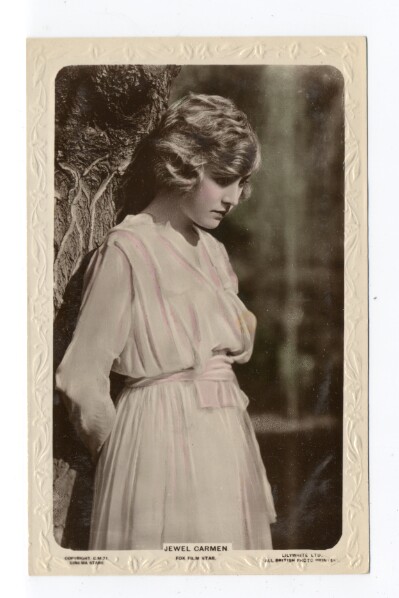
 Into this mix arrives Cassius Lee (Fairbanks), an amateur entomologist hot on the trail of the migratory caterpillar. Lee winds up involved with the heiress to the Hicks' Hatpin fortune (played by Jewel Carmen at the peak of her short-lived career) as well as gunrunners smuggling weapons to Mexico during that country's civil war (presumably to be used against the American forces who had intervened in the conflict). But, of course, this is all just an excuse to show off Fairbanks's athletic prowess and we don't get cheated as he scales buildings, springs into moving cars and swings from telephone wires.
Gotta love a man able to leap both porters and park benches in a single bound.
★★★







 Posts
Posts

