skip to main |
skip to sidebar
 Beginning at 3:45 a.m. (EDT) this evening/tomorrow morning, Turner Classic Movies is showing three of my favorite silent movies. From the TCM website:
3:45 AM The Thief Of Bagdad (1924)
An Arabian thief sets out on a magical adventure to win a beautiful princess.
Dir: Raoul Walsh Cast: Douglas Fairbanks, Snitz Edwards, Charles Belcher. BW-140 mins,
 6:15 AM The Sheik (1921)
An Arabian sheik kidnaps a beautiful Englishwoman to win her heart.
Dir: George Melford Cast: Rudolph Valentino, Agnes Ayres, Ruth Miller. BW-86 mins
 7:45 AM Our Modern Maidens (1929)
In this silent film, a flapper offers herself to a diplomat to advance her fiance's career.
Dir: Jack Conway Cast: Joan Crawford, Rod La Rocque, Douglas Fairbanks Jr. BW-76 mins
 By the way, the description of Our Modern Maidens neglects to mention some stellar supporting work from Anita Page. Now you're sold for sure!
Set your recorders boys and girls. Or better yet, stay up very, very late.
 Before Marlene Dietrich, before Ingrid Bergman, Sophia Loren or even Greta Garbo, Polish film star Pola Negri made the journey from Europe to Hollywood and found fame in America, the first European film actress to succeed on both sides of the Atlantic.
She was born Barbara Apolonia Chałupiec in what is now Poland in 1897, fashioning the name "Pola Negri" for herself (after Italian poet Ada Negri) during her confinement to a sanitarium for tuberculosis. After Russian authorities sent Negri's father to Siberia as a revolutionary, Negri and her mother moved to Warsaw where Negri studied ballet and eventually found success on the stage and screen.
 During World War I, she moved to Berlin where she caught the attention of Ernst Lubitsch who signed her to a movie contract at Universum Film AG ("UFA"), Germany's best studio and, until the Nazis took power in 1933, one of the most influential in the world. After a half dozen low-budget films with other directors, Lubitsch in 1918 cast Negri as the lead in Die Augen der Mumie Ma—"The Eyes of the Mummy."
We remember Lubitsch now for his witty, sophisticated comedies, but during his early career in Germany, he alternated between broad farces and serious dramas. The former usually starred Ossi Oswalda, the latter, Negri. Despite its lurid title, The Eyes of the Mummy wasn't a horror picture but a tragic romance, the story of a young woman (Negri) rescued from the Egyptian tombs where her captor (Emil Jannings) has held her for years only to find him stalking her anew through the posh capitals of Europe.
 The Eyes of the Mummy is a minor entry in the Lubitsch canon, and Negri is still a raw young actress (she was just twenty-one when filming began), but somebody connected with the film—the screenwriters, Lubitsch, Negri—knew something about the psychology of stalking from the point of view of both the stalker and the victim, and Negri is effective as a lusty child-woman slavishly devoted to whichever man possesses her at any given moment.
 Better is Lubitsch's next collaboration with Negri, a film version of Prosper Mérimée's novel, Carmen. Adapted to film as early as 1907, the story of a soldier who throws over his family, his fiancee and his honor for a beautiful gypsy smuggler with tragic results has spawned dozens of versions over the years and was familiar enough to audiences that Charlie Chaplin could film a spoof of it, A Burlesque on Carmen, in 1915. Stripped of its Spanish setting, Carmen is essentially a retelling of Eve and the apple, and while I agree with Nero Wolfe's sidekick Archie Goodwin that "[n]o man was ever taken to hell by a woman unless he already had a ticket in his pocket, or at least had been fooling around with timetables," that doesn't mean this oft-repeated formula doesn't work; indeed, it forms the basis of much of literature, film noir and some of the more brutal aspects of many of the world's cultures.
 The key to Carmen is, of course, the actress playing the title role. You have to believe that an honorable man would throw away his good name, a promising career and a faithful fiancee for a romp with a treacherous tramp. Although the print of Carmen has deteriorated beyond repair in places, it's still possible to see what both Don José and movie audiences saw in Pola Negri's Carmen—she's ripe and sensual, with large eyes full of promises she has no intention of keeping.
Better men than Don José have given up a whole lot more for a whole lot less.
 "Love is disgusting," Negri herself later opined, "when you no longer possess yourself."
Negri and Lubitsch made a total of eight movies together, each better than the one before it. In addition to The Eyes of the Mummy and Carmen, they made Madame DuBarry (a.k.a Passion) and Rausch (both 1919), Sumurun (a.ka. One Arabian Night) (1920), Die Bergkatze ("The Wildcat") (1921), Die Flamme (1923) and Forbidden Paradise (made in Hollywood in 1924 for Paramount).
Negri's collaboration with Lubitsch made her an international star, and so great was her reputation that the U.S. finally dropped its embargo of German films (instituted during the war) just to satisfy popular curiosity. After the success of Carmen (released in the United States in 1921 as Gypsy Blood), Negri signed with Paramount and arrived in New York in September 1922.
 She quickly supplanted Theda Bara as silent film's top sex symbol and while (thanks to the vagaries of film preservation) I can't compare Negri to Bara's most famous role, Cleopatra, if Bara's surviving film A Fool There Was is any indicator, Negri was lightyears beyond her in terms of projecting sexuality on the screen. Was Negri a great actress? I'm not sure. But judging from the reaction of audiences when her European films finally made their way to America, she was revolutionary.
The films with Lubitsch also represented Negri at the top of her popularity. Despite begging her to come to Hollywood, Paramount didn't really know what to do with Negri and as her star faded, she became even more theatrical and haughty, which poisoned her relationship to both the studio and her audience.
 When in 1926, the press decided her engagement to the recently deceased Rudolph Valentino was a fabrication, the public was done with her. To her dying day, Negri insisted that the engagement was real and told the Los Angeles Times shortly before her death, "Rudy was the great love of my life. I remember him with great regret. Somehow, the fates changed what wasn't to be. You can't rage with anger against it, and even though you love someone, you like to be with them and want to marry them and hope that it will all work out this time ... but he died, just when we were engaged to be married."
She was also briefly engaged to Charlie Chaplin who jilted her soon after giving her a $15,000 engagement ring. Negri's revenge? She gave the ring to her Forbidden Paradise co-star, Rod La Rocque.
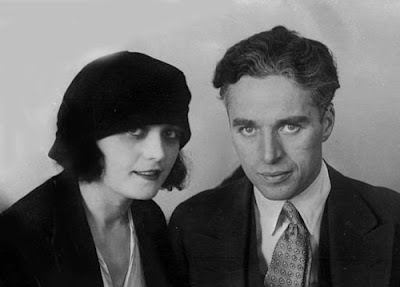 She later married a Georgian prince, Serge Mdivani, who left her for an opera singer after Negri lost her fortune in the stock market crash of 1929. After their divorce, Negri lived with Margaret West, a Texas oil heiress, until the latter's death in 1963.
"No one could believe that we were closest friends, that nothing sexual was involved," she wrote in her autobiography. "Yet it is true. She was as close a friend as I've ever had."
 When talkies came in, Negri's thick accent relegated her to supporting roles. Despite a measure of success in such films as A Woman Commands—she had a hit with the song "Paradise"—she retreated to Europe and retired in 1943, making one last picture in 1964, The Moon-Spinners, at Walt Disney's personal behest. Her London press conference promoting the film was a sensation—she showed up with a live cheetah on a chain leash.
Negri died on August 1, 1987, in San Antonio, Texas. She was 90 years old.
"That's Typing" Tuesday, in which I share unpolished, unpublished writings from my vast store of unpolished, unpublished writings. On Tuesdays.
 My post about Anita Loos yesterday inspired this additional thought: that during the silent era, Hollywood was a wide-open town as far as opportunities for women were concerned. Not just limited to the latest pretty face, women had a chance to direct, produce and especially write—hell, Mary Pickford owned her own studio and distribution company.
 Indeed, I've read that more than half the screenwriters in Hollywood during the silent era were women—certainly the good ones were: in addition to Anita Loos, there was Frances Marion (who'd later win two Oscars), Jeanie Macpherson (who wrote all the good movies Cecil B. DeMille ever made) and June Mathis (who made Rudolph Valentino a star and later adapted Ben-Hur for the screen).
 When the sound era forced studios to build thousands of new theaters and then the Great Depression soon after decimated the marketplace, Hollywood's moguls were forced to borrow millions of dollars to keep their studios afloat. Much like today, these money men were more interested in seeing a return on their investment than they were in art, experimentation or newfangled ideas (even the ones that worked). Powerful women made them nervous and women in the workplace, generally, smacked of unorthodox business practices, so women were out—no more Lois Weber's, no more Alice Guy's.
Because let's face it: nobody fears the future quite like a man with money.
 And Kathryn Bigelow's Oscar (The Hurt Locker) notwithstanding, Hollywood's women have never really recovered, at least not in terms of the percentages working in high places. Something to think about the next time you congratulate yourself for being smarter than your grandparents.
 As part of this month's feature series, "Hollywood and Race: Arab Images On Film," Turner Classic Movies is showing three silent films tonight, The Sea Hawk (1924), The Thief of Bagdad (1924) and The Sheik (1921).
I've never seen the silent version of The Sea Hawk, but The Thief of Bagdad and The Sheik are must-see movies if you want to understand the silent era. The former is the best Douglas Fairbanks movie ever made, the latter established Rudolph Valentino as the greatest sex symbol of his generation.
I highly recommend both movies.
From TCM's website:
8:00 PM The Sea Hawk (1924)
In this silent film, an English noble sold into slavery escapes and turns himself into a pirate king. Dir: Frank Lloyd Cast: Milton Sills, Enid Bennett, Lloyd Hughes. BW-124 mins, TV-G
10:30 PM The Thief Of Bagdad (1924)
An Arabian thief sets out on a magical adventure to win a beautiful princess. Dir: Raoul Walsh Cast: Douglas Fairbanks, Snitz Edwards, Charles Belcher. BW-140 mins, TV-PG
1:00 AM The Sheik (1921)
An Arabian sheik kidnaps a beautiful Englishwoman to win her heart. Dir: George Melford Cast: Rudolph Valentino, Agnes Ayres, Ruth Miller. BW-86 mins
 A great on-screen couple in three silent movies (Flesh And The Devil, Love and A Woman Of Affairs), Greta Garbo and John Gilbert also had a passionate off-screen romance and were, to my mind, the most beautiful of Hollywood's Silent Era couples.
They met on the set of their first movie together, Flesh And The Devil. Gilbert was one of Hollywood's biggest names, earning a million dollars a year after the critical and commercial success of King Vidor's The Big Parade, and with the death of Rudolph Valentino, heir to the title of the Sexiest Man Alive. Garbo was a virtual unknown with a reputation as a moody ice queen.
"Hello, Greta," Gilbert reportedly said at their first meeting.
"It is Miss Garbo," was her reply.
Yet somehow they lit up the screen together. The two fell in love with the cameras rolling and began an affair before the production was over.
The movie was a smash. Garbo created a sensation with her ethereal beauty, cool, exotic manner and thoroughly modern (for 1926) characterization of an amoral woman who slept with whomever she wanted. Gilbert further cemented his reputation as the screen's greatest lover. Their off-camera romance was a mirror of their on-screen one—torrid, tempestuous and complicated by other relationships. Gilbert, who was married four times and was in the midst of a bitter divorce, proposed and Garbo, who never married, came as close to saying "I do" with Gilbert as she ever did.
Some say she left Gilbert literally standing at the altar.
I don't know if that story is based in fact or the work of an overly-romantic publicity department, but in any event, the two parted and their careers went in decidedly different directions.
Despite his fine, classically-trained stage voice, Gilbert's career foundered with the introduction of sound. Audiences expecting John Wayne got Ronald Colman, not to mention that the studio carelessly saddled Gilbert with poor scripts in his first sound outings. That "I love you I love you I love you" bit from Singin' In The Rain? That was Gene Kelly copying an actual John Gilbert performance.
The two made one last movie together, the box-office failure Queen Christina, before Gilbert died of a heart attack in 1936.
Garbo continued to make movies, was nominated for three Oscars and then abruptly retired in 1941 to become one of history's most famous recluses. I'll go into more depth about her later career when we reach the sound era.
And in a few weeks, as part of an occasional series about famous Hollywood couples, I'll write about the other great couple of Silent Era, Mary Pickford and Douglas Fairbanks.
 Considered the movies' first male sex symbol, Rudolph Valentino tangoed his way into the hearts of American women in 1921 with his breakthrough role in The Four Horsemen Of The Apocalypse, in which he played the playboy son of an Argentine cattle baron. His most famous role was as the title character in The Sheik, a bodice-ripper set in the Arabian desert.Born in Italy in 1895, Valentino emigrated to the United States at the age of 18 and worked for a time as a taxi dancer at Maxim's. Following a relationship with a married woman who shot her husband during a messy divorce proceeding, Valentino fled New York and ended up in Los Angeles.
He had minor roles in a number of films before being spotted by screenwriter June Mathis who thought he would be perfect in her next picture. The Four Horsemen Of The Apocalypse, released in early 1921, made Valentino a star. His performance in The Sheik six months later cemented his image as the screen's greatest sex symbol.
Despite his success, Valentino spent lavishly and was often in debt. He was twice married, had numerous relationships with women (and possibly men) and was once arrested on bigamy charges.
On the subject of romance, The Great Latin Lover, as he was known, offered up this insight: "To generalize on women is dangerous. To specialize in them is infinitely worse."
Valentino died at the age of 31 after an operation for a perforated ulcer, still at the height of his popularity. As many as 100,000 people attended his memorial service in New York.
Trivia: Sheik Condoms, first marketed in the 1930s, were named after Valentino's most famous role and carried his silhouette on the package. Silhouette of what, exactly, is unclear ...
 Decades after the demise of silent movies, one star from that era remains instantly recognizable: Charles Chaplin. And when it came time to choose the best actor of the Silent Era, I didn't hesitate. I'm a Chaplin man, through and through.
My feelings on this matter, however, are not universally shared, nor should they be, this being a democracy of aesthetic preferences rather than a tyranny of objective certainties. But I think I can explain my choice in a way that will at least show it's an informed one.
First, let's run through the nominees one by one.
Arguably, Emil Jannings was the most respected dramatic actor of the Silent Era and in fact, he won the very first Oscar for his performances in The Last Command and The Way Of All Flesh (early Oscars were awarded for a body of work in a given year rather than for a specific performance).
But you don't hear much about Jannings anymore—and not just because he returned to Hitler's Germany in the early 1930s and became an ardent Nazi. As I have written before, silent movies didn't lend themselves to straight drama and watching Jannings work now is, in my opinion, strictly for film students.
Another fine dramatic actor was John Barrymore, a handsome matinee idol known as "The Great Profile." Still, to my mind, his best performances (until alcoholism destroyed his career) came during the early days of the sound era.
Then there's Rudolph Valentino, the male pin-up star of the Silent Era. He made thirty-eight movies, The Sheik being the best known. Frankly, though, Valentino was more of an icon than an actor—pleasing eye candy if that's your idea of a good time—and his appeal lies more in the idea the name evokes than in any actual performance.
Equally famous in his day was Douglas Fairbanks. He was in some fine movies, co-founded United Artists and was awarded an honorary Oscar in 1940. But fairly or unfairly, I think of Fairbanks primarily as the Silent Era's greatest stunt man and swashbuckler than its greatest actor.
The strongest choice for best actor of the Silent Era not named Buster Keaton or Charlie Chaplin would be Lon Chaney, forever known, thanks to his brilliant makeup jobs and varied characterizations, as "The Man of a Thousand Faces." The title roles he played in the silent versions of The Hunchback Of Notre Dame and The Phantom Of The Opera are among the most indelible in the history of motion pictures.
Nevertheless, as great as Chaney was, there are only two real possible choices for title of Best Actor of the Silent Era: Charles Chaplin or Buster Keaton.
Next up, Part Two: "Chaplin Or Keaton: The Never-ending Argument"

 Beginning at 3:45 a.m. (EDT) this evening/tomorrow morning, Turner Classic Movies is showing three of my favorite silent movies. From the TCM website:






 Posts
Posts


