skip to main |
skip to sidebar
In Tod Browning's West Of Zanzibar, Lon Chaney is crippled in a quarrel with his wife's lover (Lionel Barrymore) and takes his revenge on the daughter he believes to be theirs. First he forces her to work in a brothel. Then he arranges for cannibals to burn her alive. Then he really gets mad.
As with most Lon Chaney movies, it starts out weird then rides the twists and turns to a bloody and bizarre conclusion. Like an O. Henry story written by a psychopath.
Good stuff.
With Mary Nolan as the grown child.
(What is this? Read here.)
Best Performance in a Quentin Tarantino Movie
In case you haven't noticed, this is actually a pretty tough category. Several actors and actresses have given career performances in Tarantino's films—Michael Madsen, Samuel L. Jackson, John Travolta, Pam Grier, Robert Forster, Uma Thurman ...
Any one of whom would be a great choice. But I'm going with Christoph Waltz as Col. Hans Landa in Inglourious Basterds. Smart, smarmy, sinister, he might be the only actor in history who could make you sweat bullets simply by eating a strudel.
Best Performance With a Serious Disease
Oscar loves this sort of thing, but generally speaking, the Monkey doesn't. If a cartoon character's performance counted, I'd go with the two-part breast cancer episode of FX's spy spoof Archer. But that's television and we're talking movies, so I'm going with Greta Garbo in Camille. She makes dying look so beautiful and stylish, I almost wish I had tuberculosis.
Best Performance Where You Do a Lot of A-C-T-I-N-G and Arm-Waving
Meryl Streep owns this category, but I'll be honest with you—outside of her latter-day comedies, Meryl Streep's not really my cup of tea. Acting may indeed be hard, but I've always thought the best actors made it look easy. I'll take Cary Grant over Laurence Olivier any day.
I do enjoy some of the great ham actors of history—particularly John Barrymore and Wallace Beery—but among cinema's more serious-minded scenery-chewers, I'm quite fond of Kirk Douglas. And my favorite Kirk Douglas performance is that of bottom-feeder tabloid journalist Chuck Tatum in Billy Wilder's Ace in the Hole, quite possibly the most cynical movie ever made.
Best Performance Where You Just Sit There and Your Eyes Get Sad
Usually with a pop tune playing in the background—a staple of bad television. But at the risk of enraging Douglas Fairbanks, I have to say Lon Chaney, the silent era's man of a thousand faces, did more acting with his eyes than nearly anyone I can think of. Being buried under all that makeup, he had to.
He gave many great performances, including The Hunchback of Notre Dame and The Phantom of the Opera, but maybe the one that depended the most on "sad eyes" was Laugh, Clown, Laugh, the story of an aging circus performer who raises an abandoned girl as his own only to find to his horror and his shame that when she grows to young womanhood he is falling hopelessly in love with her. A brilliant performance.
Best Performance With a Lot of Nudity That Was Probably Unnecessary But Not Unwelcome
The 1970s was the era of gratuitous nudity—at least one scene casually featuring bare breasts was pretty much de rigueur back then, especially in films that aspired to hip sophistication—but looking back at it now, the whole trend seems sexist, exploitative and even a bit creepy. So I'm jumping forward two decades to 1997's Titanic, a film that grossed something like a billion dollars, won the Oscar for best picture and has completely faded from my memory except for Kate Winslet's nude scene.
Bluenosed video store owners excised the footage from VHS copies of the movie without realizing Winslet's shapely bosom was the only part of the movie worth watching. I hope they at least had the good sense to stitch all that discarded tape together into a single endless loop.
Tomorrow: explosions, cross-overs, aging, manly tears and Citizen Kane.
 Along with Méliès's rocket hitting the moon in the eye and Chaplin as the Tramp, Harold Lloyd hanging from the hands of a clock is one of the most iconic images of the silent era. And the movie it comes from, Safety Last!, is quintessential Lloyd—the nebbishy nice guy with the glasses who winds up performing some truly outrageous and inventive physical stunts, all for love.
I'm going with Lloyd for best actor.
My choice for best picture is The Hunchback of Notre Dame. You've probably heard of it—stars a fellow named Lon Chaney in one of his most famous roles.
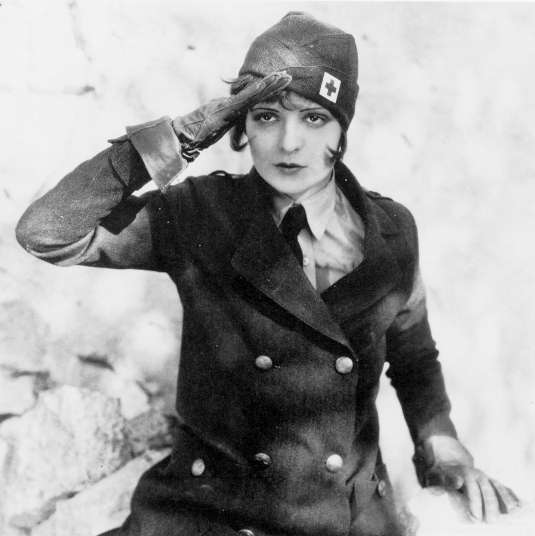
Finally, according to Alternate Oscar guru Danny Peary, I'm entitled to one tie in the actor category and one in the actress. I'm using my actress tie here, to recognize Colleen Moore and Norma Talmadge with what are essentially career achievement awards. Only one reel of Flaming Youth survives, but it was a trendsetter—much more than anything Louise Brooks would later do, Colleen Moore with this role established the "flapper look" in the minds of the public—and along with those films of Moore's that do survive, I think she's one of the top actresses of the silent era. As for Norma Talmadge, she was to the silent era what Bette Davis was to the Golden Age. Her best available movie is the 1926 comedy Kiki, but Within the Law is actually more typical.
Picture: The Hunchback Of Notre Dame (prod. Carl Laemmle and Irving Thalberg)
 Actor: Harold Lloyd (Safety Last!)
 Actress: Colleen Moore (Flaming Youth) and Norma Talmadge (Within The Law) (tie)
 Director: Abel Gance (La Roue)
 Supporting Actor: Adolphe Menjou (A Woman Of Paris)
 Supporting Actress: Gladys Brockwell (The Hunchback Of Notre Dame)
 Screenplay: Perley Poore Sheehan (adaptation) and Edward T. Lowe Jr. (scenario), from the novel by Victor Hugo (The Hunchback Of Notre Dame)

 Some of you are probably too young to remember, but I originally started this blog to peddle (in a non-remunerative way) something I like to call the "Katie-Bar-The-Door Awards"—alternate Oscars (who should have been nominated, who should have won) but which as you know are really just an excuse to write a history of the movies from the Silent Era to the present day.
Then I got distracted by silent movies and will continue to be distracted for the foreseeable future.
But what about the Katie Awards?
Well, rather than let them wither on the vine, I'm going to post them, one year at a time, one post a day, until I run out of them, say sometime in February. I've been serving them up on the stand-alone pages highlighted on the right hand side of the blog, but people rarely head over there (why would they) and while some of my choices may be no better than "meh," the pictures that accompany them are, all modesty aside, dynamite.
So here, in case you've forgotten, are my first year's worth of picks, covering the Oscar year running from August 1, 1927 to July 31, 1928.
PICTURE (Drama)
winner: Sunrise: A Song Of Two Humans (prod. William Fox)
nominees: The Crowd (prod. Irving Thalberg); The Last Command (prod. Jesse L. Lasky and Adolph Zukor); Laugh, Clown, Laugh (prod. Herbert Brenon); The Man Who Laughs (prod. Paul Kohner); Wings (prod. Lucien Hubbard)
Must-See Drama: The Crowd; The Last Command; Laugh, Clown, Laugh; The Man Who Laughs; Sadie Thompson; Sunrise: A Song Of Two Humans; Wings
PICTURE (Comedy/Musical)
winner: The Jazz Singer (prod. Warner Brothers)
nominees: The Circus (prod. Charles Chaplin); My Best Girl (prod. Mary Pickford); Speedy (prod. Harold Lloyd); The Student Prince In Old Heidelberg (prod. Ernst Lubitsch)
Must-See Comedy/Musical: The Circus; The Jazz Singer; My Best Girl; The Patsy; Speedy; The Student Prince In Old Heidelberg
PICTURE (Foreign Language)
winner: Spione (Spies) (prod. Erich Pommer)
nominees: Berlin: Symphony Of A Great City (prod. Karl Freund); October (Ten Days That Shook The World) (prod. Sovkino)
ACTOR (Drama)
winner: Lon Chaney (Laugh, Clown, Laugh)
nominees: Emil Jannings (The Last Command); Conrad Veidt (The Man Who Laughs)
ACTOR (Comedy/Musical)
winner: Al Jolson (The Jazz Singer)
nominees: Charles Chaplin (The Circus); Harold Lloyd (Speedy)
ACTRESS (Drama)
winner: Janet Gaynor (7th Heaven; Sunrise: A Song Of Two Humans and Street Angel)
nominees: Eleanor Boardman (The Crowd); Gloria Swanson (Sadie Thompson)
ACTRESS (Comedy/Musical)
winner: Mary Pickford (My Best Girl)
nominees: Marion Davies (The Patsy); Norma Shearer (The Student Prince In Old Heidelberg)
DIRECTOR (Drama)
winner: F.W. Murnau (Sunrise: A Song Of Two Humans)
nominees: Paul Leni (The Cat And The Canary and The Man Who Laughs); King Vidor (The Crowd); Josef von Sternberg (The Last Command); William A. Wellman (Wings)
DIRECTOR (Comedy/Musical)
winner: Charles Chaplin (The Circus)
nominees: Ernst Lubitsch (The Student Prince In Old Heidelberg); Lewis Milestone (Two Arabian Knights); Ted Wilde (Speedy)
SUPPORTING ACTOR
winner: Jean Hersholt (The Student Prince In Old Heidelberg)
nominees: Lionel Barrymore (Sadie Thompson); Gary Cooper (Wings); Rudolf Klein-Rogge (Spione); William Powell (The Last Command)
SUPPORTING ACTRESS
winner: Clara Bow (Wings)
nominees: Evelyn Brent (The Last Command); Gladys Brockwell (7th Heaven); Louise Brooks (A Girl In Every Port); Mary Philbin (The Man Who Laughs)
SCREENPLAY
winner: Herman J. Mankiewicz (titles) and John F. Goodrich (writer), from a story by Lajos Biró and Josef von Sternberg (The Last Command)
nominees: King Vidor and John V.A. Weaver; titles by Joseph Farnham (The Crowd); Elizabeth Meehan; titles by Joseph Farnham; from a play by David Belasco and Tom Cushing (Laugh, Clown, Laugh); Raoul Walsh; titles by C. Gardner Sullivan; from a story by W. Somerset Maugham (Sadie Thompson)
SPECIAL AWARDS
George Groves (The Jazz Singer) (Special Achievement In The Use Of Sound); "Toot Toot Tootsie" (The Jazz Singer) (Best Song); Charles Rosher and Karl Struss (Sunrise: A Song Of Two Humans) (Cinematography); Roy Pomeroy (Wings) (Special Effects)
(Note: I'll cop to having changed one of my picks from when I originally posted them back in 2009. Originally, I went with The Crowd, King Vidor's blistering take on the American Dream, for best screenplay. At the time it struck me as edgy and unique. In fact, now that I've watched 800+ silent movies, I realize that The Crowd actually arrived at the tale end of a long series of social message pictures that dated back to D.W. Griffith's one-reel wonder A Corner in Wheat and included tales about the hot button issues of the day—immigration, white slavery, abortion, etc. Far from being cutting edge, The Crowd was in 1928 something of a cliche—a well-made cliche, perhaps, but no more brave than, say, Guess Who's Coming To Dinner was in 1967.
 Instead, I've gone with The Last Command, Josef von Sternberg's moving story about a Russian general reduced after the revolution of 1917 to begging bit parts as an actor in Hollywood. It won Emil Jannings a well-deserved Oscar and also starred William Powell in one of his darkest dramatic roles. A real must-see.)


 Along with Méliès's rocket hitting the moon in the eye and Chaplin as the Tramp, Harold Lloyd hanging from the hands of a clock is one of the most iconic images of the silent era. And the movie it comes from, Safety Last!, is quintessential Lloyd—the nebbishy nice guy with the glasses who winds up performing some truly outrageous and inventive physical stunts, all for love.


 Some of you are probably too young to remember, but I originally started this blog to peddle (in a non-remunerative way) something I like to call the "Katie-Bar-The-Door Awards"—alternate Oscars (who should have been nominated, who should have won) but which as you know are really just an excuse to write a history of the movies from the Silent Era to the present day.



 Instead, I've gone with The Last Command, Josef von Sternberg's moving story about a Russian general reduced after the revolution of 1917 to begging bit parts as an actor in Hollywood. It won Emil Jannings a well-deserved Oscar and also starred William Powell in one of his darkest dramatic roles. A real must-see.)




 Posts
Posts


