skip to main |
skip to sidebar
At first blush, Dorothy Vernon of Haddon Hall is a radical departure for its star Mary Pickford.
Based on a popular novel by Charles Major, Dorothy Vernon is a lavish costume drama set during the conflict between Queen Elizabeth I and Mary, Queen of Scots. Pickford plays the title character, a real-life aristocrat who for reasons history has not quite remembered managed to alienate both sides in the battle of royal succession. The film is full of court intrigue, murder plots, sword fights—in short, the sort of movie Pickford's husband Douglas Fairbanks might have made during this period.

But as the story develops, the Pickford we know and love quickly emerges. She plays an adult role for once, but an eighteen year old on the eve of an arranged marriage to a scheming cousin who wants to use the occasion to attract the presence of Elizabeth, whom he plans to murder in a plot to put Mary Stuart on the throne of England.
If you know your British history, you know Mary Stuart never sat upon the throne of England so I don't think it's a spoiler to say that the plucky, feisty, bonny Dorothy—the traits most typical of a Pickford character—saves the day. (For more background about Pickford, click here.)

She succeeds with the help of her true love, Sir John Manners, essayed by Pickford's brother-in-law, Allan Forrest. (The film was a real family affair, with Pickford's sister Lottie playing Dorothy's lady-in-waiting.) Forrest plays his part in the Douglas Fairbanks style, with lots of swashbuckling and leaping about, and even throwing his back and laughing uproariously, a patented Fairbanks move.
And therein lies the film's weakness—Forrest is no Douglas Fairbanks. That fact is made abundantly clear in his very first scene, a shot of his wide muscular back as a doctor attends to wounds received in battle. Forrest was, in fact, a quite slender lad, and the back is doubled by none other than Fairbanks himself, who was filming The Thief of Bagdad one set over. I couldn't help but wonder how much more fun the film would have been if Fairbanks had actually played the role of John Manners. Not only would the acting and swordplay have been better, but the outsized nature of his magnetic personality would have short-circuited the need for so much character exposition that bogs down the beginning of the film.

But, alas, Fairbanks and Pickford made only one movie together, the 1929 talkie, The Taming of the Shrew.
Still, a Pickford movie is primarily about Mary Pickford, and she does not disappoint. She had one of the most expressive faces of the silent era, and one of the most appealing personas. Throw in the wonderful costumes and Pickford's stunt work performed herself when her double was injured—including a particularly dangerous gallop up a three-foot wide stair to the top of a narrow stone wall—and you've got a pretty entertaining movie on your hands.
The film wasn't one of Pickford's blockbuster smashes upon its release in 1924, but it did turn a tidy profit and was a nice prestige release for Pickford's studio, United Artists.

A newly-restored 35 mm print of the film is playing now in a limited run in select cities. Film historian Christel Schmidt, author of Mary Pickford: Queen of the Movies, will be touring with the film, as will Ben Model, who provides live musical accompaniment. If you get a chance to see it before it heads back to the archives at the Cinematheque Royale de Belgique, by all means, don't miss it.
 Before Marlene Dietrich, before Ingrid Bergman, Sophia Loren or even Greta Garbo, Polish film star Pola Negri made the journey from Europe to Hollywood and found fame in America, the first European film actress to succeed on both sides of the Atlantic.
She was born Barbara Apolonia Chałupiec in what is now Poland in 1897, fashioning the name "Pola Negri" for herself (after Italian poet Ada Negri) during her confinement to a sanitarium for tuberculosis. After Russian authorities sent Negri's father to Siberia as a revolutionary, Negri and her mother moved to Warsaw where Negri studied ballet and eventually found success on the stage and screen.
 During World War I, she moved to Berlin where she caught the attention of Ernst Lubitsch who signed her to a movie contract at Universum Film AG ("UFA"), Germany's best studio and, until the Nazis took power in 1933, one of the most influential in the world. After a half dozen low-budget films with other directors, Lubitsch in 1918 cast Negri as the lead in Die Augen der Mumie Ma—"The Eyes of the Mummy."
We remember Lubitsch now for his witty, sophisticated comedies, but during his early career in Germany, he alternated between broad farces and serious dramas. The former usually starred Ossi Oswalda, the latter, Negri. Despite its lurid title, The Eyes of the Mummy wasn't a horror picture but a tragic romance, the story of a young woman (Negri) rescued from the Egyptian tombs where her captor (Emil Jannings) has held her for years only to find him stalking her anew through the posh capitals of Europe.
 The Eyes of the Mummy is a minor entry in the Lubitsch canon, and Negri is still a raw young actress (she was just twenty-one when filming began), but somebody connected with the film—the screenwriters, Lubitsch, Negri—knew something about the psychology of stalking from the point of view of both the stalker and the victim, and Negri is effective as a lusty child-woman slavishly devoted to whichever man possesses her at any given moment.
 Better is Lubitsch's next collaboration with Negri, a film version of Prosper Mérimée's novel, Carmen. Adapted to film as early as 1907, the story of a soldier who throws over his family, his fiancee and his honor for a beautiful gypsy smuggler with tragic results has spawned dozens of versions over the years and was familiar enough to audiences that Charlie Chaplin could film a spoof of it, A Burlesque on Carmen, in 1915. Stripped of its Spanish setting, Carmen is essentially a retelling of Eve and the apple, and while I agree with Nero Wolfe's sidekick Archie Goodwin that "[n]o man was ever taken to hell by a woman unless he already had a ticket in his pocket, or at least had been fooling around with timetables," that doesn't mean this oft-repeated formula doesn't work; indeed, it forms the basis of much of literature, film noir and some of the more brutal aspects of many of the world's cultures.
 The key to Carmen is, of course, the actress playing the title role. You have to believe that an honorable man would throw away his good name, a promising career and a faithful fiancee for a romp with a treacherous tramp. Although the print of Carmen has deteriorated beyond repair in places, it's still possible to see what both Don José and movie audiences saw in Pola Negri's Carmen—she's ripe and sensual, with large eyes full of promises she has no intention of keeping.
Better men than Don José have given up a whole lot more for a whole lot less.
 "Love is disgusting," Negri herself later opined, "when you no longer possess yourself."
Negri and Lubitsch made a total of eight movies together, each better than the one before it. In addition to The Eyes of the Mummy and Carmen, they made Madame DuBarry (a.k.a Passion) and Rausch (both 1919), Sumurun (a.ka. One Arabian Night) (1920), Die Bergkatze ("The Wildcat") (1921), Die Flamme (1923) and Forbidden Paradise (made in Hollywood in 1924 for Paramount).
Negri's collaboration with Lubitsch made her an international star, and so great was her reputation that the U.S. finally dropped its embargo of German films (instituted during the war) just to satisfy popular curiosity. After the success of Carmen (released in the United States in 1921 as Gypsy Blood), Negri signed with Paramount and arrived in New York in September 1922.
 She quickly supplanted Theda Bara as silent film's top sex symbol and while (thanks to the vagaries of film preservation) I can't compare Negri to Bara's most famous role, Cleopatra, if Bara's surviving film A Fool There Was is any indicator, Negri was lightyears beyond her in terms of projecting sexuality on the screen. Was Negri a great actress? I'm not sure. But judging from the reaction of audiences when her European films finally made their way to America, she was revolutionary.
The films with Lubitsch also represented Negri at the top of her popularity. Despite begging her to come to Hollywood, Paramount didn't really know what to do with Negri and as her star faded, she became even more theatrical and haughty, which poisoned her relationship to both the studio and her audience.
 When in 1926, the press decided her engagement to the recently deceased Rudolph Valentino was a fabrication, the public was done with her. To her dying day, Negri insisted that the engagement was real and told the Los Angeles Times shortly before her death, "Rudy was the great love of my life. I remember him with great regret. Somehow, the fates changed what wasn't to be. You can't rage with anger against it, and even though you love someone, you like to be with them and want to marry them and hope that it will all work out this time ... but he died, just when we were engaged to be married."
She was also briefly engaged to Charlie Chaplin who jilted her soon after giving her a $15,000 engagement ring. Negri's revenge? She gave the ring to her Forbidden Paradise co-star, Rod La Rocque.
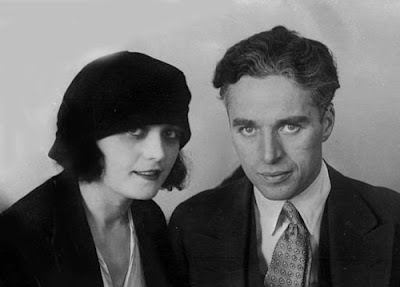 She later married a Georgian prince, Serge Mdivani, who left her for an opera singer after Negri lost her fortune in the stock market crash of 1929. After their divorce, Negri lived with Margaret West, a Texas oil heiress, until the latter's death in 1963.
"No one could believe that we were closest friends, that nothing sexual was involved," she wrote in her autobiography. "Yet it is true. She was as close a friend as I've ever had."
 When talkies came in, Negri's thick accent relegated her to supporting roles. Despite a measure of success in such films as A Woman Commands—she had a hit with the song "Paradise"—she retreated to Europe and retired in 1943, making one last picture in 1964, The Moon-Spinners, at Walt Disney's personal behest. Her London press conference promoting the film was a sensation—she showed up with a live cheetah on a chain leash.
Negri died on August 1, 1987, in San Antonio, Texas. She was 90 years old.
"That's Typing" Tuesday, in which I share unpolished, unpublished writings from my vast store of unpolished, unpublished writings. On Tuesdays.
 From my notes on Bull Durham, the 1988 comedy written and directed by Ron Shelton about a romantic triangle set in baseball's Carolina League.
... what makes it art is not the romance or the baseball but its pitch-perfect insights into the existence of a marginally-talented man. On the margins is where most of us live—if we're lucky (it's a hard world)—and aspirations of greatness almost always wind up being delusional.
"Full many a flower is born to blush unseen," Thomas Grey wrote, "and waste its sweetness on the desert air."
Well said. Unfortunately.
 While preparing for my essay on the well-known and not-so-well-known movies of 1916, I stumbled across a rather obscure Lillian Gish feature, Sold For Marriage, which I'd recommend both to fans of the legendary actress and to those interested in how Hollywood treated what was then, as now, a hot-button issue in American politics, immigration.
 By 1916, approx- imately one of every eight persons living in the United States was a first- gener- ation immigrant, with a million more arriving every year, and given that most studio owners were themselves immigrants, it should come as no surprise that the daily lives of immigrants was a frequent topic of movies throughout the decade. Sold For Marriage is specifically about Russian immigrants, a substantial community of over 3 million mostly Jewish, Ukranian and Belarusan peasants and laborers who between 1881 and 1914 had arrived in the U.S. seeking political and religious freedom and economic opportunity.
The story opens in Russia with Gish playing Marfa, a young woman on the verge of being sold into an arranged marriage to the town's most eligible bachelor, a short, fat "beast" who nevertheless promises wealth and social standing. Predictably, Marfa prefers Jan (Frank Bennett), a young, handsome—and poor—laborer. Following a narrow escape from a lusty army officer who won't take no for an answer, Marfa and her family immigrate to the U.S., where once again a struggle ensues between Marfa's desire for Jan and her family's desire to arrange a profitable marriage.
 Even though Sold For Marriage was directed by Christy Cabanne, the ending is straight out of the D.W. Griffith playbook, with classic three-part intercutting between Gish and her tormentors as her would-be savior rushes to the rescue, the sort of sequence Griffith more or less invented in 1909 and repeated many times, including in Gish's very first film, 1912's An Unseen Enemy.
 I'd like to tell you that Sold For Marriage is a nuanced look at life in the Russian community on par with near- documentary quality films such as Traffic in Souls or The Italian. It isn't. Instead, the story of a girl forced into marriage has a ripped-from-the-headlines feel to it, exploiting a hot topic for quick box-office bucks rather than offering any meaningful insight into what life might have been like for these newly-minted Americans.
And you thought Law & Order invented cheap exploitation.
What makes Sold For Marriage worth tracking down is Gish's performance. Not only is it good—as you would expect—but it reveals a side of her I can't say I've seen before. She's sullen, she's petulant, at times she funny, and more to the point, she's flirtatious and sexual, for example, clinging to Frank Bennett with a hunger that is as refreshing as it surprising. Even her performances in The Scarlet Letter and La Boheme, a pair of romances from 1926, didn't prepare me for the notion that Gish as an actress could ever be particularly comfortable as a romantic lead.
 While we think of Gish from this era as D.W. Griffith's go-to girl—e.g., The Birth of a Nation, Broken Blossoms and Way Down East—her chief collaborator in 1916 was a Griffith protege, director Christy Cabanne, and maybe this accounts for the uncharacteristic nature of Gish's performance. While Cabanne isn't nearly as imaginative a director as Griffith, perhaps he didn't so narrowly conceive of Gish as the embodiment of a virginal Victorian fantasy, allowing him to see in Gish possibilities Griffith never did.
In any event, Sold For Marriage is an unusual entry in the Lillian Gish filmography and will require me to broaden my sense of her range.
 Finally, a word about the DVD. If you're not familiar with the outfit, Classic Video Streams sells copies of rare silent-era films through Amazon.com. Generally, the videos are transferred from 16mm reduction prints and vary in quality from not-too-bad to beat-to-hell; the discs also include music scores cobbled together from pre-existing recordings. There are no "extras" so don't look for any.
In researching the films of 1916, I bought DVDs from Classic Video Streams starring Norma Talmadge, Douglas Fairbanks and Lillian Gish, and while I'd say every one of the films presented cries out for a proper restoration, for a film history buff such as myself, they are very much better than nothing.
"That's Typing" Tuesday, in which I share unpolished, unpublished writings from my vast store of unpolished, unpublished writings. On Tuesdays.
 From my notes about Miss Pettigrew Lives for a Day, a 2008 screwball comedy starring Frances McDormand and Amy Adams.
a rarity now, a romantic comedy for adults about adults—and more to the point—about adults behaving like adults ... the sort of thing that studios cranked out by the basketful in the 1930s to great effect ... Hollywood has largely forgotten how to make movies like this; worse still, audiences have forgotten how to watch them.
Frances McDormand as Miss Pettigrew ... neither glam'ed up nor glamorously made plain in the fashion of Hollywood ... simply allowed to inhabit that long face and those impossible cheekbones.
 ... Amy Adams plays Delysia LeFosse like an Egyptian embalmer has sucked her brain out with a straw—I mean that as a compliment—the sort of role Carole Lombard could have played in her sleep. On the face of it, she's a golddigger, sleeping with three different men, sometimes within minutes of each other, mostly for what they can give her; she's has the attention span of a three year old—"There is something so sensual about fur next to the skin, don't you think?"—and she's the sort of housekeeper who disposes of oyster shells in a kitchen drawer. But her scheming is so transparent, there's a sort of honesty in it, and she's so accepting of the odd, gawky Miss Pettigrew, seeing her not as an inferior but as a soul mate, that you can't help but like her.
This is a performance that could have easily gone wrong ...
 As the story opens, Delysia and Miss Pettigrew meet on the thin margin between having and having not ... a major theme of the movie, how precarious it is being a woman in what, in 1939, was very much a man's world ... so that even your enemies are kindred spirits when you're jostling for a spot in the same boat ...
... not so much a love story as a story about figuring out what's worth loving ...
Both McDormand and her unexpected, rather low-key love interest, perfectly underplayed by Ciarán Hinds (Persuasion, Munich), were in their early fifties when this was filmed. ... The trivial pursuits of youth are in their rearview mirror, and with World War II coming on, they know that everything from now on is played for keeps ... adds an undercurrent of melancholy to the daffy proceedings. ... reminds me very much of My Man Godfrey in that regard ...
 Based on a novel published in 1938, I get the impression the book's author, Winifred Watson, spent a lot of time at the movies—Miss Pettigrew would fit nicely on a bill with Stage Door and Gold Diggers of 1933 or, for that matter, Pygmalion and Lady For A Day.
Question for my readers: If you were casting this movie in the 1930s, who would you cast as the two leads?
Note: I've now finished watching movies for my essay about 1916. I should have that up in the next few days.
The Birth Of A Nation—A Deeply Flawed, Would-Be Masterpiece
 Introduction
Not entirely by coincidence, my series on the early silent era has arrived at the year 1915 on the day of the 150th anniversary of the beginning of the American Civil War. What better time then to review the most notorious Civil War film in history, D.W. Griffith's The Birth of a Nation, which premiered in the United States on February 8, 1915.
The Birth of a Nation was the most celebrated film of its era. Critics gushed in their praise, audiences gladly lined up to pay $2 to see it at a time when the average ticket cost a nickel, and when it played at the White House, President Woodrow Wilson was moved to comment, "It was like writing history with lightning."
It was the top grossing film of the silent era, with estimates of its box office take ranging from $10 million to $16 million during its initial run, more than twice that of any other silent film. With its budget of $250,000, The Birth of a Nation still ranks as one of the twenty most profitable films in history.
It's also, in my opinion, the most controversial movie ever made. The film includes sequences—for example, Ku Klux Klansmen riding to the rescue of white women being raped by actors wearing blackface—that are so grotesque in their depictions of race and their distortions of history that you can't believe that you are seeing them. In 1915, its exhibition sparked protests in cities across the nation. Riots broke out in Boston and Philadelphia, and it was banned outright in Chicago, Denver, Kansas City, Minneapolis, Pittsburgh and St. Louis. After allowing the film's premiere in Los Angeles, city leaders banned it there as well. And even where it did play, Griffith was forced to make cuts to get the film past local censors.
The reaction so stung Griffith, he spent the rest of his life apologizing, both through his films and in private.
While films such as Life of Brian and The Last Temptation of Christ generated controversy at the time of their release, can you imagine anyone turning out to protest them a hundred years from now? Yet nearly a hundred years after its release, The Birth of a Nation still generates controversy. In 2000 and 2004, plans to show the film were cancelled after complaints, and as recently as last year in Rome, New York, the film's exhibition drew a crowd of protesters that included the city's mayor.
 Let's Pretend—For A Moment
Reviewing The Birth of a Nation is never an easy task and I suspect many film critics and historians secretly (and not so secretly) wish they could just skip right over it and talk about something else. The film's reputation as being virulently racist is well deserved; and its story and its views on race are inextricably linked—every character on the screen is defined by their race and their attitudes about race and most are motivated by racial animus. So to review the movie without reviewing its racism and its distortions of history—always touchy subjects—is impossible
I won't shirk my duty, I promise, but nevertheless, let's pretend, for a moment, that we're visitors from another planet, and that issues of race and history are lost on us.
The Birth of a Nation tells the story of two families, one Northern, the other Southern, torn apart by war and its aftermath; and of a nation torn apart by the "peculiar institution," slavery. Beginning in 1860 with the election of Abraham Lincoln and running through the end of post-war Reconstruction (1865-1877), the movie covers the major events of the era—the South's secession from the Union, the resulting civil war, the emancipation of the slaves, the assassination of Lincoln, the chaotic post-war attempts to ensure the civil rights of newly-freed slaves, and finally, the white backlash that led to a century of segregation.
In the foreground of all this history is a simple love triangle involving an abolitionist senator's daughter (Lillian Gish); the senator's protegee, a free black (George Siegmann in blackface) who will eventually be named lieutenant governor of an unnamed Southern state; and a former Confederate officer (Henry Walthall) who remains unreconciled to the South's defeat. As the film builds to a climax, the senator's daughter rejects the black politician's proposal of marriage, he reacts by unleashing his wrath on whites everywhere, and the Confederate officer forms the Ku Klux Klan and rides to the rescue.
The movie is split into two halves—war and peace—and when it focuses on the former, it excels. The battle scenes play like Matthew Brady's photographs brought to life and those sequences must have seemed like a time machine to audiences in 1915. Indeed, they still rank high on a short list of well-staged combat scenes.
Also worthy of high praise is Griffith's staging of Lincoln's assassination, as well as the film's sets, cinematography, costumes and film editing, all unsurpassed in their day.
The problem with the film lies in its second half, the depiction of the post-war peace. Not only is it racist and an unforgivable distortion of history—a point we'll get to in a moment—it's also essentially ludicrous, because as the film presents it, the fate of the entire post-war South, indeed, the nation, pivots on the rival ambitions of two men—the former Confederate officer and the black lieutenant governor—to get into Lillian Gish's underpants.
The Birth of a Nation was not the first film to reduce complex historical issues to a simple question of who's humping who (although come to think of it, it may well have been), but that the fate of a nation could come down to a romantic obsession with the freakishly coy Gish—who in one scene flinches from a man's smile the way another woman might flinch from a blow—is preposterous.
The casting of Gish should have been the film's greatest strength. She was, as I've said before, the finest actress of the silent era, and her performances in Broken Blossoms, Way Down East and The Wind are as good as any ever essayed on film. But great as she was, Helen of Troy she was not, and while two men's obsession with Vivien Leigh's Scarlett O'Hara—essentially a modern flapper in a hoop skirt—could turn Gone With The Wind into one of the greatest romances ever made, Griffith's idealized conception of Gish as a virginal 19th century dishrag was old-fashioned even by 1915's terms.
Thus, without war or the saintly Lincoln or a compelling romance to carry the film's second half, The Birth of a Nation depends purely on its racial politics—and the action related thereto—to supply its forward momentum. And there's the rub: if you don't bring an inate fear of blacks into the theater with you, if the thought of blacks voting, owning property, marrying whomever they want and even, gee whiz, running the country doesn't inherently scare the pants off you, the last ninety minutes becomes unbearably tedious.
I have to admit that even though I'm a veteran of over 600 silent movies, once The Birth of a Nation reached its second half, I found my eyelids growing heavy.
So let's talk about the film's racial politics.
Race And Racism
There's no sidestepping the racism at the heart of The Birth of a Nation, and watching it and claiming not to have an opinion is like saying you only read Playboy for the interviews—you're either a fool or a liar. (Turn-ons: movie bloggers, Netflix. Turn-offs: pan-and-scan.)
 There are two types of racism on display in The Birth of a Nation. One you might call "common practice racism," that is to say, the sort of racism that arose from the habitual practices of the day. The use of white actors in blackface, for example, is a prime example. Studios of that era believed that audiences—and maybe more to the point, state and local censorship boards—would object to seeing blacks and whites together on screen, particularly where, as here, violence or sex was involved. So what were clearly white actors in blackface makeup were substituted for black actors.
Too, racial minorities commonly served in film as comic relief, and were most often portrayed—when they were portrayed at all—as ignorant, fearful and subservient clowns. You'll see plenty of that here and while I've argued in the past and will argue again in the future that to ignore every image or performance that a modern audience might find objectionable today would be to present a history of film even more lily white than it already was, I won't pretend that such depictions in The Birth of a Nation aren't as bad as you're ever likely to see.
But ultimately, it's the film's second type of racism, what I'd call "propagandist racism," that is so deeply troubling. For the racism of The Birth of a Nation was not merely an unfortunate, unintentional side effect of the early 20th century's societal ills—it was the point. Thomas Dixon's novel, The Clansman, on which the movie was based, was an unapologetic exercise in white supremacist propaganda, stacking the deck against blacks to foment rage in its intended white audience and garner support for segregationist policies.
The Birth Of A Nation turns history on its head, telling us that after the Civil War a "helpless white minority" lived under the boot heel of black oppression and that the United States didn't become a nation, indivisible, once again until all white people, Northerner and Southerner, Unionist and Confederate, abolitionist and ex-slaveholder, rallied together to combat the single biggest threat to civilization—black men with equal rights.
The film is a white supremacist's wet dream. As history, it's ridiculous. The landed, slave-owning gentry that had led the South out of the Union and into the Civil War may have feared losing its iron-grip on power after the war, but it never feared losing its right to exist; whereas the reality for freed slaves was that their most basic freedoms—to vote, to own property, to walk down the street without fear of being murdered at the whim of a white man—were fragile at best and easily taken away again. The notion that the Klan was the only thing standing between civilization and a marauding hoard of rape-hungry blacks is not only racist, it's a bald-faced lie.
And don't get me started on its views of the Civil War's causes, which are fanciful if by no means unique—meddling abolitionist firebrands, motivated by naked ambition, pious naivete and interracial lust, launch a pre-emptive and unconstitutional war to impose their radical racial views on a peaceful, idyllic South, upsetting the delicate, harmonious balance between benevolent plantation owners and their loyal, contented slaves
In reality, Southern slave owners were more than happy for the federal government to intervene to quash state's rights when it acted in favor of slavery. (I refer you, for example, to the Fugitive Slave Act, the Supreme Court's Dred Scot decision and the Missouri Compromise, among other historical events.) The foundations of secession, Confederate Vice President Alexander Stevens said in his famous Cornerstone Speech, "are laid, its cornerstone rests, upon the great truth that the negro is not equal to the white man; that slavery subordination to the superior race is his natural and normal condition."
That later some would say the South seceded for any other reason than to preserve slavery would have come as a great surprise to the men who led it out of the Union.
Admittedly, the South presented in Gone With The Wind isn't any more accurate, but that movie never purports to explain the war or its aftermath except in terms of their colossal inconvenience to Scarlett O'Hara. If she could have bedded Ashley Wilkes by freeing all the slaves she would have done it, and if she could have bedded him without freeing any slave she would have done that. Everything else is irrelevant.
Here, race and racism are pretty much the only point. That Griffith saw the film's source material only as a rousing tale that reminded him of the folksy stories his Confederate grandfather used to tell on the front porch of their rural Kentucky home is a testament to just what a blinkered existence the man led. He was a workaholic who lived only to make movies and he rarely walked beyond the narrow limits of the studio except to shoot yet another movie on location.
Well, he's dead now and has thus paid the ultimate price for his sins. No point in my piling on. He wouldn't feel it anyway.
You, on the other hand, have no excuses. Watch The Birth of a Nation if you want—I've seen it three times—but don't kid yourself as to what you're watching.
 The Film's Legacy
One of the most cherished myths of film history (or perhaps just its laziest) is that The Birth of a Nation represented a revolution in filmmaking technique, that with it Griffith invented the feature film, basic editing techniques such as cross-cutting, camera shots such as the close up, and above all, exciting action sequences and chase scenes.
As Roger Ebert has written, "[A]udiences in 1915 were witnessing the invention of intercutting in a chase scene. Nothing like it had ever been seen before: Parallel action building to a suspense climax. Do you think they were thinking about blackface? They were thrilled out of their minds."
Except he was wrong. As I have written previously (here), when I traced the evolution of film technique between 1906 and 1914, audiences had not only seen everything Ebert is describing, they had seen it enough that Mack Sennett felt comfortable spoofing it in a Keystone Kop comedy made two years before Griffith directed The Birth Of A Nation, with Mabel Normand barricaded in her house, fending off "burglars" who turn out to be her parents while the world's most inept policeman tries to ride to the rescue in a balky automobile. You don't spoof what you've never seen; you only spoof what you've seen so many times that humor arises from subverting the expectations of the audience. (See it here.)
Ebert's misunderstanding is not unique and I shouldn't pick on him—his was the common (mis)perception among film historians for decades. The error is understandable: until recently, very few films made prior to 1915 were available, and when your film library skips the entire decade following The Great Train Robbery (1903), The Birth of a Nation tends to look more startlingly innovative than it really is.
The fact is, while audiences responded to Griffith's film in record numbers, what they weren't doing, at least not for the first time, was seeing the groundbreaking technical breakthroughs that tend to justify The Birth Of A Nation's reputation as a great film. Yes, all those techniques were there, and yes, Griffith put them all together in epic form to tell the most rousing story yet told. But cross-cutting, close-ups, battle scenes—they were already staples of Griffith's filmmaking style, techniques he had developed while making some five hundred shorts for Biograph between 1908 and 1913.
And if you've seen any of those feature-length films I wrote about yesterday (here), you know that these techniques were shared by directors the world over as well.
Which is not to say that The Birth of a Nation wasn't important. It was a huge box office hit at a time when the jury was still out on the commercial viability of the feature-length film. After its release, there was never again a question about whether an audience would pay to sit through a long-form film.
Even more importantly, The Birth of a Nation woke audiences and critics alike to the reality that motion pictures weren't just a novelty, but were in fact an artistic medium, one that would turn out to be the most important of the 20th century. The film's reception inspired a generation of filmmakers, and as a result, we are blessed now with feature films from Charlie Chaplin, John Ford, Orson Welles, Alfred Hitchcock and many others who publicly acknowledged a debt to D.W. Griffith.
Maybe that's not everything that's been claimed for The Birth of a Nation, but it's not nothing either.
To Watch Or Not To Watch
I've been tough on The Birth of a Nation. It's a film a critic needs to be tough on. But I haven't answered the essential question: should you see it?
The answer, as always, is it depends.
 As I mentioned earlier, I've watched The Birth of a Nation three times, and my reaction has been different every time. On the first viewing, I think my reaction was the typical one—I was appalled by the film's racist propaganda. The second time through, I was able to see both the power of the film's action sequences and the tedium of its romantic triangle.
But then I watched it a third time, and found that after I had peeled back the racism, after I had peeled back the tedium, what I was watching was the tragedy of American apartheid—"Jim Crow," we called it—as told through the imperfect, unwitting eyes of a triumphant white racist. Why, that's almost Faulkneresque, an Absalom, Absalom on film, if you will, albeit without the genius of William Faulkner's language or his insight standing between you and the deeply-flawed man narrating the story. That Griffith didn't understand the implications of what he was saying doesn't make the tale any less tragic. It's a little like listening to some ignorant blowhard tell a long story all the time not realizing he's the villain of the piece. You listen to him with a queasy look on your face and think, "You dumb bastard," but his blindness doesn't stop you from seeing glimmers of the underlying truth.
Ultimately, Griffith isn't Faulkner and what you're left with is a deeply-flawed would-be masterpiece. If you've never seen a silent movie before, for crying out loud, don't start with this one. It's hard enough to decipher the unfamiliar storytelling techniques of silent film without also having to struggle with the film's racism.
But if you're an amateur film historian, silent film fanatic, budding critic, Civil War buff, or want to get a sense of just how deeply interwoven the issue of race is with America's national character, then the answer is yes, you should eventually see The Birth of a Nation—once you've become well-enough versed in American history to separate the fact from the nonsense.
And if you're a Saturday night movie fan with only a limited interest in silent movies? I'd say there are a lot of other movies you should see first. Click here for my silent movie starter set, see those, then branch out.
To continue to Part Two, a review of the best movie(s) of 1915, Les Vampires, click here.
[To read Part One of this essay, click here. To read Part Two of this essay, click here. To read Part Three of this essay, click here.]
IV. Design For Living: Screwball Before There Was Screwball
 In Trouble In Paradise, with its depictions of thieves living happily ever after, Ernst Lubitsch had pushed the limits of pre-Code permissiveness; with his next picture, Design For Living, he blew right past those limits. Design For Living was by far the naughtiest movie he made in a career filled with naughty movies.
The story of a woman who loves two men and makes them like it, Design For Living was based on Noel Coward's play about his own tangled relationship with Broadway's most famous acting couple, Alfred Lunt and Lynn Fontanne, a triangle marked by professional and romantic jealousy, and self-destructive egotism. So personal was the story, Coward refused to stage it until Lunt and Fontanne were available to appear in it, with Coward himself playing the third lead.
 After acquiring the film rights to the play, Lubitsch initially asked Broadway playwright Samson Raphaelson, fresh off the success of Trouble In Paradise, to handle the screenwriting chores. Raphaelson declined, I suspect because as a Hollywood screenwriter he knew he couldn't produce a script faithful to the original play, and as a creature of Broadway, had no desire to cross a man of Coward's reputation.
So Lubitsch brought in Hollywood's foremost screenwriter, Ben Hecht, who had written the script for 1932's gangster classic Scarface (and would later pen Alfred Hitchcock's Notorious). Like Raphaelson, Hecht had had success on the stage (with The Front Page), but he'd made his name as a journalist covering Chicago's seamy, violent underworld and had no patience for the pretensions of Coward's characters. Hecht kept the relationships, the settings and the plot, and discarded the arch dialogue and the self-pitying tone. He also re-imagined the European male leads, Otto and Leo, as the distinctly American Tom and George. More importantly, he shifted the focus of the triangle onto the female character, Gilda, which served to turn a play about the limits of a man's sexual ego into an exploration of female empowerment. (To read more about Hecht, click here.)
Coward had been pleased with Hollywood's adaptation of Private Lives, starring Norma Shearer and Robert Montgomery (read my review of it here), but he refused to even see what Lubitsch had made of Design For Living. "I'm told that there are three of my original lines left in the film—such original ones as 'Pass the mustard,'" he quipped later.
 Despite criticism at the time, I think Lubitsch and Hecht were right to go off in another direction. The subject matter, with hints of bisexuality, was intensely personal and would have been daring stuff, even for a pre-Code movie. And although the play has its moments (I've read it, but never seen it performed), it is not now regarded as one of Coward's better efforts and is rarely revived. As Coward himself admitted, Design For Living "was liked and disliked, and hated and admired, but never, I think, sufficiently loved by any but its three leading actors."
It's no wonder Lubitsch and Hecht took liberties with the text.
"I offer no apologies to Coward," Lubitsch said, "who knows very well that no picture ever lives up to a play if filmed word for word."
 As the movie opens, George (Gary Cooper) and Tom (Fredric March) are, respectively, an unsuccessful painter and an unsuccessful playwright—deservedly so judging by samples of their work. On a train to Paris, they meet Gilda (Miriam Hopkins), a commercial artist not the least bit embarrassed to earn a living painting advertisements of Napoleon in long underwear. She immediately recognizes the innate quality of both men and is determined to give George and Tom the pointers they need to become great artists while taking advantage of their soon-proven talents as lovers.
"A thing happened to me that usually happens to men," she says. "You see, a man can meet two, three or even four women and fall in love with all of them, and then, by a process of, uh, interesting elimination, he is able to decide which one he prefers. But a woman must decide purely on instinct, guesswork, if she wants to be considered nice. Oh, it's alright for her to try on a hundred hats before she picks one out, but—"
"That's very fine," says Tom, "but which chapeau do you want, madame?"
"Both."
 Ironically, a few years before, Lubitsch had before faced the same dilemma in real life—his wife Helene Kraus had an affair with his best friend, writer Hans Kraly—which resulted not in the sophisticated comedy of his movies but in a very public scene and an acrimonious divorce.
Lubitsch sought Ronald Colman and Leslie Howard for the male leads, but Colman wanted too much money and Howard didn't want to risk the comparison to Alfred Lunt, then the most respected actor on Broadway. Douglas Fairbanks, Jr. was cast opposite Oscar-winner Fredric March, but fell ill shortly before production began, and the part finally fell to Gary Cooper.
 For the female lead, Gilda Farrell, Lubitsch turned again to Miriam Hopkins, who had starred in The Smiling Lieutenant and Trouble In Paradise. Hopkins is perfect in the part, never veering too far into either smug certainty or guilt-wracked introspection. Lubitsch always wrote interesting female characters, and Gilda is one of his best. We think of feminism and the sexual revolution as primarily modern movements, a product of baby boomer discontent, but in fact, many movies in the pre-Code era were about strong women insisting on sexual and economic freedom. Barbara Stanwyck's Lily Powers, who sleeps her way to the top in 1933's Baby Face, was the most ruthless incarnation of the pre-Code feminist, but Lubitsch's Gilda may well have been the strongest.
Edward Everett Horton provides his typically wonderful support as a disapproving stuffed-shirt who finds himself caught in the middle of this ménage à trois.
 Design For Living doesn't hit as many notes as Trouble In Paradise, but it tackles the triangular dilemma presented by the former head on and comes up with a perfectly logical, if perfectly insane, solution. Had the pace and performances in Design For Living been a touch more manic, you could credit Lubitsch with inventing the screwball comedy, that distinctly American form of humor that features crazy situations and aggressively loony characters. As it is, you can see that a key component of the screwball style is an inherent lack of sympathy with the screwball character's plight—you're not rooting for him to solve his problem, you're waiting for him to grow up and realize he is the problem—and to the extent that he succeeds or fails determines whether he is the hero or the villain. While the distinction of creating the screwball comedy was reserved for Frank Capra's It Happened One Night and Howard Hawks's Twentieth Century, both released a year later, Design For Living fits neatly within the tradition and should be mentioned when discussing this beloved art form.
Although Mordant Hall of the New York Times praised the film as "a most entertaining and highly sophisticated subject," most critics took Lubitsch to task for departing from the text of Coward's play and panned the movie. But though it won no awards, audiences, at least, were pleased—Design For Living was one of the year's top ten grossing films.
 As with its immediate predecessor, Trouble In Paradise, the Hays Office did not certify Design For Living for re-release after the Code took effect in 1934 and the film languished unseen in studio vaults for decades. Even now, it is available on DVD only as part of The Gary Cooper Collection, which also includes such titles as Beau Geste and The Lives Of A Bengal Lancer. It is well worth searching out.
[To read Part Five, click here.]
[To read Part One of this essay, click here. To read Part Two of this essay, click here.]
III. Trouble In Paradise: Champagne and Moonlight
 After the success of his naughty operettas, The Love Parade, Monte Carlo, The Smiling Lieutenant and One Hour With You (and the failure of a somber anti-war film, Broken Lullaby), Ernst Lubitsch turned his attention to what most critics now point to when they speak of Lubitsch's best work, Trouble In Paradise.
Trouble In Paradise is the story of a pair of sophisticated lovers, Gaston and Lily, who romance and thieve their way across Europe, only to find their happiness threatened by a beautiful young widow who also happens to be the target of their latest scam. Lubitsch based the story on the first act of Laszlo Aladar's failed stageplay, The Honest Finder—a crook finds a rich woman's handbag—and originally thought to do a spoof of the gentleman-thief stories, such as Raffles, The Saint and The Falcon, which were popular at the time. Then Lubitsch and long-time collaborator Samson Raphaelson hit upon the idea of making the thieves a man and a woman, which added both a romance angle and then when they take aim at the widow, a romantic complication.
The gentleman thief is Gaston Monescu, "the man who walked into the Bank of Constantinople and walked out with the Bank of Constantinople." The studio had suggested a young Cary Grant for the role, but as Lubitsch's biographer Scott Eyman noted, in 1932 Grant was still more the Cockney roughneck Archie Leach of his birth than the style icon of later years; and Lubitsch preferred an actor who possessed the sort of cultured aplomb that one can only acquire through experience.
 Instead, he chose another English actor, Herbert Marshall, a twenty year veteran of the London stage who was as suave and sophisticated in real life as the gentleman thief he portrayed on screen here, but who, having lost a leg in World War I and then so mastered the use of a prosthetic limb the resulting limp was barely apparent, also possessed the mettle to convincingly depict a master criminal.
When the movie opens, we see the thief's escape, his silhouette leaping over the balcony of a ritzy Venetian hotel while his victim lays unconscious on the floor, an example of the indirect and innovative way Lubitsch preferred to stage action—rather than show us the crime itself, Lubitsch leaves us to fill in the blanks and instead moves us directly into the relationship that will define the rest of the movie.
We get our first good look at Gaston a short distance from the scene of his crime as he instructs a waiter on the preparation of a romantic dinner:
 "It must be the most marvelous supper. We may not eat it, but it must be marvelous."
"Yes, Baron."
"And waiter?"
"Yes, Baron?"
"You see that moon?"
"Yes, Baron."
"I want to see that moon in the champagne."
"Yes, Baron." (makes note on pad) "'Moon in champagne.'"
"I want to see—um—"
"Yes, Baron."
"And as for you, waiter—"
"Yes, Baron?"
"I don't want to see you at all."
Gaston is pretending to be a baron so he can scam a countess, who ironically turns out to be Lily pretending to be a countess so she can scam a baron. As Lily, Lubitsch cast Miriam Hopkins, who had worked with the director a year earlier in the musical comedy, The Smiling Lieutenant (she would work with him again in 1933's Design For Living). As I have written before (here), "Hopkins was one of the sauciest actresses of the pre-Code age, excelling in light comedies and lurid melodramas alike," yet because her best films often proved too scandalous to be re-issued once censors began taking scissors to Hollywood's past, "even film fanatics can admit to having rarely seen her work."
 It doesn't take long for Gaston and Lily to realize the truth about each other, but rather than being angry or disappointed, the two are titillated, and dinner turns into a virtual striptease of items they've stolen from each other—a wallet, a brooch, a pocket watch—climaxing with the revelation of the most audacious theft of all:
"I hope you don't mind if I keep your garter."
"Darling!"
The film quickly jumps ahead a year—no wasted motion for Lubitsch. Gaston and Lily have been living together and thieving together through the capitals of Europe and all is well until they run across a wealthy young widow. Madame Colet is rich, generous and bored with the stiffs who court her—veteran farceurs, Charlie Ruggles and Edward Everett Horton (the latter the very man Gaston robbed in Venice). When Gaston appears at her door as part of a scheme to separate her from her fortune, she sees in him the sort of handsome, Continental man she's been longing for.
 "Madame Colet, if I were your father—which fortunately I am not—and you made any attempt to handle your own business affairs, I would give you a good spanking. In a business way, of course."
"What would you do if you were my secretary?"
"The same thing."
"You're hired."
 The widow, who may well know she's being taken but is still eager for the ride, is played with sympathy and sex appeal by Kay Francis. Her polished, dark beauty contrasts nicely with Hopkins's earthy blonde charms and no doubt was a factor in her casting, as was her performance earlier that year in Jewel Robbery, in which she plays a willing victim to William Powell's elegant jewel thief. Although her career would later take a nose-dive after a bitter contract dispute at Warner Brothers, in 1932, she was at the peak of her popularity.
Just the plot I've described so far would provide the makings of a good comedy (or spun in a different direction, suspense thriller), but Lubitsch ups the ante by creating genuine chemistry between Gaston and the widow. Suddenly Trouble In Paradise is no longer a simple story about the theft of money, but the theft of Gaston's affections as well, which realistically can't end well for somebody. The inevitable heartbreak adds what Andrew Sarris called "a counterpoint of poignant sadness during a film's gayest moments," and is what, I think, lifts this sparkling comedy to the level of pure genius.
And that's without even addressing the numerous examples of Lubitsch's mastery of the technical end of his craft, which not only keeps the story moving but gives this confection its airy, art Deco style. "I think I have done nothing better or as good," he wrote of the film shortly before his death.
 "The plot is grown-up, funny and sad," Roger Ebert wrote in 2002, and for his review of the film for his Great Movies series, he added, "in a drawing room comedy of froth and inconsequence, you find that you believe in the characters and care about them."
The result was a hit with audiences and the film landed in the list of the year's top ten money makers despite mixed reviews from the critics. Despite its success, relatively rare for Lubitsch, the film was withdrawn from circulation once the studios began enforcing the Production Code in 1934 and was not seen again until 1968. Coupled with the fact that it was never released on videotape and didn't land on DVD until 2003, Trouble In Paradise probably ranks high on a list of least-seen essential classics.
In 1991, the Library of Congress selected Trouble In Paradise for preservation in the National Film Registry.
[To read Part Four of this essay, click here.]
If you're a devotee, as I am, of both Turner Classic Movies and the Katie-Bar-The-Door Awards, you'll be glad to know that a pair of Katie nominees, King Kong and Jewel Robbery are airing on America's classiest cable channel tomorrow, Saturday, May 8. King Kong is up for three Katies, including best picture and director; Kay Francis is up for best actress in Jewel Robbery.
 At 6 a.m. EDT is Jewel Robbery, starring William Powell as a suave jewel thief who forces his victims to smoke marijuana during the robbery, leaving them happy, giggling and quite unable to identify him to the police. One of his victims (Kay Francis) is so taken with the thief, she insists on a repeat performance.
After the film's release, thousands of people wrote the studio asking where they could get hold of some of this marijuana stuff for themselves.
 The other film, King Kong, I dare say you've heard of. Released in 1933, this is the ultimate in fun-stupid summer-blockbuster entertainment. It's spawned many remakes and sequels, but the original is the one people keep coming back to, and with good reason. If somehow you've never seen this classic action-sci-fi-horror flick, set your recorder or block out some time.
It's on at Noon, EDT time.
From TCM's website:
6:00am [Romance] Jewel Robbery (1932)
A jewel thief falls for a tycoon's wife in Vienna.
Cast: William Powell, Kay Francis, Helen Vinson, Hardie Albright Dir: William Dieterle BW-68 mins
12:00pm [Horror/Science-Fiction] King Kong (1933)
A film crew discovers the "eighth wonder of the world," a giant prehistoric ape, and brings him back to New York, where he wreaks havoc.
Cast: Fay Wray, Robert Armstrong, Bruce Cabot, Frank Reicher Dir: Merian C. Cooper BW-105 mins







 Posts
Posts

