skip to main |
skip to sidebar
Adapted from three previous posts on the occasion of Miriam Hopkins's 109th birthday.
 Largely forgotten now, Miriam Hopkins was one of the sauciest actresses of the pre-Code age, excelling in light comedies and lurid melodramas alike and nabbing an Oscar nomination along the way. Her early sound movies are some of the best of the era, yet often proved too scandalous to be re-issued once censors began taking scissors to Hollywood's past. Coupled with the years lost while she languished on the McCarthy-era blacklist, and even film fanatics can admit to having rarely seen her work.
Hopkins was born in Savannah, Georgia, and grew up in a small town on the Alabama border, but she was acting on the Broadway stage by the age of eighteen with her turn in the stage adaptation of Theodore Dreiser's An American Tragedy in 1926 really making audiences sit up and take notice. She made her feature-film debut in the 1930 comedy Fast and Loose, and within a year turned in two of her best film performances, in Ernst Lubitsch's musical comedy The Smiling Lieutenant and Rouben Mamoulian's adaptation of the Robert Louis Stevenson horror classic, Dr. Jekyll and Mr. Hyde.
 In the first of these, Maurice Chevalier plays a randy lieutenant in the Austrian army who beds down with an equally randy violinist played by Claudette Colbert. (Her band's name? "The Viennese Swallows." Ahem.) The two make beautiful music together, literally and figuratively, until by accident, Chevalier finds himself mistakenly flirting with a visiting princess—the prim, virginal Hopkins—instead of Colbert, threatening an international incident.
"When you winked at my daughter," asks the king, "were your intentions honorable?"
"They were," says the lieutenant.
"Well, then naturally you'll marry her."
"My intentions were dishonorable!" the lieutenant says quickly.
"Then you'll have to marry her!"
Variety in a contemporary review praised Hopkins as the more experienced Colbert's equal, while eighty years later Dan Callahan noted, "Hopkins gives an expertly timed comic performance as plain-Jane royalty with Princess Leia buns on her ears who makes a play for Chevalier."
 A movie fan of today who knows Hopkins's pre-Code work waits a little impatiently for the princess to bust out—knowing that when she does, it'll be worth it. But an audience of the time, not knowing Hopkins and what she was capable of, must have found her transformation from a prudish virgin to a cigarette-smoking, jazz-playing temptress just as shocking as Chevalier's lieutenant does.
It's a fun movie, loaded with double entendres and sexy situations, served up with the director's typically light, frothy style. I tell you, it's as bracing and intoxicating as cold champagne.
Hopkins followed up her success in The Smiling Lieutenant with Dr. Jekyll and Mr. Hyde, a movie that is the polar opposite of Lubitsch's comedy in every sense but quality. Both pictures received Oscar nominations, the former for best picture, the latter for actor, cinematography and screenplay.
 The basic outline of Dr. Jekyll and Mr. Hyde is familiar to us all—a scientist drinks a potion that turns him into a murdering beast with hairy hands and bad teeth. What tends to be forgotten is the why. Dr. Jekyll (here pronounced with a long "e," as in "gee whiz" rather than the familiar rhyme with "heckle") is striving for the perfectability of man, using science to distill out our bestial dark side, freeing the angels of our better nature to pursue more virtuous callings.
As in the other great horror picture of 1931, Frankenstein, the hubris of playing God leads to disaster.
 Here, Hopkins plays Ivy Pearson, saloon singer, prostitute, and physical embodiment of Jekyll's base desires. The character is not in the novel, but is so perfect, you wonder why not. Taking full advantage of the pre-Code era's permissiveness, there's no question that Ivy is a prostitute and Hopkins doesn't try to soften her. Her Ivy is both lovely and—what is the word?—skanky at the same time. Her play for Jekyll is coarse and obvious, pulling up her skirts to show her legs, offering to be his slave. Even the priggish and pompous Jekyll feels the pull of the animal, and his shame is what drives him to try to cleanse himself of his base nature, resulting in the experiments that divide him.
That's the flaw, by the way, in the great Ingrid Bergman's performance as the same character in the 1941 remake. Her Ivy may live in low economic circumstances, but Bergman can't convince us that even on her worst day she was ever low or common, and thus Jekyll's revulsion at himself for wanting her makes no sense. But Hopkins? Well, she's very convincing as someone who'd inspire you to both sleep with her and then scrub yourself with lye soap and a wire brush afterwards, so different from the prim and proper princess of The Smiling Lieutenant you wonder that it's the same actress.
After the triumphs of 1931, Hopkins would top herself in two more Lubitsch comedies, Trouble in Paradise, in which she plays a con artist who teams up romantically and professionally with Herbert Marshall's master thief, and Design For Living, in which she scandalously resolves a love triangle with Fredric March and Gary Cooper by living with them both.
 Trouble In Paradise is the story of a pair of sophisticated lovers, Gaston and Lily—Herbert Marshall and Hopkins—who romance and thieve their way across Europe, only to find their happiness threatened by a beautiful young widow who also happens to be the target of their latest scam.
The widow, who may well know she's being taken but is still eager for the ride, is played with sympathy and sex appeal by Kay Francis. Her polished, dark beauty contrasts nicely with Hopkins's earthy blonde charms and no doubt was a factor in her casting, as was her performance earlier that year in Jewel Robbery, in which she plays a willing victim to William Powell's elegant jewel thief. Although her career would later take a nose-dive after a bitter contract dispute at Warner Brothers, in 1932, she was at the peak of her popularity.
 Just the plot I've described so far would provide the makings of a good comedy (or spun in a different direction, suspense thriller), but Lubitsch ups the ante by creating genuine chemistry between Gaston and the widow. Suddenly Trouble In Paradise is no longer a simple story about the theft of money, but the theft of Gaston's affections as well, which realistically can't end well for somebody. The inevitable heartbreak adds what Andrew Sarris called "a counterpoint of poignant sadness during a film's gayest moments," and is what, I think, lifts this sparkling comedy to the level of pure genius.
And that's without even addressing the numerous examples of Lubitsch's mastery of the technical end of his craft, which not only keeps the story moving but gives this confection its airy, art Deco style. "I think I have done nothing better or as good," he wrote of the film shortly before his death.
 If Trouble In Paradise, with its depictions of thieves living happily ever after, had pushed the limits of pre-Code permissiveness, Hopkins's next picture, Design For Living, blew right past them.
The story of a woman who loves two men and makes them like it, Design For Living was based on Noel Coward's play about his own tangled relationship with Broadway's most famous acting couple, Alfred Lunt and Lynn Fontanne, a triangle marked by professional and romantic jealousy, and self-destructive egotism.
As the movie opens, George (Gary Cooper) and Tom (Fredric March) are, respectively, an unsuccessful painter and an unsuccessful playwright—deservedly so judging by samples of their work. On a train to Paris, they meet Gilda (Miriam Hopkins), a commercial artist not the least bit embarrassed to earn a living painting advertisements of Napoleon in long underwear. She immediately recognizes the innate quality of both men and is determined to give George and Tom the pointers they need to become great artists while taking advantage of their soon-proven talents as lovers.
"A thing happened to me that usually happens to men," she says. "You see, a man can meet two, three or even four women and fall in love with all of them, and then, by a process of, uh, interesting elimination, he is able to decide which one he prefers. But a woman must decide purely on instinct, guesswork, if she wants to be considered nice. Oh, it's alright for her to try on a hundred hats before she picks one out, but—"
"That's very fine," says Tom, "but which chapeau do you want, madame?"
"Both."
 Hopkins is perfect in the part, never veering too far into either smug certainty or guilt-wracked introspection. Lubitsch always wrote interesting female characters, and Gilda is one of his best. We think of feminism and the sexual revolution as primarily modern movements, a product of baby boomer discontent, but in fact, many movies in the pre-Code era were about strong women insisting on sexual and economic freedom. Barbara Stanwyck's Lily Powers, who sleeps her way to the top in 1933's Baby Face, was the most ruthless incarnation of the pre-Code feminist, but Lubitsch's Gilda may well have been the strongest.
Even more scandalous was 1933's The Story of Temple Drake. Based on William Faulkner's novel Sanctuary, the story of a flighty debutante's rape proved so shocking, it was banned in many states; Joseph Breen, who succeeded Will Hays as the head of the Production Code Office, later ordered it withdrawn from circulation and it remained unseen for decades. (Click here for Erik Beck's review.)
In 1935, Hopkins received her only Oscar nomination, for playing the conniving title character in Becky Sharp. Being a fellow Georgian, she was Margaret Mitchell's choice to play Scarlett O'Hara in Gone With The Wind, but of course it was David O. Selznick's opinion that mattered.
 Despite her success on screen, Hopkins was not well-liked by her Hollywood peers and she bounced around several studios in a short number of years. She had several well-publicized battles with Bette Davis on the sets of The Old Maid and Old Acquaintance, Davis later declaring, "Miriam Hopkins was a bitch!" (That Davis was having an affair with Hopkins's husband, Anatole Litvak, was no doubt a primary cause of the friction.)
Hopkins also disdained Hollywood society, preferring the company of writers such as William Faulkner, Theodore Dreiser and William Saroyan. And even her sympathetic biographer Allan Ellenberger admits she had a volatile temper, waging on-set and behind-the-scenes battles with producers, directors and co-stars alike. She was also well-known for her eccentricities, for example, always consulting a psychic before accepting a new role, leading her to turn down the lead role in Frank Capra's It Happened One Night, a part that won Claudette Colbert an Oscar, proving once and for all that the stars may control our fates but they don't know a damn thing about the movies.
 Hopkins grew in- creasingly unpopular as the decade wore on—in 1940, the Harvard Lampoon dubbed her "the least desirable companion on a desert island"—and she retired in 1943. She didn't appear in another movie for six years, then made her comeback in The Heiress as Olivia de Havilland's aunt, a performance the Golden Globe awards recognized with a nomination for best supporting actress. In 1952, however, Hopkins was accused of being a Communist sympathizer and again she was out of the movies, this time for nine years.
In all, Hopkins made only thirty-three movies in her career, twenty-two of them by 1937.
Hopkins launched yet another comeback in the 1961 film, The Children's Hour, playing Shirley MacLaine's ditsy aunt to good reviews. (Coincidentally, Hopkins had played the MacLaine role in the first film version of Lillian Hellman's play in 1936 when it was produced under the title These Three.)
 Hopkins also did a lot of television back when that meant appearances in live theater productions on shows such as Studio One and Lux Video Theater. She continued to work almost up to her death of a heart attack in 1972.
 The most elusive and enigmatic superstar in movie history, Greta Garbo is also one of the most recognizable, familiar even to those who have never seen one of her movies. Because the beautiful and talented Swedish import rarely granted interviews, retired early and lived the rest of her days in jealously-guarded seclusion, nearly everything we know about her, or think we know, comes down to us in the form of the perfectly-rendered, never-aging images she made iconic on the silver screen. To the extent that acting is a matter of invention, Garbo surely ranks as one of the greatest, since in a very real sense, she is purely a product of her own self-creation.
Of the two dozen Hollywood movies she made in a career that began with great fanfare in the waning days of the silent age and lasted until her sudden retirement in 1941, many movie fans and historians count her performance in Queen Christina as the best of her career. I count it as the best by a dramatic actress in 1932-33.
The Contenders
 Queen Christina may have been Garbo's best performance—to my mind, it was at the very least her first great performance after the introduction of sound—but the choice of Garbo as best dramatic actress of 1932-33 was hardly a clear-cut one.
Like Garbo, Barbara Stanwyck and Katharine Hepburn consistently turn up on lists of the ten best actresses in Hollywood history, and Kay Francis, though little remembered now outside a small but devoted band of followers, was at the peak of her career in 1932.
 Why, even Fay Wray, who isn't generally regarded as a great actress, made a vital contribution to the field, teaching a generation of damsels in distress how to scream—and scream she did. She screamed with her whole body, she screamed from her toes, and the horror genre has never been the same. Think about it: before 1927, it wasn't even possible to hear an actress scream in a movie, and before Fay Wray, it wasn't clear we were supposed to. Afterwards, we knew that the only proper response to being scared out of our wits was to scream, and nobody would ever do it better. So before we move on to talk about greater actresses in greater roles, let's stop to salute her contribution to movie history.
Done? Okay, let's keep moving.
 Barbara Stanwyck would have been a good choice for the top acting prize this year. The Bitter Tea Of General Yen and Baby Face are terrific movies, better than any movie at issue here aside from King Kong. The former, one of director Frank Capra's best, is the story of an American missionary (Stanwyck) who falls in love with a Chinese warlord (Nils Asther) and in the process confronts her own racism and hypocrisy. The latter, about a woman who sleep her way to the top, is the most deliciously cynical movie of the pre-Code era and helped usher in tighter studio censorship.
But while Stanwyck did some terrific work in the 1930s—these two pictures, The Miracle Worker, Stella Dallas—it's really her work in the 1940s that made her a legend and since she's a lock for two best actress awards, in 1941 (The Lady Eve, Ball Of Fire and Meet John Doe) and in 1944 (Double Indemnity), I'm going to risk the wrath of her loyal fans and bypass her this year.
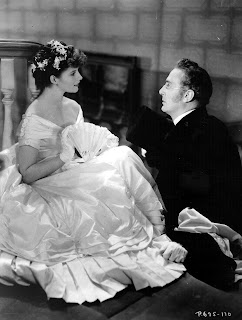 Likewise, Katharine Hepburn is one of the greatest actresses of all time—maybe the greatest—but I can think of at least five performances from the 1930s alone (Alice Adams, Stage Door, Bringing Up Baby, Holiday and even Sylvia Scarlett) that are more assured than the one she gave in Little Women. She's going to win two, three, maybe even four awards before we're done (assuming I live to be 140). I'm going to wait to recognize her accomplishments for a movie I really want to talk about.
 Finally, we have Kay Francis who in the space of a little over two months starred in three of the best movies of her career, Jewel Robbery, One Way Passage and Trouble In Paradise, a phenomenal run. In particular, One Way Passage is a splendid showcase of her abilities. The story of two people (Francis as a cancer patient, William Powell as a condemned criminal) who fall in love on an ocean voyage not knowing the other has little time to live, it's one of those magnificently stylish weepers that once upon a time Hollywood cranked out in its sleep. If you haven't seen it, get cracking—I highly recommend it.
That said, though, it's was Greta Garbo who gave the most moving performance of the year, and in many ways, the most iconic of her career. The vote may have been close, but when the final tally was read, it was Garbo's name at the top of the list.
Queen Christina: Great Performance, Flawed Movie
 As Queen Christina opens, Sweden is embroiled in midst of the Thirty Years' War, a destructive 17th century conflict that had its origins in the ongoing battle between Protestants and Catholics for control of central Europe. The country's beloved King Gustavus Adolphus has just fallen on the field of battle leaving his seven year old daughter to ascend to the throne. Raised as a boy and schooled in the arts of war (well, to the extent that a child can be), Christina tosses aside her regent's carefully-worded speech about "wag[ing] war with courage" and instead vows "to win it!"
In the next scene, it's years later and we see the grown up Christina (Garbo) in trousers and a man's hat riding astride a galloping horse through the forests on the palace grounds. To a modern audience, this scene might mean nothing, but in 1933 a woman in trousers riding astride rather than sidesaddle, these are signals that Christina has taken to heart the notion that to rule the country means ruling as a man. And indeed, by the standards of the day's cinema, she dresses like a man, argues like a man, and, it is implied when she kisses her lady-in-waiting on the lips, loves like a man.
 Despite Christina's skill and devotion as a leader, all is not well at home. The people clamor for more war, clamor for a royal marriage, clamor for an heir.
"In short," she says, "they clamor."
At the heart of the unrest is the desire that the queen should settle the question of the royal succession by producing an heir of Swedish blood, which of necessity requires her to settle on a mate, be it the handsome schemer Magnus or the aging war hero, cousin Charles. Christina sees marriage as a loss of her hard-earned freedom, a prospect that drives her to distraction.
"But majesty, you cannot die an old maid!"
"I have no intention to, Chancellor. I shall die a bachelor!"
 Fed up with demands of power, Christina disguises herself (as a man, always as a man) and spends a few days riding alone in the wintery countryside to clear her head. There, she stumbles across the Spanish ambassador (John Gilbert) and his entourage stranded in the snow. The ambassador, Antonio, mistakes her for an impudent boy—a conceit the filmmakers expect you to roll with since Garbo looks no more like a boy than Jean Harlow looks like Abe Vigoda—and the two wind up sharing a room in a nearby inn.
Not until Christina slips off her outer garments does Antonio finally tumble to the fact that he's in the presence of a beautiful woman.
(To read about Garbo's real-life romance with Gilbert, click here.)
It's the goofiest sequence in the entire movie, one that always has me itching to turn off the player, but it's followed by what is not only the best scene in the movie, but to me, the best scene in Garbo's illustrious career.
 Christina and Antonio have fallen into bed, no great surprise, but they've also fallen in love, an event so unexpected and new to both of them, they barely know how to express their joy and wonder. They recline sated before the fire, sharing a bowl of grapes and talking, but their spirits are soaring, and unable to contain herself, Christina finally gets up to wander around the room, as if first love were an out-of-body experience and she is following her soul around the bedchamber.
 The scene works because it pays such close attention to the emotion, particularly the melancholy that colors Christina's happiness. She wanders around the room, touching everything that Antonio has touched—a dresser, a candle, a spinning wheel—memorizing by touch and smell and sight every inch of the only room in which she has ever known complete happiness.
"In the future in my memory," she says, "I shall live a great deal in this room."
You don't have to be a monarch to appreciate just how fleeting time is or how rare moments of pure happiness are.
It's telling that, as she tours the room, she watches Antonio's image in the mirror, and his image in turn watches her, as if she is already viewing the moment in her memory, and feeling already the exquisite pain associated with an ideal past we can never revisit.
 It seems wholly appropriate to me that Garbo spends so much of the scene in front of both the mirror and, on the other side of the room, a religious triptych. Garbo was as much about images as she was about acting, holding poses that represent emotions rather than embody them from within, a style more akin to kabuki theater or the pantomime of the silent era than the Method approach actors have held to for more than fifty years. In that sense, Garbo's performance, like the triptych on the wall, is literally iconic—a pictorial representation whose form suggests its meaning. It's not "modern," but then when did we buy into the notion that "modern" and "better" were synonymous. In any event, I wouldn't want to throw out Garbo just because I also like Brando, any more than I'd throw out Rembrandt just because I also like Picasso.
In any event, as Christina feared, the moment is all too soon over. Antonio continues his journey to Stockholm, and she leaves by a different route to the same destination. Imagine Antonio's surprise when he discovers the woman he loves is a queen. Imagine the royal court's surprise when it discovers that their queen is in love with envoy of their enemy.
 The latter conflict sets in motion the final act of the movie. For the Protestant Christina to pursue a relationship with the Catholic Antonio after thirty years of war between those two faiths would be like Nixon bedding down with Brezhnev at the height of the Cold War. It's not simply xenophobia or self-interest that drives the opposition to the romance, it's a genuine horror at the idea of having to refight, both at home and abroad, an issue that was settled at the price of so much blood and treasure. Christina must choose between love and responsibilities. The way she chooses, and the consequences of her choice, lead to the most famous scene of Garbo's career, that final enigmatic shot that I won't describe except to say every film buff must see it.
 Now, I'm going to be up front with you: Queen Christina is one of the more problematic entrants in the Hollywood film canon. Even TV Guide in its glowing 5 (out of 5) star review describes the script as "great clumps of unleavened bread," which is a charitable way of saying that parts of the movie are preposterous—can anybody, for example, accept on the film's own terms the notion that John Gilbert could mistake Greta Garbo for a man? I don't care how dark that inn is or how mannish Garbo's clothes, unless Gilbert's character has an affinity for Swedish lads with rouged lips and plucked eyebrows, there's no way to watch that scene without thinking that either director Rouben Mamoulian set out deliberately to undermine his own movie or that the makeup man and cinematographer made some pretty grievous errors in professional judgment.
 Then again, many critics have suggested that that is the point. Historically, Christina was thought to be bisexual, Garbo was almost certainly bisexual, and Mamoulian was gay; perhaps without being able to say it explicitly during a time when even pre-Code permissiveness didn't permit a frank exploration of such things, Garbo and Mamoulian set out to investigate the limits of sexual orientation and wound up suggesting that, rather than being distinctly straight or gay, we reside on a sliding continuum between the two. And that, thus, in the right moment with the right person, even John Gilbert's Antonio could find himself attracted to a young Swedish lad on a cold, cold night.
Well, maybe.
Or maybe Garbo should have scrubbed off her makeup and cut her hair, ala Katharine Hepburn in Sylvia Scarlett, and really played the part instead of pretending to play it. But given the degree to which Garbo hid behind the mask of her perfect face and her professional mannerisms, asking her to strip all of that away and hang herself out there emotionally naked might have been as impossible as asking her grow wings and fly to the moon.
 Besides, did anybody ever argue that Tony Curtis, Milton Berle, Dustin Hoffman or Bugs Bunny should have made greater efforts to look like women when they played such in their movies? God forbid—the lack of illusion was half the joke.
Anyway, I suspect that I'm bringing 21st century expectations of "realism" to a 1933 movie and that an audience of the time, with the conceits of the silent era's cross-dressing comedies still fresh in their minds, wouldn't have expected Garbo to look like a man, but would simply have accepted the comic set-up and moved on.
I don't know.
What I do know is that when Queen Christina works, it works as well as any movie Garbo ever made.
"They usually ask me if it was easy or difficult to direct Garbo," Rouben Mamoulian said years later, "and the answer is that it was either easy or impossible. If she respected you as an artist, and if you gave her something that was better than what she had in mind, she was the easiest, most professional person to work with. In the case of Queen Christina she was simply marvelous."
A Troubling Pattern: Garbo In Eclipse
 Queen Christina premiered in New York the day after Christmas, 1933, with a nationwide release on February 9, 1934. Reviews were mixed. Mordaunt Hall of the New York Times wrote that Queen Christina was "a skillful blend of history and fiction" and that Garbo, "alluring as ever, gives a performance which merits nothing but the highest praise." Variety on the other hand, called the movie "slow and ofttimes stilted" and criticized Garbo's performance as "too often apace of the script's lethargy."
It turned out Variety knew American audiences better than Hall did. The film didn't perform well in the U.S. Garbo's sensibilities had always been foreign to American audiences, and while during the silent era that may have suggested a "desirable metropolitan European sophistication" (to quote Marcia Landy and Amy Villarejo writing in the BFI Film Classic study of the movie), by the time of the Great Depression, American audiences had become increasingly hostile to Garbo (and to her German counterpart, Marlene Dietrich).
 These same sensibilities, however, be they uniquely European or simply a product of Garbo's own matchless talents, helped make Queen Christina a big hit overseas where it made back twice its budget in Britain alone, establishing a pattern that would hold true for the remainder of Garbo's career. From Queen Christina forward through the end of her career, Garbo's movies made far more money overseas than in America, and more than any particular desire on Garbo's part, it was the outbreak of World War II, which closed off the foreign market, that hastened her early retirement from pictures. (After the war, Garbo sent out tentative feelers, thinking to make a comeback, but found no interest.)
Ironically, despite her waning domestic box-office appeal, with Queen Christina Garbo had hit her stride as an actress and would soon produce the best movies of her career, including Camille and Ninotchka. But we'll talk about those in their own good time.
[For a post on the production of Queen Christina, click here.]
Programming Note: Tuesday, August 24 is John Gilbert day on TCM and on the schedule is a showing of Queen Christina. Check your local listings and mark your calendar.
 Some quick facts about Kay Francis, star of the Ernst Lubitsch classic, Trouble In Paradise.
● Born in Oklahoma City to an actress mother and a father who left when Kay was four, Francis made her Broadway debut at the age of twenty in a modern-dress version of Hamlet. In 1928, she appeared in a play with future Oscar-winner Walter Huston who was so impressed with her that he arranged a screen test with Paramount Pictures. The test was a success, and Francis made her film debut the following year in the Marx Brothers' first film, The Cocoanuts, which was filmed at Paramount's Astoria Studio in New York.
● Francis had a lisp and was known around the backlots of Hollywood as "the Wavishing Kay Fwancis." Generally, dialogue was carefully tailored to conceal her speech impediment, but Ernst Lubitsch refused to rewrite key scenes of Trouble In Paradise for her and you can hear traces of her lisp if you listen closely.
 ● She left Paramount in 1930 for Warner Brothers. During the early sound era, she was the highest paid actress at Warners.
● At the time she was known for soap opera-style pictures about long-suffering women who wore great clothes, and much to her chagrin, these productions often focused on the clothes more than the dialogue. This eventually led to a protracted dispute with Warners she was destined to lose.
● She was married five times, divorced five times, and kept a diary that included details of numerous affairs with both men and women. George Cukor later said that all the great stars carry a secret which is revealed in their faces, and that Kay's face suggested her secret was particularly wicked.
● Along with Katharine Hepburn, Marlene Dietrich, Greta Garbo and Mae West, Francis was labeled "box office poison" in 1938 by a group of independent theater owners.
 ● She made her last movie in 1946. Among her best films were Jewel Robbery, One-Way Passage, Trouble In Paradise and In Name Only.
● She died of breast cancer in 1966. Her estate was valued at around $1 million, the bulk of which went to Seeing Eye, Inc., a company that trained seeing-eye dogs.
[To read Part One of this essay, click here. To read Part Two of this essay, click here.]
III. Trouble In Paradise: Champagne and Moonlight
 After the success of his naughty operettas, The Love Parade, Monte Carlo, The Smiling Lieutenant and One Hour With You (and the failure of a somber anti-war film, Broken Lullaby), Ernst Lubitsch turned his attention to what most critics now point to when they speak of Lubitsch's best work, Trouble In Paradise.
Trouble In Paradise is the story of a pair of sophisticated lovers, Gaston and Lily, who romance and thieve their way across Europe, only to find their happiness threatened by a beautiful young widow who also happens to be the target of their latest scam. Lubitsch based the story on the first act of Laszlo Aladar's failed stageplay, The Honest Finder—a crook finds a rich woman's handbag—and originally thought to do a spoof of the gentleman-thief stories, such as Raffles, The Saint and The Falcon, which were popular at the time. Then Lubitsch and long-time collaborator Samson Raphaelson hit upon the idea of making the thieves a man and a woman, which added both a romance angle and then when they take aim at the widow, a romantic complication.
The gentleman thief is Gaston Monescu, "the man who walked into the Bank of Constantinople and walked out with the Bank of Constantinople." The studio had suggested a young Cary Grant for the role, but as Lubitsch's biographer Scott Eyman noted, in 1932 Grant was still more the Cockney roughneck Archie Leach of his birth than the style icon of later years; and Lubitsch preferred an actor who possessed the sort of cultured aplomb that one can only acquire through experience.
 Instead, he chose another English actor, Herbert Marshall, a twenty year veteran of the London stage who was as suave and sophisticated in real life as the gentleman thief he portrayed on screen here, but who, having lost a leg in World War I and then so mastered the use of a prosthetic limb the resulting limp was barely apparent, also possessed the mettle to convincingly depict a master criminal.
When the movie opens, we see the thief's escape, his silhouette leaping over the balcony of a ritzy Venetian hotel while his victim lays unconscious on the floor, an example of the indirect and innovative way Lubitsch preferred to stage action—rather than show us the crime itself, Lubitsch leaves us to fill in the blanks and instead moves us directly into the relationship that will define the rest of the movie.
We get our first good look at Gaston a short distance from the scene of his crime as he instructs a waiter on the preparation of a romantic dinner:
 "It must be the most marvelous supper. We may not eat it, but it must be marvelous."
"Yes, Baron."
"And waiter?"
"Yes, Baron?"
"You see that moon?"
"Yes, Baron."
"I want to see that moon in the champagne."
"Yes, Baron." (makes note on pad) "'Moon in champagne.'"
"I want to see—um—"
"Yes, Baron."
"And as for you, waiter—"
"Yes, Baron?"
"I don't want to see you at all."
Gaston is pretending to be a baron so he can scam a countess, who ironically turns out to be Lily pretending to be a countess so she can scam a baron. As Lily, Lubitsch cast Miriam Hopkins, who had worked with the director a year earlier in the musical comedy, The Smiling Lieutenant (she would work with him again in 1933's Design For Living). As I have written before (here), "Hopkins was one of the sauciest actresses of the pre-Code age, excelling in light comedies and lurid melodramas alike," yet because her best films often proved too scandalous to be re-issued once censors began taking scissors to Hollywood's past, "even film fanatics can admit to having rarely seen her work."
 It doesn't take long for Gaston and Lily to realize the truth about each other, but rather than being angry or disappointed, the two are titillated, and dinner turns into a virtual striptease of items they've stolen from each other—a wallet, a brooch, a pocket watch—climaxing with the revelation of the most audacious theft of all:
"I hope you don't mind if I keep your garter."
"Darling!"
The film quickly jumps ahead a year—no wasted motion for Lubitsch. Gaston and Lily have been living together and thieving together through the capitals of Europe and all is well until they run across a wealthy young widow. Madame Colet is rich, generous and bored with the stiffs who court her—veteran farceurs, Charlie Ruggles and Edward Everett Horton (the latter the very man Gaston robbed in Venice). When Gaston appears at her door as part of a scheme to separate her from her fortune, she sees in him the sort of handsome, Continental man she's been longing for.
 "Madame Colet, if I were your father—which fortunately I am not—and you made any attempt to handle your own business affairs, I would give you a good spanking. In a business way, of course."
"What would you do if you were my secretary?"
"The same thing."
"You're hired."
 The widow, who may well know she's being taken but is still eager for the ride, is played with sympathy and sex appeal by Kay Francis. Her polished, dark beauty contrasts nicely with Hopkins's earthy blonde charms and no doubt was a factor in her casting, as was her performance earlier that year in Jewel Robbery, in which she plays a willing victim to William Powell's elegant jewel thief. Although her career would later take a nose-dive after a bitter contract dispute at Warner Brothers, in 1932, she was at the peak of her popularity.
Just the plot I've described so far would provide the makings of a good comedy (or spun in a different direction, suspense thriller), but Lubitsch ups the ante by creating genuine chemistry between Gaston and the widow. Suddenly Trouble In Paradise is no longer a simple story about the theft of money, but the theft of Gaston's affections as well, which realistically can't end well for somebody. The inevitable heartbreak adds what Andrew Sarris called "a counterpoint of poignant sadness during a film's gayest moments," and is what, I think, lifts this sparkling comedy to the level of pure genius.
And that's without even addressing the numerous examples of Lubitsch's mastery of the technical end of his craft, which not only keeps the story moving but gives this confection its airy, art Deco style. "I think I have done nothing better or as good," he wrote of the film shortly before his death.
 "The plot is grown-up, funny and sad," Roger Ebert wrote in 2002, and for his review of the film for his Great Movies series, he added, "in a drawing room comedy of froth and inconsequence, you find that you believe in the characters and care about them."
The result was a hit with audiences and the film landed in the list of the year's top ten money makers despite mixed reviews from the critics. Despite its success, relatively rare for Lubitsch, the film was withdrawn from circulation once the studios began enforcing the Production Code in 1934 and was not seen again until 1968. Coupled with the fact that it was never released on videotape and didn't land on DVD until 2003, Trouble In Paradise probably ranks high on a list of least-seen essential classics.
In 1991, the Library of Congress selected Trouble In Paradise for preservation in the National Film Registry.
[To read Part Four of this essay, click here.]
In case you've never stopped by Film Noir Photos before, here's another example of why it's on my every day to-do list—a spectacular photo of Katie Award nominee Kay Francis:
 I'm working away on my essay for best supporting actor of 1932-33. Should have it up today, or tomorrow at the latest.
If you're a devotee, as I am, of both Turner Classic Movies and the Katie-Bar-The-Door Awards, you'll be glad to know that a pair of Katie nominees, King Kong and Jewel Robbery are airing on America's classiest cable channel tomorrow, Saturday, May 8. King Kong is up for three Katies, including best picture and director; Kay Francis is up for best actress in Jewel Robbery.
 At 6 a.m. EDT is Jewel Robbery, starring William Powell as a suave jewel thief who forces his victims to smoke marijuana during the robbery, leaving them happy, giggling and quite unable to identify him to the police. One of his victims (Kay Francis) is so taken with the thief, she insists on a repeat performance.
After the film's release, thousands of people wrote the studio asking where they could get hold of some of this marijuana stuff for themselves.
 The other film, King Kong, I dare say you've heard of. Released in 1933, this is the ultimate in fun-stupid summer-blockbuster entertainment. It's spawned many remakes and sequels, but the original is the one people keep coming back to, and with good reason. If somehow you've never seen this classic action-sci-fi-horror flick, set your recorder or block out some time.
It's on at Noon, EDT time.
From TCM's website:
6:00am [Romance] Jewel Robbery (1932)
A jewel thief falls for a tycoon's wife in Vienna.
Cast: William Powell, Kay Francis, Helen Vinson, Hardie Albright Dir: William Dieterle BW-68 mins
12:00pm [Horror/Science-Fiction] King Kong (1933)
A film crew discovers the "eighth wonder of the world," a giant prehistoric ape, and brings him back to New York, where he wreaks havoc.
Cast: Fay Wray, Robert Armstrong, Bruce Cabot, Frank Reicher Dir: Merian C. Cooper BW-105 mins
 Boy, oh, boy! We're finally getting to the heart of what I think of the era of classic movies—and not a moment too soon, I'm sure you're thinking.
Not that I've lacked for great movies to talk about. I've handed out best picture awards to the likes of All Quiet On The Western Front, City Lights and Frankenstein, among others, I've written about legendary sex symbols such as Marlene Dietrich and Clara Bow, and I've shown you comedies from Buster Keaton and Charlie Chaplin that are as funny now as the day they debuted.
But let's face it, many of the stars I've been talking about—Marie Dressler, Anita Page—are virtually unknown today even among film buffs, and the movies themselves—silents such as Sunrise, early talkies like Bulldog Drummond and Hallelujah!—feel alien at times, almost like they're a wholly different medium.
Which is why, as much fun as it's been for me so far, it's a bit of relief to reach a year in film history that I didn't have to research virtually from scratch, and hopefully one that for once won't leave you, my long-suffering readers, scratching your collective heads. As they say in Kathmandu, the ox is slow, but the earth is patient. And you've been very patient indeed.
 Although rarely mentioned in the same breath with 1939, I'd suggest 1932-33 was perhaps the greatest year in movie history—well, year and a half, really, since the Oscar season ran from August 1, 1932 to December 31, 1933 as the Academy was bringing its confusing split-year award season in line with the calendar. Clark Gable was now a star, Jean Harlow discovered a flair for comedy, James Cagney and Edward G. Robinson were at the top of their games. Barbara Stanwyck was taking full advantage of the pre-Code era's permissiveness. And the Marx Brothers were funnier than ever.
Not to mention that Katharine Hepburn not only made her film debut, she won the first (of four) Oscars; Busby Berkeley, that master of wildly flamboyant choreography, was busy reviving the movie musical. And Fred Astaire and Ginger Rogers danced together for the first time.
 Among my nominees are such classics as Duck Soup, King Kong, Trouble in Paradise, Dinner at Eight, Design For Living, Red Dust, Boudu Saved From Drowning, The Invisible Man, Queen Christina, Sons of the Desert, Baby Face, The Bitter Tea of General Yen. And on top of that, Fritz Lang's classic M arrived in the United States in 1933, making it eligible for an award come Oscar time. Boy, what a year!
So how come you don't hear more about 1932-33 when it comes time to talk about the greatest years in movie history?
Well, let's put it this way: of those movies I listed above, how many Oscars did they win between them?
Zero.
Zero? Yeah, zero.
Okay, sure, sometimes the Academy screws up, but how many Oscar nominations did they receive between them?
Zero.
That's right, a baker's dozen of the best movies of all time and as far as the Academy was concerned, they didn't even exist. Still, the Academy did nominate some solid movies, traditional Oscar fare such as I Am A Fugitive From A Chain Gang, Little Women, The Private Life of Henry VIII, A Farewell To Arms, Lady For A Day, 42nd Street and the like.
So which of these fine movies did the Academy choose as the best picture of the year? Cavalcade.
Whoozitwhatsis?
 A starchy, stage-bound adaptation of a Noel Coward play, Cavalcade is not much remembered now and may well be the worst movie to ever win the Oscar for best picture. (Aside: Here's a fun little game to play in your head the next time you're out walking the dog—well, fun, that is, if you're an unhinged film fanatic like me: Name the worst movie ever nominated for best picture, the worst movie to win the Oscar for best picture, and the worst movie to win the Oscar for best picture that nevertheless deserved to win. For me, so far, the answers are The Hollywood Revue of 1929, Cavalcade and possibly The Sound Of Music, but I haven't made up my mind about that last one and I have thirty-two years to think it over.)
It's not just that Cavalcade is slow moving and wholly lacking in action (that's true of a lot of good movies), but it's also repetitive and uninvolving. The story follows an upper-crust British family and their downstairs servants through the first thirty years of the Twentieth Century, certainly a volatile time in world history, yet the characters—two-dimensional ciphers at best—bear only passive witness to the passing parade and if you're not already emotionally invested in such moments as the death of Queen Victoria or Louis Bleriot's flight across the English Channel, nothing that happens on screen is likely to make you care.
 I'll give you an example. Two newlyweds on a ship talk about how happy they are and if they were to die that very night, well, so be it, and then they step away from the railing to retreat to their cabin and reveal a life preserver with the name (wait for it) "Titanic" stenciled on it. Fade to black and now we're on a train two years later in 1914, just hours before Britain declares war on Germany, and you just know that in a few scenes, the mother of the enthusiastic boy-soldier next to her will be reading a telegram informing her of his death.
And on and on like that, hopping from one event to the next with no insight, no character development, just another "Where were you on the morning of November 11, 1918?" sort of thing. Maybe this was a nice catharsis for a London theater audience in 1933, a chance to remember and shed a tear or two without anything on stage getting in the way. But for a 21st Century audience? It's as dry and mystifying as a chatty Christmas newsletter from a complete stranger.
Basically, it's Forrest Gump without Gump, chocolate or a plot.
 So why did it win the Oscar for best picture? A lot of reasons, I think. The threat of govern- ment censor- ship, for one. You see a lot of Oscars then (and now) handed out to movies with the stale whiff of "art" about them, and this was especially true during the early sound era when Hollywood was absolutely paranoid about its worth compared to the so-called "legitimate" theater. On display as well was America's insecurity about its young culture compared to Britain's venerable old one. Once America dropped the atomic bomb in 1945, it was never insecure about anything again. But in 1933, we still felt a bit like provincial rubes sitting at the grown-up's table.
Yet another factor may have been labor unrest among the Academy's ranks. Faced with mounting losses during the Depression, the studios had just announced an across-the-board pay cut of 50% for all its employees, a move that prompted the formation of the Screen Actors Guild and the Screen Writers Guild (the latter founded by Frances Marion, Hollywood's top writer who swiftly found herself unemployed in retaliation). Many of the voters simply refused to vote for a Hollywood product and opted for the British Cavalcade instead.
Whatever the reason, what was a popular choice in 1933 is a puzzler now.
 (Another aside: one of Oscar's most embarrassing moments resulted from Frank Lloyd's win as best director of Cavalcade. In announcing the win, host Will Rogers said only "It couldn't have happened to a nicer guy! Come up and get it, Frank!" Frank Capra, nominated for Lady For A Day, was halfway to the stage before he realized it was Lloyd, not he, who had won. Capra called the trip back to his seat "the longest, saddest, most shattering walk in my life." He got the last laugh, though, winning three of the suckers over the next five years.)
The categories for best actor and actress were considered upsets and their winners received only lukewarm applause from the assembled guests. Maybe it was lucky neither winner bothered to attend the ceremony.
 As the title character in The Private Life of Henry VIII, Charles Laughton chewed scenery with as much gusto as the king he portrayed chewed on those big turkey legs we always associate him with, and his narrow victory (vote totals were made public) over Paul Muni was not a popular one. The Private Life of Henry VIII is actually a very fine movie, something of a British bedroom farce disguised as a history lesson, and you could just as easily call it a comedy as a drama. But I'm willing to bet it's the least seen of all of Laughton's great performances.
As for the best actress winner, it had taken Katharine Hepburn less than two years to establish a reputation for being a snooty prima donna, and her win over the popular May Robson (Lady For A Day) was a shock. Still, Morning Glory, the story of a naive country girl who takes  Broadway by storm, got good reviews, and she was even better in three other movies she made between 1932 and 1933, A Bill Of Divorcement, Christopher Strong, and especially in Little Women, in which she gave not only the definitive interpretation of Louisa Mae Alcott's tomboy heroine, Jo March, but the first indispensable performance of her great and illustrious career.
(Aside number three: On March 16, 1934, when Walt Disney won the award for producing the year's best cartoon short, Three Little Pigs, he thanked the Academy for giving him an "Oscar." This was the first time the term "Oscar" was used in public to refer to an Academy Award. How about that.)
Anyway, 1932-33 was a big year, too big, in fact, to stick with the conventional Oscar awards format I've been following—too much risk of skipping over too many good movies I think you'll want to see. Since we're on the cusp of Hollywood's Golden Age, let's adopt instead the Golden Globes format, with its separate acting and best picture categories for drama and comedy/musical. And let's throw in an award for best foreign-language film, too. The Nazis may have finished off the German film industry in 1933, but the French filmmakers were flourishing and there are a lot of good foreign movies to choose from.
You okay with this set-up? Yes? Good.
Among the actors, there are a lot of first-time nominees here, too many to mention, so I'll say instead that previous Katie winner Marie Dressler gets the third and final nomination of her career (she died a year later), and Miriam Hopkins and Joan Blondell, who also have previously won, each receive their second. Paul Muni, John Barrymore, James Cagney, the Marx Brothers, Barbara Stanwyck and Adolphe Menjou also receive their second noms.
All of the directors are first-time nominees. [6/1/10 After a an online discussion with my readers, here and here, I likewise split the director nominees in the categories of drama and comedy/musical. Better too many nominees than too few.]
Other than a handful of director-producer types, no one gets nominated in more than one category; thus, you get John Barrymore as supporting actor in Dinner At Eight, his best role that year, rather than for the lead in the less well-known Counsellor-at-Law. Mostly, I wanted to spread the wealth and encourage you to see as many movies as possible—thirty-two (plus one cartoon short) in all.
 But to pull that off, I fudged a handful of nominations— Jean Harlow, for one. I've nominated her in the lead actress in a comedy category, based in part on her terrific performance in Bombshell. But of the other two movies I mention, Red Dust is a drama and her role in Dinner At Eight is supporting; still, all three performances are primarily comedic, classically so, and rather than nominate her in three categories or ignore any of her great performances from this period, I lumped them all together under one umbrella.
Likewise, Kay Francis receives a nomination in the drama category for a pair of little-seen but really-good movies she did with William Powell, Jewel Robbery and One Way Passage. The latter is a romantic weeper—Powell and Francis fall in love on an ocean voyage from Hong Kong to San Francisco, neither knowing the other hasn't long to live, she because of a terminal illness,  he because he faces execution for murder—but the former is more a crime-caper-comedy-romance than strictly a drama. (Powell is a suave jewel thief who plays classical music and forces his victims to smoke marijuana while he robs them; during the movie's first robbery, Francis is so taken with him, she encourages a repeat performance.) One Way Passage is the indispensable one, so into the drama category her nomination goes, but you don't want to miss Jewel Robbery if you can find it.
And then, a couple of comedy acts—Laurel and Hardy, and the Marx Brothers—I treated as single entities for the purposes of best comedy actor nominations. This may strike movie fans, who aren't primed for ensemble awards, as odd, but music fans, I think, readily grasp, for example, that the Beatles as a group is a different animal from John, Paul, George and Ringo as individual solo acts—and if you don't believe me, compare "A Day in the Life" to, say, "Ebony and Ivory." The Marx Brothers and Laurel and Hardy are teams and I've nominated them as teams. So there.
Finally, there's the problem of when to nominate Carl Theodor Dreyer's horror classic, Vampyr, which was filmed in 1930, first premiered in Berlin in May 1932, then after scathing reviews was substantially reworked and re-premiered in Paris in September 1932. I can't say for sure when it showed up in America (under the title Castle Of Doom) but my guess it that it was some time after that. I probably could have chosen just about any year to nominate it for a Katie Award, but I went for 1932-33 on the theory that the version Dreyer wanted the world to see was released during that time frame.
If you would have handled these issues differently, I for one won't say you're wrong.
PICTURE (Drama)
The Bitter Tea Of General Yen (prod. Frank Capra)
I Am A Fugitive From A Chain Gang (prod. Hal B. Wallis)
The Invisible Man (prod. Carl Laemmle, Jr.)
King Kong (prod. Merian C. Cooper and Ernest B. Schoedsack)
Red Dust (prod. Hunt Stromberg and Irving Thalberg)
PICTURE (Comedy/Musical)
Dinner At Eight (prod. David O. Selznick)
Duck Soup (prod. Herman J. Mankiewicz)
42nd Street (prod. Darryl F. Zanuck)
Gold Diggers Of 1933 (prod. Jack L. Warner and Robert Lord)
Trouble In Paradise (prod. Ernst Lubitsch)
PICTURE (Foreign Language)
Boudu Saved From Drowning (prod. Michel Simon)
Liebelei (prod. Herman Millakowsky)
The Testament Of Dr. Mabuse (prod. Fritz Lang and Seymour Nebenzal)
Vampyr (prod. Carl Theodor Dreyer and Julian West)
Zero For Conduct (prod. Jean Vigo)
ACTOR (Drama)
Nils Asther (The Bitter Tea Of General Yen)
Charles Laughton (The Old Dark House, Island Of Lost Souls and The Private Life Of Henry VIII)
Paul Muni (I Am A Fugitive From A Chain Gang)
Claude Rains (The Invisible Man)
Paul Robeson (The Emperor Jones)
ACTOR (Comedy/Musical)
James Cagney (Footlight Parade)Stan Laurel and Oliver Hardy (Sons Of The Desert)
Herbert Marshall (Trouble In Paradise)
The Marx Brothers (Horse Feathers and Duck Soup)
Michel Simon (Boudu Saved From Drowning)
ACTRESS (Drama)
Kay Francis (Jewel Robbery and One Way Passage)
Greta Garbo (Queen Christina)
Katharine Hepburn (Little Women)
Barbara Stanwyck (The Bitter Tea Of General Yen and Baby Face)
Fay Wray (The Most Dangerous Game and King Kong)
ACTRESS (Comedy/Musical)
Joan Blondell (The Gold Diggers Of 1933)
Jean Harlow (Red Dust, Dinner At Eight and Bombshell)
Miriam Hopkins (Trouble in Paradise and Design For Living)
May Robson (Lady For A Day)
Mae West (I'm No Angel)
DIRECTOR (Drama)
Frank Capra (The Bitter Tea Of General Yen and Lady For A Day)
Merian C. Cooper and Ernest B. Schoedsack (King Kong)
Carl Theodor Dreyer (Vampyr)
Fritz Lang (The Testament Of Dr. Mabuse)
Mervyn LeRoy (I Am A Fugitive From A Chain Gang and Gold Diggers Of 1933)
Rouben Mamoulian (Love Me Tonight and Queen Christina)
James Whale (The Old Dark House and The Invisible Man)
DIRECTOR (Comedy/Musical)
Lloyd Bacon (42nd Street and Footlight Parade)
George Cukor (Dinner At Eight and Little Women)
Victor Fleming (Red Dust and Bombshell)
Ernst Lubitsch (Trouble In Paradise and Design For Living)
Leo McCarey (Duck Soup)
Jean Renoir (Boudu Saved From Drowning)
Jean Vigo (Zero For Conduct)
SUPPORTING ACTOR
John Barrymore (Dinner At Eight)
Edward Everett Horton (Trouble In Paradise and Design For Living)
Edgar Kennedy (Duck Soup)
Guy Kibbee (Gold Diggers of 1933, Lady For A Day and Footlight Parade)
Adolphe Menjou (A Farewell To Arms)
SUPPORTING ACTRESS
Billie Burke (Dinner At Eight)
Marie Dressler (Dinner At Eight)
Margaret Dumont (Duck Soup)
Elsa Lanchester (The Private Life of Henry VIII)
Una O'Connor (The Invisible Man)
SCREENPLAY
Jean Renoir and Albert Valentin; from a play by René Fauchois (Boudu Saved From Drowning)
Frances Marion and Herman J. Mankiewicz; additional dialogue Donald Ogden Stewart; from a play by George S. Kaufman and Edna Ferber (Dinner At Eight)
Bert Kalmar, Harry Ruby, Arthur Sheekman and Nat Perrin (Duck Soup)
Howard J. Green and Brown Holmes, from the autobiography by Robert E. Burns (I Am A Fugitive From A Chain Gang)
Grover Jones and Samson Raphelson; from a play by Aladar Laszlo (Trouble In Paradise)
BEST SONG (Reader Voted)
"Forty-Second Street" music by Harry Warren, lyrics by Al Dubin (42nd Street)
"The Gold Diggers Song (We're In The Money)" music by Harry Warren, lyrics by Al Dubin (Gold Diggers Of 1933)
"Isn't It Romantic" music by Richard Rodgers, lyrics by Lorenz Hart (Love Me Tonight)
"Remember My Forgotten Man" music by Harry Warren, lyrics by Al Dubin (Gold Diggers Of 1933)
"Who's Afraid Of The Big Bad Wolf" music and lyrics by Frank Church and Ted Sears (Three Little Pigs)

 Largely forgotten now, Miriam Hopkins was one of the sauciest actresses of the pre-Code age, excelling in light comedies and lurid melodramas alike and nabbing an Oscar nomination along the way. Her early sound movies are some of the best of the era, yet often proved too scandalous to be re-issued once censors began taking scissors to Hollywood's past. Coupled with the years lost while she languished on the McCarthy-era blacklist, and even film fanatics can admit to having rarely seen her work.
 In the first of these, Maurice Chevalier plays a randy lieutenant in the Austrian army who beds down with an equally randy violinist played by Claudette Colbert. (Her band's name? "The Viennese Swallows." Ahem.) The two make beautiful music together, literally and figuratively, until by accident, Chevalier finds himself mistakenly flirting with a visiting princess—the prim, virginal Hopkins—instead of Colbert, threatening an international incident.
 A movie fan of today who knows Hopkins's pre-Code work waits a little impatiently for the princess to bust out—knowing that when she does, it'll be worth it. But an audience of the time, not knowing Hopkins and what she was capable of, must have found her transformation from a prudish virgin to a cigarette-smoking, jazz-playing temptress just as shocking as Chevalier's lieutenant does.
 The basic outline of Dr. Jekyll and Mr. Hyde is familiar to us all—a scientist drinks a potion that turns him into a murdering beast with hairy hands and bad teeth. What tends to be forgotten is the why. Dr. Jekyll (here pronounced with a long "e," as in "gee whiz" rather than the familiar rhyme with "heckle") is striving for the perfectability of man, using science to distill out our bestial dark side, freeing the angels of our better nature to pursue more virtuous callings.
 Here, Hopkins plays Ivy Pearson, saloon singer, prostitute, and physical embodiment of Jekyll's base desires. The character is not in the novel, but is so perfect, you wonder why not. Taking full advantage of the pre-Code era's permissiveness, there's no question that Ivy is a prostitute and Hopkins doesn't try to soften her. Her Ivy is both lovely and—what is the word?—skanky at the same time. Her play for Jekyll is coarse and obvious, pulling up her skirts to show her legs, offering to be his slave. Even the priggish and pompous Jekyll feels the pull of the animal, and his shame is what drives him to try to cleanse himself of his base nature, resulting in the experiments that divide him.
 Trouble In Paradise is the story of a pair of sophisticated lovers, Gaston and Lily—Herbert Marshall and Hopkins—who romance and thieve their way across Europe, only to find their happiness threatened by a beautiful young widow who also happens to be the target of their latest scam.
 Just the plot I've described so far would provide the makings of a good comedy (or spun in a different direction, suspense thriller), but Lubitsch ups the ante by creating genuine chemistry between Gaston and the widow. Suddenly Trouble In Paradise is no longer a simple story about the theft of money, but the theft of Gaston's affections as well, which realistically can't end well for somebody. The inevitable heartbreak adds what Andrew Sarris called "a counterpoint of poignant sadness during a film's gayest moments," and is what, I think, lifts this sparkling comedy to the level of pure genius.
 If Trouble In Paradise, with its depictions of thieves living happily ever after, had pushed the limits of pre-Code permissiveness, Hopkins's next picture, Design For Living, blew right past them.
 Hopkins is perfect in the part, never veering too far into either smug certainty or guilt-wracked introspection. Lubitsch always wrote interesting female characters, and Gilda is one of his best. We think of feminism and the sexual revolution as primarily modern movements, a product of baby boomer discontent, but in fact, many movies in the pre-Code era were about strong women insisting on sexual and economic freedom. Barbara Stanwyck's Lily Powers, who sleeps her way to the top in 1933's Baby Face, was the most ruthless incarnation of the pre-Code feminist, but Lubitsch's Gilda may well have been the strongest.
 Despite her success on screen, Hopkins was not well-liked by her Hollywood peers and she bounced around several studios in a short number of years. She had several well-publicized battles with Bette Davis on the sets of The Old Maid and Old Acquaintance, Davis later declaring, "Miriam Hopkins was a bitch!" (That Davis was having an affair with Hopkins's husband, Anatole Litvak, was no doubt a primary cause of the friction.)
 Hopkins grew in- creasingly unpopular as the decade wore on—in 1940, the Harvard Lampoon dubbed her "the least desirable companion on a desert island"—and she retired in 1943. She didn't appear in another movie for six years, then made her comeback in The Heiress as Olivia de Havilland's aunt, a performance the Golden Globe awards recognized with a nomination for best supporting actress. In 1952, however, Hopkins was accused of being a Communist sympathizer and again she was out of the movies, this time for nine years.
 Hopkins also did a lot of television back when that meant appearances in live theater productions on shows such as Studio One and Lux Video Theater. She continued to work almost up to her death of a heart attack in 1972.







 Posts
Posts

