skip to main |
skip to sidebar

A few facts about silent film star Ramon Novarro:
● He was born José Ramón Gil Samaniego in Durango, Mexico, in 1899. At age fourteen, he moved with his family to Los Angeles to escape the Mexican Revolution.
● Novarro made his acting debut with an uncredited part as a starving peasant in Cecil B. DeMille's 1916 costume epic, Joan the Woman.
● After ten more small, usually uncredited bit roles between 1917 and 1921, Novarro scored his breakout role as Rupert of Hentzau in the 1922 version of The Prisoner of Zenda.
● Novarro's biggest role was the title character in Fred Niblo's silent classic, Ben-Hur: A Tale of the Christ. Among his silent works, I can also highly recommend Scaramouche and Ernst Lubitsch's The Student Prince in Old Heidelberg.
● As was the case with many actors of the time, his career suffered with the advent of the talkies. He made his talkie debut in 1929, and of these early efforts, I'd point you to 1931's Mati Hari in which he co-starred with an especially luminous Greta Garbo. MGM dropped his contract in 1935.
● Novarro was a devout Roman Catholic; he was also gay, and was tormented by the conflict between his sexuality and his religious beliefs. Nevertheless, he refused to enter into a sham marriage to satisfy the gossip columnists or his boss, Louis B. Mayer.
● Of his later movies, I am a big fan of his work in the 1949 comic noir The Big Steal, starring Robert Mitchum and Jane Greer. There he is a Mexican police inspector who plays cat-and-mouse with a thief and his pursuers. He also appeared in an episode of The Wild Wild West, a childhood favorite of mine.
● Novarro was brutally murdered in his home in 1968 by two male prostitutes who mistakenly believed Novarro had a large cache of money hidden in his home. They eventually made off with $20, were captured, convicted and served less than ten years each for their crimes.
● And while we're here, how about a few more photos of Ramon Novarro:
with Ernst Lubitsch:
with Joan Crawford:
with Norma Shearer:
Any review of a Broadway play starring Nathan Lane necessarily starts with Nathan Lane's performance, and when Nathan Lane's performance turns out to be one of the best of his career, your review can pretty much stop there, too.
That I start elsewhere and write five hundred words before getting to Nathan Lane—well, that's just what you've come to expect from the Mythical Monkey.
Set in 1937, The Nance recreates the "naughty, raucous" world of American burlesque in its lowbrow heyday just before its abrupt and unceremonious demise. A form of variety show popular in America from the 1860s to the early 1940s, burlesque featured songs, crude humor and striptease—with the striptease distinguishing it from vaudeville, music hall and "legitimate" theater. In terms of respectability, burlesque was the lowest of the low, but it gave us Sally Rand and Gypsy Rose Lee, and provided starts for Mae West, W.C. Fields, Eddie Cantor, Jackie Gleason, Red Skelton, and many others.

It may be a limited world, but in it, nobody is better at making people laugh than Chauncey Miles—two-time Tony winner Nathan Lane in top form—a stage comedian who specializes in what was known as a "nance" act, an exaggeratedly camp gay character who served up ribald comedy and broad double entendres while at the same time serving as an object of the audience's derision and merriment.
That off-stage Chauncey is a closeted gay man makes him something of a crying-on-the-inside kind of clown. Indeed, Chauncey specifically likens himself to Bert Williams, the real-life African-American comedian who performed in blackface, and in a moment perhaps a bit on the nose, quotes W.C. Fields who called Williams "the funniest man I've ever seen—and the saddest man I've ever known."
The contrast between Chauncey's on-stage joy and his off-stage misery is the source of much of the play's drama.
Yet while homosexuality in 1937 is a crime, and meeting like-minded men is difficult and dangerous, a sort of shadow society has evolved, with carefully-observed rules and rituals summed up by the recurring punchline "I'll meet you 'round the corner in a half an hour." The cops make occasional sweeps of known gay haunts, and gay-baiting thugs work out their insecurities and repressed desires with their fists, but in the main, "respectable" society and its gay counterpart have reached a don't ask-don't tell arrangement for co-existing.
And as he does in the theater, Chauncey thrives in this deeply-compromised environment. He lives not so much for the meeting at the beginning of the ritual or the sex at the end, as for the thirty minutes in between, a half hour of exquisite anticipation that could end in a beating, an arrest, a trip to the moon on gossamer wings or even nothing at all.
Then two developments threaten Chauncey's carefully-disordered world—monogamy, in the form of a young man (Jonny Orsini), and unemployment, in the form of government censorship.

The difficulty of the former for someone addicted to the chase, you probably intuitively grasp. The latter was the work of Fiorello LaGuardia, the mayor of New York from 1937 to 1945. Although never appearing on stage, LaGuardia's impact on the story is as outsized as his impact on the city he governed. A reform-minded Republican, he supported FDR and the New Deal, cracked down on government corruption, and championed the rights of immigrants and minorities. He was also authoritarian, self-aggrandizing and priggish in the extreme, and he made it his mission to shut down the burlesque houses that were popular in New York at the time.
As his legal and professional status deteriorates, Chauncey falls back on old patterns. The old life is as risky and unsatisfying as ever, but it's also familiar, reminding us that even unhappiness can provide a measure of comfort if it's what you've know best.
That Nathan Lane can serve up so many genuine laughs while convincingly playing such a tortured (and in many ways, unlikeable) character is a testament to his real versatility as an actor. He doesn't soften Chauncey one bit, yet you feel for him. Nor does he shy away from the offensive nature of "nance" humor, yet you can't help but laugh with him.
I wonder how many reviewers have predicted that Lane's performance will earn him another Tony nomination—probably all of them—but in this case, I'd be shirking my duty if I failed to state the obvious.
Still, I'm going to be frank with you—The Nance is not for everybody, especially if the everybody in your group includes a homophobic out-of-towner and his blue-nosed great aunt. The production, directed by three-time Tony winner Jack O'Brien, features full frontal male nudity, exotic dancers in g-strings and pasties, and enough double (and single) entendres to fill out a drag queen's stage act.
Too, playwright Douglas Carter Beane tries a bit too hard to cover every base, touching not just on Chauncey's professional and personal problems, but also on union politics, right-wing hypocrisy, left-wing cowardice, New York parochialism, and a host of other issues. I mean, let's face it, when you introduce a Marxist-spouting stripper to the proceedings—and not for laughs—you're gilding the lily.
But all in all, these are minor quibbles. The point of the evening is Nathan Lane. And Nathan Lane is terrific.
The Nance is currently playing at the Lyceum Theatre in New York.
(Let's stagger on home to the end of the least read series in Mythical Monkey history.)
Best Appearance in Movie Where the Dog Dies
I'm sure she means best appearance by an actor in a movie where the dog dies—like, say, the kid in Old Yeller or something—but I'm more interested in the dog itself, which means I get to write about my favorite movie dog of all time, "Dog" in John Wayne's Big Jake.
In case you've never seen Big Jake—and unless you're a John Wayne fan of a certain age, there's no real reason to think you would have—the Duke's Jacob McCandles has the best trained dog in history. He says "Dog!" and that means maul the bad guy with the machete, and then he says "Dog!" and that means knock the hostage off the horse before the sniper can shoot him, and sometimes he says "Dog!" and that means "heel" or "sit" or pretty much whatever else Big Jake might be thinking at the moment. Very impressive. John Wayne makes Cesar Millan look like a crazy cat lady.
Best Making Way Too Big a Deal About Playing a Gay Character
Generally speaking, gays have not fared well on the big screen. For the first fifty years of movie history, they were comic relief; in the fifty that followed, tragic figures. Perhaps in the next fifty, the movies will depict them as they are—everyday people who just happen to be attracted to the same rather than opposite sex.
Well, maybe when society itself views the matter that way.
In the meantime, to answer the question, I'm going with Tom Hanks in Philadelphia. The performance won him an Oscar but, to my mind anyway, it has not aged well. If the film had been made in, say, 1983, at a time when seemingly respectable people were still saying out loud that AIDS was a "gay problem" and thus of no concern to the "rest of us," perhaps righteous anger alone might still carry the otherwise hackneyed storyline. But by 1993, the year of Philadelphia's release, we had all pretty much agreed—at least as a matter of public policy—both that AIDS was a national problem and that gays were people, too (well, you know, as long as they didn't want to marry or serve in the military or take part in any of the many other workaday activities that heterosexuals take for granted and gays couldn't and in many places still can't). Instead what seemed at the time brave and heart-rending has been revealed as what it always was: timid and cliched.
Unfortunately, that's almost always the case when Hollywood tackles anything even remotely controversial. Mainstream movies cost so much to make that no one is willing is write a check without at least some hope that they'll get their investment back, and to make something truly controversial is to run the risk of whittling your potential audience down to the point where a profit is no longer possible. And if there's one thing Hollywood is not, it's a philanthropic enterprise. So the people in charge wait until it's clear which way the wind is blowing, and then serve up a product, like Philadelphia, that is so bland and smugly certain of itself that what you hear at the end is not applause but the audience patting itself on the back.
There's more emotional power in one AIDS quilt than in this entire movie.
Best Acting on a Boat
If you've never seen Buster Keaton in The Navigator, you're in for a real treat. Released the same year as the better-known Sherlock, Jr., I think The Navigator is the funnier movie, one of Keaton's best.
Best Acting in Sandals
I assume this doesn't mean Katharine Hepburn in a pair of high heel sandals, but instead "sword and sandals" or "Shakespeare" or "Spartacus" or anything with men in togas. Now, I'm not 100% sure what he had on his feet during the "Toga Party" sequence, but I am sure that I'd rather watch John Belushi in Animal House than Marlon Brando in Julius Caesar, Laurence Olivier in Spartacus or Russell Crowe in Gladiator.
Best Performance in a Movie Parents Liked
I can't speak for parents in general, but the people who conceived, birthed and raised me were big fans of the movies and believed that there were certain films you had to see in order to be considered literate. Thus, they introduced me not just to Disney and the usual child-friendly suspects but to the Marx Brothers, Cary Grant, Gone with the Wind and a lot of other stuff, too. The best performance in a movie my parents liked enough to make me see? Jeepers. Let's go with the aforementioned Cary Grant in His Girl Friday, one of the funniest movies he ever did and one of the few movies of its era to suggest that a woman's place is not in the kitchen but in the office, if it turns out that's the work she was born for.
That's it. We're done. Be sure to come back Sunday morning to start voting in the Favorite Classic Movie Actress Tournament.
My review of Garbo's Queen Christina, reposted in honor of her birthday
 The most elusive and enigmatic superstar in movie history, Greta Garbo is also one of the most recognizable, familiar even to those who have never seen one of her movies. Because the beautiful and talented Swedish import rarely granted interviews, retired early and lived the rest of her days in jealously-guarded seclusion, nearly everything we know about her, or think we know, comes down to us in the form of the perfectly-rendered, never-aging images she made iconic on the silver screen. To the extent that acting is a matter of invention, Garbo surely ranks as one of the greatest, since in a very real sense, she is purely a product of her own self-creation.
Of the two dozen Hollywood movies she made in a career that began with great fanfare in the waning days of the silent age and lasted until her sudden retirement in 1941, many movie fans and historians count her performance in Queen Christina as the best of her career. I count it as the best by a dramatic actress in 1932-33.
 As Queen Christina opens, Sweden is embroiled in midst of the Thirty Years' War, a destructive 17th century conflict that had its origins in the ongoing battle between Protestants and Catholics for control of central Europe. The country's beloved King Gustavus Adolphus has just fallen on the field of battle leaving his seven year old daughter to ascend to the throne. Raised as a boy and schooled in the arts of war (well, to the extent that a child can be), Christina tosses aside her regent's carefully-worded speech about "wag[ing] war with courage" and instead vows "to win it!"
In the next scene, it's years later and we see the grown up Christina (Garbo) in trousers and a man's hat riding astride a galloping horse through the forests on the palace grounds. To a modern audience, this scene might mean nothing, but in 1933 a woman in trousers riding astride rather than sidesaddle, these are signals that Christina has taken to heart the notion that to rule the country means ruling as a man. And indeed, by the standards of the day's cinema, she dresses like a man, argues like a man, and, it is implied when she kisses her lady-in-waiting on the lips, loves like a man.
 Despite Christina's skill and devotion as a leader, all is not well at home. The people clamor for more war, clamor for a royal marriage, clamor for an heir.
"In short," she says, "they clamor."
At the heart of the unrest is the desire that the queen should settle the question of the royal succession by producing an heir of Swedish blood, which of necessity requires her to settle on a mate, be it the handsome schemer Magnus or the aging war hero, cousin Charles. Christina sees marriage as a loss of her hard-earned freedom, a prospect that drives her to distraction.
"But majesty, you cannot die an old maid!"
"I have no intention to, Chancellor. I shall die a bachelor!"
 Fed up with demands of power, Christina disguises herself (as a man, always as a man) and spends a few days riding alone in the wintery countryside to clear her head. There, she stumbles across the Spanish ambassador (John Gilbert) and his entourage stranded in the snow. The ambassador, Antonio, mistakes her for an impudent boy—a conceit the filmmakers expect you to roll with since Garbo looks no more like a boy than Jean Harlow looks like Abe Vigoda—and the two wind up sharing a room in a nearby inn.
Not until Christina slips off her outer garments does Antonio finally tumble to the fact that he's in the presence of a beautiful woman.
(To read about Garbo's real-life romance with Gilbert, click here.)
It's the goofiest sequence in the entire movie, one that always has me itching to turn off the player, but it's followed by what is not only the best scene in the movie, but to me, the best scene in Garbo's illustrious career.
 Christina and Antonio have fallen into bed, no great surprise, but they've also fallen in love, an event so unexpected and new to both of them, they barely know how to express their joy and wonder. They recline sated before the fire, sharing a bowl of grapes and talking, but their spirits are soaring, and unable to contain herself, Christina finally gets up to wander around the room, as if first love were an out-of-body experience and she is following her soul around the bedchamber.
 The scene works because it pays such close attention to the emotion, particularly the melancholy that colors Christina's happiness. She wanders around the room, touching everything that Antonio has touched—a dresser, a candle, a spinning wheel—memorizing by touch and smell and sight every inch of the only room in which she has ever known complete happiness.
"In the future in my memory," she says, "I shall live a great deal in this room."
You don't have to be a monarch to appreciate just how fleeting time is or how rare moments of pure happiness are.
It's telling that, as she tours the room, she watches Antonio's image in the mirror, and his image in turn watches her, as if she is already viewing the moment in her memory, and feeling already the exquisite pain associated with an ideal past we can never revisit.
 It seems wholly appropriate to me that Garbo spends so much of the scene in front of both the mirror and, on the other side of the room, a religious triptych. Garbo was as much about images as she was about acting, holding poses that represent emotions rather than embody them from within, a style more akin to kabuki theater or the pantomime of the silent era than the Method approach actors have held to for more than fifty years. In that sense, Garbo's performance, like the triptych on the wall, is literally iconic—a pictorial representation whose form suggests its meaning. It's not "modern," but then when did we buy into the notion that "modern" and "better" were synonymous. In any event, I wouldn't want to throw out Garbo just because I also like Brando, any more than I'd throw out Rembrandt just because I also like Picasso.
In any event, as Christina feared, the moment is all too soon over. Antonio continues his journey to Stockholm, and she leaves by a different route to the same destination. Imagine Antonio's surprise when he discovers the woman he loves is a queen. Imagine the royal court's surprise when it discovers that their queen is in love with envoy of their enemy.
 The latter conflict sets in motion the final act of the movie. For the Protestant Christina to pursue a relationship with the Catholic Antonio after thirty years of war between those two faiths would be like Nixon bedding down with Brezhnev at the height of the Cold War. It's not simply xenophobia or self-interest that drives the opposition to the romance, it's a genuine horror at the idea of having to refight, both at home and abroad, an issue that was settled at the price of so much blood and treasure. Christina must choose between love and responsibilities. The way she chooses, and the consequences of her choice, lead to the most famous scene of Garbo's career, that final enigmatic shot that I won't describe except to say every film buff must see it.
 Now, I'm going to be up front with you: Queen Christina is one of the more problematic entrants in the Hollywood film canon. Even TV Guide in its glowing 5 (out of 5) star review describes the script as "great clumps of unleavened bread," which is a charitable way of saying that parts of the movie are preposterous—can anybody, for example, accept on the film's own terms the notion that John Gilbert could mistake Greta Garbo for a man? I don't care how dark that inn is or how mannish Garbo's clothes, unless Gilbert's character has an affinity for Swedish lads with rouged lips and plucked eyebrows, there's no way to watch that scene without thinking that either director Rouben Mamoulian set out deliberately to undermine his own movie or that the makeup man and cinematographer made some pretty grievous errors in professional judgment.
 Then again, many critics have suggested that that is the point. Historically, Christina was thought to be bisexual, Garbo was almost certainly bisexual, and Mamoulian was gay; perhaps without being able to say it explicitly during a time when even pre-Code permissiveness didn't permit a frank exploration of such things, Garbo and Mamoulian set out to investigate the limits of sexual orientation and wound up suggesting that, rather than being distinctly straight or gay, we reside on a sliding continuum between the two. And that, thus, in the right moment with the right person, even John Gilbert's Antonio could find himself attracted to a young Swedish lad on a cold, cold night.
Well, maybe.
Or maybe Garbo should have scrubbed off her makeup and cut her hair, ala Katharine Hepburn in Sylvia Scarlett, and really played the part instead of pretending to play it. But given the degree to which Garbo hid behind the mask of her perfect face and her professional mannerisms, asking her to strip all of that away and hang herself out there emotionally naked might have been as impossible as asking her grow wings and fly to the moon.
 Besides, did anybody ever argue that Tony Curtis, Milton Berle, Dustin Hoffman or Bugs Bunny should have made greater efforts to look like women when they played such in their movies? God forbid—the lack of illusion was half the joke.
Anyway, I suspect that I'm bringing 21st century expectations of "realism" to a 1933 movie and that an audience of the time, with the conceits of the silent era's cross-dressing comedies still fresh in their minds, wouldn't have expected Garbo to look like a man, but would simply have accepted the comic set-up and moved on.
I don't know.
What I do know is that when Queen Christina works, it works as well as any movie Garbo ever made.
"They usually ask me if it was easy or difficult to direct Garbo," Rouben Mamoulian said years later, "and the answer is that it was either easy or impossible. If she respected you as an artist, and if you gave her something that was better than what she had in mind, she was the easiest, most professional person to work with. In the case of Queen Christina she was simply marvelous."
 Queen Christina premiered in New York the day after Christmas, 1933, with a nationwide release on February 9, 1934. Reviews were mixed. Mordaunt Hall of the New York Times wrote that Queen Christina was "a skillful blend of history and fiction" and that Garbo, "alluring as ever, gives a performance which merits nothing but the highest praise." Variety on the other hand, called the movie "slow and ofttimes stilted" and criticized Garbo's performance as "too often apace of the script's lethargy."
It turned out Variety knew American audiences better than Hall did. The film didn't perform well in the U.S. Garbo's sensibilities had always been foreign to American audiences, and while during the silent era that may have suggested a "desirable metropolitan European sophistication" (to quote Marcia Landy and Amy Villarejo writing in the BFI Film Classic study of the movie), by the time of the Great Depression, American audiences had become increasingly hostile to Garbo (and to her German counterpart, Marlene Dietrich).
 These same sensibilities, however, be they uniquely European or simply a product of Garbo's own matchless talents, helped make Queen Christina a big hit overseas where it made back twice its budget in Britain alone, establishing a pattern that would hold true for the remainder of Garbo's career. From Queen Christina forward through the end of her career, Garbo's movies made far more money overseas than in America, and more than any particular desire on Garbo's part, it was the outbreak of World War II, which closed off the foreign market, that hastened her early retirement from pictures. (After the war, Garbo sent out tentative feelers, thinking to make a comeback, but found no interest.)
Ironically, despite her waning domestic box-office appeal, with Queen Christina Garbo had hit her stride as an actress and would soon produce the best movies of her career, including Camille and Ninotchka. But we'll talk about those in their own good time.
[For a post on the production of Queen Christina, click here. And click here for my most popular post ever, photos of Garbo as she aged, from 9 to 85.]
In honor of Carole Lombard's 103rd birthday today, Carole & Co. is hosting the "Carole-tennial+3 blogathon." This is my meager contribution.
 I'll be honest with you. When I signed up to write about Carole Lombard's career in silent movies—she made 36 between 1921 and 1929—I'd hoped to pass along to you a sense of a star in the making, a talent in training, that sort of thing. I figured I'd write something about how when we think of the transition from silent films to talkies, we focus on the careers that were destroyed—John Gilbert's, for example—but that there were also actors whose careers took off once the public could hear them speak (William Powell, Ronald Colman, Gary Cooper). And then I'd slot Carole Lombard into that list and go from there.
But after watching all of what little of her silent work is available, what I came away with instead was both a sense of frustration at the abysmal state of film preservation in this country and a wonder that Carole Lombard had a film career at all.
 Born in Indiana as Jane Peters, Carole Lombard moved to Los Angeles with her mother at the age of eight when her parents divorced. In 1921, Alan Dwan (who would later direct Douglas Fairbanks in Robin Hood and John Wayne in Sands of Iwo Jima) spotted her playing baseball and cast her on the spot as a tomboy in A Perfect Crime. She was twelve years old.
The role seems in retrospect a presciently appropriate one—although she was one of the most beautiful actresses of her generation, Lombard was at heart a boisterous, small-town tomboy who swore like a sailor, and preferred duck shooting and fly fishing to fancy clothes and big parties.
"I can't imagine a duller fate," she once said, "than being the best dressed woman in reality. When I want to do something I don’t pause to contemplate whether I’m exquisitely gowned. I want to live, not pose!"
 Lombard wouldn't appear in another film until 1924, when she signed a contract with the Fox Film Corporation where she languished in uncredited bit parts in forgettable movies. Few of these efforts survive and those that do don't tell us much of anything about Lombard's early career.
I watched her three surviving films from this period—Dick Turpin, The Plastic Age and the classic Ben-Hur—and I can tell you, she is completely invisible in all of them, playing roles that don't even rise to the level of a bit part. She was literally just a figure moving around in the deep background, less significant to the plot than a potted plant or a picture on a wall.
 In fact, I must have blinked when she played these blink-and- you'll-miss-it parts, because despite my best efforts, I missed her in all of them. (Indeed, some Lombard fanatics have decided she's not even in Ben-Hur, based both on the absence of any still photos of her in the movie and her own assertion that she wasn't in it. You can't prove it by me one way or the other.)
In 1926, the eighteen year old Lombard was involved in an automobile accident that required multiple surgeries and left a permanent scar running from her nose to her left cheek. Fox canceled her contract, leaving her out of work and her career in jeopardy.
 In desperation, she joined Mack Sennett's stable of "bathing beauties" that graced his low-budget comedies. Although by 1926 Sennett's career as the "King of Comedy" was in decline—he was notoriously cheap and stubbornly devoted to a style of comedy that had been out of date for a decade—he still had the unparalleled eye for talent that had led to his discovery of Charlie Chaplin, Roscoe Arbuckle, Mabel Normand, Gloria Swanson, and many others.
In the course of making nineteen two-reel shorts for the old master, Lombard learned to play comedy, a skill that would later define her. Potential disaster had turned out to be divine providence.
Although by and large these films survive, most are squirreled away in various archives and remain unseen by the public. Of course, we here at the Monkey tracked down what we could and this is what we learned:
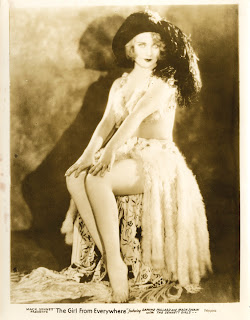 Lombard tended to play athletic coeds who preferred—in the words of one title card—"Romeos, Roadsters and Rollerskates" to studying, serving in such films as The Campus Vamp and Matchmaking Mama as a distinct contrast to the good girl played by Sally Eilers, who at the time seemed destined to be the much bigger star. Top-billed in these comedies was usually Daphne Pollard, a 4-foot 9-inch, pear-shaped comedienne with a 6-foot personality who got laughs playing an authority figure while staring up at her younger charges.
Lombard features most prominently in Run, Girl, Run, in which she plays a "star athlete who once ran a mile in almost nothing—and was nearly expelled for it," while Pollard plays her oddly asexual coach who stops at nothing to keep her charge away from boys. The comedy mostly turns on coded references to lesbianism—homosexuality was almost always treated as a punchline in early Hollywood—with Pollard slipping into Lombard's bed to keep an eye on her and later kissing her on the lips when she wins a track meet (and then to prove how truly exciting the win is, Pollard kisses a boy, too).
 I'll point out one other brief appearance Lombard made in silent films—Mary Pickford's My Best Girl, which I wrote about at length here and here—and then finish by saying that at this stage of her career, Lombard was just one of a parade of pretty girls who passed through Hollywood, nothing special. Without the benefit of her breathless voice, the stark contrast between her refined beauty and her raw, unaffected personality was largely lost, and it was only with the coming of sound that she blossomed into a star.
 Even then, it's clear from her early sound films that Hollywood didn't have a clue what to do with her. Directors liked her personally, and I think they put her in movies because they liked having her around. But when it came time to cast her, they didn't think to offer her anything other than the role of a generically beautiful woman. Granted, she was never going to play the girl next door type—unaffected isn't the same as innocent—but the fact is, while Carole Lombard was a beautiful women, she never really figured how to play one on screen. She had no sense of entitlement, none of the slack indolence or rapaciousness, that was required to play the parts she was offered.
It was Howard Hawks who first had the wit to see that a beautiful woman who didn't mind making a fool of herself on camera was a rare commodity, and during the dark, bleak days of the Great Depression, a highly-marketable one. Lombard's breakthrough didn't come until 1934 when he cast her in Twentieth Century, the first of four classic comedies (including My Man Godfrey, Nothing Sacred and To Be Or Not To Be) that today largely define her screen appeal.

 Blog about movies long enough and eventually you discover Dennis Cozzalio's fabulous website, Sergio Leone and the Infield Fly Rule, and his justly-famous film quizzes, which have become something of a semi-annual rite of passage.
As Beveridge D. Spencer so eloquently put it, "You know those dreams you have where you're in school with no pants on and there's a test that you didn't study for because you don't go to school any more, you're a grown up darn it? Well, that dream just came true! Unless you're wearing pants. Or still in school."
Seriously, these are wickedly hard tests.
It's been a while since Dennis posted one, but this month we get Professor Ed Avery's Cortizone-Fueled, Bigger-Than-Life, Super Big Gulp-Sized Summer Movie Quiz.
Here are my answers ...
1) Depending on your mood, your favorite or least-loved movie cliché
 Least loved movie-making cliche would be the hand-held, barf-inducing shaky cam, coupled with frenetic editing and poorly-composed, poorly-thought-out action sequences. See, e.g., every summer action movie made in the last ten years.
Least loved story-telling cliche—admittedly more a problem with series television than movies—is where a central character does something that in the real world would land them in jail, the brig or at the very least, the unemployment line, but which the authority figure ultimately excuses because, dammit, the character is so good at their job. In the real world, nobody is that good at their job. See, e.g., MASH, House, Battlestar Galactica.
Favorite movie cliche is no doubt the traditional rom-com story arc ...
2) Regardless of whether or not you eventually caught up with it, which film classic have you lied about seeing in the past?
 Maybe because I'm a lawyer, one of my pet peeves is people who insist on lying and then do a lousy job of it, spinning elaborate yarns filled with ridiculous exaggerations or easily-disputed alibis. If you must lie, remember: keep it simple, stick as closely to the facts as you can and then either omit the offending information or feign a misunderstanding of the situation.
In the long run, honesty is definitely the best policy, if only to establish your credibility down the road for the really big lie. As a matter of fact, the best lie of all is the truth. Master that paradox and you can rule the world.
3) Roland Young or Edward Everett Horton?
Love them both, but got to go with Edward Everett Horton, from pre-Code Lubitsch and Astaire-Rogers comedies, all the way to the narration of "Fractured Fairytales" on Rocky and Bullwinkle.
 4) Second favorite Frank Tashlin movie
Son of Paleface? Will Success Spoil Rock Hunter? One of his Porky Pig cartoons from the 1930s? Truth is, Susan Slept Here is the only Frank Tashlin movie I really like.
5) Clockwork Orange-- yes or no?
I have seen A Clockwork Orange many times ...
6) Best/favorite use of gender dysphoria in a horror film (Ariel Schudson)
Does Norman Bates count? It's a stretch, admittedly. As a general rule, using gender dysphoria as a horror device isn't really my cup o' tea.
 7) Melanie Laurent or Blake Lively?
Mélanie Laurent, based on her work in Inglorious Basterds. I confess, I have no idea who Blake Lively is. Does that make me old?
 8) Best movie of 2011 (so far…)
Couldn't tell you. The best feature film I saw for the first time in 2011 (so far) is Stella Maris, the 1918 Mary Pickford movie.
9) Favorite screen performer with a noticeable facial deformity (Peg Aloi)
Huh?
10) Lars von Trier: shithead or misunderstood comic savant? (Dean Treadway)
The first one.
11) Timothy Carey or Henry Silva?
Henry Silva for his work as the Korean interpreter in The Manchurian Candidate.
12) Low-profile writer who deserves more attention from critics and /or audiences
The Mythical Monkey
 13) Movie most recently viewed theatrically, and on DVD, Blu-ray or streaming
Theatrically? Maybe North By Northwest at the AFI.
DVD/Blu-Ray or streaming? The Heart of Texas Ryan a.k.a. Single Shot Parker, a 1917 western starring Tom Mix.
14) Favorite film noir villain
Jane Greer's Kathy Moffitt from Out of the Past.
 15) Best thing about streaming movies?
Cheap, plentiful and immediate. Which is three things ...
16) Fay Spain or France Nuyen? (Peter Nellhaus)
I'm a fan of both countries, but have never heard of either actress.
17) Favorite Kirk Douglas that isn’t called Spartacus (Peter Nellhaus)
Chuck Tatum in Ace in the Hole. But I could name ten Kirk Douglas movies off the top of my head I like better than Spartacus.
 18) Favorite movie about cars
Used Cars
19) Audrey Totter or Marie Windsor?
Marie Windsor, one of the greatest noir B-actresses ever.
 20) Existing Stephen King movie adaptation that could use an remake/reboot/overhaul
Re-boot this, pal.
21) Low-profile director who deserves more attention from critics and/or audiences
If he's alive and I've heard of him, he can't be all that low profile.
22) What actor that you previously enjoyed has become distracting or a self-parody? (Adam Ross)
 Ronald Reagan. If the real Reagan were alive today, Republicans would drum him out of the party as a left-wing RINO. Which tells you everything you need to know about the current state of the Republican Party.
23) Best place in the world to see a movie
Lying on my couch with Katie-Bar-The-Door and our dog.
24) Charles McGraw or Sterling Hayden?
Is this a trick question? Sterling Hayden, of course, protector of our precious bodily fluids.
 25) Second favorite Yasujiro Ozu film
I Was Born, But ..., behind only Tokyo Story.
26) Most memorable horror movie father figure
Do they have fathers in horror movies?
27) Name a non-action-oriented movie that would be fun to see in Sensurround (Sal Gomez)
I'm actually old enough to remember Sensurround first hand. The correct answer is: None.
28) Chris Evans or Ryan Reynolds?
Ryan Reynolds looked vaguely familiar when I googled him, so Ryan Reynolds.
 29) Favorite relatively unknown supporting player, from either or both the classic and the modern era
Eugene Pallette, Edward Arnold, James Gleason, Jack Carson ... the list goes on and on.
30) Real-life movie location you most recently visited or saw
Well, I see Washington, D.C., practically every day.
31) Second favorite Budd Boetticher movie
So far as I can tell, when it came to motion pictures, Budd Boetticher directed pure crap, but he was the assistant director on The More the Merrier, starring Joel McCrea and Jean Arthur, so I'll say that. Oh, wait, that would be my favorite Boetticher movie. So, um, one of the episodes of Maverick he directed.
32) Mara Corday or Julie Adams?
Julie Adams, for all her television work.
 33) Favorite Universal-International western
Amazing what you can find out with the advanced search function at Imdb.com. Probably Winchester '73.
34) Favorite actress of the silent era
Musidora. This week.
35) Best Eugene Pallette performance (Larry Aydlette)
My Man Godfrey
 36) Best/worst remake of the 21st century so far? (Dan Aloi)
Haven't seen a lot of remakes. The Manchurian Candidate, which I saw on cable, wasn't good, though.
37) What could multiplex owners do right now to improve the theatrical viewing experience for moviegoers? What could moviegoers do?
Slash ticket prices and turn off their electronic devices, respectively.
Postscript: Some time between when I cut-and-pasted the questions from Sergio Leone and when I posted my answer, Dennis added a question, which was number 34 on his list: What's the biggest "gimmick" that's drawn you out to see a movie? (Sal Gomez)
Presumably that means ever, because no mere gimmick has drawn me out to the theater in years. But within my lifetime, I would have to say the "dinner-and-a-movie date" concept has drawn me out to more movies than any other gimmick.







 Posts
Posts

