skip to main |
skip to sidebar
Eugene Pallette—best known for his froggy bass voice, this veteran of such films as My Man Godfrey and Mr. Smith Goes to Washington made his first movie in 1913 and had an important role in D.W. Griffith's classic Intolerance.
Adolphe Menjou—debuting in 1914, he was already great in such silent films as A Woman of Paris and The Marriage Circle, but sound added another layer of smarm and good humor. See, e.g., Morocco, The Front Page, A Farewell to Arms, Stage Door, Paths of Glory, etc.
Wallace Beery—a ham in any age, he played supporting roles in the The Last of the Mohicans (1920), the Douglas Fairbanks version of Robin Hood (1922), Buster Keaton's Three Ages (1923), and The Lost World (1925), but he won an Oscar in the sound era.
Mary Astor—made her film debut in 1920, but did her best work in Dodsworth and The Maltese Falcon, and won an Oscar for The Great Lie in 1941.
Lionel Barrymore—debuted in 1908 and was excellent in the Gloria Swanson version of Sadie Thompson but is best known for such sound work as It's A Wonderful Life, Key Largo, Grand Hotel and his Oscar-winning role in A Free Soul.
Marie Dressler—she starred across from Chaplin in the first feature-length comedy, Tillie's Punctured Romance in 1914, became a supporting player, then virtually disappeared before becoming Hollywood's top leading lady (no, seriously!) in the sound era, winning an Oscar for Min and Bill and providing the best double take in film history opposite Jean Harlow in Dinner at Eight.
Carole Lombard—debuting in 1921, she made multiple brief appearances as eye candy until Howard Hawks had the good sense to cast this irreverent, salty-tongued goddess in a comedy, 1934's Twentieth Century. After that, we got such classics as My Man Godfrey, Nothing Sacred and To Be or Not to Be before her untimely death in 1942.
Myrna Loy—played dozens of largely-forgotten vamps and exotics between 1925 and 1934 until cast opposite William Powell in the classic comedy whodunit, The Thin Man. After that, she was one of the biggest stars of Hollywood's Golden Age, a leading lady to the likes of Clark Gable, Cary Grant, Fredric March and, of course, Powell with whom she made fourteen films.
William Powell—Roger Ebert once wrote that Powell was to dialogue what Fred Astaire was to dance, and with the coming of the sound era, his career blossomed. But you can see him in thirty-five silent films, mostly as the stock heavy (including a brilliant turn as a Russian revolutionary in Josef von Sternberg's The Last Command.)
A look ahead at the Monty's March Madness Favorite Actress Tournament, part of which we'll be hosting here at the Monkey.
Voting begins March 5.
Barbara Stanwyck
 Birth Name: Ruby Catherine Stevens
Tourney Bracket and Seeding: "Tough Broads and Pre-Code Babes" #1
Birth Date: July 16, 1907
Birthplace: Brooklyn, New York
Height: 5' 5"
Film Debut: Broadway Nights (1927)
Academy Awards: 4 nominations, honorary Oscar (1982)
Katie Awards: Best Actress (Comedy/Musical) (1941) (Ball of Fire and The Lady Eve) and Best Actress (Drama) (1944) (Double Indemnity)
Three More To See: The Bitter Tea of General Yen, Baby Face, Sorry, Wrong Number
versus
Miriam Hopkins
 Birth Name: Ellen Miriam Hopkins
Tourney Bracket and Seeding: "Tough Broads and Pre-Code Babes" #8
Birth Date: October 18, 1902
Birthplace: Savannah, Georgia
Height: 5' 2"
Film Debut: The Home Girl (1928)
Academy Awards: 1 nomination
Katie Awards: Best Supporting Actress (1931-32) (The Smiling Lieutenant and Dr. Jekyll and Mr. Hyde)
Three More To See: Trouble in Paradise, The Story of Temple Drake, Design for Living
The winner of this match-up will face the winner of:
Claudette Colbert
 Birth Name: Emilie Claudette Chauchoin
Tourney Bracket and Seeding: "Tough Broads and Pre-Code Babes" #4
Birth Date: September 13, 1903
Birthplace: Saint-Mandé, France
Height: 5' 4½"
Film Debut: For the Love of Mike (1927)
Academy Awards: 3 nominations, 1 win (Best Actress, 1934) (It Happened One Night)
Three More To See: Imitation of Life, Midnight, The Palm Beach Story
versus
Mary Astor
 Birth Name: Lucile Vasconcellos Langhanke
Tourney Bracket and Seeding: "Tough Broads and Pre-Code Babes" #5
Birth Date: May 3, 1906
Birthplace: Quincy, Illinois
Height: 5' 6"
Film Debut: Bullets or Ballots (1921)
Academy Awards: 1 win (Best Supporting Actress, 1941) (The Great Lie)
Katie Awards: Best Supporting Actress (1941) (The Great Lie and The Maltese Falcon)
Three More To See: Red Dust, Dodsworth, The Palm Beach Story
 I won a major award last November for my thoughts on Citizen Kane which you can read here. I won't rehash any of that now except to say that despite its revered status as the classic to end all classics, Citizen Kane is a terrifically entertaining and satisfying movie.
Or to put it another way, just because your 10th grade English teacher made you read Silas Marner and called it a "classic"—because that's what this is all about, isn't it—that's no reason to avoid Citizen Kane.
My other thought (SPOILERS AHEAD) is about Mary Astor, whose performance in The Maltese Falcon is surprisingly divisive among classic movie fans. Many think she is not nearly enough of a "knockout" to justify Sam Spade's interest in her.
Me, I think the thirty-five year old Astor was perfectly cast.
 We've grown inured to the notion that in movies, forty-two year old actors should hook up with twenty-four year old actresses, but the fact is, if Bogart's Sam Spade had flipped for a young hottie, we the audience would have concluded that he was thinking with his libido and she was playing him for a sap.
Very noirish, but rendering the twist ending emotionally hollow, in my opinion.
As it stands, they come to each other as equals: he's found his soul mate, someone as smart, amoral and reptilian as he is; and she, after a decade of knocking around places like Istanbul and Hong Kong with a collection of tough, dim pretty boys, has at last met a man with whom she feels truly safe.
Ironic how it works out.
That they are both also rapidly approaching their sell-by date makes the ending all the more poignant.
But maybe that's just the romantic in me.
PICTURE (Drama)
winner: Citizen Kane (prod. Orson Welles)
nominees: High Sierra (prod. Hal B. Wallis); How Green Was My Valley (prod. Darryl F. Zanuck); The Little Foxes (prod. Samuel Goldwyn); The Maltese Falcon (prod. Hal B. Wallis)
PICTURE (Comedy/Musical)
winner: Sullivan's Travels (prod. Preston Sturges)
nominees: The Devil And Miss Jones (prod. Frank Ross); Fantasia (prod. Walt Disney); Here Comes Mr. Jordan (prod. Everett Riskin); The Lady Eve (prod. Paul Jones)
PICTURE (Foreign Language)
winner: Genroku Chûshingura (The 47 Ronin) (prod. Shintarô Shirai)
nominees: Todake no kyodai (The Brothers and Sisters of the Toda Family) (prod. Shôchiku Film)
ACTOR (Drama)
winner: Orson Welles (Citizen Kane)
nominees: Humphrey Bogart (High Sierra and The Maltese Falcon); Walter Huston (The Devil and Daniel Webster); Herbert Marshall (The Little Foxes); Tyrone Power (Blood and Sand)
ACTOR (Comedy/Musical)
winner: Gary Cooper (Meet John Doe and Ball Of Fire)
nominees: Charles Coburn (The Devil And Miss Jones); W.C. Fields (Never Give A Sucker An Even Break); Henry Fonda (The Lady Eve); Joel McCrea (Sullivan's Travels); Robert Montgomery (Here Comes Mr. Jordan); William Powell (Love Crazy and Shadow of the Thin Man)
ACTRESS (Drama)
winner: Bette Davis (The Little Foxes)
nominees: Joan Crawford (A Woman's Face); Olivia de Havilland (Hold Back The Dawn); Irene Dunne (Penny Serenade); Joan Fontaine (Suspicion); Vivien Leigh (That Hamilton Woman)
ACTRESS (Comedy/Musical)
winner: Barbara Stanwyck (Ball Of Fire and The Lady Eve)
nominees: Jean Arthur (The Devil And Miss Jones); Deanna Durbin (It Started With Eve); Wendy Hiller (Major Barbara); Dorothy Lamour (Road to Zanzibar); Myrna Loy (Love Crazy and Shadow of the Thin Man)
DIRECTOR (Drama)
winner: Orson Welles (Citizen Kane)
nominees: John Ford (How Green Was My Valley); John Huston (The Maltese Falcon); Raoul Walsh (High Sierra); William Wyler (The Little Foxes)
DIRECTOR (Comedy/Musical)
winner: Preston Sturges (The Lady Eve and Sullivan's Travels)
nominees: Frank Capra (Meet John Doe); Alexander Hall (Here Comes Mr. Jordan); Howard Hawks (Ball of Fire); Sam Wood (The Devil and Miss Jones)
SUPPORTING ACTOR
winner: Sidney Greenstreet (The Maltese Falcon)
nominees: Donald Crisp (How Green Was My Valley); William Demarest (The Lady Eve); James Gleason (Here Comes Mr. Jordan); Peter Lorre (The Maltese Falcon); Claude Rains (Here Comes Mr. Jordan)
SUPPORTING ACTRESS
winner: Mary Astor (The Great Lie and The Maltese Falcon)
nominees: Sara Allgood (How Green Was My Valley); Spring Byington (The Devil And Miss Jones); Patricia Collinge (The Little Foxes); Veronica Lake (Sullivan's Travels); Teresa Wright (The Little Foxes)
SCREENPLAY
winner: Orson Welles and Herman J. Mankiewicz (Citizen Kane)
nominees: John Huston (The Maltese Falcon); Preston Sturges (The Lady Eve and Sullivan's Travels)
SPECIAL AWARDS
Gregg Toland (Citizen Kane) (Cinematography); Perry Ferguson and Van Nest Polglase; Al Fields and Darrell Silvera (Citizen Kane) (Art Direction-Set Decoration); Bernard Herrmann (Citizen Kane) (Score); Robert Wise (Citizen Kane) (Film Editing)
 Be sure to look for a Joan Blondell double feature on Turner Classic Movies early Thursday, June 9, 2011, with Night Nurse at 6 a.m. EDT, followed by Other Men's Women at 7:15.
I cited both of these movies when I chose Blondell as the best supporting actress of 1930-31. This is what I had to say, in part:
 If any one person has come to personify in my mind the glorious excesses of Hollywood's pre-Code era, it's Joan Blondell. She was sexy, she was sassy, and stripped down to her skivvies as she invariably was, she was always on the make. She had big blue eyes that rivaled those of Bette Davis, but unlike Bette's eyes, which always promised a knee to the groin if you got too close, Blondell's eyes promised a good time—if you measured up. And with very few predecessors to point the way, she had a gift for projecting moral ambiguity on the screen that set her work apart from the black-and-white caricatures her peers presented. Her very real talent was too often taken for granted but it really shone during the Early Sound Era when the brakes of censorship were off and if you want to know what film historians mean when they talk about "pre-Code" movies, you need look no further than Joan Blondell.
Movie audiences wouldn't see this much explicit behavior on screen again until Hollywood abandoned the Code altogether in 1968 and suffice it to say the Joan Blondell movies I've cited here—Sinners' Holiday, Other Men's Women and Night Nurse—violated just about every aspect of its prohibitions, showing murder, revenge, the use of liquor, undressing scenes, scenes in bedrooms, adultery, impure love, semi-nudity, transparent clothing and God knows what else in ways that made all of those things seem like pretty good ideas. Throw in the cruelty to children and surgical operations that were central to the plot of Night Nurse and you've pretty much covered every aspect of the Code except venereal disease and the ridicule of religion.
No wonder these movies were so much fun to watch.
 The first movie on my list, Sinners' Holiday, is typical of Blondell's pre-Code work, showing off both her no-nonsense sex appeal and talent for playing working class women. Set on the Coney Island boardwalk, Blondell here plays a photographer's model who gets mixed up with James Cagney and his penny ante bootleg liquor operation with tragic results. Although playing what are clearly supporting roles, Blondell and Cagney provided the movie's energy, blowing their higher-billed, better-paid co-stars off the screen, and drawing the attention of critics and moviegoers alike. Maybe it was their talent for making stock characters seem like real people—the eye is drawn to that on the screen that reminds you of something real, and both Blondell and Cagney imbue their characters with a reality otherwise sorely lacking in this pedestrian tale.
 Sinners' Holiday was based on a stage play, Penny Arcade, that featured both Blondell and Cagney. The play only ran three weeks, but in the audience was Al Jolson (of The Jazz Singer) who was so impressed with the supporting work Blondell and Cagney turned in, he bought the film rights to the play for $20,000 and sold them to Jack Warner on the condition that he cast Blondell and Cagney in their original roles. Jolson had never met either performer, but he had an eye for talent. Sinners' Holiday was Blondell's fifth movie, co-star James Cagney's film debut, and for both performers it proved to be a promise of great things to come.
Blondell and Cagney teamed up again just three months later for Other Men's Women, the story of a love triangle involving a married couple and the husband's best friend. That neither Blondell nor Cagney, again relegated to supporting roles, figure into the affair should tell you all you need to know about the production's chief weakness. But the movie still works as a showcase of both stars' talents and is a prime example of the sort of things a pre-Code movie could get away with that movie audiences wouldn't see again for thirty years.
 Blondell is slinging hash behind the counter at a railroad diner in this one, and with her eyes and with her voice, she draws a convincing portrait of a tired, jaded working woman, a real tough cookie. When she asks the customers "Anything else you guys want?" you can feel the slap in her voice and when one of them eyes her as she bends over and answers "Yeah, gimme a big slice of you on toast" she tells him with a look that let's him know she's heard it all before and is immune to his nonsense, "Listen, baby, I'm A.P.O.—Ain't Puttin' Out!"
Blondell's pining for the railroad engineer who's forgotten he's promised to marry her when he gets back into town—pining, that is, without love and without feeling any need to be particularly chaste while she's waiting. She blows him the raspberry and when he later rips her her dress, she gives him a slap he no doubt felt down to his heels; if Blondell pulled her punch, it was the most convincing pulled punch in movie history.
 The star of Other Men's Women is a young and beautiful Mary Astor, who just as in Red Dust, can make you believe a guy would throw over a Joan Blondell or a Jean Harlow for her. But Blondell is the most convincing performer in the movie, and that includes Cagney in his last role before he became a star (by the way, what a swell movie this might have been if director Wellman had thought to cast Cagney as the lead). Blondell could play saucy in her sleep and hers is the performance you'll remember from this one.
After the January premiere of Other Men's Women, Blondell made nine more movies in 1931 (she made ten in 1932 and eight the year after that), her best roles coming in Night Nurse and Blonde Crazy, two of the best Code-busting movies ever made. The latter, with Blondell's famous bathtub scene, came out too late in 1931 to be eligible for a Katie here, but Night Nurse and its parade of lingerie just squeezed in with a July premiere in New York.
In Night Nurse, Blondell again has a supporting role, this time to Barbara Stanwyck who plays a nurse trainee paired with a more experienced nurse (Blondell) who specializes primarily in ways to skirt the strict rules against men, booze and late nights boozing with men.
"I'm sure in your heart you love it," says the eager Stanwyck.
"Sez you," sneers Blondell.
 The movie is not eight minutes old before the actresses are out of their clothes. Blondell picks out a uniform for Stanwyck then watches as she undresses, sizing up the competition. William A. Wellman—this is the same guy who gave us a quick glimpse of Clara Bow's bare breasts in Wings—directs the scene in his typically leering style. "Oh, don't be embarrassed," says Dr. Smooth-Weasel when he saunters in. "You can't show me a thing. I just came from the delivery room."
Then Stanwyck plants her foot in Blondell's lap so Blondell can help Stanwyck off with her stockings. To their credit, the two actresses handle the scene so casually it almost doesn't occur to you to wonder what director Wellman thought he was up to. Almost. Stanwyck and Blondell spend an awful lot of the movie dressing and undressing, and in the case of Stanwyck, who at this point in her acting career was as green as wet wood, it helps disguise the fact that she didn't quite know what she was doing. In Blondell's case, it just seems a natural aspect of her gum-chewing, hip-swiveling character.
 The plot is pure gangster melo- drama. In a part originally written for James Cagney (who, with the unexpected success of The Public Enemy, was now too big for supporting roles) (and yes, Blondell was in that Cagney effort, too; in the first five years of their careers, they made seven movies together), Clark Gable starves the children of his rich society lover so he can get his hands on their trust fund. Stanwyck and Blondell stumble across the scheme when they sign on as night nurses at the rich woman's estate and the rest of the plot concerns the plucky Stanwyck's attempts to thwart Gable, a charismatic brute who doesn't mind knocking a woman cold with a right cross.
Despite the role's size, the best performance in the movie once again belongs to Blondell. What I like most about her, in this movie and elsewhere, is you can't easily read her character. Does she have a heart of gold or a heart of brass? Usually, it's both, with the mix, depending on the role, sliding along the continuum toward one end or the other but never fully arriving—as with most people. This is her strength as a character actress, I think, and maybe her weakness as a lead: Hollywood typically likes its stars to be all one thing, a hero or a villain you can root for or against. With Blondell, well, you're never quite sure.
 Take Night Nurse, for example. For Stanwyck, nursing is a calling and she's ready to risk her career to stop Gable. For Blondell—"I don't know a thing, I just work here"—nursing is a job and sticking her neck out is no way to keep the paychecks coming. In other words, Blondell is us the way we really are, Stanwyck as we like to pretend we are, and we go to the movies to pretend.
Joan Blondell worked very hard for a very long time but with a few exceptions—most notably in 1945's A Tree Grows In Brooklyn—she flew under the radar. Like Joan Crawford, Barbara Stanwyck and Jean Arthur, she excelled at playing working class women. Like Jean Harlow and Marlene Dietrich, she was genuinely sexy. But after a couple of successful starring roles, she was largely relegated to supporting status.
 Between film, stage and television, Blondell worked steadily from 1930 to her death in 1979, receiving a Tony nomination in 1958 for The Rope Dancers and two Emmy nominations for the television series Here Come The Brides. She received her only Oscar nomination, a supporting actress nod, for the 1951 movie The Blue Veil, and won the National Board of Review's award for the best supporting actress of 1965 for her performance as Lady Fingers in The Cincinnati Kid.
"I don't know what the secret to longevity as an actress is," she once said. "It's more than talent and beauty. Maybe it's the audience seeing itself in you."
Today is the centennial of Jean Harlow's birth. In her honor, I'm posting this Reader's Digest version of the four-part, 5000 word essay I wrote about her last year.
 If she'd just been another pretty face, she would have been forgotten long ago, one of the thousands of beauties who for a brief season capture the fancy of the paparazzi and the tabloids and the fickle paying public and then quickly fade from our memory. But more than just a platinum blonde beauty, Jean Harlow also possessed an unexpected gift for comedy and self-parody, and as the pre-Code era drew to a close, she became not only America's premier sex symbol but one of its premier actresses as well.
 Born to a Kansas City dentist and the daughter of a wealthy real estate developer, Harlean Harlow Carpenter tried out for the movies on a dare, got the job and later signed with the Hal Roach Studios. Working under her mother's maiden name, Jean Harlow played the "swanky blonde" in four Laurel and Hardy comedy shorts and appeared in uncredited bit roles in more than a dozen movies (including Chaplin's City Lights) before Howard Hughes cast her in Hell's Angels. Hughes epic about World War I flying aces proved to be Harlow's big break. Although she was as skittish as a newborn foal, barely able to speak her lines, the public immediately responded to her beauty—the expressions "platinum blonde" and "blonde bombshell" were coined to describe her—and she soon landed better parts, including that of James Cagney's love interest in William Wellman's gangster classic The Public Enemy, and the unobtainable society girl in Frank Capra's comedy Platinum Blonde.
Directors clearly had no idea what to do with Harlow in these early efforts and mostly she stood around, serving as a symbol of something the hero thinks he wants and learns the hard way that he doesn't. The bombshell image may have packed the theaters with the curious and the salivating, but it blinded directors and producers to her talent.
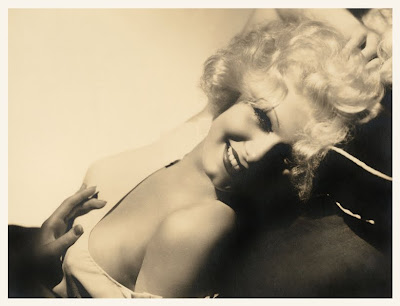 "The newspapers sure have loused me up," she complained cheerfully, "calling me a sexpot! Where'd they ever get such a screwy idea?"
It was MGM's legendary producer Irving Thalberg who determined to mold a screen image for Harlow beyond that of sex symbol. Thalberg bought Harlow's contract from Howard Hughes and cast her in the screen adaptation of Red-Headed Woman, Katharine Brush's racy novel about a woman who sleeps her way into high society. F. Scott Fitzgerald took the first crack at the screenplay, but couldn't solve the puzzle of how to make the audience like a character he himself didn't approve of, and it was instead Anita Loos, a veteran screenwriter and author of Gentlemen Prefer Blondes, who drafted the final screenplay.
 Although Harlow played a manipulative gold digger—she seduces her married boss and breaks up his marriage—there was a sincerity to her transparent scheming, and with Harlow serving up the brassy bits with humor and wounded pride, audiences found themselves rooting for her. The result was one of the biggest hits of 1932.
Variety summed up the general reaction: "Jean Harlow, hitherto not highly esteemed as an actress, gives an electric performance."
 Next up was an even better vehicle for Harlow, one that would both display her talent for comedy and pair her with fast-rising star Clark Gable. Based on a failed stageplay, Red Dust starred Gable as the overseer of a Vietnamese rubber plantation, Harlow as the "cute little trick" who falls for him, and Mary Astor as the wife of the plantation's latest hire, a woman Gable sets out to seduce.
"What a pleasant little house party this is going to be," Harlow quips. The women's rivalry is not just one of sex and love but of class, education and manners—everything Astor's Mrs. Willis takes for granted, everything Harlow's Vantine has struggled to survive without—and as the love triangle plays out, Harlow really hits her stride as an actress. As Vantine competes with Mrs. Willis (and Harlow with Astor), she is funny, bawdy, hurt, angry, and then as much as her Vantine wishes she weren't, compassionate, too, protecting her rival when she could just as easily destroy her.
 Harlow's "uniquely effortless vulgarity, humor and slovenliness," wrote Movie Diva in her review of Red Dust, "create the rarest of Hollywood goddesses, the beautiful clown."
It's one of the best performances of the pre-Code era.
The following year Harlow gave what may be her best-remembered performance, that of none-too-bright social climber Kitty Packard in the comedy-drama, Dinner At Eight.
A successful play by Broadway legends George S. Kaufman and Edna Ferber, Dinner At Eight is a loosely-connected series of vignettes about a group of wealthy Manhattanites preparing for a dinner party as their respective worlds fall down around their ears. For the movie adaptation, producer David O. Selznick assembled the brightest of MGM's stars, including the three male leads from Grand Hotel, and added America's most popular actress Marie Dressler as a faded Broadway star, Billie Burke as the twittery hostess of this train wreck, and Harlow as the spoiled young trophy wife of Wallace Beery's crooked businessman.
 Director George Cukor, fresh off Katharine Hepburn's successful debut in A Bill Of Divorcement, cast Harlow over the objections of Louis B. Mayer, who felt she wasn't actress enough to keep up with her more experienced co-stars. But Red Dust had convinced Cukor that Harlow had a gift for comedy and with the director's help, she wound up stealing the show. Harlow's Kitty manipulates her men, bullies her maid, and otherwise lazes around, eating bonbons and complaining of boredom. Yet because she hungers to improve herself (even if she seems to think the surest path to knowledge is to sleep with an educated man), we find ourselves cheering her on.
"I'm going to be a lady if it kills me," she vows.
 In terms of its complexity, the role of Kitty Packard was a leap for Harlow, but where she had been ill-equipped to handle early roles in Hell's Angels and Platinum Blonde, now she was ready. In Red-Headed Woman, she'd learned how to gain an audience's sympathy despite playing an unlikeable character. In Red Dust, she'd learned how to deliver tough wisecracks while conveying hurt and vulnerability. In Dinner At Eight, she found the last piece of the puzzle, "the ability," in the words of Frank Miller, writing for Turner Classic Movies, "to deliver lines as though she didn't quite know what they meant."
The result was the best performance of her career, and when Harlow finished her last scene for the movie, she went to her dressing room and cried, perhaps knowing that nothing she would ever do afterwards would top this performance.
"Harlow played comedy," said Cukor, "as naturally as a hen lays an egg."
 Movie-going audiences loved Dinner At Eight and loved Harlow in it, not only because she looked great in her backless evening gown (designed by Adrian, it was known as the "Jean Harlow dress" and was so tight she couldn't sit down in it), but also because she had proven herself once and for all as one of Hollywood's great comedic actresses.
"Acting honors," said Variety at the time, "probably will go to Dressler and Harlow, the latter giving an astonishingly well-balanced treatment of Kitty, the canny little hussy who hooks a hard-bitten and unscrupulous millionaire and then makes him lay down and roll over."
"I was not a born actress," Harlow confessed later. "No one knows it better than I. If I had any latent talent, I have had to work hard, listen carefully, do things over and over and then over again in order to bring it out."
After the critical and commercial successes of Red Dust and Dinner At Eight, Jean Harlow leapt to the top of her profession, surpassing Joan Crawford, Greta Garbo and Norma Shearer as the most popular actress at MGM. And although Hollywood began enforcing the Production Code in 1934 and as a result toned down the more explicit sexuality of her movies, Harlow remained an audience favorite. In fact, from 1932 until her untimely death in 1937, Harlow had at least one movie, and often two, finish among the top ten grossing films of the year.
 Despite her success with critics and audiences, Harlow was never nominated for an Academy Award—comedic performances rarely are—but she did rank twenty-second on the American Film Institute's list of the top 100 movie legends and forty-ninth on Entertainment Weekly's list of the all-time greatest movie stars. In his cult classic Alternate Oscars, Danny Peary chose her performance in the screwball comedy Libeled Lady as the best by an actress in 1936.
In contrast to her movie career, Harlow's personal life was marked by scandal and heartbreak. Harlow's mother was overbearing and controlling, living out dreams of movie stardom through her daughter. In 1932, Harlow's second husband Paul Bern died of a gunshot wound under mysterious circumstances. In 1933, MGM arranged a quick, short-lived marriage to cinematographer Harold Rosson to cover up Harlow's affair with a married man. Like her character Lola Burns in the 1933 comedy Bombshell, Harlow was hounded by greedy studio bosses, greedier family members, stalkers, fraudsters, slicky boys and the tabloid press, and treated more as a cash cow than a flesh and blood woman.
"She didn't want to be famous," said Clark Gable, "she wanted to be happy."
 In 1935, Harlow fell in love with William Powell, her co-star in the movie Reckless, and finally after years of turmoil, her personal life began to match the success of her professional one. The two secretly engaged although never married—in his early forties, Powell worried about being linked to such a young actress, and Harlow also claimed MGM studio chief Louis B. Mayer didn't approve of the union.
In 1937, during filming of her sixth movie with Clark Gable, Saratoga, Harlow fell ill with a serious kidney ailment and died before the end of production. The studio finished the film with long shots of a stand-in and released the film with much fanfare. It was the highest grossing film of 1937, a fitting tribute to her brief but brilliant career.
Postscript
 You can check out other tributes to Jean Harlow at the Kitty Packard Pictorial, a site devoted to all things Harlow. The Pictorial is also promoting a new biography, Harlow in Hollywood: The Blonde Bombshell in the Glamour Capital, 1928-1937 by Darrell Rooney and Mark A. Vieira.
 If she'd just been another pretty face, a cut flower from yesterday's bouquet, she would have been forgotten long ago, one of the thousands of beauties who for a brief season capture the fancy of the paparazzi and the tabloids and the fickle paying public and then quickly fade from our memory. But more than just a platinum blonde beauty, Jean Harlow also possessed an unexpected gift for comedy and self-parody, and as the pre-Code era drew to a close, she became not only America's premier sex symbol but one of its premier actresses as well.
Of what I would call the five essential performances in her career—Red-Headed Woman, Red Dust, Dinner At Eight, Bombshell and Libeled Lady—three of them were released during the award year that ran from August 1, 1932 to the end of 1933, and she's my choice for the best actress in a comedy or musical.
The Girl From Missouri
 Born to a Kansas City dentist and the daughter of a wealthy real estate developer, Harlean Harlow Carpenter tried out for the movies on a dare, got the job and later signed with the Hal Roach Studios. Working under her mother's maiden name, Jean Harlow played the "swanky blonde" in four Laurel and Hardy comedy shorts and appeared in uncredited bit roles in more than a dozen movies (including City Lights) before Howard Hughes cast her in Hell's Angels. Hughes epic about World War I flying aces proved to be Harlow's big break. Although she was as skittish as a newborn foal, barely able to speak her lines, the public immediately responded to her beauty—the expressions "platinum blonde" and "blonde bombshell" were coined to describe her—and she soon landed better parts, including that of James Cagney's love interest in William Wellman's The Public Enemy, a part initially intended for Louise Brooks.
On the set, Cagney couldn't help but notice that Harlow never wore undergarments and asked her, "How do you hold those things up?"
"I ice them," she answered matter-of-factly.
 She played a similar kind of role—the beautiful, unobtainable society girl—in Frank Capra's comedy Platinum Blonde (retitled from Gallagher to capitalize on Harlow's popularity) and while critics called the performance no better than "competent," the public was already clamoring for more.
Directors clearly had no idea what to do with Jean Harlow in these early efforts and mostly she stood around, serving as a symbol of something the hero thinks he wants and learns the hard way that he doesn't. The bombshell image may have packed the theaters with the curious and the salivating, but it blinded directors and producers to her talent.
 "The newspapers sure have loused me up," she complained cheerfully, "calling me a sexpot! Where'd they ever get such a screwy idea?"
"One look at Harlow," screenwriter Frances Marion replied in print, "and whether you were male or female you could get no other idea; she was the Scylla and Charybdis of sex, from her provocative come-hither expression to the flowing lines of her beautifully proportioned body."
Red-Headed Woman and Red Dust: Red-Hot Harlow
 It was MGM's legendary producer Irving Thalberg who determined to mold a screen image for Harlow beyond that of sex symbol. Thalberg bought Harlow's contract from Howard Hughes and cast her in the screen adaptation of Red-Headed Woman, Katharine Brush's racy novel about a woman who sleeps her way into high society. F. Scott Fitzgerald took the first crack at the screenplay, but couldn't solve the puzzle of how to make the audience like a character he himself didn't approve of, and it was instead Anita Loos, a veteran screenwriter and author of Gentlemen Prefer Blondes, who drafted the final screenplay.
Although Harlow's Lillian Andrews is a manipulative gold digger—she seduces her married boss, poor sap, and breaks up his marriage—there was a sincerity to Lil's transparent scheming, and with Harlow serving up the brassier bits with humor and wounded pride, audiences found themselves rooting for her. The result was one of the biggest hits of 1932.
 It was a remarkably nuanced performance from an actress who before this had always shown more leg than promise. Variety summed up the general reaction: "Jean Harlow, hitherto not highly esteemed as an actress, gives an electric performance."
Next up was an even better vehicle for Harlow, one that would both display her talent for comedy and pair her with fast-rising star Clark Gable.
 Based on a failed stageplay, MGM had purchased Red Dust as a vehicle for Greta Garbo and John Gilbert, the studio's two biggest stars of the silent era. Once the couple's relationship ended, however, Garbo backed out and Thalberg cast Harlow to replace her. While adapting the play for the screen, writer John Lee Mahin recommended that Thalberg replace Gilbert with Gable, and his suggestion proved to be an inspired one. Harlow and Gable had an undeniable chemistry on screen and ended up making six pictures together, including Harlow's last, Saratoga.
Clark Gable is Dennis Carson, the overseer of a rubber plantation deep in the jungles of French Indochina. As the movie opens, Carson is on edge—production is behind schedule, his crew chief (Donald Crisp) is a drunk, and if that weren't enough to worry about, a prostitute on the run from the law decides to hide out in Carson's bed.
 "You've got your yearly case of nerves," says his friend and mentor (Tully Marshall). "Why don't you go down to Saigon and blow the lid off. ... As a matter of fact, what came up from Saigon isn't so bad looking."
"I've been looking at her kind," Carson sneers, "ever since my voice changed."
 But as Carson notes, the prostitute, Vantine (Harlow), is a "cute little trick" and she makes him laugh and, well, she's there and why not. Things get a bit complicated when she falls for him, but Carson is oblivious and at the end of the month, he puts her on the boat and hands her a wad of cash she doesn't want. "It isn't half enough," he tells her as her eyes fill with tears. "And when I get down to Saigon, there'll be plenty more." Harlow is terrific in this scene as we glimpse Vantine's vulnerability while never letting down the guard a woman of her profession would necessarily have developed.
And then things really do get complicated. As Vantine gets on the boat, Barbara Willis (Mary Astor) gets off it, and though she's the wife of his latest hire, Carson is immediately smitten. Mrs. Willis represents everything that he, as a poor kid with his nose forever pressed against the glass, has ever wanted and he sets out to seduce her.
 When the boat soon after runs aground and Vantine is thrown back into Carson's care, a worldly-wise Harlow immediately sizes up the situation. "What a pleasant little house party this is going to be." The women's rivalry is not just one of sex and love but of class, education and manners—everything Mrs. Willis takes for granted, everything Vantine has struggled to survive without—and this is where Harlow really hits her stride as an actress. As Vantine competes with Mrs. Willis (and Harlow with Astor) with gestures both subtle (a mocking description of a fictional blue-blooded background) and not so subtle (bathing in the company drinking water), Harlow is funny, bawdy, hurt, angry, and then as much as her Vantine wishes she weren't, compassionate, too, protecting her rival when she could just as easily destroy her.
 As the Movie Diva put it in her review of Red Dust, Harlow's "uniquely effortless vulgarity, humor and slovenliness create the rarest of Hollywood goddesses, the beautiful clown." It's one of the best performances of the pre-Code era.
The movie itself has been selected for preservation in the National Film Registry.
 Despite being known as a "man's director," Victor Fleming was remarkably adept at getting strong performances from actresses—Clara Bow in Mantrap, Judy Garland in The Wizard Of Oz, Vivien Leigh in Gone With The Wind—and he probably deserves more credit than he usually gets for establishing Harlow as an actress (he also directed her in Bombshell and Reckless). He liked to create onscreen the sort of women he preferred to spend time with in private—"resourceful, strong-willed and sexual," as David Denby put in The New Yorker (May 25, 2009).
Harlow's Vantine was all that and more.
[To read Part Two, click here.]







 Posts
Posts

