skip to main |
skip to sidebar
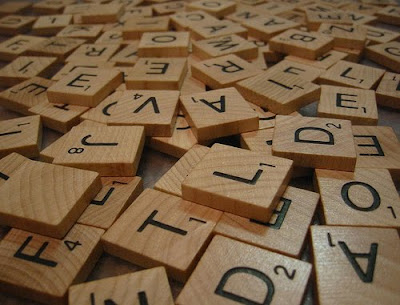 In case you're wondering why my review of Cecil B. DeMille's 1918 film Old Wives For New is taking so long, let me put it this way: I've polished up 1150 words so far and the next sentence starts "As the film opens ..."
Wordy or thorough? You decide ...
Anyway, I have to go cook dinner now.
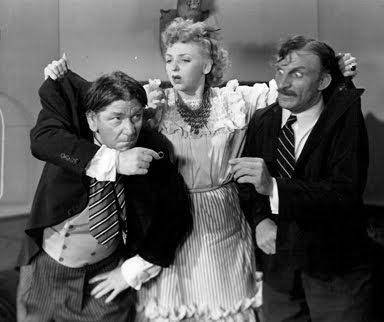 Blog pal Who Am Us Anyway said in a comment the other day "Now, it's a sad commentary on me—I mean, on people—but a compendium of Stooges bits followed by clips of their bits' origins might-could have the same effect the British blues bands had on 60s kids who otherwise might never have listened to Muddy Waters or Robert Johnson ..."
That is a great idea. And all it would require is a little effort on the part of yours truly. But as you can see, I've been making as little effort as possible recently, and there's a ballgame on at 1 p.m. to boot. So you'll have to wade through these unedited and draw your own conclusions.
 First up is Seven Chances, Buster Keaton's feature-length comedy in which the Great Stoneface must get married by the end of the day or lose a large inheritance. Hard on its heels are not one but two Three Stooges shorts, In the Sweet Pie and Pie (here it's three women who have to get married—to Moe, Larry and Curly) and Brideless Groom (a Shemp one where he's the one who must get married). That's six Stooges for the price of one!
Hold hands, you lovebirds!
Seven Chances (1925)
In The Sweet Pie and Pie (1941)
Brideless Groom (1947)
 This is my contribution to the Mary Pickford Blogathon, hosted by one of the Monkey's favorite bloggers, KC of Classic Movies.
Amarilly of Clothes-Line Alley was the second of five movies Mary Pickford made in 1918, and the first after the spectacular achievement of Stella Maris. Here, Pickford mines a familiar vein—the collision of the upper and lower classes told through the eyes of a spirited girl from the wrong side of the tracks—this time played mostly for comedy. Although not as iconic as Rebecca of Sunnybrook Farm or The Poor Little Rich Girl, Amarilly of Clothes-Line Alley is a prime example of Pickford's lasting appeal.
 Adapted from Belle K. Miniates's novel by Pickford's friend and favorite screenwriter, the legendary Frances Marion, Amarilly of Clothes-Line Alley is the story of Amarilly Jenkins, "a debutante" of the tenement slum known as "Clothes Line Alley." To support her brothers and sisters, Amarilly takes a job selling cigarettes in a dive bar and winds up falling for a rich, handsome swell out slumming with his rich, handsome pals. The comedy turns on Amarilly's battles with his snobbish family, with our Mary getting the best of them before finally realizing what she really wants in life.
Throughout her career, Pickford excelled at light comedy and Amarilly is no exception, turning a ride on the back of a motorcycle, a tumble through a doorway on the threshold of her first kiss, and her enthusiasm for a barroom brawl into nice bits of humor. But it was mostly her bright, searching eyes, her shy, knowing smile, and, above all, her plucky, indomitable spirit that made her so adorable. In fact, if one word could sum up Pickford's extraordinary appeal during the era, "plucky" would be it.
 As you might expect from a film written by Marion, the social observations are tart and biting without overwhelming the comedy. The rich are alternately portrayed as stuffy, lifeless bores and perfumed, pampered bums. Amarilly's love interest (Norman Kerry) is an effete drunk who ducks his work and his family with equal abandon. His best friend is a deadbeat trust fund baby who hogs the guest room and never picks up a check. And his mother is a pompous dowager who founds a charity that actively despises the objects of its care.
The resulting study of American social mobility is more Pygmalion than Cinderella and ends with a twist that thumbs its nose at both literary conventions. I quite can't tell if the film's politics are progressive or reactionary—maybe a bit of both—but no matter: Amarilly's happiness is the only item on the bipartisan agenda.
 To direct Amarilly, Pickford chose Marshall Neilan, who had overseen the hugely successful Stella Maris. This time around, Neilan required none of the special effects or camera tricks that made Pickford's dual role in Stella Maris possible, but his direction is a solid example of the classical Hollywood style then emerging. The pacing is nimble and assured, the acting solid, and the camera work as light on its feet as the story itself.
One shot in particular, that of Amarilly's steady boyfriend finding the new guy's top hat on the landing outside her door—when compared with, say, Mack Sennett's rather obvious and by then painfully dated park bench sex comedies—shows just how far the movies had come in the space of a couple of years.
 Look also for the way Neilan composes shots contrasting the worlds of the wealthy and the poor. In the former, Amarilly's beau is lost in vast expanses of sterile marble; in the latter, Amarilly's loving family is tucked into a warm, snug room. Neilan further underscores the divide by often framing Amarilly standing in doorways and perched on window sills, literally and symbolically straddling two worlds. Neilan's notions about poverty may be sentimental, but he's making his argument visually, cinematically, rather than spelling everything out with clumsy intertitles.
Despite the chronic alcoholism that made him unreliable and eventually ended his career, Pickford adored Neilan. "[T]o my way of thinking, he was the best director ever, better than the great D.W. Griffith."
 The admiration was mutual. "She has something," Neilan said, "that irrespective of looks or age or anything else, will live on. She has personality."
Amarilly of Clothes-Line Alley premiered on March 11, 1918, and to the surprise of no one, became one of the biggest hits of the year.
 "Mary Pickford," wrote Motion Picture Magazine, "has gone to an entirely different well of characterization for Amarilly and drawn up as full a pitcher of success as in the renowned Stella Maris."
After Amarilly, Pickford continued to play plucky young girls in films such as Daddy-Long-Legs, Pollyanna, Tess of the Storm Country and Sparrows. The range of her roles was narrow and often fit the star like a straightjacket. "I'm sick of Cinderella parts," she once admitted, "of wearing rags and tatters. I want to wear smart clothes and play the lover." But fed-up or not, Pickford was not one to trifle with the expectations of a fan base that had made her the most powerful woman in the history of Hollywood.
 "I am a servant of the people," she said, "and I have never forgotten that."
Only after the advent of sound made further little girl roles impossible did Pickford finally abandon the "Little Mary" persona for good. And as she feared, her audience abandoned her as well.
 Back from a week at the beach where I had limited internet access, nice weather and a good book to read—a recipe for blogging disaster. I don't feel the least bit guilty.
I see that while I was gone, Erich von Stroheim's Greed was your choice for best picture of 1924, narrowly edging Buster Keaton's Sherlock, Jr.. I'll keep that in mind when my unofficial picks one day become official.
Douglas Fairbanks' swashbuckling classic The Thief of Bagdad finished third, F.W. Murnau's The Last Laugh fourth, and Keaton's The Navigator tied with "other" for fifth. Actually, "I have not seen any movie made in 1924" came in third, but we'll skip over that.
While we're here, how about another poll—What is your choice for the best movie of 1925? Arguably, the best year in silent movie history. Your choices, in alphabetical order:
Battleship Potemkin
 Ben-Hur: A Tale of the Christ
 The Big Parade
 The Freshman
 The Gold Rush
 Lady Windermere's Fan
 The Lost World
 The Merry Widow
 The Phantom of the Opera
 Seven Chances
 Other
I Have Not Seen Any Movies From 1925
 Don't you just hate it when people tell you they've been too busy to blog? I don't, of course, because I love everybody and if I have one specialty, it's listening attentively with an (apparently) sympathetic look on my face, a skill even more valuable in the long run, I have found, than a fluent familiarity with the rules of appellate litigation.
 But I do have many irons in the fire, some of which are related to blogging: an essay about Cecil B. DeMille, with sidebar essays about silent character actor Theodore Roberts and screenwriter Jeanie Macpherson; a review of The Testament of Judith Barton, a retelling of Vertigo from the Kim Novak character's point of view, authorized by the Hitchcock estate (read KC's review here); a big project unrelated to the movies that I need to get into shape by Thursday evening; Washington Nationals baseball; a pending visit to Katie-Bar-The-Door's beloved family; a pending visit from my beloved family. Etc. Not to mention that my literary agent asked me to dig up a copy of one of my old novels—one I have not so much as laid eyes on in six years—so she can submit it to some new editors.
Busy.
 With luck, the Cecil B. DeMille essay will be up tomorrow. But in the meantime, why not amuse yourself with a new poll: Which of these silent movies would be your choice for best picture of 1924? Your choices: Greed, The Last Laugh, The Navigator, Sherlock, Jr., The Thief of Bagdad, "other" and "I have not seen any movie made in 1924."
I've got my money on the latter.
 The first year of the Academy Awards covered films released between August 1, 1927 and July 31, 1928. Thus the oddly truncated Silent Oscar award season for 1927.
Plenty of good movies to choose from, though.
By the way, the Lon Chaney movie, The Unknown, is relatively unknown (hardy har har), but is actually a better showcase of his acting than The Hunchback of Notre Dame or The Phantom of the Opera. Not to mention it's the most macabre version of O. Henry's "The Gift of the Magi" ever. Directed by the great Tod Browning (Dracula, Freaks), it's must-see movie watching.
Just make sure you've tamped your lunch down tightly ahead of time.
Picture: Metropolis (prod. Erich Pommer)
 Actor: Lon Chaney (The Unknown)
 Actress: Clara Bow (It)
 Director: Fritz Lang (Metropolis)
 Supporting Actor: Rudolf Klein-Rogge (Metropolis)
 Supporting Actress: Brigitte Helm (Metropolis)
 Screenplay: Thea von Harbou, from her novel (Metropolis)

 A great year for silent movies—The Gold Rush, Battleship Potemkin, The Big Parade, The Phantom of the Opera, Seven Chances, The Freshman, Ben-Hur, The Lost World, Don Q Son of Zorro, Lady Windemere's Fan, The Merry Widow ... the list goes on.
Picture: The Gold Rush (prod. Charles Chaplin)
 Actor: John Gilbert (The Merry Widow and The Big Parade)
 Actress: Irene Rich (Lady Windermere's Fan)
 Director: Sergei M. Eisenstein (Strike and Battleship Potemkin)
 Supporting Actor: Francis X. Bushman (Ben-Hur: A Tale Of The Christ)
 Supporting Actress: May McAvoy (Lady Windermere's Fan and Ben-Hur: A Tale Of The Christ)
 Screenplay: Charles Chaplin (The Gold Rush)

 Okay, so this one requires more than a little explanation. I think the consensus pick for best picture would be Erich von Stroheim's Greed, with Buster Keaton's Sherlock, Jr. running a close second. And maybe I'll come around to that viewpoint by the time I actually write these essays. But for now I'm going with the Douglas Fairbanks's swashbuckling masterpiece The Thief of Bagdad as the best movie of the year.
 Greed is a very good movie in its present form—ten reels of film about a dimwitted dentist, his gold-obsessed wife and a meddling friend who wants revenge for a wrong that only a self-entitled monster would think he was done—but I think its reputation as the best movie of 1924 rests as much on what's not on the screen as what's on it: as you likely know, Stroheim's first cut of the movie was nine hours long and film critics have lamented its loss as the number one tragedy in movie history.
Well, maybe.
I've read Stroheim's original screenplay—all 300 single-spaced pages of it—and it's either as wonderfully subtle as a season's worth of Mad Men episodes or as wordy and punishing as a nine hour silent movie threatens to be. Maybe both. I've given it the award for best screenplay, but without seeing how the actors performed their parts, how Stroheim set up his camera shots, and how the editor paced the story, I have no way of knowing how good it actually was. And neither does anybody else, not really.
 As for Sherlock Jr., I'd call it the perfect summation of everything that Georges Méliès ever wanted to do on film, a collection of the most inventive trick camera shots of the entire silent era, all staged and performed by Keaton, edited together seamlessly into a very funny little comedy. If I were to treat Sherlock Jr. and Keaton's other 1924 film, The Navigator, together as a single body of work, I'd give the pair the award for best picture. But while I've done that in the past with short one- and two-reel films, I'm not inclined to do so with feature films.
Keaton wins a well deserved award for best direction, though.
Which leaves The Thief of Bagdad. I've written about it before, saying, "With the graceful and athletic Douglas Fairbanks at its heart, The Thief of Bagdad is as fluid as a ballet while at the same time serving up a rip-snorting yarn filled with the best special effects 1924 could offer." I stand by that. If you're only going to see one Douglas Fairbanks movie in your life, see this one.
I don't expect you to agree, but then half the fun of an award is giving people an opportunity to complain you got it wrong. So have at it: tell me I'm wrong.
Picture: The Thief Of Bagdad (prod. Douglas Fairbanks)
 Actor: Emil Jannings (The Last Laugh)
 Actress: Marie Prevost (The Marriage Circle)
 Director: Buster Keaton (Sherlock Jr.)
 Supporting Actor: Conrad Veidt (Waxworks)
 Supporting Actress: Zasu Pitts (Greed)
 Screenplay: Erich von Stroheim, from the novel McTeague by Frank Norris (Greed)
 Special Awards: Buster Keaton (Sherlock, Jr.) (Film Editing); William Cameron Menzies (The Thief of Bagdad) (Art Direction-Set Decoration)

 In case you're wondering why my review of Cecil B. DeMille's 1918 film Old Wives For New is taking so long, let me put it this way: I've polished up 1150 words so far and the next sentence starts "As the film opens ..."







 Posts

