skip to main |
skip to sidebar

It's said that Glenda Farrell could speak 400 words in 40 seconds which considering how quiet I am could come in handy at a dinner party. She could also act — both comedy and drama — which came in really handy in a career that lasted nearly sixty years.
Unless you're a fan of Pre-Code Hollywood movies, it's likely you've never heard of Glenda Farrell, but she's worth getting to know. Pushed by a mother whose own dreams of becoming an actress were never realized, Farrrell began working on the stage at the age of seven in Enid, Oklahoma, the beginning of a career that only ended with her death in 1971 at the age of sixty-six.
Farrell worked on Broadway in the late 1920s and made her film debut in Lucky Boy, a George Jessel vehicle I've never heard of, but really took off in 1931 with Little Caesar, the gangster classic that made James Cagney a star.
In short order, Farrell appeared in Three on a Match, I Am a Fugitive from a Chain Gang (her best performance, as Paul Muni's gold digging wife) and Mystery of the Wax Museum, an early two-strip Technicolor horror classic in which Fay Wray screamed and Farrell did all the acting.
She also had a nice role in the Frank Capra comedy Lady for a Day based on a Damon Runyon story about a poor apple seller's efforts to pass as a classy society maven in front of her long-lost daughter — a terrific movie if you've never seen it.
Come to think of it, maybe that's Glenda Farrell's best performance.
She's best known now for her recurring role as Torchy Blane, a smart, wisecracking newspaper reporter who solves crimes, playing the part seven times in three years between 1937 and 1939.
"So before I undertook to do the first Torchy," she said years later, "I determined to create a real human being — and not an exaggerated comedy type. I met those [newswomen] who visited Hollywood, and watched them work on visits to New York City. They were generally young, intelligent, refined and attractive. By making Torchy true to life, I tried to create a character practically unique in movies."
According to Joe Shuster and Jerry Siegel, the creators of Superman, Farrell's performance as Torchy inspired the character of Lois Lane.
After she left Warner Brothers in 1939, Farrell split her time between Hollywood and the Broadway stage. A decade later, she made her television debut on The Chevrolet Tele-Theater and worked steadily as a guest star in such shows as Route 66, The Fugitive, Bonanza and Bewitched.
In 1963, she won an Emmy for her supporting performance in a two-part episode of Ben Casey.
Her later film work included roles in the 1942 film noir Johnny Eager, the Cary Grant comedy The Talk of the Town, a funny turn as Dick Powell's secretary in Susan Slept Here, and a part in Kissin' Cousins, one of those million or so movies Elvis Presley churned out in the 1960s.
Farrell was married twice, first in the 1920s to Thomas Richards, and then in 1941 to Henry Ross, an Army Air Force flight surgeon, to whom she remained married until death did them part.
"She was marvelous," said her son Tommy, himself a film actor. "She never got a bad notice in her life."
 If Jimmy Stewart had died in the war while flying bomber missions over Germany, I think we would have said some nice things about him, but I don't think it would have occurred to anyone to carve his face onto acting's Mount Rushmore. After the war, Stewart either had within him an undercurrent of rage and melancholy that he fought to control or during the war he perfectly observed rage and melancholy and could draw on that understanding like the truest method actor. Either way, after World War II, I think he was just about the finest actor around.
By nearly universal acclaim, mine included, Jimmy Stewart's performance in It's A Wonderful Life was his best. It was his (and Frank Capra's) first movie after a five year absence and he had serious doubts about his ability to revive his career. The scene where George Bailey is praying in Martini's bar and the tears begin to flow, Stewart said that was real. He started thinking about himself and the war and his fears about his career, and the tears just came.
 There are two scenes in It's A Wonderful Life you should especially watch for, bits with no dialogue, just concentrating on Stewart's face. The first is when's he's leaving to go to college and the guy says "but they'll vote with Potter otherwise." The second is a bit later when his brother comes home on the train with Ruth Dakin (Ruth Dakin Bailey!). In both, you see realization, then despair, then the conscious rearranging of his face so that no one else will see—the whole set-up of the movie in a pair of five second bits. Damn fine acting, in my layman's opinion.
In other scenes, Stewart is able to hit notes of despair and self-pity and anger that are scary, and he's not afraid to take it out on his wife and children. For an actor who has a reputation as a nice guy, in many scenes in this movie and others in the post-war era, he's a completely unredeemed bastard.
Anyway, if you've never seen It's A Wonderful Life and you've convinced yourself in advance that it's pure treacle, trust me, you couldn't be more wrong.
PICTURE (Drama)
winner: It's A Wonderful Life (prod. Frank Capra)
nominees: The Best Years of Our Lives (prod. Samuel Goldwyn); The Big Sleep (prod. Howard Hawks); Gilda (prod. Virginia Van Upp); Great Expectations (prod. Ronald Neame); The Killers (prod. Mark Hellinger); A Matter Of Life And Death (prod. Michael Powell and Emeric Pressburger); My Darling Clementine (prod. Samuel J. Engel); Notorious (prod. Alfred Hitchcock); The Postman Always Rings Twice (prod. Carey Wilson)
PICTURE (Comedy/Musical)
winner: Make Mine Music (prod. Walt Disney)
nominees: Cluny Brown (prod. Ernst Lubitch); The Harvey Girls (prod. Arthur Freed); A Night in Casablanca (prod. David L. Loew); Road To Utopia (prod. Paul Jones)
PICTURE (Foreign Language)
winner: La belle et la bête (Beauty And The Beast) (prod. André Paulvé)
nominees: Paisà (Paisan) (prod. Rod E. Geiger and Roberto Rossellini); Sciuscià (Shoeshine) (prod. Giuseppe Amato and Paolo William Tamburella)
ACTOR (Drama)
winner: James Stewart (It's A Wonderful Life)
nominees: Dana Andrews (The Best Years Of Our Lives); Humphrey Bogart (The Big Sleep); Henry Fonda (My Darling Clementine); John Garfield (The Postman Always Rings Twice); Cary Grant (Notorious); Fredric March (The Best Years Of Our Lives)
ACTOR (Comedy/Musical)
winner: Bob Hope and Bing Crosby (Road To Utopia)
nominees: Ray Bolger (The Harvey Girls); Charles Boyer (Cluny Brown)
ACTRESS (Drama)
winner: Rita Hayworth (Gilda)
nominees: Lauren Bacall (The Big Sleep); Ingrid Bergman (Notorious); Joan Crawford (Humoresque); Irene Dunne (Anna and the King of Siam); Deborah Kerr (I See A Dark Stranger); Donna Reed (It's A Wonderful Life); Lana Turner (The Postman Always Rings Twice)
ACTRESS (Comedy/Musical)
winner: Jennifer Jones (Cluny Brown)
nominees: Judy Garland (The Harvey Girls); Dorothy Lamour (Road To Utopia)
DIRECTOR (Drama)
winner: Frank Capra (It's A Wonderful Life)
nominees: Vittorio de Sica (Sciuscià a.k.a. Shoeshine); John Ford (My Darling Clementine); Tay Garnett (The Postman Always Rings Twice); Howard Hawks (The Big Sleep); Alfred Hitchcock (Notorious); David Lean (Great Expectations); William Wyler (The Best Years Of Our Lives)
DIRECTOR (Comedy/Musical)
winner: Jean Cocteau (La belle et la bête a.k.a. Beauty And The Beast)
nominees: Ernst Lubitsch (Cluny Brown)
SUPPORTING ACTOR
winner: Claude Rains (Notorious)
nominees: Lionel Barrymore (It's A Wonderful Life); Walter Brennan (My Darling Clementine); Oscar Levant (Humoresque); Thomas Mitchell (It's A Wonderful Life); Harold Russell (The Best Years Of Our Lives); Henry Travers (It's A Wonderful Life); Clifton Webb (The Razor's Edge)
SUPPORTING ACTRESS
winner: Myrna Loy (The Best Years Of Our Lives)
nominees: Ethel Barrymore (The Spiral Staircase); Anne Baxter (The Razor's Edge); Ava Gardner (The Killers); Leopoldine Konstantin (Notorious); Jean Simmons (Great Expectations); Teresa Wright (The Best Years Of Our Lives)
SCREENPLAY
winner: Robert E. Sherwood, from the novella Glory For Me by MacKinlay Kantor based on a Time magazine article (The Best Years Of Our Lives)
nominees: William Faulkner, Leigh Brackett and Jules Furthman, from the novel by Raymond Chandler (The Big Sleep); David Lean, Ronald Neame and Anthony Havelock-Allan (Great Expectations); Frances Goodrich, Albert Hackett and Frank Capra, with additional scenes by Jo Swerling, from a short story by Philip Van Doren Stern (It's A Wonderful Life); Ben Hecht (Notorious)
SPECIAL AWARDS
Christian Berard, Lucien Carre and Rene Moulaert (La belle et la bête a.k.a. Beauty And The Beast) (Art Direction-Set Decoration)
 What time frame constitutes the so-called "Golden Age" of Hollywood movies is open to debate, but to my mind, 1934 is a good starting point. It was the year that studios began enforcing the Production Code; Clark Gable grew his trademark pencil-thin moustache and won an Oscar; William Powell and Myrna Loy teamed up for the first time; Astaire and Rogers danced their way to stardom; Frank Capra and Howard Hawks invented the screwball comedy; and Bette Davis gave a blistering performance in Of Human Bondage that pretty much finished the job James Cagney started in The Public Enemy, putting a fork in the genteel British stage style that had dominated the early sound era. Not to mention that, on a technical level, sound recording had improved to the point that it's no longer an issue for a modern viewer.
 When the Golden Age ended is a bit murkier. The artistic and commercial quality of Hollywood movies continued unabated at least into the post-war era, and then came the challenges of television, the Supreme Court's 1948 antitrust decision, foreign competition and the cultural upheaval of the 1960s. The studio system cracked up, the Production Code fell by the wayside and nothing was ever quite the same again.
Not that Hollywood wouldn't continue to make great movies in the 1960s and beyond (I'm no Luddite, nor am I a prude), but the economic model Hollywood studios followed changed radically and with it, so did the look, content and feel of the movies. In some ways, that's a welcome development. But we'll get to that when we get to that.
By the way, this is the first of what we might refer to as the "future" Katie Awards—which is to say, I haven't written about any of these movies yet. So a little context is in order.
As always I've picked three "best" picture awards in three different categories, but don't kid yourself, all winners are not created equal. The fact is every comedy/musical nominee of 1934 and nearly every foreign language nominee is better than the winner of best drama, The Scarlet Empress, at least in my book. Frankly, I have less affection for The Scarlet Empress than just about any picture I foresee handing an award to. My appreciation of it is purely intellectual as perhaps the ultimate example of the concept of "auteur theory" and I would be remiss if I didn't acknowledge it. Doesn't mean I much like it, though.
The fact is that during the course of his celebrated collaboration with Marlene Dietrich, director Josef von Sternberg behaved less and less like a professional storyteller and more and more like a neurotic voyeur trying to possess what had already eluded him, and the movies he made with her became a peephole through which he watched as she paraded before him a progression of imaginary and not so imaginary lovers.
 I'll give Sternberg this: his films are not the chilly, disinterested exercises of a theoretician—they are the fevered dreams of a director increasingly no longer in control of himself or his passions, the celluloid confessions of a man obsessed with a woman who no longer loves him, needs him or even thinks much about him except in moments of bemused contempt.
 In later years, Sternberg liked to imply that Dietrich was a no-talent hack who existed only in the lens of his camera. That to me sounds like the ranting of a rejected suitor—Don José in Bizet's Carmen killing his ex-lover rather than letting anyone else have her—because what I see and what he evidently failed to see is the amused smile playing on Dietrich's lips as she toys with her director, allowing him to photograph her but never truly possess her. It's why she survived Sternberg's fetishistic excesses unscathed while he was destroyed—she was sharing a private joke with her audience at his expense. "Watch me make him jump through another hoop," she seems to be saying, even as she emerged from, say, the gorilla costume in Blonde Venus. The harder he tried to possess her with his camera, the more ridiculous the effort looked. Nobody was ever going to pin Dietrich down.
The other award I should mention is that for Louise Beavers in Imitation of Life. Modern viewers often have trouble wrapping their heads around what to our eyes looks like condescending noblesse oblige racism on the one hand, and passive "Uncle Tom-ism" on the other. What can I tell you. That which was subversive in 1934—a black woman as the secret brains of a lucrative business empire—is puzzlingly dated and racist now.
 I think there are two ways of dealing with racism in the movies of the past: You can judge it by the standards of today and shun every performance by a black actor before, say, Sidney Poitier in 1967's In The Heat Of The Night, leaving your viewing habits even more lily-white than the lily-white Hollywood of the time; or you can watch these roles in context and judge them by how much the actor was able to do given the crippling limitations they worked under. Since option one would require me to ignore Louise Beavers, Nina Mae McKinney, Paul Robeson, Hattie McDaniel, Eddie Anderson, Ethel Waters, Lena Horne, Dooley Wilson, Rex Ingram, and many, many others, I'm going with option two.
Mind you, I'm not grading the performance on a curve—I think Louise Beaver's gentle portrayal of a mother who sacrifices everything for an ungrateful daughter is the best supporting performance of the year regardless of the historical context—but I am cutting the role some slack.
If your conscience leads you to weigh these issues differently, though, I can't say you're wrong.
The rest of these movies you've probably heard of.
PICTURE (Drama)
winner: The Scarlet Empress (prod. Josef von Sternberg)
nominees: The Black Cat (prod. E.M. Asher and Carl Laemmle, Jr.); Imitation Of Life (prod. Carl Laemmle, Jr.); The Man Who Knew Too Much (prod. Michael Balcon)
PICTURE (Comedy/Musical)
winner: The Thin Man (prod. Hunt Stromberg)
nominees: The Gay Divorcee (prod. Pandro S. Berman); It Happened One Night (prod. Frank Capra); It's A Gift (prod. William LeBaron); The Merry Widow (prod. Ernst Lubitsch and Irving Thalberg); Twentieth Century (prod. Howard Hawks)
PICTURE (Foreign Language)
winner: L'Atalante (prod. Jacques-Louis Nounez)
nominees: Les misérables (prod. Raymond Borderie); Mauvaise Graine (prod. Georges Bernier); Shen nu (The Goddess) (prod. Minwei Tian); Ukikusa monogatari (A Story Of Floating Weeds) (prod. Shochiku Company)
ACTOR (Drama)
winner: Robert Donat (The Count Of Monte Cristo)
nominees: Harry Baur (Les misérables); Leslie Howard (Of Human Bondage and The Scarlet Pimpernel); Bela Lugosi (The Black Cat)
ACTOR (Comedy/Musical)
winner: William Powell (The Thin Man)
nominees: Fred Astaire (The Gay Divorcee); John Barrymore (Twentieth Century); W.C. Fields (It's A Gift); Clark Gable (It Happened One Night); The Three Stooges (Punch Drunks, Men In Black and Three Little Pigskins)
ACTRESS (Drama)
winner: Bette Davis (Of Human Bondage)
nominees: Marlene Dietrich (The Scarlet Empress); Dita Parlo (L'Atalante); Margaret Sullavan (Little Man, What Now)
ACTRESS (Comedy/Musical)
winner: Myrna Loy (The Thin Man)
nominees: Claudette Colbert (It Happened One Night); Carole Lombard (Twentieth Century); Jeanette MacDonald (The Merry Widow); Ginger Rogers (The Gay Divorcee)
DIRECTOR (Drama)
winner: Josef von Sternberg (The Scarlet Empress)
nominees: Raymond Bernard (Les misérables); Robert J. Flaherty (Man Of Aran); Yasujiro Ozu (Ukikusa monogatari (A Story Of Floating Weeds)); Jean Vigo (L'Atalante)
DIRECTOR (Comedy/Musical)
winner: Frank Capra (It Happened One Night)
nominees: Howard Hawks (Twentieth Century); Ernst Lubitsch (The Merry Widow); Norman McLeod (It's A Gift); W.S. Van Dyke (The Thin Man)
SUPPORTING ACTOR
winner: Michel Simon (L'Atalante)
nominees: Edward Everett Horton (The Merry Widow and The Gay Divorcee); Sam Jaffe (The Scarlet Empress); Charles Laughton (The Barretts Of Wimpole Street); Peter Lorre (The Man Who Knew Too Much); Frank Morgan (Affairs of Cellini)
SUPPORTING ACTRESS
winner: Louise Beavers (Imitation Of Life)
nominees: Alice Brady (The Gay Divorcee); Louise Dresser (The Scarlet Empress); Una Merkel (The Merry Widow); Merle Oberon (The Private Life Of Don Juan and The Scarlet Pimpernel)
SCREENPLAY
winner: Albert Hackett and Frances Goodrich, from the novel by Dashiell Hammett (The Thin Man)
nominees: Robert Riskin, from a short story by Samuel Hopkins Adams (It Happened One Night); Jean Vigo and Albert Riéra (adaptation and dialogue), Jean Guinée (scenario) (L'Atalante); Ben Hecht and Charles MacArthur, from a play by Charles Bruce Millholland (Twentieth Century)
SPECIAL AWARDS
Man Of Aran (Documentary Feature); Joseph Walker (It Happened One Night) (Cinematography); Sergei Prokofiev (Poruchik Kizhe a.k.a. Lieutenant Kije) (Score)
 The two best films of 1933 that unfortunately are not going to win any of my self-invented Katie awards are a pair of pre-Code Barbara Stanwyck classics, as different from each other in every respect except quality as two movies can get. I highly recommend you see both.
I've mentioned the term "pre-Code" many times and written about this period in Hollywood history at length here and here. In a nutshell, in order to stave off state and federal attempts to censor movies, Hollywood's studios issued a set of guidelines of what were unacceptable topics for the big screen. Without any enforcement power, though, the guidelines were more often than not honored in the breach, and in fact, New York's National Board of Review and the Catholic League of Decency had a far greater influence on the content of films than Hollywood's own Hays Office. Not until Joseph Breen took over the office in 1934 did Hollywood studios agree to enforce the Code.
 Anyone who is a fan of pre-Code movies has in mind some actor or actress who personifies the era's permiss- iveness. For some it's Joan Blondell, for others it's Jean Harlow; still others prefer Miriam Hopkins, Kay Francis, Mae West, Clark Gable, James Cagney or even Norma Shearer. For me, though, Barbara Stanwyck more than any other performer, has come to personify in my mind the essence of the pre-Code era. Not only did she strip down to her skivvies in such films as Night Nurse, but she also displayed a fierce independence than always feels modern to me, even in the creakiest of film vehicles.
"It would be difficult to think of an actress so expressive of the early 1930s girl on the make," British film historian David Thomson has written, "as intimate, shiny, and flimsy as a discarded slip, but with eyes ever sly and alert."
Stanwyck rose quickly to stardom in the pre-Code era, primarily through the films of two great directors, William Wellman (Night Nurse, So Big and The Purchase Price) and Frank Capra, whose early films with Stanwyck included Ladies Of Leisure, The Miracle Woman, Forbidden and in the 1933 film, The Bitter Tea Of General Yen.
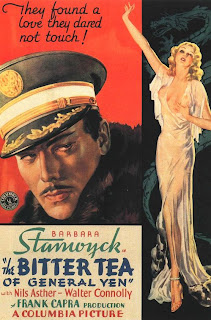 General Yen is the story of an American missionary (Stanwyck) who travels to China to marry her rather stuffy fiance only to wind up as the captive of a powerful warlord during the country's interminable civil war. At first, Yen (Nils Asther in the best performance of his career) holds Stanwyck in an effort to blunt the reformist zeal of Stanwyck's fiancé, but he soon finds himself falling in love with her.
Stanwyck, for her part, has a hard time reconciling her properly virginal upbringing with her growing lust for Yen, and in the process must confront for the first time in her sheltered life her own hypocrisy and prejudices. Her fevered dream in which she finds herself both menaced by and drawn to Yen is one of the most beautifully filmed sequences of Capra's illustrious career.
 The film was a flop upon its initial release and Capra later dismissed it as "the only film in which I ever tried to become arty, because I was trying to win an Academy Award." The notion of a romance between a white woman and an Asian man shocked some and the picture played to protests around the country. "The women’s clubs came out very strongly against it," Stanwyck later said. "I was so shocked."
 Even more shocking was Stanwyck's next film, Baby Face, one of the most notorious films of the pre-Code era. Written by Darryl F. Zanuck, who quit Warner Brothers shortly afterwards to form Twentieth Century Films, Baby Face was so racy that many scenes had to be re-shot and even then two version went out to theaters.
In Baby Face, Stanwyck plays Lily Powers, the daughter of an abusive saloon keeper who's been pimping her out since she was fourteen years old. She's inured to the humiliation—the look on her face as she realizes her father has just pimped her out is perfectly underplayed, as bored and blase as if he'd just read her the out-of-town baseball scores, but underneath seething with resentment—but she yearns for something better and is beginning to understand the power of her own sexuality.
 In a key early scene that sets the tone, a powerful local politician puts his hand on Lily's knee, expecting to put his hand on a lot more than that. With barely a glance, Lily picks up a cup of coffee and casually dumps it on him.
"Oh, excuse me, my hand shakes so when I'm around you." When she later breaks a bottle over his head, he finally gets the message that this isn't foreplay.
With her only friend Chico (Theresa Harris), Lily leaves her father and hops a freight train—sleeping with a railroad cop to avoid arrest—and winds up in the big city where she ruthlessly sleeps her way to the top. (Among her conquests, look for a young John Wayne.)
 Baby Face won no awards, but in 2005, the Library Congress included the film in the National Film Registry. If you're going to see it, make sure to track down the uncut version, which was for years thought lost then rediscovered in 2004. It's worth seeing both as a reminder that Hollywood didn't invent sex and sin in 1967, and as a pivotal moment in Stanwyck's career, being to my mind the moment she really became what we think of as "Barbara Stanwyck," with the impudence of Bette Davis, the independence of Katharine Hepburn, and the street smarts of Joan Crawford, only warmer, sexier and much less neurotic, respectively.
 Within a year, the studios began to enforce the strict guidelines of the Pro- duction Code and Holly- wood wouldn't again make films with content as explicit and controversial as The Bitter Tea Of General Yen and Baby Face until the 1960s. Stanwyck herself shifted gears and found popularity playing the martyred mother in such films as Stella Dallas. Not until The Lady Eve in 1941 would she figure how to sell the public on a character as brazen as Lily Powers.
Trivia: The Bitter Tea Of General Yen was the first movie ever to play Radio City Music Hall in New York. Scheduled to run for two weeks, the theaters owners yanked the film after eight days despite having made back only $80,000 of the $100,000 rental they had paid the studio.







 Posts
Posts

