My choices are noted with a ★. A tie is indicated with a ✪. Historical Oscar winners are noted with a ✔. Best foreign-language picture winners are noted with an ƒ.
A great year for science fiction ...
Postscript I'm home from the hospital, four days earlier than expected. The surgery was a complete success, and the recovery so far has, according to my surgeon, "obliterated the benchmark." Apparently my heretofore unknown superpower is fighting cancer.
My new stomach and I are still getting to know each other but so far so good. It looks like I'll be around to chat movies with you for a long, long time. Thanks so much to everyone for their good thoughts. — Mythical Monkey
My choices are noted with a ★. Historical Oscar winners are noted with a ✔. Best foreign-language picture winners are noted with an ƒ.
Would Henry Fonda have won the Oscar for On Golden Pond if he had already won as he should have for The Grapes of Wrath? Well, maybe. I think Hollywood liked the idea of him and his daughter Jane reconciling at last, if only on the big screen — which, come to think of it, is the only place that counts. It didn't hurt that he was dying.
As for Katharine Hepburn, this was her fourth Oscar, and like the one for Guess Who's Coming to Dinner, it was her co-star who did all the heavy lifting. I've already given her three alternate Oscars, and so have you (per current vote tallies). That's plenty. Let's give somebody else a chance.
My choices are noted with a ★. Historical Oscar winners are noted with a ✔. A historical winner who won in a different category is noted with a ✱.
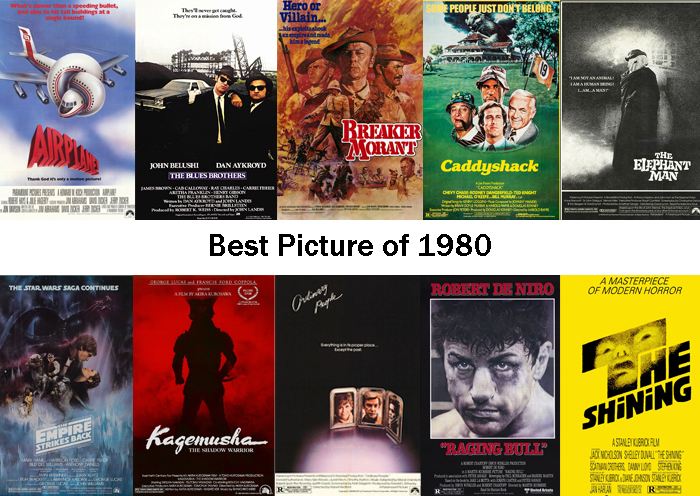
The Academy nominated Mary Tyler Moore as the lead in Ordinary People and Timothy Hutton as supporting actor, I think largely based on their stature in the film industry — this was Hutton's first feature whereas Moore had been a star of television for twenty years. But I think it's pretty clear Hutton was the lead, so I've nominated Hutton and Moore for alternate Oscars in the categories where I think they belong.
I've blogged ahead to the middle of June so that there will be no interruption in the weekly voting, but starting tomorrow I won't be here to read or answer comments for quite a while. Feel free to have your say and I'll catch up later this Spring.
Oh, and a happy 25th anniversary today to Turner Classic Movies, the best movie network on the planet! Fingers crossed for another 25!
My choices are noted with a ★. Historical Oscar winners are noted with a ✔.
As I look at my list of movies from 1979, I find it interesting just how many of them — Apocalypse Now, Manhattan, North Dallas Forty, All That Jazz, even the robot in Alien — were about the destructive nature of what we now call toxic masculinity. So, of course, the Academy (always with a finger on the pulse of its own product) gave all the Oscars to the movie about toxic feminism, Kramer vs. Kramer. Pee-yew!
Okay, I exaggerate. But Kramer vs. Kramer is, at its heart, comfort food for men in need of reassurance when what they desperately needed was a cold, hard slap in the face.
For years, I had Woody Allen's Manhattan down as the best picture of the year (I first saw it forty years ago, the summer I turned eighteen), but in revisiting it recently, I saw not the wistful romance I remembered but the uncomfortable story of a sweet seventeen year old girl (Mariel Hemingway) who finds herself in the clutches of a creepy, balding homunculus twenty-five years her senior (Woody Allen). Woody works overtime to remake the girl in his own crabbed, misanthropic image, but — good for her! — she wriggles free of his grasp at the last minute. The cinematography (Gordon Willis) is gorgeous, the Gershwin music sublime, and maybe I'm just cranky because both Mariel Hemingway and I are now old enough to be the girl's grandparents, but I don't find this stuff amusing anymore.
My choices are noted with a ★. Historical Oscar winners are noted with a ✔.
I probably saw fifty movies in the theater in 1978 — I had a driver's license and matinees were incredibly cheap back then. If my memory serves, these were the ten most talked about movies at the time.
Unlike a lot of years when the best picture is obvious, I've been going round and round with this one. Rather than re-write this post every time I change my mind, let's just see what happens ...
Trivia: Ingrid Bergman received her final Oscar nomination for 1978's Autumn Sonata while Meryl Streep received her first for The Deer Hunter. How often do two such lengthy, celebrated careers overlap so neatly?
My choices are noted with a ★. Historical Oscar winners are noted with a ✔.
Annie Hall is a great comedy — arguably Woody Allen's best — and it would have been an easy winner in most any other year. But Star Wars is one of the most iconic movies ever made, and in terms of reshaping everything that came after it, one of the most influential of all time.
By the way, I prefer the hard-to-see original theatrical release of Star Wars to any of George Lucas's re-worked clusterhumps. Han shot first, my friends.
P.S. Katie-Bar-The-Door and I had an opportunity to see a sneak preview of The Best of Enemies down at the AFI-Silver this past Thursday night. Starring Oscar-nominee Taraji P. Henson (Hidden Figures, TV's "Empire") and Oscar-winner Sam Rockwell (Three Billboards Outside Ebbing, Missouri), it's based on the true story of civil rights activist Ann Atwater and KKK Exalted Cyclops C.P. Ellis who squared off in Durham, North Carolina, over school integration back in 1971.
The film is witty, moving and avoids the trope of the "white savior." Highly recommended.
Henson (a Washington, D.C. native), writer-director Robin Bissell and producer Dominique Telson spoke afterwards.
Named for Katie-Bar-The-Door, the Katies are "alternate Oscars"—who should have been nominated, who should have won—but really they're just an excuse to write a history of the movies from the Silent Era to the present day.
To see a list of nominees and winners by decade, as well as links to my essays about them, click the highlighted links:
Remember: There are no wrong answers, only movies you haven't seen yet.
The Silent Oscars
And don't forget to check out the Silent Oscars—my year-by-year choices for best picture, director and all four acting categories for the pre-Oscar years, 1902-1927.
Look at me—Joe College, with a touch of arthritis. Are my eyes really brown? Uh, no, they're green. Would we have the nerve to dive into the icy water and save a person from drowning? That's a key question. I, of course, can't swim, so I never have to face it. Say, haven't you anything better to do than to keep popping in here early every morning and asking a lot of fool questions?









 Posts
Posts

