Flicker Alley is currently promoting The Best Arbuckle/Keaton Collection, Vol. 1 &2 which will be available as a manufacture-on-demand DVD in March. As always, the Monkey encourages his readers to explore the wonderful world of silent movies. This would be a good place to start.
The Flicker Alley titles on my shelf, all of them definitive and essential:
I've been on the road for most of February and only this morning heard about the Buster Keaton Blogathon ongoing at Silent-ology. I cobbled together this contribution from some previous posts.
Of all the developments that made 1917 such a landmark year in film—the industry-wide adoption of what is now known as "classical continuity editing," Mary Pickford's emergence as the most powerful woman in Hollywood history, Charlie Chaplin's maturation as an artist—perhaps the happiest for movie fans today was the big screen debut of the greatest film comedian of all time, Buster Keaton.
That Buster Keaton is only now arriving on the scene may come as a bit of a surprise to those of us who naturally think of Keaton as a contemporary of Chaplin—certainly we frame the debate "Chaplin versus Keaton" in those terms—but the fact is, Chaplin was already an international star with sixty films to his credit (including forty he directed himself) before Keaton ever set foot in a film studio. And although Keaton would brilliantly subvert most of the rules of early film comedy in a brief but prolific run between 1920 and 1928, it was by and large Chaplin who had established those rules, a fact that Keaton himself later conceded.
Which is not to say Keaton was an amateur when he joined Roscoe Arbuckle during the filming of The Butcher Boy in early 1917. He had been performing on the vaudeville stage with his parents from the age of four as part of a rough and tumble "knockabout" comedy act.
"I'd just simply get in my father's way all the time," Keaton said, "and get kicked all over the stage. But we always managed to get around the [child labor] law," he added, "because the law read: No child under the age of sixteen shall do acrobatics, walk wire, play musical instruments, trapeze—and it named everything—but none of them said you couldn't kick him in the face."
Legend has it he was dubbed "Buster" when escape artist Harry Houdini saw the infant Keaton take a fall down a flight of stairs and bounce up unharmed. Whether he was born with it, or developed it doing routines with his father, if Keaton wasn't the most talented pratfall artist in movie history, I'd like to see the guy who survived long enough to be a better one. He did stunts that rivaled those of Douglas Fairbanks, and when he was done, he doubled for his co-stars and did their stunts, too.
"The secret," he once said, "is in landing limp and breaking the fall with a foot or a hand. It's a knack. I started so young that landing right is second nature with me. Several times I'd have been killed if I hadn't been able to land like a cat."
In early 1917, Keaton was booked into New York's Winter Garden for a series of shows when he bumped into Roscoe Arbuckle while strolling down Broadway.
For those of you who only know Arbuckle—"Fatty" to his fans, "Roscoe" to his friends—through the tabloid scandal and subsequent trial that (despite his acquittal) ended his career, you're missing out on one of the greatest comedic actor-directors of the silent era. Although I wouldn't put him in the same league as "the three geniuses"—Chaplin, Keaton and Harold Lloyd—Arbuckle was, in terms of his popularity and impact, the best of the rest, the very top of the second tier of comedians that included Mabel Normand, Charley Chase, Harry Langdon, Ford Sterling and Max Linder.
Mark Bourne in his review of the Arbuckle/Keaton collection for The DVD Journal suggested that Arbuckle was to his biggest commercial rival, Charlie Chaplin, what Adam Sandler is these days to Woody Allen, "less artistic and sophisticated by miles, but nonetheless obviously skilled and unquestionably popular with his own characteristic wacky and raucous manner."
The collaboration between Keaton and Arbuckle was to prove pivotal for Buster.
"Arbuckle asked me if I'd ever been in a motion picture," Keaton told Kevin Brownlow in 1964. "I said I hadn't even been in a studio. He said, 'Come on down to the Norma Talmadge Studio on Forty-eighth Street on Monday. Get there early and do a scene with me and see how you like it.' Well, rehearsals [at the Winter Garden] hadn't started yet, so I said, 'all right.' I went down and we did it."
That first scene, in the Arbuckle short comedy The Butcher Boy, ends in one of the best of Keaton's early gags. At the 6:25 mark of the film, Keaton wanders into the country store where Arbuckle works as a butcher and by the end of the scene, Keaton's trademark porkpie hat is full of molasses and the store is a wreck.
"The first time I ever walked in front of a motion picture camera," he said, "that scene is in the finished motion picture and instead of doing just a bit [Arbuckle] carried me all the way through it."
It's a terrific sequence, but it's as notable for what isn't in it as what is—Keaton does not wear an outrageous costume or wild facial hair, nor does he indulge in the over-the-top reactions and shameless mugging common to the era. He's just a thoroughly average American—albeit, one who can take a swipe at Al St. John, do a 360º spin in mid-air and wind up flat on his back—who has somehow wandered in off the street and found himself thrust into the insanity of a two-reel silent comedy.
Keaton's understatement was the antithesis of the Mack Sennett approach, and was so wholly original, it constituted something of a revolution. Audiences and critics alike instantly took note, if not always approvingly.
"The deadpan was a natural," Keaton said. "As I grew up on the stage, experience taught me that I was the type of comedian that if I laughed at what I did, the audience didn't. Well, by the time I went into pictures when I was twenty-one, working with a straight face, a sober face, was mechanical with me.
"I got the reputation immediately [of being] called 'frozen face,' 'blank pan' and things like that. We went into the projection room and ran our first two pictures to see if I'd smiled. I hadn't paid any attention to it. We found out I hadn't. It was just a natural way of acting."
But deadpan, as any Keaton fan can tell you, isn't synonymous with inert, and as film historian Gilberto Perez has noted, Keaton was able to show us a face, "by subtle inflections, so vividly expressive of inner life. His large deep eyes are the most eloquent feature; with merely a stare he can convey a wide range of emotions, from longing to mistrust, from puzzlement to sorrow."
Keaton's next film with Arbuckle, The Rough House, is one of their best. Not only does it feature some of the best gags of Arbuckle's career—the dancing dinner rolls, trying to douse a raging fire with a teacup, squeezing out a bowl of soup with a sponge—but many film historians also now list Keaton as its uncredited co-director.
"The first thing I did in the studio," he told Robert and Joan Franklin in 1958, "was to tear that camera to pieces. I had to know how that film got into the cutting-room, what you did to it in there, how you projected it, how you finally got the picture together, and how you made things match. The technical part of pictures is what interested me."
Keaton and Arbuckle made three more comedies in 1917, His Wedding Night, Oh Doctor! and Coney Island. Each features an aspect of Keaton rarely seen after.
In the first, Keaton plays a milliner's delivery boy and winds up in drag as he models a wedding dress. Mistaking him for the bride, Al St. John kidnaps Keaton and hauls him off to the preacher at gunpoint.
In Oh, Doctor!, he plays Arbuckle's little boy, a reprise of the sort of comedy Keaton and his father Joe had done for years on stage, and pulls off a stunt you have to see to believe—Arbuckle smacks him, Keaton tumbles backwards over a table, picks up a book as he falls, and lands upright in a chair, with the book on his lap as if he's been there all along, reading comfortably.
And while Coney Island is mostly an excuse to watch Arbuckle caper around Luna Park—its plot of men wooing women on park benches is a throwback to the Keystone comedies—the film is worth seeking out for two reasons: one, for its documentary footage of Coney Island nearly one hundred years ago, and two, a rare chance to see Buster Keaton smile!
The smile notwithstanding, in terms of his look, his acting style, his fearless physical stunts and his fascination with technology, the basic Keaton was already on full display in these early two-reel comedies. He had only to add the context—that of a rational man enmeshed in the machinery of a universe that exists only to achieve absurd ends—for his unique brand of humor to reach its full flower.
In 1918, Keaton made five more two-reel comedies with Arbuckle before shipping off to France to serve in the army during World War I. Although not credited as such, by this time Keaton was working as the assistant director when Arbuckle, the credited director, was in front of the camera.
"You fell into those jobs," Keaton said later. "He never referred to me as the assistant director, but I was the guy who sat alongside of the camera and watched scenes that he was in. I ended up just practically co-directing with him."
The new balance in their collaboration showed up in front of the camera as well. In the first three films of 1918, he and Arbuckle are equal partners, more Laurel and Hardy—with Keaton as a thin straight man and Arbuckle a rotund goof—than the star/supporting player dynamic of 1917. The first film of the year, Out West is a parody of the Western genre, popular at the time, with Arbuckle playing a drifter riding the rails who winds up working for Keaton as an uncharacteristically tough saloon owner. Parody would soon prove to be one of Keaton's trademarks—indeed, his two-reeler The Frozen North in 1922 was such a savage parody of William S. Hart's "good bad guy" westerns that Hart refused to speak to Keaton for two years.
Next up was The Bell Boy, the story of two Stooge-like bellhops in a shabby hotel. The horse-drawn elevator is pure Keaton who was always fascinated by machines, and built several movies around them, culminating in his classic train picture, The General.
The film that followed, Moonshine, is the most Keatonesque of all his collaborations with Arbuckle. Ostensibly the story of a pair of inept revenuers (Keaton and Arbuckle) hot on the trail of West Virginia bootleggers, this is really a movie about movies, with the title cards constantly breaking the fourth wall to explain the filming process. "Look, this is only a two-reeler," one says, "We don't have time to build up to love scenes." Opening up the mechanics of movie making for laughs was a Keaton trick he would revisit time and again, culminating with Sherlock Jr. in 1924 when a projectionist gets sucked into the film itself.
The next two shorts, Good Night, Nurse and The Cook, both came out after Keaton had shipped out for the European war and his contributions look hasty, as if he filmed a couple of scenes for both, leaving the main plot for Arbuckle to flesh out later. Still, they're both worth a look, particularly The Cook which was thought to be lost for decades until rediscovered in Norway in 1999.
After a year in the Army left Keaton deaf in one ear, he went right back to making short films with Arbuckle. The first of them, Back Stage, is a traditional "hey kids, lets put on a play" story with one extraordinary scene—anticipating Keaton's most famous stunt in 1928's Steamboat Bill Jr., a house falls on Arbuckle only to miss him thanks to an open second floor window. Here, the house is only a cardboard stage prop and, unlike that latter example which might have killed Keaton, nobody is in danger, but seeing this early attempt at a famous gag is a bit like finding a preliminary sketch of Picasso's Guernica on the back of a cocktail napkin.
There were two more shorts, The Hayseed in 1919 and The Garage in 1920, after which Arbuckle left to make full-length feature films, but not before leaving the keys to the studio to Keaton. With Arbuckle's public blessing, Keaton began to direct films of his own.
Today is Mary Pickford's birthday. One of the greatest stars of the silent era, and pound-for-pound the most powerful woman in Hollywood history, Mary Pickford's work is indispensable for the film fanatic. If you've never seen a Mary Pickford movie and don't know where to begin, here are five films to get you started.
The Poor Little Rich Girl (1917)
An unprecedented blend of comedy and melodrama that worried the studio but delighted its star, the story of a girl whose wealthy parents neglect her while others prey on her could easily have become sentimental claptrap. Instead, Pickford's Gwendolyn is, by turns, impetuous, flighty and sullen, but also curious, kind and fun—in other words, a real girl. The film was one of the biggest hits of 1917 and is a National Film Registry selection.
Rebecca of Sunnybrook Farm (1917)
A cross between Charles Dickens and Louisa May Alcott, this story of a poor girl sent to live with a pair of maiden aunts is the most typical example of a Mary Pickford movie. Boasting plenty of comedy with a soupçon of pathos in the final act, Rebecca was Pickford's biggest hit yet.
Stella Maris (1918)
Based on a novel by William J. Locke, Stella Maris is a Victorian melodrama of the first water, the riveting story of two girls, one a rich shut-in sheltered from life's realities, the other, an ugly duckling orphan—both played by Pickford—whose paths intersect with tragic results. Variety called the performance "a revelation," the Los Angeles Times deemed it "brilliant, powerful and poignant" and studio chief Adolph Zukor later called it "the most remarkable thing which Mary Pickford has ever done for the screen." And they were right.
Sparrows (1926)
The other contender for Pickford's best movie, Sparrows is the harrowing tale of a group of backwoods orphans menaced by white slavers. In a sort of teenage take on Lillian Gish's gun-toting granny in 1955's The Night of the Hunter, Pickford attempts to lead her wards to safety while danger lurks at every turn—including the very real alligators director William Beaudine brought onto the set.
My Best Girl (1927)
In a rare adult role, Pickford plays a shop girl who falls in love with the owner's son. Played strictly for laughs, the result is a nifty little comedy, as fresh and light and funny as the actress who carries it on her back. As film critic Steve Vineberg says, the performance is "an extraordinary combination of spunk and delicacy." And as an added bonus, look for a brief, pre-stardom appearance by Carole Lombard as one of the shop girls.
As has been the case with nearly every technical innovation in the visual arts since the first man painted pictures on a cave wall, sex proved to be a key selling point in the marketing of the new motion picture technology to curious audiences. In 1896, just six years after Thomas Edison began his experiments with film, William Heise recorded May Irwin and John C. Rice recreating the kiss from their Broadway hit, The Widow Jones.
The resulting twenty second clip—called, appropriately enough, The Kiss—was the first such act ever recorded on film. The moralizing classes reacted with outraged spluttering; the paying public made it Edison's top grossing film of the year.
Other filmmakers quickly scrambled to sell their own take on this most important of human endeavors, as the resulting efforts serve as something of a Rorschach test for directors, writers, actors and the audiences themselves. Georges Méliès, for example, chose to titillate his audiences with suggestions of nudity. Russian, Italian, Swedish and Dutch directors offered up sex as a source of tragedy and misery. America's greatest director, D.W. Griffith, moralized, while his comic counterpart, Mack Sennett, guffawed. That Theda Bara—whose name was famously billed as an anagram of "Arab Death"—wound up representing both the allure and the danger of sex in the late 1910s tells you all you need to know about the state of the American psyche during the first world war.
But sex as something adults engage in without shame or embarrassment—well, not so much. We tend to assume, when think of it at all, that sophisticated sex in the cinema must have been the invention of Ernst Lubitsch. And while it's true Lubitsch was a master of the light touch when it came to the subject, he didn't really acquire that touch until 1924, with The Marriage Circle. Before that, he tended toward heavy costume dramas and broad farces.
Instead, the sophisticated sex movie was a creation from the most unlikely of sources—cinema's most famous purveyor of Bible epics and historical dramas, Cecil Blount DeMille.
Some of my readers—those reared on The Ten Commandments and The Greatest Show On Earth—might guffaw to read his name in the same sentence with "sophisticated" and "sex," but the fact is, beginning in 1918 with Old Wives For New, DeMille reeled off a series of "nervously brilliant, intimate melodramas" and "sly marital comedies" (Scott Eyman, Empire of Dreams) centering on the notion that grown ups engage in sexual relations and are glad that they do.
The son of a playwright and an acting teacher, DeMille began acting in New York at the age of nineteen and in little more than a decade became a successful Broadway director and producer. He also wrote several one-act operettas for producer Jesse L. Lasky and it was this association that led him into motion pictures. Lasky aspired to combine what he saw as the "high art" of theater with the money-making potential of mass-produced movies, and with the reluctant financial backing of his brother-in-law, Samuel Goldfish (later Goldwyn), Lasky teamed up with DeMille to found the Jesse L. Lasky Feature Film Company.
It was a grandiose gesture considering that neither man had ever made so much as a one-reel short before, but the two set off for the western United States to film a feature-length version of The Squaw Man, a popular stage play of the era. The two stopped first in Flagstaff, Arizona, but DeMille pictured wide open spaces rather than mountains for the wild west storyline, so they continued west until they settled in a sleepy village north of Los Angeles called "Hollywood."
Legend has it that they set up shop in a barn, but legend neglects to mention that L.L. Burns and Harry Reiver, a couple of established filmmakers with American Gaumont, had converted the barn into a studio nine months earlier. No matter. The Squaw Man was the first feature film ever made in Hollywood, and when it grossed $244,000 on an investment of $15,000, DeMille's future was assured.
Although DeMille's education as a film director consisted of a day spent at the Edison studios to see how the cameras worked, and watching Oscar Apfel "co"-direct The Squaw Man, he quickly demonstrated a grasp of the film medium superior to all but a few of his peers. In his biography Cecil B. DeMille's Hollywood, Robert S. Birchard notes that within a half-dozen movies of his first one, DeMille had moved the camera closer to his actors, "showing a greater reliance on personality and subtlety of performance," had picked up the pace of both individual scenes and his films as a whole, and, by using light and shadow in a groundbreaking way to accent (or obscure) aspects of the production, "set a much-imitated standard for visual excellence."
In all, DeMille directed thirty-seven movies between 1914 and early 1918, dipping into a variety of genres including Westerns, costume dramas and even a pair of Mary Pickford movies. The best of these early films was The Cheat, made in 1915 and featuring Sessue Hayakawa in a star-making role as an unscrupulous businessman who barters money for sex from a spoiled housewife and then brands her with an iron when she reneges on the deal.
As Simon Louvish notes in his biography Cecil B. DeMille: A Life in Art, The Cheat "electrified audiences, who were not accustomed to this degree of emotion in a tale dealing with rampant sexual desire ...."
These early films demonstrated DeMille's interest in melodrama, spectacle and lurid romance, which perhaps explains his interest in the subject of his thirty-eighth film, a popular novel called Old Wives For New (available free online here). Business partner Jesse Lasky pushed this story of a marriage that disintegrates in boredom, adultery and divorce to get DeMille "away from the spectacle stuff for one or two pictures and try to do modern stories of great human interest."
And since Lasky was the one footing the bill, DeMille chose to follow his advice. The studio bought the film rights for $6,500.
Although the novel's author, David Graham Phillips, was a pretty interesting character in his own right—a muckraking journalist who exposed the nexus between corporate money and the U.S. Senate, he was murdered by a man who believed Phillips had libeled his family—the novel itself was 495 pages of "clover" and "heaving bosoms," turning a tale that included adultery, murder, blackmail and skullduggery into something earnest and flowery and dull.
To adapt the novel, DeMille turned to his favorite writer—and favorite mistress—Jeanie Macpherson. During their long sexual and professional relationship, MacPherson worked on forty screenplays for DeMille, including such silent classics as The Cheat, Joan the Woman, Male and Female, The Affairs of Anatol, The Ten Commandments and The King of Kings.
To condense the sprawling tale, Macpherson reduced an episodic narrative spread out over decades into three tight acts with a single flashback to explain how the bored husband had ever fallen for his plump, drab, dowdy wife in the first place. She also added witty intertitles that transformed the melodrama into a sharp satire of upper-class manners.
As the film begins, oil baron Charles Murdock (Elliott Dexter) is on the verge of what we now call a mid-life crisis. While he's respected as a "genius" in the world of business, at home he's little more than a cipher—a human ATM machine to his kids, a nursemaid to his hypochondriac wife. He sits alone in his study, dejected, depressed, with only his dog for companionship.
Next, DeMille introduces us in shotgun fashion to the five supporting characters who will combine to remake Murdock's life—Sylvia Ashton as his not-so-pleasingly plump wife; Marcia Manon as a "painted lady;" Florence Vidor as Juliette Raeburn, a successful New York dressmaker, who, according to the intertitles, "was finally to cut the thread of his fate;" and two of the finest character actors of the silent era, Gustav von Seyffertitz as his "crafty" secretary; and Theodore Roberts as Murdock's dissolute business partner.
In each of these vignettes, DeMille shows a close-up of the character's hands—the wife picking through bon bons, the courtesan reaching for rouge—as if to say that a person is what he does not what he says, and no matter what he believes about himself or wants you to believe about him, his actions will always reveal his true character.
After following Murdock through his frustrating morning routine, DeMille treats us to the most cleverly edited sequence of the film, a flashback to Murdock's initial courtship of his wife that cuts back and forth between the young couple and his present-day wife bursting in on her husband's reverie, as if she's catching them in flagrante delicto—a remarkable show of faith on DeMille's part that, even though the classical Hollywood "style" had only become the industry standard the year before, his audience would understand what's going on.
Similarly, DeMille later uses lap dissolves and iris-shots-within-iris-shots to convey the content of Murdock's daydreams, trusting his audience to understand what he saying without spelling it out in clumsy intertitles or belabored scenes, a testament both to how quickly film had progressed in five years and how cutting edge DeMille really was. As a result, he's able to maintain a sprightly pace—and sweep past some of the story's more improbable twists.
Technical innovations aside, though, it was the substance of Old Wives For New that made the film so groundbreaking.
The married Murdock meets Juliette, fools her into believing he's a much younger—and unattached—man, and falls in love with her. Attempting to drown both the memory of Juliette and the misery of his domestic situation, Murdock follows his business partner into the champagne-soaked fleshpots of New York City, an excursion that leads to murder, scandal and divorce (a sequence of events that must have reminded audiences in 1918 of Stanford White's murder during a musical revue on the roof of Madison Square Garden).
In turning this set-up into a happy ending, DeMille essentially made a pre-Code film before there was a Code to subvert, dispensing with karma and moral judgment, and putting the fun back into sex, sin and every kind of bad behavior. People drink, lie, carouse and generally defy social mores, and not only suffer no consequences, they prosper. Murder goes unpunished, adultery is rewarded and divorce is presented as a sane and sophisticated solution to an unhappy marriage.
"In scene after scene," Birchard wrote, "Old Wives for New must have been startling for 1918 audiences." Photoplay condemned the film's "disgusting debauchery" and clucked that "Cecil B. DeMille, director, seemed to revel in the most immoral episodes."
Adolph Zukor was so shocked by the film's suggestion that divorce might be the appropriate end for some marriages that he held up its distribution, only relenting after positive reactions during audience testing.
Old Wives For New premiered on May 19, 1918, and Photoplay's sputtering outrage aside, the reviews were generally positive. "There are somewhat risqué situations in the story," The Motion Picture News wrote, "but these have been handled delicately. It is not a story that children will understand, and it is one that the prudes will consider a reflection on themselves. All in all, it is one of the most satisfactory pictures that has been shown on Broadway in months."
Variety praised DeMille's direction as "expert."
Financially, the picture did well, grossing nearly $300,000 on a budget of $66,000, but its impact on the culture was even greater, ushering in an era of adult-themed movies, including not only DeMille's own risque classics Male and Female and The Affairs of Anatol (adding Gloria Swanson to the mix), but also Chaplin's A Woman of Paris, Murnau's Sunrise and pretty much Lubitsch's entire oeuvre.
"Those who find it fashionable to denigrate [DeMille]," wrote Gene Ringgold and DeWitt Boden in The Films of Cecil B. DeMille, "ignore the high regard in which his work as a director was held by critics and film historians during those first years ... Among directors, only his name and those of D.W. Griffith and Alfred Hitchcock were really sufficient in themselves to attract top box-office trade."
Maybe in the long run, DeMille's primary contribution was in figuring out how to sell sex to American audiences that were both curious and squeamish. Here, he hit it directly; later he dressed it up in historical and Biblical epics that allowed his audiences to piously condemned the sin while lingering over every salacious detail. He let the public have its cake and eat it too, and was rewarded with forty-two years of unbroken commercial success—one of the longest and most profitable careers in Hollywood history.
His kind of films long ago went out of fashion, but don't kid yourself: DeMille was as instrumental during the silent era as Griffith and Chaplin in selling the habit of movie-going to American audiences, no small accomplishment.
This is my contribution to the Mary Pickford Blogathon, hosted by one of the Monkey's favorite bloggers, KC of Classic Movies.
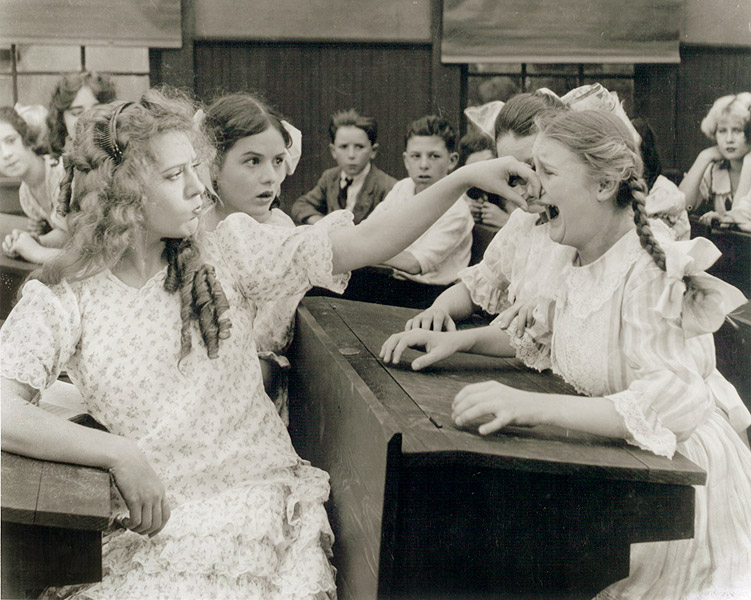
Amarilly of Clothes-Line Alley was the second of five movies Mary Pickford made in 1918, and the first after the spectacular achievement of Stella Maris. Here, Pickford mines a familiar vein—the collision of the upper and lower classes told through the eyes of a spirited girl from the wrong side of the tracks—this time played mostly for comedy. Although not as iconic as Rebecca of Sunnybrook Farm or The Poor Little Rich Girl, Amarilly of Clothes-Line Alley is a prime example of Pickford's lasting appeal.
Adapted from Belle K. Miniates's novel by Pickford's friend and favorite screenwriter, the legendary Frances Marion, Amarilly of Clothes-Line Alley is the story of Amarilly Jenkins, "a debutante" of the tenement slum known as "Clothes Line Alley." To support her brothers and sisters, Amarilly takes a job selling cigarettes in a dive bar and winds up falling for a rich, handsome swell out slumming with his rich, handsome pals. The comedy turns on Amarilly's battles with his snobbish family, with our Mary getting the best of them before finally realizing what she really wants in life.
Throughout her career, Pickford excelled at light comedy and Amarilly is no exception, turning a ride on the back of a motorcycle, a tumble through a doorway on the threshold of her first kiss, and her enthusiasm for a barroom brawl into nice bits of humor. But it was mostly her bright, searching eyes, her shy, knowing smile, and, above all, her plucky, indomitable spirit that made her so adorable. In fact, if one word could sum up Pickford's extraordinary appeal during the era, "plucky" would be it.
As you might expect from a film written by Marion, the social observations are tart and biting without overwhelming the comedy. The rich are alternately portrayed as stuffy, lifeless bores and perfumed, pampered bums. Amarilly's love interest (Norman Kerry) is an effete drunk who ducks his work and his family with equal abandon. His best friend is a deadbeat trust fund baby who hogs the guest room and never picks up a check. And his mother is a pompous dowager who founds a charity that actively despises the objects of its care.
The resulting study of American social mobility is more Pygmalion than Cinderella and ends with a twist that thumbs its nose at both literary conventions. I quite can't tell if the film's politics are progressive or reactionary—maybe a bit of both—but no matter: Amarilly's happiness is the only item on the bipartisan agenda.
To direct Amarilly, Pickford chose Marshall Neilan, who had overseen the hugely successful Stella Maris. This time around, Neilan required none of the special effects or camera tricks that made Pickford's dual role in Stella Maris possible, but his direction is a solid example of the classical Hollywood style then emerging. The pacing is nimble and assured, the acting solid, and the camera work as light on its feet as the story itself.
One shot in particular, that of Amarilly's steady boyfriend finding the new guy's top hat on the landing outside her door—when compared with, say, Mack Sennett's rather obvious and by then painfully dated park bench sex comedies—shows just how far the movies had come in the space of a couple of years.
Look also for the way Neilan composes shots contrasting the worlds of the wealthy and the poor. In the former, Amarilly's beau is lost in vast expanses of sterile marble; in the latter, Amarilly's loving family is tucked into a warm, snug room. Neilan further underscores the divide by often framing Amarilly standing in doorways and perched on window sills, literally and symbolically straddling two worlds. Neilan's notions about poverty may be sentimental, but he's making his argument visually, cinematically, rather than spelling everything out with clumsy intertitles.
Despite the chronic alcoholism that made him unreliable and eventually ended his career, Pickford adored Neilan. "[T]o my way of thinking, he was the best director ever, better than the great D.W. Griffith."
The admiration was mutual. "She has something," Neilan said, "that irrespective of looks or age or anything else, will live on. She has personality."
Amarilly of Clothes-Line Alley premiered on March 11, 1918, and to the surprise of no one, became one of the biggest hits of the year.
"Mary Pickford," wrote Motion Picture Magazine, "has gone to an entirely different well of characterization for Amarilly and drawn up as full a pitcher of success as in the renowned Stella Maris."
After Amarilly, Pickford continued to play plucky young girls in films such as Daddy-Long-Legs, Pollyanna, Tess of the Storm Country and Sparrows. The range of her roles was narrow and often fit the star like a straightjacket. "I'm sick of Cinderella parts," she once admitted, "of wearing rags and tatters. I want to wear smart clothes and play the lover." But fed-up or not, Pickford was not one to trifle with the expectations of a fan base that had made her the most powerful woman in the history of Hollywood.
"I am a servant of the people," she said, "and I have never forgotten that."
Only after the advent of sound made further little girl roles impossible did Pickford finally abandon the "Little Mary" persona for good. And as she feared, her audience abandoned her as well.
Named for Katie-Bar-The-Door, the Katies are "alternate Oscars"—who should have been nominated, who should have won—but really they're just an excuse to write a history of the movies from the Silent Era to the present day.
To see a list of nominees and winners by decade, as well as links to my essays about them, click the highlighted links:
Remember: There are no wrong answers, only movies you haven't seen yet.
The Silent Oscars
And don't forget to check out the Silent Oscars—my year-by-year choices for best picture, director and all four acting categories for the pre-Oscar years, 1902-1927.
Look at me—Joe College, with a touch of arthritis. Are my eyes really brown? Uh, no, they're green. Would we have the nerve to dive into the icy water and save a person from drowning? That's a key question. I, of course, can't swim, so I never have to face it. Say, haven't you anything better to do than to keep popping in here early every morning and asking a lot of fool questions?









 Posts
Posts

