My choices are noted with a ★. A tie is indicated with a ✪. Historical Oscar winners are noted with a ✔. Best foreign-language picture winners are noted with an ƒ. A historical winner who won in a different category is noted with a ✱.
I've been meaning to re-do this one for a long time. I royally screwed it up the first time (I had cancer, remember). The nominees include three of my favorite character actors (Jack Carson, Dan Duryea and S.Z. "Cuddles" Sakall) as well as the actual winner, James Dunn, and my pick Boris Karloff in one of Val Lewton's suspense-horror masterpieces, The Body Snatcher. Have at it.
My choices are noted with a ★. A tie is indicated with a ✪. Historical Oscar winners are noted with a ✔. Best foreign-language picture winners are noted with an ƒ. Best animated feature winners are noted with an @. A historical winner who won in a different category is noted with a ✱.
This is a simple re-vote. There were some clear-cut shenanigans the first time around so I shut down the ballot early ...
Tough choice for you. All five actresses, in my opinion, turned in the best performances of their career. If it means anything to you, Joan Crawford already has an alternate Oscar in the bank with her turn in 1932's Grand Hotel. But don't let that influence you if, like me, you're a fan of Mildred Pierce.
Have at it.
My choices are noted with a ★. A tie is indicated with a ✪. Historical Oscar winners are noted with a ✔.
My choices are noted with a ★. A tie is indicated with a ✪. Historical Oscar winners are noted with a ✔.
I wrote this about To Have and Have Not some time ago:
At the heart of every Howard Hawks action movie is the concept of the professional doing his job, and doing it well, despite the imminent threat of death — an idealized code of conduct Hemingway called "grace under pressure." We're all going to die sooner or later, Hawks seems to be saying, can't we at least do it with a bit of dignity and honor and laughter and good company?
That, above all, I think, is at the core of what is known as "a Hawksian woman," one who can laugh and provide good company in the face of death.
Whatever else a Howard Hawks drama is about, usually a woman meets a man and grows up enough to prove worthy of him and his cadre of professional associates (what one might loosely think of his family).
His comedies, in contrast, are about a man proving worthy enough of a woman to start a family (through marriage).
To Have and Have Not, so far as I can remember, is the one Hawks movie that takes that comedy formulation — the man proving worthy of the woman — and applies it to a dramatic situation. Do you know To Have and Have Not? In it, Harry Morgan (Humphrey Bogart) has retreated from the messy political world into a cocoon of isolationism so complete he's willing to ignore the fascists in charge of the local government even as they are shooting his clients and making his life and the lives of his friends miserable.
Into that mix comes Marie "Slim" Browning (Lauren Bacall in her first film role), teaching him how to whistle and forcing him to realize that no matter how much he thinks he's successfully avoided sticking his neck out, his neck is out there, on the block, along with the necks of his "family" (Eddie, Frenchy, Cricket and, finally, Slim herself).
Whether he likes it or not, the Cause is his and he can either fight for it or go down the tubes anyway. So he fights, and in so doing, becomes worthy of Lauren Bacall, the toughest of tough young broads ever to grace the screen.
And I once wrote this about Joan Crawford:
Joan Crawford was a complicated woman—which is to say that like all of us, she had her good points and her bad points. She was catty and cruel, she was uneducated and insecure about it, she had the morals of an alley cat and her failures as a mother are legendary. But she also had a tremendous work ethic, always tried to improve herself, and as far as I can tell, she never phoned in a performance, not even in the execrable sci-fi horror flick, Trog, which proved to be her last.
And she was always willing to take a shot at Norma Shearer, which is a plus all by itself.
A lot has been written over the years about Joan Crawford's private life, particularly with regard to her sexuality and her parenting skills, so much so that the scandals have completely obscured her work as an actress. But if I were handing out awards based on people's private lives, we'd wind up with a roster full of nice people and very few good movies. Only to the extent that I can discern a clear relationship between a person's off-screen life and their on-screen work will I tend to dwell on the former. Beyond that, celebrity gossip bores me. In fact, as far as I can tell, when they're not working, most celebrities are actually pretty dull people.
Besides, in his biography Possessed: The Life of Joan Crawford, Donald Spoto states flatly that the infamous "No wire hangers!" incident never happened. But then a lot of famous incidents never happened—J. Edgar Hoover didn't wear dresses, Walt Disney wasn't cryogenically frozen, and the military-industrial complex didn't assassinate John F. Kennedy.
Fans of the novel might be tempted to complain that Hollywood sanitized and simplified James M. Cain's original vision. But let's face it, no novel ending with the line "Let's get stinko" was going to make it to the big screen intact in 1945. Besides, the final product is plenty violent for all but the most bloodthirsty among us and as cynical about human behavior as the darkest film noir. Mildred Pierce isn't a perfect movie, just a great one and Crawford gave her best performance in it.
Joan Crawford was a complicated woman—which is to say that like all of us, she had her good points and her bad points. She was catty and cruel, she was uneducated and insecure about it, she had the morals of an alley cat and her failures as a mother are legendary. But she also had a tremendous work ethic, always tried to improve herself, and as far as I can tell, she never phoned in a performance, not even in the execrable sci-fi horror flick, Trog, which proved to be her last.
And she was always willing to take a shot at Norma Shearer, which is a plus all by itself.
A lot has been written over the years about Joan Crawford's private life, particularly with regard to her sexuality and her parenting skills, so much so that the scandals have completely obscured her work as an actress. But if I were handing out awards based on people's private lives, we'd wind up with a roster full of nice people and very few good movies. Only to the extent that I can discern a clear relationship between a person's off-screen life and their on-screen work will I tend to dwell on the former. Beyond that, celebrity gossip bores me. In fact, as far as I can tell, when they're not working, most celebrities are actually pretty dull people.
Besides, in his biography Possessed: The Life of Joan Crawford, Donald Spoto states flatly that the infamous "No wire hangers!" incident never happened. But then a lot of famous incidents never happened—J. Edgar Hoover didn't wear dresses, Walt Disney wasn't cryogenically frozen, and the military-industrial complex didn't assassinate John F. Kennedy.
Fans of the novel might be tempted to complain that Hollywood sanitized and simplified James M. Cain's original vision. But let's face it, no novel ending with the line "Let's get stinko" was going to make it to the big screen intact in 1945. Besides, the final product is plenty violent for all but the most bloodthirsty among us and as cynical about human behavior as the darkest film noir. Mildred Pierce isn't a perfect movie, just a great one and Crawford gave her best performance in it.
What else do you need to know. Anchors Aweigh is the one where Gene Kelly dances with Jerry the Mouse, The Naughty Nineties is the one with the most complete (and best) version of Abbott and Costello's "Who's On First?" routine. And Children of Paradise is considered by many to be the best movie France has ever produced.
Have at it.
PICTURE (Drama) winner:Brief Encounter (prod. Noel Coward) nominees:And Then There Were None (prod. René Clair); Detour (prod. Leon Fromkess); The Lost Weekend (prod. Charles Brackett); Mildred Pierce (prod. Jerry Wald); The Southerner (prod. Robert Hakim and David L. Loew); They Were Expendable (prod. John Ford); A Tree Grows In Brooklyn (prod. Louis D. Lighton)
PICTURE (Comedy/Musical) winner:Anchors Aweigh (prod. Joe Pasternak) nominees:Blithe Spirit (prod. Noel Coward); I Know Where I'm Going! (prod. Michael Powell and Emeric Pressburger)
PICTURE (Foreign Language) winner:Les enfants du paradis (Children Of Paradise) (prod.Raymond Borderie and Fred Orain) nominees:Roma, città aperta (Rome, Open City) (prod. Giuseppe Amato, Ferruccio De Martino and Roberto Rossellini)
ACTOR (Drama) winner: Ray Milland (The Lost Weekend) nominees: Jean-Louis Barrault (Les enfants du paradis a.k.a. Children Of Paradise); Trevor Howard (Brief Encounter); James Mason (The Seventh Veil); Robert Montgomery (They Were Expendable); Edward G. Robinson (Scarlet Street)
ACTOR (Comedy/Musical) winner: Bud Abbott and Lou Costello (The Naughty Nineties) nominees: Rex Harrison (Blithe Spirit); Gene Kelly (Anchors Aweigh); Roger Livesey (I Know Where I'm Going!)
ACTRESS (Drama) winner: Joan Crawford (Mildred Pierce) nominees: Arletty (Les enfants du paradis a.k.a. Children Of Paradise); Joan Bennett (Scarlet Street); Peggy Anne Garner (A Tree Grows In Brooklyn); Celia Johnson (Brief Encounter); Anna Magnani (Roma, città aperta a.ka. Rome, Open City); Gene Tierney (Leave Her To Heaven)
ACTRESS (Comedy/Musical) winner: Wendy Hiller (I Know Where I'm Going!) nominees: Kay Hammond (Blithe Spirit); Barbara Stanwyck (Christmas In Connecticut)
DIRECTOR (Drama) winner: Marcel Carné (Les enfants du paradis a.k.a. Children Of Paradise) nominees: René Clair (And Then There Were None); Michael Curtiz (Mildred Pierce); John Ford (They Were Expendable); Elia Kazan (A Tree Grows In Brooklyn); Fritz Lang (Scarlet Street); David Lean (Brief Encounter); Jean Renoir (The Southerner); Billy Wilder (The Lost Weekend)
DIRECTOR (Comedy/Musical) winner: George Sidney (Anchors Aweigh) nominees: Michael Powell and Emeric Pressburger (I Know Where I'm Going!)
SUPPORTING ACTOR winner: Boris Karloff (The Body Snatcher) nominees: Jack Carson (Mildred Pierce); James Dunn (A Tree Grows In Brooklyn); Dan Duryea (Scarlet Street); Robert Mitchum (The Story Of G.I. Joe)
SUPPORTING ACTRESS winner: Margaret Rutherford (Blithe Spirit) nominees: Eve Arden (Mildred Pierce); Joan Blondell (A Tree Grows In Brooklyn); Ann Blyth (Mildred Pierce); Maria Casares (Les enfants du paradis a.k.a. Children of Paradise)
SCREENPLAY winner: Ted Slesinger and Frank Davis, from the novel by Betty Smith (A Tree Grows In Brooklyn) nominees: Anthony Havelock-Allan, David Lean and Ronald Neame; from a play by Noel Coward (Brief Encounter); Charles Brackett and Billy Wilder, from the novel by Charles R. Jackson (The Lost Weekend); Ranald MacDougall, from the novel by James M. Cain (Mildred Pierce); Frank Wead from a book by William L.White (They Were Expendable)
SPECIAL AWARDS Joseph H. August (They Were Expendable) (Cinematography); Val Lewton (Career Achievement Award)
Named for Katie-Bar-The-Door, the Katies are "alternate Oscars"—who should have been nominated, who should have won—but really they're just an excuse to write a history of the movies from the Silent Era to the present day.
To see a list of nominees and winners by decade, as well as links to my essays about them, click the highlighted links:
Remember: There are no wrong answers, only movies you haven't seen yet.
The Silent Oscars
And don't forget to check out the Silent Oscars—my year-by-year choices for best picture, director and all four acting categories for the pre-Oscar years, 1902-1927.
Look at me—Joe College, with a touch of arthritis. Are my eyes really brown? Uh, no, they're green. Would we have the nerve to dive into the icy water and save a person from drowning? That's a key question. I, of course, can't swim, so I never have to face it. Say, haven't you anything better to do than to keep popping in here early every morning and asking a lot of fool questions?


 A lot has been written over the years about Joan Crawford's private life, particularly with regard to her sexuality and her parenting skills, so much so that the scandals have completely obscured her work as an actress. But if I were handing out awards based on people's private lives, we'd wind up with a roster full of nice people and very few good movies. Only to the extent that I can discern a clear relationship between a person's off-screen life and their on-screen work will I tend to dwell on the former. Beyond that, celebrity gossip bores me. In fact, as far as I can tell, when they're not working, most celebrities are actually pretty dull people.
 Fans of the novel might be tempted to complain that Hollywood sanitized and simplified James M. Cain's original vision. But let's face it, no novel ending with the line "Let's get stinko" was going to make it to the big screen intact in 1945. Besides, the final product is plenty violent for all but the most bloodthirsty among us and as cynical about human behavior as the darkest film noir. Mildred Pierce isn't a perfect movie, just a great one and Crawford gave her best performance in it.
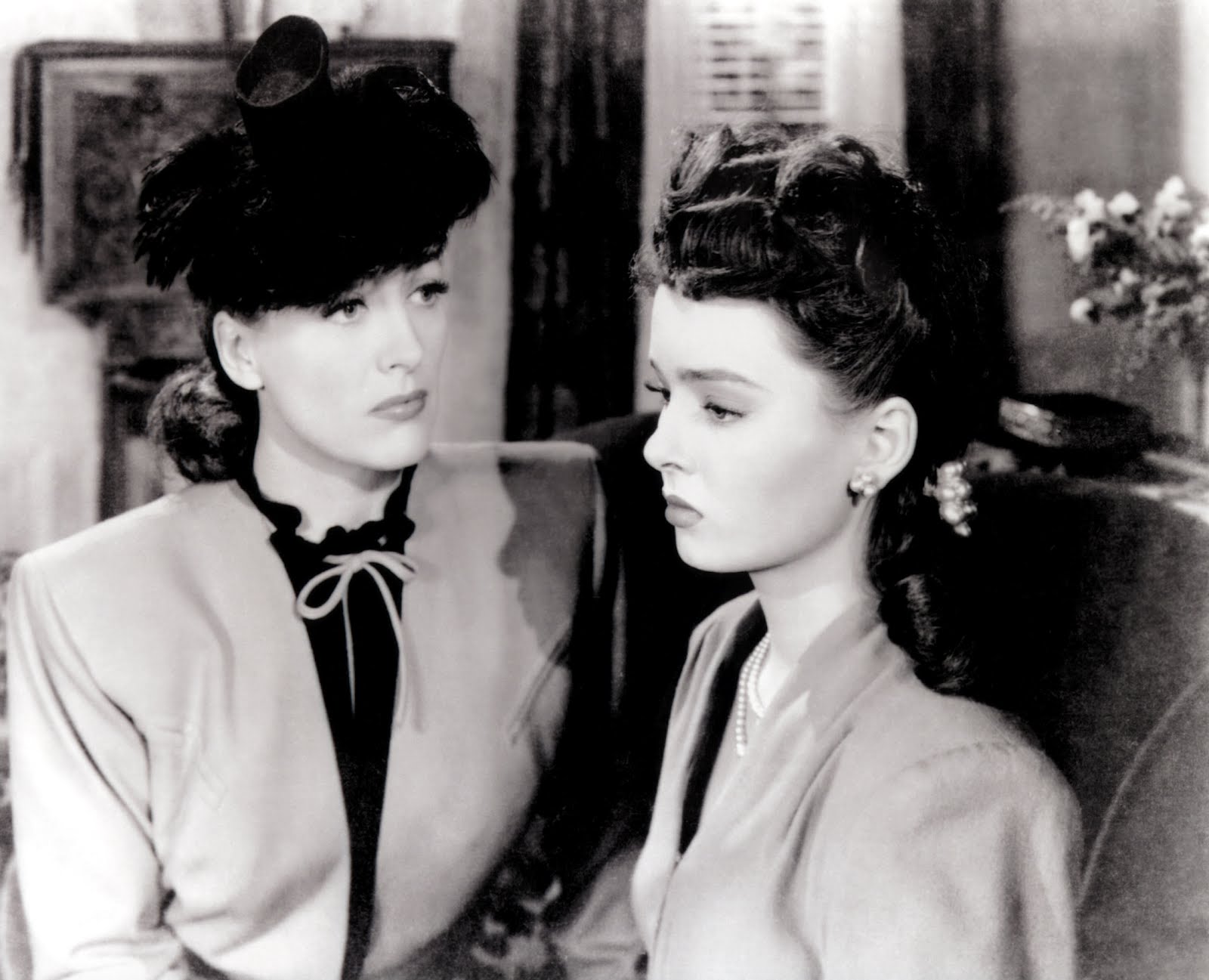 Joan Crawford was a complicated woman—which is to say that like all of us, she had her good points and her bad points. She was catty and cruel, she was uneducated and insecure about it, she had the morals of an alley cat and her failures as a mother are legendary. But she also had a tremendous work ethic, always tried to improve herself, and as far as I can tell, she never phoned in a performance, not even in the execrable sci-fi horror flick, Trog, which proved to be her last.






 Posts
Posts


