skip to main |
skip to sidebar
 Here's another award that tied me in knots for a while and with good reason. The five nominees belong on a short list of the greatest character actresses of the era, each appearing in superb movies while giving performances that are both memorable and representative of their careers as a whole.
Elsa Lanchester gave the first great performance of her long career as a decidedly non-historical Anne of Cleves in the witty satire The Private Life Of Henry VIII. Conversely, Marie Dressler, beloved in her day, largely forgotten now, gave the last great performance of her career, playing a has-been actress and veteran flirt too old to any longer trade on her name or looks in Dinner At Eight. And Billie Burke and Una O'Connor provide wonderful comic relief to what at times are quite serious movies, the former as a ditzy socialite in the aforementioned Dinner At Eight, the latter as a terrified scullery maid in The Invisible Man.
Any one of them would have been a good choice. A couple of them were almost mine.
But simply put, Margaret Dumont was the most talented straight-(wo)man in the history of movie comedies, and Duck Soup being both the best movie of the year and the most representative of her gifts, she's my pick as the best supporting actress of 1932-33.
 Born Daisy Juliette Baker in Brooklyn in 1882 (she claimed to have been born Marguerite Baker in Atlanta in 1889), Margaret Dumont was raised by her godfather Joel Chandler Harris, author of the Uncle Remus stories. Dumont trained as an opera singer and spent the first decade of the twentieth century working as a singer and comedic actress, both abroad and on the American vaudeville circuit. Described in reviews of the time as "a statuesque beauty," Dumont met and married the wealthy industrialist John Moller, Jr. in 1910 and retired from the stage, but returned eight years later after his sudden death.
It was playwright George S. Kaufman who recommended Dumont for the role of a stuffy dowager staying at a hotel run by the Marx Brothers in the Broadway stageplay, The Cocoanuts, and she proved so successful as a comic foil to the supremely irreverent Groucho, she was cast in a nearly identical part in the Brothers' next play, Animal Crackers, then reprised both roles for film.
"There has never been a good comedian that didn't have a good straight man," Groucho said. "Audiences don't think the straight man means anything, but it's very important."
 The role of the stuffy rich widow was a part she played in all seven of the Marx Brothers films she appeared in, and she played the part perfectly—regal and self-possessed without being arrogant, naive and romantic without being vulnerable—so that the audience neither felt sorry for her not angry at her as Groucho bounces insults off her. Indeed, his attempts at seduction play as surreal rather than hostile, enhancing the anarchic quality of the Marx Brothers' humor.
"Not that I care, but where is your husband?"
"Why, he's dead."
"I bet he's just using that as an excuse."
"I was with him to the very end."
"No wonder he passed away."
"I held him in my arms and kissed him."
"Oh, I see, then it was murder! Will you marry me? Did he leave you any money? Answer the second question first."
(In real life, Groucho's aggressive banter drove three wives to drink. Maybe he should have married Margaret Dumont as many fans in the 1930s assumed he had.)
The widely-accepted notion that Dumont had no sense of humor, promoted by Groucho, studio publicists and perhaps by Dumont herself, is belied not only by the evidence of her early career as a comic actress but from her performances in the movies themselves.
 Listen sometime to her delivery of a line like "It's a gala day for you" from Duck Soup (to which Groucho replies, "Well, a gal a day is enough for me. I don't think I could handle any more.") The line comes at the end of a long, florid speech and as she arrives at the straight-line, her pace slows up just a hair and she adds a slight emphasis to the words, setting the gag up on a tee for Groucho. She clearly understood how a gag was constructed and how to deliver a straight-line in a way that made the audience anticipate the punchline, which as Buddy Hackett once explained to Roger Ebert, goes a long way toward selling a joke.
"I'm a straight lady," Dumont once said, "the best in Hollywood. There is an art to playing the straight role. You must build up your man but never top him, never steal the laughs." Groucho recognized as much when upon accepting an honorary Oscar, he spoke of Chico and Harpo then added, "I wish Margaret Dumont could be here, too. She was a great straight-woman for me."
 Dumont also knew how to react to Groucho's gags. It may sound counter- intuitive, but in a comedy it's important that none of the actors in it signal to the audience that they know they're in a comedy. Unless you're Harvey Korman on the old Carol Burnett Show, where half the fun was watching him trying and failing to keep a straight face, a comic actor has to react as though what is happening makes complete sense in the world he inhabits; to laugh at the punchline is to take all the air out of the gag. Dumont's reactions punctuate the humor without puncturing it. Nobody else in the Marxian universe ever did it better.
And then, of course, with her battleship bearing and her battleship body, Dumont not only feeds Groucho an endless series of straight-lines, but is a walking straight-line herself.
"I've sponsored your appointment," she intones, "because I feel you are the most able statesman in all Freedonia!"
"Well, that covers a lot of ground," Groucho says. "Say, you cover a lot of ground yourself. You'd better beat it. I hear they're gonna tear you down and put up an office building where you're standing."
Let's face it—it's funny because it's true. We're just too polite to say so.
 And then Dumont was often given the thankless task of keeping the slender narrative of the Brothers' movies on track. This was especially true in Duck Soup where she insists on the appointment of Rufus T. Firefly (Groucho) as leader of Freedonia; introduces him to his political and romantic rival Trentino of Sylvania (Louis Calhern); worries about the secret code (and two pair of plans!); and tries to prevent war; all without ever becoming tedious in the process.
 The best example of Dumont's work in Duck Soup is the scene in her bedroom involving all three Marx Brothers. Attempting to steal secret war plans hidden in Dumont's safe, Chico and Harpo (disguised as Groucho), followed by Groucho himself, pop in and out of her room with all the freneticism of a British bedroom farce.
"Your Excellency, I thought you'd left!"
"Oh no," says Chico, "I no leave."
"But I saw you with my own eyes!"
"Well, who you gonna believe, me or your own eyes?"
Here, Dumont plays off three different styles of comedy—Groucho's hostile levity, Chico's faux Italian malapropisms and Harpo's pantomime—but just as Ringo mastered every musical style John, Paul and George threw at him without losing the beat (or his temper), Dumont plays off all three of the Brothers expertly.
Eventually you come to realize what you're watching in Dumont and the Marx Brothers is the equivalent of a tight little Jazz band, with Dumont providing a steady backing rhythm that keeps Groucho's (and his brothers') wild improvisations grounded and on track.
It's surprising then that the Marx Brothers ever worked with anyone else, and I suspect some (very) casual fans might not even be aware that she didn't. In fact, though, after the release of Animal Crackers in 1930, the Marx Brothers left New York for Hollywood; Dumont did not follow them. Whether that was her choice or theirs, I don't know, but in any event, the studio opted for the glamorous Thelma Todd in her place. Todd was young, beautiful and a veteran of the Hal Roach Studios where she made comedies with Laurel and Hardy, among others. Yet as lovely as she was, and no doubt comically adept, Todd's presence in Monkey Business and Horse Feathers serves only to underscore what Dumont brought to the proceedings.
 In her two movies with the Marx Brothers, Todd played a seductress who has all four brothers panting for her company. Unfortunately, as it turned out, there's nothing inherently funny about a middle-aged man attempting to seduce a beautiful young woman—embarrassing maybe, and certainly foolish, but funny? Indeed, at times, watching Groucho and his brothers fawning over Todd is a bit creepy (to me, anyway).
Further, what is surreal and subversive when aimed at Dumont becomes hostile and misogynistic when aimed at Todd. Take for example Erik Beck's (of the Boston Becks) favorite line from Duck Soup—"We go forth to fight for this woman's honor, which is probably more than she ever did." Applied to Dumont, the idea is absurd and incongruous and just plain hilarious. Not only does the physically imposing Dumont look like she could snap a man in half (certainly Groucho, who was two inches shorter than Dumont), she also comes across as a woman so Victorian, she doesn't even know what sex is, much less engage in it wantonly—you'd probably just bounce off of her.
 But can you imagine that same line spoken about Thelma Todd, or any other young, beautiful actress? Suddenly it becomes a credible insult and not a funny one at that.
Besides, the Marx Brothers are funniest when they stop making sense altogether and there's nothing nonsensical about Thelma Todd. I mean, who wouldn't want to make love to Thelma Todd? But Margaret Dumont? That's plain crazy.
In her 1937 review of A Day At The Races, film critic Cecilia Ager wrote perhaps the finest tribute ever to Dumont's talents:
"There ought to be a statue erected, or a Congressional Medal awarded, or a national holiday proclaimed, to honor that great woman, Margaret Dumont, the dame who takes the raps from the Marx Bros. For she is of the stuff of which our pioneer women were made, combining in her highly indignant person Duse, stalwart oak, and Chief Fall Guy—a lady of epic ability to take it, a lady whose mighty love for Groucho is a saga of devotion, a lady who asks but little and gets it.
"Disappointment can't down her, nor perfidy shake her faith. Always she comes back for more though slapsticks have crippled her, custard pies spattered her trusting face. Surrounded by brothers who are surely a little odd, she does not think so. To her, her world of Marx Bros. pictures is rational, comprehensible, secure. Calmly she surveys it, with infinite resource she fights to keep on her feet in it. Equally ready for amorous dalliance or hair-pulling, for Groucho's sudden tender moods, or base betrayal, all her magnificent qualities are on display in A Day At the Races, where once again her fortitude is nothing human. It's godlike."
 It's a pity more people didn't recognize Dumont's gifts at the time. Her success with the Marx Brothers led to typecasting and pretty much finished her dreams of taking on dramatic film roles. She appeared in fifty movies in a career that began with an uncredited bit part in 1917's A Tale Of Two Cities and ended shortly before her death in 1965 with a televised performance with Groucho on The Hollywood Palace where she reprised her role as Mrs. Rittenhouse from Animal Crackers.
"Don't step on those few laughs I have up here," he ad-libbed at one point, for once cracking up the consummate straight woman.
Margaret Dumont called herself the best straight woman in Hollywood and when I look back over the history of film comedy, I can't think of a better one. And more to the point, I can't think of a more indispensable one. With all due respect to Zeppo, Margaret Dumont was the real fourth Marx Brother.
Postscript: Half a dozen sources note that Margaret Dumont won the Screen Actors Guild award for best supporting actress of 1937 for her work in A Day At The Races—sources beyond the ever-reliable Wikipedia, such as The Marx Brothers: A Bio-Bibliography by Wes D. Gehring and Hal Erickson's All Movie Guide. Well, maybe. The Screen Actors Guild Awards as we currently know and love them only came into existence in 1995, so perhaps these sources are referring to an earlier, now-defunct version of the award. Or perhaps it was some other award. Only I can't find any reference to any of the other winners of such an award from 1937 and the usually thorough Internet Movie Database doesn't mention it at all. But there are many things I don't know and maybe she did win some kind of an award for A Day At The Races. If so, good for her, because she certainly deserved some recognition in her lifetime.
Can anybody out there clear up the discrepancy? If so, I'd appreciate it if you'd drop a line in the comments box and fill me in.
In any event, she's now won a Katie-Bar-The-Door Award which trumps the Screen Actors Guild any day, and I'm sure if Margaret Dumont were alive today, she'd rise up out of her grave, and we'd only have to bury her again.
Note: To read about Duck Soup's screenplay, click here.
For all you snow-bound shut-ins on the east coast of the United States, Turner Classic Movies is showing Our Dancing Daughters tomorrow, Friday February 12 at 10:30 a.m.
I, for one, will be lounging on the couch with Anita Page, Joan Crawford and their gang of rich, rowdy flapper friends. Why don't you join us?

 Largely forgotten now, Miriam Hopkins was one of the sauciest actresses of the pre-Code age, excelling in light comedies and lurid melodramas alike and nabbing an Oscar nomination along the way. Her early sound movies are some of the best of the era, yet often proved too scandalous to be re-issued once censors began taking scissors to Hollywood's past. Coupled with the years lost while she languished on the McCarthy-era blacklist, and even film fanatics can admit to having rarely seen her work.
That's a situation we here at the Monkey will try to correct.
Hopkins was born in Savannah, Georgia, and grew up in a small town on the Alabama border, but she was acting on the Broadway stage by the age of eighteen with her turn in the stage adaptation of Theodore Dreiser's An American Tragedy in 1926 really making audiences sit up and take notice for the first time. She made her feature-film debut in the 1930 comedy Fast and Loose, and within a year turned in two of her best film performances, in Ernst Lubitsch's musical comedy The Smiling Lieutenant and Rouben Mamoulian's adaptation of the Robert Louis Stevenson horror classic, Dr. Jekyll and Mr. Hyde.
 In the first of these, Maurice Chevalier plays a randy lieutenant in the Austrian army who beds down with an equally randy violinist played by Claudette Colbert. (Her band's name? "The Viennese Swallows." Ahem.) The two make beautiful music together, literally and figuratively, until by accident, Chevalier finds himself mistakenly flirting with a visiting princess—the prim, virginal Hopkins—instead of Colbert, threatening an international incident.
"When you winked at my daughter," asks the king, "were your intentions honorable?"
"They were," says the lieutenant.
"Well, then naturally you'll marry her."
"My intentions were dishonorable!" the lieutenant says quickly.
"Then you'll have to marry her!"
Hopkins's princess is as naive as Colbert is worldly, and when a marriage is hastily arranged, she has no clue what to do with her unwilling husband. For his part, Chevalier can't wait to get back to Claudette Colbert.
Variety in a contemporary review praised Hopkins as the more experienced Colbert's equal, while eighty years later Dan Callahan noted, "Hopkins gives an expertly timed comic performance as plain-Jane royalty with Princess Leia buns on her ears who makes a play for Chevalier."
 By the way, those looking for an example of the "Lubitsch touch" need look no further than The Smiling Lieutenant. On the royal couple's wedding night, a manservant and maid prepare the bedchamber—the man puts two pillows on the bed, the maid studies the arrangement, then moves the two pillows together so they're touching; the man looks it over, thinks a moment, then plops one pillow on top of the other. The man and woman look at each other, smile knowingly, then declare the royal bed ready.
All quite clean yet oh so dirty and served up without one extra word, glance or gesture. That's the Lubitsch touch.
 A movie fan of today who knows Hopkins's pre-Code work waits a little impatiently for the princess to bust out—knowing that when she does, it'll be worth it. But an audience of the time, not knowing Hopkins and what she was capable of, must have found her transformation from a prudish virgin to a cigarette-smoking, jazz-playing temptress just as shocking as Chevalier's lieutenant does.
It's a fun movie, loaded with double entendres and sexy situations, served up with the director's typically light, frothy style. I tell you, it's as bracing and intoxicating as cold champagne.
Hopkins followed up her success in The Smiling Lieutenant with Dr. Jekyll and Mr. Hyde, a movie that is the polar opposite of Lubitsch's comedy in every sense but quality. Both pictures received Oscar nominations, the former for best picture, the latter for actor, cinematography and screenplay.
 The basic outline of Dr. Jekyll and Mr. Hyde is familiar to us all—a scientist drinks a potion that turns him into a murdering beast with hairy hands and bad teeth. What tends to be forgotten is the why. Dr. Jekyll (here pronounced with a long "e," as in "gee whiz" rather than the familiar rhyme with "heckle") is striving for the perfectability of man, using science to distill out our bestial dark side, freeing the angels of our better nature to pursue more virtuous callings.
As in the other great horror picture of 1931, Frankenstein, the hubris of playing God leads to disaster.
 Here, Hopkins plays Ivy Pearson, saloon singer, prostitute, and physical embodiment of Jekyll's base desires. The character is not in the novel, but is so perfect, you wonder why not. Taking full advantage of the pre-Code era's permissiveness, there's no question that Ivy is a prostitute and Hopkins doesn't try to soften her. Her Ivy is both lovely and—what is the word?—skanky at the same time. Her play for Jekyll is coarse and obvious, pulling up her skirts to show her legs, offering to be his slave. Even the priggish and pompous Jekyll feels the pull of the animal, and his shame is what drives him to try to cleanse himself of his base nature, resulting in the experiments that divide him.
That's the flaw, by the way, in the great Ingrid Bergman's performance as the same character in the 1941 remake. Her Ivy may live in low economic circumstances, but Bergman can't convince us that even on her worst day she was ever low or common, and thus Jekyll's revulsion at himself for wanting her makes no sense. But Hopkins? Well, she's very convincing as someone who'd inspire you to both sleep with her and then scrub yourself with lye soap and a wire brush afterwards, so different from the prim and proper princess of The Smiling Lieutenant you wonder that it's the same actress.
 When Dr. Jekyll and Mr. Hyde was re-released just five years later, by the way, it required eight minutes of cuts to satisfy the stringent requirements of the Production Code and the best of Hopkins's performance wound up on the censor's cutting room floor. It was decades before audiences would rediscover Hopkins in the restored print.
After the triumphs of 1931, Hopkins would top herself in two more Lubitsch comedies, Trouble in Paradise, in which she plays a con artist who teams up romantically and professionally with Herbert Marshall's master thief, and Design For Living, in which she scandalously resolves a love triangle with Fredric March and Gary Cooper by living with them both.
Even more scandalous was 1933's The Story of Temple Drake. Based on William Faulkner's novel Sanctuary, the story of a flighty debutante's rape proved so shocking, it was banned in many states; Joseph Breen, who succeeded Will Hays as the head of the Production Code Office, later ordered it withdrawn from circulation and it remained unseen for decades.
In 1935, Hopkins received her only Oscar nomination, for playing the conniving title character in Becky Sharp. Being a fellow Georgian, she was Margaret Mitchell's choice to play Scarlett O'Hara in Gone With The Wind, but of course it was David O. Selznick's opinion that mattered.
 Despite her success on screen, Hopkins was not well-liked by her Hollywood peers and she bounced around several studios in a short number of years. She had several well-publicized battles with Bette Davis on the sets of The Old Maid and Old Acquaintance, Davis later declaring, "Miriam Hopkins was a bitch!" (That Davis was having an affair with Hopkins's husband, Anatole Litvak, was no doubt a primary cause of the friction.) Hopkins also disdained Hollywood society, preferring the company of writers such as William Faulkner, Theodore Dreiser and William Saroyan. And even her sympathetic biographer Allan Ellenberger admits she had a volatile temper, waging on-set and behind-the-scenes battles with producers, directors and co-stars alike. She was also well-known for her eccentricities, for example, always consulting a psychic before accepting a new role, leading her to turn down the lead role in Frank Capra's It Happened One Night, a part that won Claudette Colbert an Oscar, proving once and for all that the stars may control our fates but they don't know a damn thing about the movies.
 Hopkins grew in- creasingly unpopular as the decade wore on—in 1940, the Harvard Lampoon dubbed her "the least desirable companion on a desert island"—and she retired in 1943. She didn't appear in another movie for six years, then made her comeback in The Heiress as Olivia de Havilland's aunt, a performance the Golden Globe awards recognized with a nomination for best supporting actress. In 1952, however, Hopkins was accused of being a Communist sympathizer and again she was out of the movies, this time for nine years.
In all, Hopkins made only thirty-three movies in her career, twenty-two of them by 1937.
Hopkins launched yet another comeback in the 1961 film, The Children's Hour, playing Shirley MacLaine's ditsy aunt to good reviews. (Coincidentally, Hopkins had played the MacLaine role in the first film version of Lillian Hellman's play in 1936 when it was produced under the title These Three.)
 Hopkins also did a lot of television back when that meant appearances in live theater productions on shows such as Studio One and Lux Video Theater. She continued to work almost up to her death of a heart attack in 1972.
 If any one person has come to personify in my mind the glorious excesses of Hollywood's pre-Code era, it's Joan Blondell. She was sexy, she was sassy, and stripped down to her skivvies as she invariably was, she was always on the make. She had big blue eyes that rivaled those of Bette Davis, but unlike Bette's eyes, which always promised a knee to the groin if you got too close, Blondell's eyes promised a good time—if you measured up. And with very few predecessors to point the way, she had a gift for projecting moral ambiguity on the screen that set her work apart from the black-and-white caricatures her peers presented. Her very real talent was too often taken for granted but it really shone during the Early Sound Era when the brakes of censorship were off and if you want to know what film historians mean when they talk about "pre-Code" movies, you need look no further than Joan Blondell.
You know about the Code, don't you?
 After a series of scandals in the 1920s, particularly the Roscoe "Fatty" Arbuckle trial, had inspired charges that Hollywood was a den of iniquity corrupting the morals of American youth, studios put Will Hays, formerly the Postmaster General of the United States, in charge of heading off a call for federal regulation of the movie industry. In 1927, Hays drafted an informal list of topics that typically inspired state censorship of movies (the Supreme Court had ruled in 1915 that the First Amendment didn't cover motion pictures which it held was business rather artistic speech, a position long ago reversed) and then in 1930 wrote a more formal list of prohibited topics called "A Code to Govern the Making of Talking, Synchronized and Silent Motion Pictures," popularly known as the Hays Code.
It was quite a lengthy document actually and I won't reprint it here (if you're interested, you can read the 1930 version of the Production Code here) but it enumerated three guiding principles which should give you an idea of what the Code was all about:
1. No picture shall be produced that will lower the moral standards of those who see it. Hence the sympathy of the audience should never be thrown to the side of crime, wrongdoing, evil or sin.
2. Correct standards of life, subject only to the requirements of drama and entertainment, shall be presented.
3. Law, natural or human, shall not be ridiculed, nor shall sympathy be created for its violation.
 Without any formal authority to enforce the Code, however, filmmakers ignored it and sometimes purposely flouted it for commercial, and even occasionally artistic, purposes, and would continue to do so until June 1934 when the studios bowed to public pressure and began requiring films to earn a certificate of approval before their release. (Imogen Sara Smith has written a fine article about the pre-Code era called "Sinners' Holiday: An Ode To The Pre-Code" at Bright Lights Film Journal.)
In the meantime, though, movie audiences wouldn't see this much explicit behavior on screen again until Hollywood abandoned the Code altogether in 1968 and suffice it to say the Joan Blondell movies I've cited here—Sinners' Holiday, Other Men's Women and Night Nurse—violated just about every aspect of its prohibitions, showing murder, revenge, the use of liquor, undressing scenes, scenes in bedrooms, adultery, impure love, semi-nudity, transparent clothing and God knows what else in ways that made all of those things seem like pretty good ideas. Throw in the cruelty to children and surgical operations that were central to the plot of Night Nurse and you've pretty much covered every aspect of the Code except venereal disease and the ridicule of religion.
No wonder these movies were so much fun to watch.
 The first movie on my list, Sinners' Holiday, is typical of Blondell's pre-Code work, showing off both her no-nonsense sex appeal and talent for playing working class women. Set on the Coney Island boardwalk, Blondell here plays a photographer's model who gets mixed up with James Cagney and his penny ante bootleg liquor operation with tragic results. Although playing what are clearly supporting roles, Blondell and Cagney provided the movie's energy, blowing their higher-billed, better-paid co-stars off the screen, and drawing the attention of critics and moviegoers alike. Maybe it was their talent for making stock characters seem like real people—the eye is drawn to that on the screen that reminds you of something real, and both Blondell and Cagney imbue their characters with a reality otherwise sorely lacking in this pedestrian tale.
 Sinners' Holiday was based on a stage play, Penny Arcade, that featured both Blondell and Cagney. The play only ran three weeks, but in the audience was Al Jolson (of The Jazz Singer) who was so impressed with the supporting work Blondell and Cagney turned in, he bought the film rights to the play for $20,000 and sold them to Jack Warner on the condition that he cast Blondell and Cagney in their original roles. Jolson had never met either performer, but he had an eye for talent. Sinners' Holiday was Blondell's fifth movie, co-star James Cagney's film debut, and for both performers it proved to be a promise of great things to come.
Blondell and Cagney teamed up again just three months later for Other Men's Women, the story of a love triangle involving a married couple and the husband's best friend. That neither Blondell nor Cagney, again relegated to supporting roles, figure into the affair should tell you all you need to know about the production's chief weakness. But the movie still works as a showcase of both stars' talents and is a prime example of the sort of things a pre-Code movie could get away with that movie audiences wouldn't see again for thirty years.
 Blondell is slinging hash behind the counter at a railroad diner in this one, and with her eyes and with her voice, she draws a convincing portrait of a tired, jaded working woman, a real tough cookie. When she asks the customers "Anything else you guys want?" you can feel the slap in her voice and when one of them eyes her as she bends over and answers "Yeah, gimme a big slice of you on toast" she tells him with a look that let's him know she's heard it all before and is immune to his nonsense, "Listen, baby, I'm A.P.O.—Ain't Puttin' Out!"
Blondell's pining for the railroad engineer who's forgotten he's promised to marry her when he gets back into town—pining, that is, without love and without feeling any need to be particularly chaste while she's waiting. She blows him the raspberry and when he later rips her her dress, she gives him a slap he no doubt felt down to his heels; if Blondell pulled her punch, it was the most convincing pulled punch in movie history.
 The star of Other Men's Women is a young and beautiful Mary Astor, who just as in Red Dust, can make you believe a guy would throw over a Joan Blondell or a Jean Harlow for her. But Blondell is the most convincing performer in the movie, and that includes Cagney in his last role before he became a star (by the way, what a swell movie this might have been if director Wellman had thought to cast Cagney as the lead). Blondell could play saucy in her sleep and hers is the performance you'll remember from this one.
After the January premiere of Other Men's Women, Blondell made nine more movies in 1931 (she made ten in 1932 and eight the year after that), her best roles coming in Night Nurse and Blonde Crazy, two of the best Code-busting movies ever made. The latter, with Blondell's famous bathtub scene, came out too late in 1931 to be eligible for a Katie here, but Night Nurse and its parade of lingerie just squeezed in with a July premiere in New York.
In Night Nurse, Blondell again has a supporting role, this time to Barbara Stanwyck who plays a nurse trainee paired with a more experienced nurse (Blondell) who specializes primarily in ways to skirt the strict rules against men, booze and late nights boozing with men.
"I'm sure in your heart you love it," says the eager Stanwyck.
"Sez you," sneers Blondell.
 The movie is not eight minutes old before the actresses are out of their clothes. Blondell picks out a uniform for Stanwyck then watches as she undresses, sizing up the competition. William A. Wellman—this is the same guy who gave us a quick glimpse of Clara Bow's bare breasts in Wings—directs the scene in his typically leering style. "Oh, don't be embarrassed," says Dr. Smooth-Weasel when he saunters in. "You can't show me a thing. I just came from the delivery room."
Then Stanwyck plants her foot in Blondell's lap so Blondell can help Stanwyck off with her stockings. To their credit, the two actresses handle the scene so casually it almost doesn't occur to you to wonder what director Wellman thought he was up to. Almost. Stanwyck and Blondell spend an awful lot of the movie dressing and undressing, and in the case of Stanwyck, who at this point in her acting career was as green as wet wood, it helps disguise the fact that she didn't quite know what she was doing. In Blondell's case, it just seems a natural aspect of her gum-chewing, hip-swiveling character.
 The plot is pure gangster melo- drama. In a part originally written for James Cagney (who, with the unexpected success of The Public Enemy, was now too big for supporting roles) (and yes, Blondell was in that Cagney effort, too; in the first five years of their careers, they made seven movies together), Clark Gable starves the children of his rich society lover so he can get his hands on their trust fund. Stanwyck and Blondell stumble across the scheme when they sign on as night nurses at the rich woman's estate and the rest of the plot concerns the plucky Stanwyck's attempts to thwart Gable, a charismatic brute who doesn't mind knocking a woman cold with a right cross.
Despite the role's size, the best performance in the movie once again belongs to Blondell. What I like most about her, in this movie and elsewhere, is you can't easily read her character. Does she have a heart of gold or a heart of brass? Usually, it's both, with the mix, depending on the role, sliding along the continuum toward one end or the other but never fully arriving—as with most people. This is her strength as a character actress, I think, and maybe her weakness as a lead: Hollywood typically likes its stars to be all one thing, a hero or a villain you can root for or against. With Blondell, well, you're never quite sure.
 Take Night Nurse, for example. For Stanwyck, nursing is a calling and she's ready to risk her career to stop Gable. For Blondell—"I don't know a thing, I just work here"—nursing is a job and sticking her neck out is no way to keep the paychecks coming. In other words, Blondell is us the way we really are, Stanwyck as we like to pretend we are, and we go to the movies to pretend.
Joan Blondell worked very hard for a very long time but with a few exceptions—most notably in 1945's A Tree Grows In Brooklyn—she flew under the radar. Like Joan Crawford, Barbara Stanwyck and Jean Arthur, she excelled at playing working class women. Like Jean Harlow and Marlene Dietrich, she was genuinely sexy. But after a couple of successful starring roles, she was largely relegated to supporting status.
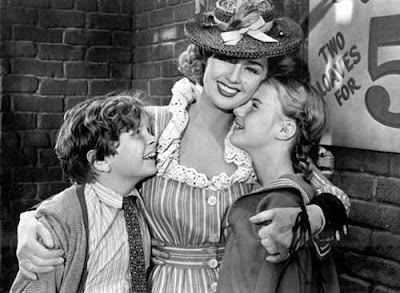 Between film, stage and television, Blondell worked steadily from 1930 to her death in 1979, receiving a Tony nomination in 1958 for The Rope Dancers and two Emmy nominations for the television series Here Come The Brides. She received her only Oscar nomination, a supporting actress nod, for the 1951 movie The Blue Veil, and won the National Board of Review's award for the best supporting actress of 1965 for her performance as Lady Fingers in The Cincinnati Kid.
"I don't know what the secret to longevity as an actress is," she once said. "It's more than talent and beauty. Maybe it's the audience seeing itself in you."
Trivia: Clark Gable made Night Nurse (which along with A Free Soul turned him from a bit player into a star) while on loan from MGM to Warner Brothers and it's interesting to think about how different Gable's career might have been if he had been under contract to Warner Brothers rather than MGM. Judging from roles like this one, he likely would have been the fourth gangster superstar along with James Cagney, Edward G. Robinson and Humphrey Bogart instead of the romantic rogue/superstar he became.
But then who would have played Rhett Butler in Gone With The Wind? Mickey Rooney, I guess—and Lewis Stone could have played Scarlett O'Hara! Chew on that for a while.

 She had a face like a bulldog, if someone had been cruel enough to stamp on that bulldog with the heel of his boot—lantern jaw, bulbous nose, heavy bags under deep-set eyes. Her pear-shaped body sagged, her voice growled and the characters she played often wore their clothes as if a field of potatoes had crawled into a burlap sack and been too tired to crawl out again. But she was a gifted actress—Buster Keaton often called her "the greatest character comedienne I ever saw"—and for a brief time, from 1931 until her death in 1934, Marie Dressler was the most popular actress in America.
It was Dressler's supporting performance in this adaptation of Eugene O'Neill's stage play that, at the unlikely age of 62, set her on the path to stardom.
Anna Christie is the story of an immigrant's daughter, Anna (played by Greta Garbo), who returns to her father for the first time in fifteen years. Each has idealized memories of and hopes for the other only to discover that time hasn't been kind to either of them. It's best known now as Greta Garbo's sound debut—"Give me a whiskey, ginger ale on the side. And don't be stingy, baby"—but it also launched Marie Dressler's comeback and made her the biggest box office draw of the Early Sound Era.
Dressler plays an aging, alcoholic "tramp" named Marthy who's shacking up with the father who suddenly finds her presence embarrassing when he gets news that the daughter he long ago sent to Minnesota to live with relatives is coming to visit.
 By chance, the two women meet over a drink and it doesn't take Marthy long to size up Anna as a younger version of herself. They meet again later, in a scene screenwriter Frances Marion invented especially for Dressler, after Anna has met yet another man who has an idealized view of her and Marthy reminds her that life is too short to spend it apologizing for who you are and pretending to be something else, a brief but important scene that illuminates Anna's subsequent actions.
In their scenes together, Dressler eats the more-celebrated Garbo alive.  To be sure Dressler possessed a theatrical talent that straddled the divide between the silent and modern eras, but I distinguish in my mind between an actor who chews scenery (Garbo, still relying on exaggerated, silent film techniques) and a character who chews scenery (Dressler's self-described "wharf rat" who hides her pain beneath a swaggering pose of indifference).
Garbo eventually shed the exaggerated techniques that had served her well during the silent era and mastered the subtleties of the new sound medium. But not before Dressler had bested her in their one head-to-head outing.
Long before Anna Christie, Dressler had starred in the Mack Sennett comedy classic Tillie's Punctured Romance, which also featured Charlie Chaplin in one of his earliest roles. By the end of World War I, though, Dressler had pretty much disappeared from the movies. Reduced to working as a maid, Dressler later admitted she found the fall from stardom so devastating, she had seriously considered suicide.
 But back when she was still a star, Dressler had befriended a young, struggling writer from San Francisco named Frances Marion, and when their roles were reversed and Marion was the top writer in Hollywood and Dressler was out of pictures altogether, Marion remembered her old friend and began including parts for her in various comedies. Later, when Marion was adapting Eugene O'Neill's play as the vehicle for Greta Garbo's sound debut, she expanded the part of Marthy specifically with Dressler in mind.
It was a pivotal opportunity for Dressler and proved to be her comeback role.
She starred in a dozen movies over the next three years, including Min and Bill (another Frances Marion screenplay) which won Dressler an Oscar, Emma which secured her a second Oscar nomination, Tugboat Annie with Wallace Beery, and possibly her best role, that of aging stage actress Carlotta Vance in the classic dramedy, Dinner at Eight. Even people who don't know Dressler's name remember the last scene she does with up-and-coming Jean Harlow.
"I was reading a book the other day," says Harlow as the unforgettable social-climbing vamp, Kitty Packard.
 "Reading a book?" says Dressler's Vance after the greatest double take in movie history.
"Yes. It's all about civilization or something. A nutty kind of a book. Do you know that the guy says that machinery is going to take the place of every profession?"
Dressler looks Harlow up and down and then says, "Oh, my dear, that's something you need never worry about."
A year later, Dressler was dead of cancer. She was 66.
Note: There were a lot of good choices for supporting actress this year, far too many to write about at any length. In addition to nominees Nina Mae McKinney and Seena Owen (both of whom I will write about in later postings), and, of course, winner Marie Dressler, I also considered the underappreciated Margaret Dumont for her role as Groucho's comic foil in the Marx Brothers' debut film, The Cocoanuts; personal favorite Anita Page as a naive virgin who falls for smoothie Douglas Fairbanks, Jr., in Our Modern Maidens; Lilyan Tashman as a criminal mastermind in Bulldog Drummond; Leila Hyams as the sister of a prison inmate in The Big House; and Alice Roberts as possibly the movie's first onscreen lesbian in Pandora's Box.
Any one of them might be your choice for best supporting actress of the year. You won't get any kick from me.
Those of you with sharp eyes and long memories are no doubt scratching your heads to see Anita Page listed here as the best supporting actress of 1928-29. Didn't I choose Olga Baclanova in Docks of New York that year? Well, yes. Yes, I did. But because of a technical glitch we in the trade call "changing my mind," I'm going back in time and choosing Anita Page instead.
The fact is, Anita Page's performance in Our Dancing Daughters still resonates for me nearly a year later whereas Olga Baclanova, despite a fine effort, has pretty much slipped the surly bonds of my memory, the only Katie winner I can say that of.
Moreover, Page's performance resonates with other movie fans as well, showing up more often on other "Alternate Oscar" lists than any other actress in the mythical supporting category for 1928-29 (supporting performances wouldn't be officially recognized until 1936).
Anyway, I have cobbled together a short essay about Anita Page from everything I've written about her over the course of the year and substituted it for the original essay on Best Supporting Actress of 1928-29, leaving the original essay about Olga Baclanova as an addendum.
Sue me.—The Mythical Monkey (2/10/10)
 I have to confess, before I started writing this blog, I had never heard of Anita Page, but now that I've seen half a dozen of her movies and read a bit about her, it's clear that she was just as cute as the proverbial bug's ear and no doubt somebody you would have been lucky to know. Certainly Herschel House must have thought so—the Navy pilot was married to her for fifty-four years, until his death in 1991.
Mostly Page played sweet innocents who found themselves in a melodramatic load of trouble (see, for example, Our Modern Maidens), but her turn in Our Dancing Daughters as a self-absorbed, gold-digging be-yotch who tricks Joan Crawford's millionaire boyfriend into marrying her was unforgettable and should have presaged a longer career. Louis B. Mayer, a warped frustrated old man, and Irving Thalberg, a warped frustrated young man, saw to it that it didn't.
Well, you take what you can get.
 Our Dancing Daughters was the first movie written specifically for Joan Crawford and it made her a star. It's the story of a rich, wild girl (Crawford) with an addiction to short dresses and the Charleston who loses the love of her life to an even richer, wilder girl (Page, also in a star-making role), all while soaking up Jazz and bootleg booze in fabulous art Deco palaces that could only have existed on the set of an MGM movie. None of this is meant to be taken seriously—just another Hollywood studio clucking its tongue at girls gone wild even as it exploited the phenomenon to rake in box office bucks.
What's not to like?
Although she had only just celebrated her eighteenth birthday when the movie hit the theaters, Page is absolutely convincing in her ruthless pursuit of the man, first putting on an act of virginal innocence to entice him then exploiting him to the hilt after she lands him.
 In the movie's penultimate scene, Page is drunk, evil and standing at the top of a staircase. No prizes for guessing what happens next.
"Our Dancing Daughters was my picture," she said years later. "I say that because I did the acting. Joan Crawford danced her way through it. I acted my way through it."
Our Dancing Daughters was one of a series of Hollywood movies seeking to both exploit and condemn the Jazz Age flapper phenomenon. The script called for an undercurrent of tension between Page and Crawford and, boy, is there ever. Years later, Page claimed Crawford physically assaulted her on the set but the mutual hatred didn't hurt their on-screen chemistry any. In fact, despite their mutual loathing, Page and Crawford made two more movies together, Our Modern Maidens and Our Blushing Brides, trading the good girl/bad girl roles back and forth, to great commercial, if not artistic, effect.
 Page also starred in the year's Oscar winner for best picture, The Broadway Melody, and received over ten thousand fan letters a week, including nearly a hundred from fascist dictator Benito Mussolini who was infatuated with the young actress.
"Are you starting to believe your own publicity?" director Harry Beaumont asked Page during the filming of one of their six pictures together.
"Of course," she said, "Aren't you?"
Our Dancing Daughters is one of those odd silent-sound hybrids of the very early sound era. Made not long after The Jazz Singer, the film has a soundtrack, including several prominently featured songs, but no dialogue, only title cards. I actually find this approach preferable to early talkies such as The Broadway Melody where, for example, Anita Page's dialogue competes with the rustling of her own dress.
Fortunately, sound technology improved rapidly over the course of a year.
 MGM's The Broadway Melody, billed as the first "all-talking, all-singing, all-dancing" musical, was the top grossing movie of 1929 as well as the first sound picture to win the Academy Award for best picture, and further cemented sound's commercial future. The Broadway Melody was the top box office movie of 1929 and also featured "You Were Meant For Me" and "Give My Regards To Broadway."
Douglas Shearer out of necessity invented the concept of the "playback"—pre-recording a song that performers would then dance and lip-synch to—when the choreography on a huge dance number that had already been performed and recorded was deemed unsuitable. Rather than bring the orchestra back to the sound stage, Shearer figured out how to reuse the sound from the previous take, and the cast performed the dance number with its new choreography to a playback of the song. This technique became the industry standard for decades.
"I thought Our Dancing Daughters was my picture," she said later, "but Broadway Melody was Bessie Love's. I love good English, and I hated saying things like, 'Gee, ain't it elegant?' In my opinion, silents were much better than talkies. One thing you could have was mood music, which you could have playing throughout your scene to inspire you. The trouble with talkies was, they let you have the music, but they'd stop it when you had to talk, and that was always a let-down for me."
 After The Broadway Melody, Page made two more movies with Joan Crawford, and appeared in films with Lon Chaney, Buster Keaton and Clark Gable.
Her final movie for MGM was 1932's Prosperity, starring Marie Dressler and Polly Moran. On the outs with studio head Louis B. Mayer after twice refusing to sleep with him (the second proposition made in the presence of Page's mother), Page served out the remaining years of her MGM contract on loan to poverty row studios, making such low-budget bombs as Jungle Bride and Hitch Hike To Heaven. It was an ignominious end for an actress who just a couple of years before had been second only to Greta Garbo as the studio's top draw.
Page left Hollywood and married Navy flyer Herschel House in January 1937. After his death, she began to make films again, mostly low-budget fare such as The Crawling Brain and Witchcraft XI. On the 75th anniversary of the founding of the Academy of Motion Picture Arts and Sciences, Page received a standing ovation at a special screening of The Broadway Melody. She was last surviving attendee of the first Oscar ceremony and died in 2008 at the age of ninety-eight.
(Original essay follows):
For the best supporting actress award, I've nominated a trio of superficially similar actresses—each blonde, beautiful, at the peak of their careers in 1928 or 1929, two playing hookers, the third playing a heartless gold digger—but who arrived on and departed from the Hollywood stage by very different paths. All of them turned in tiptop performances during what proved to be the last year when silent movies still had an outside chance of finding an audience and I'm sorry their careers, which cracked up for a wide variety of reasons, weren't longer or more celebrated.
 The most visible of the bunch, at least at the time, was no doubt Anita Page whom I've nominated here for her performance as a gold digger who tricks Joan Crawford's millionaire boyfriend into marrying her in the Jazz Age flapper picture, Our Dancing Daughters. Although she had only just celebrated her eighteenth birthday when the movie hit the theaters, Page is absolutely convincing in her ruthless pursuit of the man, first putting on an act of virginal innocence to entice him then exploiting him to the hilt after she lands him.
In the movie's penultimate scene, Page is drunk, evil and standing at the top of a staircase. No prizes for guessing what happens next.
Our Dancing Daughters was one of a series of Hollywood movies seeking to both exploit and condemn the Jazz Age phenomenon of young girls gone wild. The script called for an undercurrent of tension between Page and Crawford and, boy, is there ever. Years later, Page claimed Crawford physically assaulted her on the set but the mutual hatred didn't hurt their on-screen chemistry any. In fact, despite their mutual loathing, Page and Crawford made two more movies together, Our Modern Maidens and Our Blushing Brides, trading the good girl/bad girl roles back and forth, to great commercial, if not artistic, effect.
Page also starred in the year's Oscar winner for best picture, The Broadway Melody, and received over ten thousand fan letters a week, including nearly a hundred from fascist dictator Benito Mussolini who was reportedly infatuated with the young actress.
"Are you starting to believe your own publicity?" director Harry Beaumont asked Page during the filming of one of their six pictures together.
"Of course," she said, "Aren't you?"
 On the other hand, the least visible of my trio of nominees was Mary Nolan—and apparently she wanted it that way. Earlier in the decade Nolan, whose real name was Imogen Robertson, had been a Ziegfeld girl performing under the stage name "Bubbles Wilson." But she had the misfortune to fall in love with married comedian Frank Tinney who routinely abused her and finally beat her so savagely, she landed in the hospital.
She also landed in the tabloids, which battered her reputation nearly as savagely.
Robertson/Wilson fled the United States, and after two years working in the German film industry, returned to work under the name Mary Nolan. In Tod Browning's West Of Zanzibar, she plays a victim as ill-used as Nolan was in real life. Lon Chaney is crippled in a quarrel and takes revenge on Nolan, believing her to be the child of his late wife and her lover, not realizing she is in fact his own flesh and blood. First he forces Nolan to work in a brothel. Then he arranges for cannibals to burn her alive. Then he really gets mad.
Either of these actresses would be fine choices for a Katie but I'm reserving the award for the third beautiful blonde in this trio, Olga Baclanova, who co-starred in one of the best movies of the year, Josef von Sternberg's The Docks Of New York.
 You might recall that I mentioned her as a potential supporting actress nominee for 1927-28 for her performance as a kinky countess with a fetish for the disfigured Conrad Veidt in The Man Who Laughs. In The Docks Of New York she plays Lou, an abandoned wife making ends meet as a prostitute in a waterfront bar.
Two of Hollywood's most successful writers, Jules Furthman and John Monk Saunders, wrote this story in the style of Eugene O'Neill, with all the action taking place in one evening and the following morning. A sailor on shore leave (George Bancroft) pulls a suicidal young woman (Betty Compson) out of New York's harbor and over the course of an evening, takes a liking to her and proposes marriage.
It sounds like the stuff of Hollywood fantasy, an early stab at Pretty Woman, say, but everyone involved handles the story soberly and realistically and the movie reminds me more than anything of O'Neill's Anna Christie which would be adapted the following year as a vehicle for Greta Garbo's first talkie. Baclanova in particular breathes life into what could have been a stock character, playing Lou as a hardened cynic when plying her trade in the dive bar that sees most of the movie's action but as a beaten down survivor in private, defeated and without illusions.
 "Do you think he can make you decent by marryin' you?" she asks Compson after hearing of Bancroft's proposal. "Until I got married, I was decent!"
Lou surprises herself and us with a pivotal act of violence in the film's third act that reveals just how much her estranged husband's thoughtless cruelty still hurts her.
Soon after this film, director von Sternberg would enter into the cinematic (and personal) relationship for which he is best remembered, the six films he made with Marlene Dietrich. These movies, while highly-regarded by cinephiles and showcasing some of Dietrich's best work, were increasingly characterized by wretched excess and a voyeuristic interest in Dietrich (Literally. In The Scarlet Empress, for example, the royal wedding night consists of the groom watching the bride through a peephole) that's inaccessible to most audiences.
While The Docks Of New York is not as visually interesting or cinematic as von Sternberg's later work, it's more moving and from my perspective more worthy of attention. Here, the director was still in touch with the needs and interests of his audience, still trying to tell a story, still trying to connect with real universal human emotions. I think it's possibly the best work of his career.
As for Baclanova and my other nominees, all three were pretty much out of the movies by 1936.
Anita Page, who only just passed away last year at the age of 98, said late in life that her career was unfairly sabotaged when she refused to sleep with producer Irving Thalberg and studio chief Louis B. Mayer (hopefully in response to separate propositions and not as part of some twisted, resentment-fueled three-way). She left Hollywood in 1936, but came out of retirement a few years ago to take small parts in a few low-budget horror films, including one, Frankenstein Rising, which is listed on the Internet Movie Database as being in post-production and due out later this year.
Mary Nolan made a handful of fine movies at the end of the Silent Era, including Desert Nights with John Gilbert, but she didn't adjust well to the demands of sound and was soon out of work. She developed a heroin habit and died penniless at the age of forty-two.
 When talkies became the norm, Olga Baclanova's heavy Russian accent limited her to "exotic" parts and B-pictures. She made one more unforgettable movie, playing the cruel circus performer Cleopatra in the cult-film Freaks, the role for which she is probably now best known. She returned to the Broadway stage in 1933 and had at least one big hit, Claudia, which ran for two years. Baclanova returned to Hollywood briefly in 1943 to make a screen version of her Broadway hit and then retired from the movies permanently. She died in 1974.
Note: I want to mention one other actress, Dorothy Mackaill, who was blonde, beautiful and turned in a well-received supporting performance as a tough-as-nails bad girl in 1928.
Once thought to be lost, a lone copy of The Barker languishes in UCLA's Film and Television Archive, unavailable on VHS or DVD. The handful of people who have seen it cite Dorothy Mackaill's performance as possibly the best of the year and certainly the best and most complex in this Oscar-nominated movie. As of this writing, at least, I'll have to take their word for it.
If you're in the mood for a road trip, The Barker will be shown at Noon on August 8, 2009, as part of the annual Capitolfest film festival at the Capitol Theater in Rome, N.Y.

 Here's another award that tied me in knots for a while and with good reason. The five nominees belong on a short list of the greatest character actresses of the era, each appearing in superb movies while giving performances that are both memorable and representative of their careers as a whole.
 Born Daisy Juliette Baker in Brooklyn in 1882 (she claimed to have been born Marguerite Baker in Atlanta in 1889), Margaret Dumont was raised by her godfather Joel Chandler Harris, author of the Uncle Remus stories. Dumont trained as an opera singer and spent the first decade of the twentieth century working as a singer and comedic actress, both abroad and on the American vaudeville circuit. Described in reviews of the time as "a statuesque beauty," Dumont met and married the wealthy industrialist John Moller, Jr. in 1910 and retired from the stage, but returned eight years later after his sudden death.
 The role of the stuffy rich widow was a part she played in all seven of the Marx Brothers films she appeared in, and she played the part perfectly—regal and self-possessed without being arrogant, naive and romantic without being vulnerable—so that the audience neither felt sorry for her not angry at her as Groucho bounces insults off her. Indeed, his attempts at seduction play as surreal rather than hostile, enhancing the anarchic quality of the Marx Brothers' humor.
 Listen sometime to her delivery of a line like "It's a gala day for you" from Duck Soup (to which Groucho replies, "Well, a gal a day is enough for me. I don't think I could handle any more.") The line comes at the end of a long, florid speech and as she arrives at the straight-line, her pace slows up just a hair and she adds a slight emphasis to the words, setting the gag up on a tee for Groucho. She clearly understood how a gag was constructed and how to deliver a straight-line in a way that made the audience anticipate the punchline, which as Buddy Hackett once explained to Roger Ebert, goes a long way toward selling a joke.
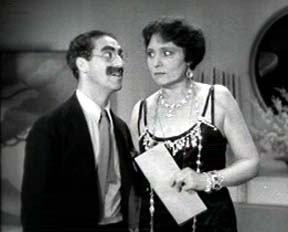 Dumont also knew how to react to Groucho's gags. It may sound counter- intuitive, but in a comedy it's important that none of the actors in it signal to the audience that they know they're in a comedy. Unless you're Harvey Korman on the old Carol Burnett Show, where half the fun was watching him trying and failing to keep a straight face, a comic actor has to react as though what is happening makes complete sense in the world he inhabits; to laugh at the punchline is to take all the air out of the gag. Dumont's reactions punctuate the humor without puncturing it. Nobody else in the Marxian universe ever did it better.
 And then Dumont was often given the thankless task of keeping the slender narrative of the Brothers' movies on track. This was especially true in Duck Soup where she insists on the appointment of Rufus T. Firefly (Groucho) as leader of Freedonia; introduces him to his political and romantic rival Trentino of Sylvania (Louis Calhern); worries about the secret code (and two pair of plans!); and tries to prevent war; all without ever becoming tedious in the process.
 The best example of Dumont's work in Duck Soup is the scene in her bedroom involving all three Marx Brothers. Attempting to steal secret war plans hidden in Dumont's safe, Chico and Harpo (disguised as Groucho), followed by Groucho himself, pop in and out of her room with all the freneticism of a British bedroom farce.
 In her two movies with the Marx Brothers, Todd played a seductress who has all four brothers panting for her company. Unfortunately, as it turned out, there's nothing inherently funny about a middle-aged man attempting to seduce a beautiful young woman—embarrassing maybe, and certainly foolish, but funny? Indeed, at times, watching Groucho and his brothers fawning over Todd is a bit creepy (to me, anyway).
 But can you imagine that same line spoken about Thelma Todd, or any other young, beautiful actress? Suddenly it becomes a credible insult and not a funny one at that.
 It's a pity more people didn't recognize Dumont's gifts at the time. Her success with the Marx Brothers led to typecasting and pretty much finished her dreams of taking on dramatic film roles. She appeared in fifty movies in a career that began with an uncredited bit part in 1917's A Tale Of Two Cities and ended shortly before her death in 1965 with a televised performance with Groucho on The Hollywood Palace where she reprised her role as Mrs. Rittenhouse from Animal Crackers.







 Posts
Posts

