Flicker Alley is currently promoting The Best Arbuckle/Keaton Collection, Vol. 1 &2 which will be available as a manufacture-on-demand DVD in March. As always, the Monkey encourages his readers to explore the wonderful world of silent movies. This would be a good place to start.
The Flicker Alley titles on my shelf, all of them definitive and essential:
I've been on the road for most of February and only this morning heard about the Buster Keaton Blogathon ongoing at Silent-ology. I cobbled together this contribution from some previous posts.
Of all the developments that made 1917 such a landmark year in film—the industry-wide adoption of what is now known as "classical continuity editing," Mary Pickford's emergence as the most powerful woman in Hollywood history, Charlie Chaplin's maturation as an artist—perhaps the happiest for movie fans today was the big screen debut of the greatest film comedian of all time, Buster Keaton.
That Buster Keaton is only now arriving on the scene may come as a bit of a surprise to those of us who naturally think of Keaton as a contemporary of Chaplin—certainly we frame the debate "Chaplin versus Keaton" in those terms—but the fact is, Chaplin was already an international star with sixty films to his credit (including forty he directed himself) before Keaton ever set foot in a film studio. And although Keaton would brilliantly subvert most of the rules of early film comedy in a brief but prolific run between 1920 and 1928, it was by and large Chaplin who had established those rules, a fact that Keaton himself later conceded.
Which is not to say Keaton was an amateur when he joined Roscoe Arbuckle during the filming of The Butcher Boy in early 1917. He had been performing on the vaudeville stage with his parents from the age of four as part of a rough and tumble "knockabout" comedy act.
"I'd just simply get in my father's way all the time," Keaton said, "and get kicked all over the stage. But we always managed to get around the [child labor] law," he added, "because the law read: No child under the age of sixteen shall do acrobatics, walk wire, play musical instruments, trapeze—and it named everything—but none of them said you couldn't kick him in the face."
Legend has it he was dubbed "Buster" when escape artist Harry Houdini saw the infant Keaton take a fall down a flight of stairs and bounce up unharmed. Whether he was born with it, or developed it doing routines with his father, if Keaton wasn't the most talented pratfall artist in movie history, I'd like to see the guy who survived long enough to be a better one. He did stunts that rivaled those of Douglas Fairbanks, and when he was done, he doubled for his co-stars and did their stunts, too.
"The secret," he once said, "is in landing limp and breaking the fall with a foot or a hand. It's a knack. I started so young that landing right is second nature with me. Several times I'd have been killed if I hadn't been able to land like a cat."
In early 1917, Keaton was booked into New York's Winter Garden for a series of shows when he bumped into Roscoe Arbuckle while strolling down Broadway.
For those of you who only know Arbuckle—"Fatty" to his fans, "Roscoe" to his friends—through the tabloid scandal and subsequent trial that (despite his acquittal) ended his career, you're missing out on one of the greatest comedic actor-directors of the silent era. Although I wouldn't put him in the same league as "the three geniuses"—Chaplin, Keaton and Harold Lloyd—Arbuckle was, in terms of his popularity and impact, the best of the rest, the very top of the second tier of comedians that included Mabel Normand, Charley Chase, Harry Langdon, Ford Sterling and Max Linder.
Mark Bourne in his review of the Arbuckle/Keaton collection for The DVD Journal suggested that Arbuckle was to his biggest commercial rival, Charlie Chaplin, what Adam Sandler is these days to Woody Allen, "less artistic and sophisticated by miles, but nonetheless obviously skilled and unquestionably popular with his own characteristic wacky and raucous manner."
The collaboration between Keaton and Arbuckle was to prove pivotal for Buster.
"Arbuckle asked me if I'd ever been in a motion picture," Keaton told Kevin Brownlow in 1964. "I said I hadn't even been in a studio. He said, 'Come on down to the Norma Talmadge Studio on Forty-eighth Street on Monday. Get there early and do a scene with me and see how you like it.' Well, rehearsals [at the Winter Garden] hadn't started yet, so I said, 'all right.' I went down and we did it."
That first scene, in the Arbuckle short comedy The Butcher Boy, ends in one of the best of Keaton's early gags. At the 6:25 mark of the film, Keaton wanders into the country store where Arbuckle works as a butcher and by the end of the scene, Keaton's trademark porkpie hat is full of molasses and the store is a wreck.
"The first time I ever walked in front of a motion picture camera," he said, "that scene is in the finished motion picture and instead of doing just a bit [Arbuckle] carried me all the way through it."
It's a terrific sequence, but it's as notable for what isn't in it as what is—Keaton does not wear an outrageous costume or wild facial hair, nor does he indulge in the over-the-top reactions and shameless mugging common to the era. He's just a thoroughly average American—albeit, one who can take a swipe at Al St. John, do a 360º spin in mid-air and wind up flat on his back—who has somehow wandered in off the street and found himself thrust into the insanity of a two-reel silent comedy.
Keaton's understatement was the antithesis of the Mack Sennett approach, and was so wholly original, it constituted something of a revolution. Audiences and critics alike instantly took note, if not always approvingly.
"The deadpan was a natural," Keaton said. "As I grew up on the stage, experience taught me that I was the type of comedian that if I laughed at what I did, the audience didn't. Well, by the time I went into pictures when I was twenty-one, working with a straight face, a sober face, was mechanical with me.
"I got the reputation immediately [of being] called 'frozen face,' 'blank pan' and things like that. We went into the projection room and ran our first two pictures to see if I'd smiled. I hadn't paid any attention to it. We found out I hadn't. It was just a natural way of acting."
But deadpan, as any Keaton fan can tell you, isn't synonymous with inert, and as film historian Gilberto Perez has noted, Keaton was able to show us a face, "by subtle inflections, so vividly expressive of inner life. His large deep eyes are the most eloquent feature; with merely a stare he can convey a wide range of emotions, from longing to mistrust, from puzzlement to sorrow."
Keaton's next film with Arbuckle, The Rough House, is one of their best. Not only does it feature some of the best gags of Arbuckle's career—the dancing dinner rolls, trying to douse a raging fire with a teacup, squeezing out a bowl of soup with a sponge—but many film historians also now list Keaton as its uncredited co-director.
"The first thing I did in the studio," he told Robert and Joan Franklin in 1958, "was to tear that camera to pieces. I had to know how that film got into the cutting-room, what you did to it in there, how you projected it, how you finally got the picture together, and how you made things match. The technical part of pictures is what interested me."
Keaton and Arbuckle made three more comedies in 1917, His Wedding Night, Oh Doctor! and Coney Island. Each features an aspect of Keaton rarely seen after.
In the first, Keaton plays a milliner's delivery boy and winds up in drag as he models a wedding dress. Mistaking him for the bride, Al St. John kidnaps Keaton and hauls him off to the preacher at gunpoint.
In Oh, Doctor!, he plays Arbuckle's little boy, a reprise of the sort of comedy Keaton and his father Joe had done for years on stage, and pulls off a stunt you have to see to believe—Arbuckle smacks him, Keaton tumbles backwards over a table, picks up a book as he falls, and lands upright in a chair, with the book on his lap as if he's been there all along, reading comfortably.
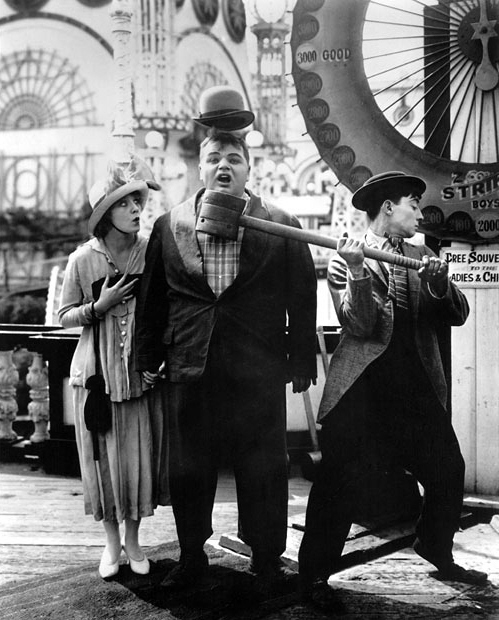
And while Coney Island is mostly an excuse to watch Arbuckle caper around Luna Park—its plot of men wooing women on park benches is a throwback to the Keystone comedies—the film is worth seeking out for two reasons: one, for its documentary footage of Coney Island nearly one hundred years ago, and two, a rare chance to see Buster Keaton smile!
The smile notwithstanding, in terms of his look, his acting style, his fearless physical stunts and his fascination with technology, the basic Keaton was already on full display in these early two-reel comedies. He had only to add the context—that of a rational man enmeshed in the machinery of a universe that exists only to achieve absurd ends—for his unique brand of humor to reach its full flower.
In 1918, Keaton made five more two-reel comedies with Arbuckle before shipping off to France to serve in the army during World War I. Although not credited as such, by this time Keaton was working as the assistant director when Arbuckle, the credited director, was in front of the camera.
"You fell into those jobs," Keaton said later. "He never referred to me as the assistant director, but I was the guy who sat alongside of the camera and watched scenes that he was in. I ended up just practically co-directing with him."
The new balance in their collaboration showed up in front of the camera as well. In the first three films of 1918, he and Arbuckle are equal partners, more Laurel and Hardy—with Keaton as a thin straight man and Arbuckle a rotund goof—than the star/supporting player dynamic of 1917. The first film of the year, Out West is a parody of the Western genre, popular at the time, with Arbuckle playing a drifter riding the rails who winds up working for Keaton as an uncharacteristically tough saloon owner. Parody would soon prove to be one of Keaton's trademarks—indeed, his two-reeler The Frozen North in 1922 was such a savage parody of William S. Hart's "good bad guy" westerns that Hart refused to speak to Keaton for two years.
Next up was The Bell Boy, the story of two Stooge-like bellhops in a shabby hotel. The horse-drawn elevator is pure Keaton who was always fascinated by machines, and built several movies around them, culminating in his classic train picture, The General.
The film that followed, Moonshine, is the most Keatonesque of all his collaborations with Arbuckle. Ostensibly the story of a pair of inept revenuers (Keaton and Arbuckle) hot on the trail of West Virginia bootleggers, this is really a movie about movies, with the title cards constantly breaking the fourth wall to explain the filming process. "Look, this is only a two-reeler," one says, "We don't have time to build up to love scenes." Opening up the mechanics of movie making for laughs was a Keaton trick he would revisit time and again, culminating with Sherlock Jr. in 1924 when a projectionist gets sucked into the film itself.
The next two shorts, Good Night, Nurse and The Cook, both came out after Keaton had shipped out for the European war and his contributions look hasty, as if he filmed a couple of scenes for both, leaving the main plot for Arbuckle to flesh out later. Still, they're both worth a look, particularly The Cook which was thought to be lost for decades until rediscovered in Norway in 1999.
After a year in the Army left Keaton deaf in one ear, he went right back to making short films with Arbuckle. The first of them, Back Stage, is a traditional "hey kids, lets put on a play" story with one extraordinary scene—anticipating Keaton's most famous stunt in 1928's Steamboat Bill Jr., a house falls on Arbuckle only to miss him thanks to an open second floor window. Here, the house is only a cardboard stage prop and, unlike that latter example which might have killed Keaton, nobody is in danger, but seeing this early attempt at a famous gag is a bit like finding a preliminary sketch of Picasso's Guernica on the back of a cocktail napkin.
There were two more shorts, The Hayseed in 1919 and The Garage in 1920, after which Arbuckle left to make full-length feature films, but not before leaving the keys to the studio to Keaton. With Arbuckle's public blessing, Keaton began to direct films of his own.
"There is no Garbo, there is no Dietrich, there is only Louise Brooks!"
Or so curator Henri Langlois said when asked why he had chosen to prominently display a huge portrait of Louise Brooks rather than Greta Garbo or Marlene Dietrich at the entrance of the Musee National d'Art Moderne in Paris on the occasion of its retrospective of the first sixty years of motion pictures.
I wonder how many essays about Louise Brooks begin with that quote. All of them, probably.
Langlois was overselling his case—after all, I wouldn't want to imagine a movie history without Greta Garbo and Marlene Dietrich—but I wouldn't want to imagine one without Brooks either. She made just twenty-three movies and she's not nearly as celebrated as her two counterparts, but in 1929 at least, there was no actress better than Louise Brooks, and when Langlois reintroduce her to a world that had forgotten her after a twenty-five year exile, perhaps he was entitled to a bit of hyperbole.
Brooks's brief but unforgettable film career followed the trajectory of an early NASA rocket—straight up, then straight down, with some crazy loops in the middle and a spectacular explosion at the end. She combined brains, elegant beauty, and scorching sex appeal with a party-girl work ethic self-destructive enough to end ten careers. She made no apologies for preferring sex, jazz and alcohol to a steady job, and she burned every bridge she ever crossed, some while she was still standing on them, until finally there were no bridges left to burn.
"I have a gift for enraging people," she once said, "but if I ever bore you, it'll be with a knife."
Twice married, twice divorced, Brooks conducted well-documented affairs with Charles Chaplin, Washington Redskins owner George Preston Marshall, movie producer Walter Wanger, and many others, including an experimental one-night stand with Greta Garbo. CBS founder William Paley, who was briefly involved with Brooks in his youth, was so fond of her that when she hit the skids after her movie career, he helped her with a monthly stipend for the rest of her life.
Born in Cherryvale, Kansas, in 1906 to an indulgent lawyer father and a social-crusading mother with the maternal instincts of an "alligator," Brooks became a dancer at an early age and as a teenager joined the Denishawn Dancers (working with the legendary Martha Graham). Later she danced with the George White Scandals and the Ziegfeld Follies. "I learned how to act by watching Martha Graham dance," Brooks said, "and I learned how to dance by watching Charlie Chaplin act."
She made her movie debut in 1925 for Paramount Pictures, appearing in eleven films over a three year period, playing the quintessential flapper across from such actors as Adolphe Menjou and W.C. Fields. She had an insatiable appetite for the Hollywood nightlife, was a regular at William Randolph Hearst's San Simeon castle, and was a fixture in the gossip columns. Her "black helmet hairdo" was one of the ten most influential haircuts in history, according to InStyle magazine, and she was one of the most photographed celebrities of her time.
But it wasn't until 1928, when she made Howard Hawks's A Girl In Every Port and William A. Wellman's Beggars of Life, that she really made an impression as an actress.
Her contemporaries, schooled in the art of silent film overacting, thought she was doing nothing on screen; years later, it's clear she was a method actress before the method had been invented. "The great art of films does not consist in descriptive movement of face and body," she said, "but in the movements of thought and soul transmitted in a kind of intense isolation." As with the works of Buster Keaton, Brooks's understated, internal approach gives her performances a modern feel, very much in contrast to her contemporary, Greta Garbo, who wouldn't completely shed her silent film theatrics until 1933. Brooks never had any to lose.
With her work in A Girl in Every Port and Beggars of Life, Brooks came to the attention of German director Georg Wilhelm Pabst, a collaboration that would result in the best work of both their careers.
Pabst, an Austrian born in what is now the Czech Republic, was one of the leading directors in Germany's important and influential film industry. After making movies with Greta Garbo (The Joyless Street, her first outside of Sweden) and Brigitte Helm (who later played the lead in Metropolis), Pabst set his sights on a movie version of a pair of stage plays, Erdgeist (Earth Spirit) and Der Büchse Die Pandora (Pandora's Box), two well-known works by German playwright Frank Wedekind.
In his two plays, Wedekind had set out to expose the secret lusts and private immoralities of Berlin's ruling class, with the action centering on the manipulations and cruelty of a prostitute named Lulu. Wedekind described Lulu as a "monster," but Pabst re-envisioned her as "sweetly innocent" and unaware of the evil she inspired, shifting the moral responsibility for the resulting tragedy to a flaw in her upper class patrons.
It was bold idea for a story well-fixed in the mind of a German public in no mood to acknowledge their role in the decadence and growing weakness of the Weimar Republic. "[M]y playing of the tragic Lulu with no sense of sin," Brooks wrote later, "remained generally unacceptable for a quarter of a century."
In Brooks, Pabst saw the precise combination of innocence and unapologetic sexual appetite he was looking for in his Lulu. The problem was, she was under contract to Paramount Pictures and the studio had its own plans for the actress. Sitting in post-production was a silent movie, The Canary Murder Case—Brooks played the "Canary" of the title, a blackmailing singer turned murder victim—which the studio wanted to re-shoot as a "talkie."
Typical of the industry as a whole, though, Paramount saw the advent of sound not just as a technical challenge, but also an opportunity to slash salaries and dump difficult stars (such as Wallace Beery and Clara Bow), using the cost of converting to the new technology as an excuse. Never a fan of the business side of acting to begin with, Brooks balked when the studio informed her she would be doing the work of dubbing The Canary Murder Case for less pay. She quit on the spot, at which time studio head B.P. Schulberg informed her of Pabst's offer.
Legend has it that Marlene Dietrich was waiting in Pabst's outer office to test for Pandora's Box when a cable arrived saying that Brooks had left Paramount and was available to play Lulu. For Brooks, it was a fateful decision.
The first scene of Pan- dora's Box sets the tone. We first see Lulu in her spacious apartment in the city, friendly, smiling, fresh-faced—with a bottle of brandy tucked under her left elbow to pay off the meter reader with less than what she owes, and even though he's old enough to know better, he can't help thinking such a lovely, innocent smile is for him only. And it is for him only, at least until the next man arrives at the door.
Any number of men open this particular Pandora's box without much regard to the cost to their dignity, social standing or bank accounts: Schigolch, a pimp and a leech, Lulu's first "patron," respectable until he met her, now an alcoholic bum with holes in his shoes; Dr. Schön, a wealthy publisher with a high-society fiancee, who lusts after Lulu and hates himself for it; and his son, Alwa, who adores her even as she cheerfully tells him she is incapable of love. There's even a Countess (played by a reluctant Alice Roberts, who didn't realize she was to play what was perhaps the first overtly lesbian character in movie history) who longs for Lulu with an unrequited passion.
Like Josef von Sternberg who was busy making a very similar movie, The Blue Angel with the aforementioned Marlene Dietrich, Pabst had men pegged as nothing much more than big animals with pants on—in one scene he shows Schön rutting like a pig in white tie and tails—and it comes as no great surprise that the last man in Lulu's life, Jack the Ripper, proves to be the biggest animal of all, albeit with a different agenda on his mind.
Lulu is blessed with a sort of short-term moral amnesia that it makes it possible to forget from moment to moment that her relationships with other people flow, or should flow, in two directions. As Brooks plays her, Lulu is a child in a woman's body, and that childlike innocence at the core of Brooks's approach is the key to the movie. Lulu is a flame who attracts men to their destruction, but because there's no malevolence in her, the audience never turns on her as they might a typically scheming femme fatale.
No doubt that's why Pabst so preferred Brooks to Dietrich. "It's a part that can't be played by her type," Brooks said later of Dietrich in a rare interview. Pabst agreed, saying, "Dietrich was too old and too obvious—one sexy look and the picture would have become a burlesque."
Pandora's Box is not a perfect movie. At 133 minutes, it's about half an hour too long for a silent film, and Pabst never really solved the structural problem of stitching two stories together. But Brooks's performance is extraordinary, quite unlike anything that had come before it and so far ahead of its time, years would pass before it found an audience.
Premiering in Berlin in January 1929, Germans were outraged that Pabst had chosen an American to play their beloved Lulu and were offended that he had dared show Berlin's upper classes in a less than flattering light. The movie fared no better when it reached the U.S. in December of that same year. Already a relic of the Silent Era, Pandora's Box sank without a ripple.
Undeterred, Pabst began work on a follow-up to Pandora's Box in June, 1929. Diary Of A Lost Girl (Tagebuch einer Verlorenen) is an adaptation of Margarete Böhme's novel about a girl who is seduced and raped only to be sent to a brutal reform school by a hypocritical father who himself has a taste for young girls.
In choosing to make Diary of a Lost Girl, Brooks turned down an offer of $10,000 from a Paramount Pictures now desperate to avoid the expense of finding another actress to dub her voice in The Canary Murder Case. With this second rejection, Brooks burned all but the last of her Hollywood bridges. B.P. Schulberg, the head of Paramount, put the word out that Brooks's voice was unsuitable for talkies and she was blackballed from most of the major studios. It was years before Brooks grasped the significance of her decision.
The resulting collaboration between Brooks and Pabst is not quite as good as Pandora's Box, but Brooks's performance may be even better. The movie blogger L'Eclisse has observed that while she's not convinced the movie works, "What is indisputable ... is the gravity of Brooks’ performance. She is delicate, subtle, vulnerable, intuitive, and a host of other immortal adjectives."
Certainly the performance proves Pandora's Box was no fluke.
As an innocent victim made to suffer outrageously at the hands of others, Brooks's character in this one, Thymian, is very nearly a polar opposite of Lulu. Yet in both movies, Brooks serves as a prism refracting upper class hypocrisy into its full spectrum of hidden sin. Discovering her father has seduced and impregnated the family housekeeper, a woman not much older than herself, Thymian turns to her father's lecherous business partner for solace, an unscrupulous lech who takes full advantage of the opportunity.
Brooks noted she played the scene as a ballet, an emo- tionally complex scene in which an "'innocent' young girl" (the quotation marks around "innocent" are Brooks's own) subtly maneuvers a "wary lecher" without any idea of what is at stake, knowing only that her father has hurt her. For Thymian, to faint dead away in her lover's arms was the consummation promised in romance novels. For the lecher, consummation was something else.
The subsequent rape, implied but not shown, leaves Thymian pregnant which, in the eyes of the hypocrites who raised her, is her own fault, a sin worthy of harsh punishment.
Filming those scenes must have been an uncomfortable reminder of a pivotal incident from Brooks's own childhood when as a nine year old she was sexually molested by a neighbor only to have her mother blame her for seducing the man when she came home crying. Brooks wrote later that the episode haunted her for the rest of her life and shaped her feelings about love and sex.
"Love is a publicity stunt," she said bluntly, "and making love—after the first curious raptures—is only another petulant way to pass the time waiting for the studio to call."
After Thymian gives birth, her baby is given over to a midwife and Thymian herself is sent to a girl's reformatory, which like the girl's school in Mädchen In Uniform, which followed two years later, seethes with authoritarian cruelty and repressed desire. That Thymian's life improves when she escapes the reform school to work in a brothel should tell you everything you need to know about Pabst's opinion of reform schools, and I think Pabst, like fellow German directors Fritz Lang (M) and Leontine Sagan (Mädchen In Uniform), was groping to diagnose the very real sickness in German society that would soon bring Adolf Hitler to power.
Censors heavily edited Diary of a Lost Girl on its release, the French version being so cut up (the entire brothel sequence was excised), the movie's screenwriter thought the film had broken half way through its premiere. Still, despite making no impression in America, Diary of a Lost Girl was enough of a success in Europe that Brooks made a third movie, Prix de Beauté, a truly European effort with a screenplay from Pabst and French director René Clair, and direction by Italian Augusto Genina.
The film was a hit, yet despite Pabst's promise to turn her into an international star to rival Garbo, Brooks was bored with Europe and after three movies there, returned to an indifferent America. The hard work of making films in a language not her own held no interest for her, no matter how much fame or fortune was in the offing.
"Your life is exactly like Lulu's," Pabst angrily told her on parting, "and you will end the same way." He wasn't far wrong.
Although her European films had had no impact on the American market and she was still in bad odor after snubbing Paramount, Brooks did find small roles in four pictures, and made her belated sound debut in the execrable comedy short Windy Riley Goes Hollywood, directed by the still-disgraced Roscoe "Fatty" Arbuckle under an assumed name. All four movies are terrible and Brooks, who admitted she knew nothing about how to project her voice for the microphone, is pretty bad in them.
Still, in 1931, William Wellman, who had directed Brooks in Beggars of Life, offered her the female lead in his next picture, James Cagney's gangster classic, The Public Enemy. Brooks initially said yes, then changed her mind and abruptly left Hollywood to be with then-lover George Preston Marshall. The role went instead to Jean Harlow and made her an instant star.
Brooks had burned her last bridge. There was nowhere to go but down.
"That Hollywood treatment is murder, just murder," she said later. "It isn't that people turn their heads not to speak to you, they don't see you, you're not a person anymore. The people who've dined with you and you've spent weekends with, they look right at you, you don't exist."
By the time she realized she missed acting, it was too late. "I never gave away anything without wishing I had kept it," she said later, composing her own epitaph, "nor kept anything without wishing I had given it away."
Brooks returned to Hollywood in 1936 and appeared in a pair of Westerns, including her last film, Overland Stage Raiders with John Wayne a year before his breakthrough in Stagecoach, then spent another two years in Hollywood waiting for offers that never came. When she left California in 1940, she left for good. She was thirty-four.
Brooks fell back on dancing for a while, working on the stage in Chicago, and even opened a dance studio in Wichita, Kansas, but she was as impatient and ill-tempered as ever, alienating clients and driving away business. Eventually she retreated to New York, working as a salesgirl, maid and finally as an "escort."
She said later that only Paley's monthly stipend kept her from suicide. "How I have existed fills me with horror," she wrote, "for I have failed in everything—spelling, arithmetic, riding, swimming, tennis, golf, dancing, singing, acting, wife, mistress, whore, friend. Even cooking. And I do not excuse myself with the usual excuse of not trying. I tried with all my heart."
She was "a very strong woman," a friend said after her death, "but whose strength annihilated her, I think, and I always felt she was a lost soul."
Then by chance in 1953, Brooks's neighbor had a conversation with James Card, curator of the George Eastman House of Photography in Rochester, N.Y., who mentioned that he had been searching for years to find Brooks. The neighbor introduced the two, and Brooks and Card began a correspondence that led Brooks to relocate to Rochester and begin writing a series of respected essays about the Silent Era, collected under the title Lulu in Hollywood. In 1957, Henri Langlois held his film retrospective in Paris and reintroduced Brooks to a world finally ready to recognize her talent.
More than a quarter of a century after she had turned her back on fame, fame forgave her. She is now regarded as one of the greatest actresses of the Silent Era.
Brooks lived out the rest of her life in Rochester, writing, painting, reading voraciously, entertaining friends, occasionally lecturing to students at the Eastman House, but otherwise avoiding the public that had rediscovered her. In her later years, she suffered from arthritis and emphysema, living, like a character from the Proust she loved, in memories of things past.
"In my dreams," she said not long before her death, "I am not crippled. In my dreams, I dance."
Stealing is a time honored tradition among comedians, and God bless them, I say—thanks to their thieving ways, we can directly compare comedy acts with different styles and of different eras and get a sense of what each brings to the table.
This is especially true, I think, where as here, the players are not at the top of their games. Great work tends to transcend its source material, and even if it's still identifiably the work of its creator, largely becomes something unique. Merely good work, on the other hand, especially when done in a hurry for money, tends to reveal its creator's default tendencies.
In this case, Charlie Chaplin, Roscoe Arbuckle and the Three Stooges all check themselves in as patients in a sanitarium and in each case, you can see them race for the tried and true. Chaplin leans on repetition and rhythm, Arbuckle on pratfalls and cross-dressing, the Stooges on destructive ineptitude. All did better work, but none more typical.
Charles Chaplin in The Cure (1917).
Roscoe Arbuckle and Buster Keaton in Good Night, Nurse (1918).
The Three Stooges in Monkey Businessmen (1946) (in two parts).
To see my awards for 1917, click here. To read about Mary Pickford, click here. And to read about the Chaplin Mutuals, click here.
The Short Comedies of Roscoe Arbuckle and Buster Keaton Of all the developments that made 1917 such a landmark year in film—the industry-wide adoption of what is now known as "classical continuity editing," Mary Pickford's emergence as the most powerful woman in Hollywood history, Charlie Chaplin's maturation as an artist—perhaps the happiest for movie fans today was the big screen debut of arguably the greatest film comedian of all time, Buster Keaton.
That Buster Keaton is only now arriving on the scene may come as a bit of a surprise to those of us who naturally think of Keaton as a contemporary of Chaplin—certainly we frame the debate "Chaplin versus Keaton" in those terms—but the fact is, Chaplin was already an international star with sixty films to his credit (including forty he directed himself) before Keaton ever set foot in a film studio. And although Keaton would brilliantly subvert most of the rules of early film comedy in a brief but prolific run between 1920 and 1928, it was by and large Chaplin who had established those rules, a fact that Keaton himself later conceded.
Or to put it another way, Keaton was to Chaplin what the Beatles were to Elvis, building a cathedral on the foundation the other had laid.
Which is not to say Keaton was an amateur when he joined Roscoe Arbuckle during the filming of The Butcher Boy in early 1917. He had been performing on the vaudeville stage with his parents from the age of four as part of a rough and tumble "knockabout" comedy act.
"I'd just simply get in my father's way all the time," Keaton said, "and get kicked all over the stage. But we always managed to get around the [child labor] law," he added, "because the law read: No child under the age of sixteen shall do acrobatics, walk wire, play musical instruments, trapeze—and it named everything—but none of them said you couldn't kick him in the face."
Legend has it he was dubbed "Buster" when escape artist Harry Houdini saw the infant Keaton take a fall down a flight of stairs and bounce up unharmed. Whether he was born with it, or developed it doing routines with his father, if Keaton wasn't the most talented pratfall artist in movie history, I'd like to see the guy who survived long enough to be a better one. He did stunts that rivaled those of Douglas Fairbanks, and when he was done, he doubled for his co-stars and did their stunts, too.
"The secret," he once said, "is in landing limp and breaking the fall with a foot or a hand. It's a knack. I started so young that landing right is second nature with me. Several times I'd have been killed if I hadn't been able to land like a cat."
In early 1917, Keaton was booked into New York's Winter Garden for a series of shows when he bumped into Roscoe Arbuckle while strolling down Broadway.
For those of you who only know Arbuckle—"Fatty" to his audience, "Roscoe" to his friends—through the tabloid scandal and subsequent trial that (despite his acquittal) ended his career, you're missing out on one of the greatest comedic actor-directors of the silent era. Although I wouldn't put him in the same league as "the three geniuses"—Chaplin, Keaton and Harold Lloyd—Arbuckle was, in terms of his popularity and impact, the best of the rest, the very top of the second tier of comedians that included Mabel Normand, Charley Chase, Harry Langdon, Ford Sterling and even Laurel and Hardy and Max Linder.
Mark Bourne in his review of the Arbuckle/Keaton collection for The DVD Journal suggested that Arbuckle was to his biggest commercial rival, Charlie Chaplin, what Adam Sandler is these days to Woody Allen, "less artistic and sophisticated by miles, but nonetheless obviously skilled and unquestionably popular with his own characteristic wacky and raucous manner."
The collaboration between Keaton and Arbuckle was to prove pivotal for Buster.
"Arbuckle asked me if I'd ever been in a motion picture," Keaton told Kevin Brownlow in 1964. "I said I hadn't even been in a studio. He said, 'Come on down to the Norma Talmadge Studio on Forty-eighth Street on Monday. Get there early and do a scene with me and see how you like it.' Well, rehearsals [at the Winter Garden] hadn't started yet, so I said, 'all right.' I went down and we did it."
That first scene, in the Arbuckle short comedy The Butcher Boy, ends in one of the best of Keaton's early gags. At the 6:25 mark of the film, Keaton wanders into the country store where Arbuckle works as a butcher and by the end of the scene, Keaton's trademark porkpie hat is full of molasses and the store is a wreck.
"The first time I ever walked in front of a motion picture camera," he said, "that scene is in the finished motion picture and instead of doing just a bit [Arbuckle] carried me all the way through it."
It's a terrific sequence, but it's as notable for what isn't in it as what is—Keaton does not wear an outrageous costume or wild facial hair, nor does he indulge in the over-the-top reactions and shameless mugging common to the era. He's just a thoroughly average American—albeit, one who can take a swipe at Al St. John, do a 360º spin in mid-air and wind up flat on his back—who has somehow wandered in off the street and found himself thrust into the insanity of a two-reel silent comedy.
Keaton's understatement was the antithesis of the Mack Sennett approach, and was so wholly original, it constituted something of a revolution. Audiences and critics alike instantly took note, if not always approvingly.
"The deadpan was a natural," Keaton said. "As I grew up on the stage, experience taught me that I was the type of comedian that if I laughed at what I did, the audience didn't. Well, by the time I went into pictures when I was twenty-one, working with a straight face, a sober face, was mechanical with me.
"I got the reputation immediately [of being] called 'frozen face,' 'blank pan' and things like that. We went into the projection room and ran our first two pictures to see if I'd smiled. I hadn't paid any attention to it. We found out I hadn't. It was just a natural way of acting."
But deadpan, as any Keaton fan can tell you, isn't synonymous with inert, and as film historian Gilberto Perez has noted, Keaton was able to show us a face, "by subtle inflections, so vividly expressive of inner life. His large deep eyes are the most eloquent feature; with merely a stare he can convey a wide range of emotions, from longing to mistrust, from puzzlement to sorrow."
Keaton's next film with Arbuckle, The Rough House, is one of their best. Not only does it feature some of the best gags of Arbuckle's career—the dancing dinner rolls, trying to douse a raging fire with a teacup, squeezing out a bowl of soup with a sponge—but many film historians also now list Keaton as its uncredited co-director.
"The first thing I did in the studio," he told Robert and Joan Franklin in 1958, "was to tear that camera to pieces. I had to know how that film got into the cutting-room, what you did to it in there, how you projected it, how you finally got the picture together, and how you made things match. The technical part of pictures is what interested me."
I confess, I'm not sure exactly which scenes Keaton is supposed to have directed, but my guess it's a sequence toward the end of the film, a location shot with Al St. John, Glen Cavender and himself—no Arbuckle in sight—containing three bits uncharacteristic of Arbuckle's previous work: a long shot of the silhouetted actors running, jumping and falling across the horizon; then the three of them running across the street toward the camera as a streetcar roars past behind them; and finally Keaton climbing over a fence only to wind up suspended by his coat on a post.
If Keaton did in fact make his directorial debut with this sequence, it's proof (to my mind at least) that his genius arrived with him fully formed. In any event, he would make his credited directing debut three years later with One Week and that one leaves no doubt of Keaton's gift for comedy.
Keaton and Arbuckle made three more comedies in 1917—His Wedding Night, Oh Doctor! and Coney Island—and each features an aspect of Keaton rarely seen after. In the first, Keaton plays a milliner's delivery boy and winds up in drag as he models a wedding dress. Mistaking him for the bride, Al St. John kidnaps Keaton and hauls him off to the preacher at gunpoint.
In Oh, Doctor!, he plays Arbuckle's little boy, a reprise of the sort of comedy Keaton and his father Joe had done for years on stage, and pulls off a stunt you have to see to believe—Arbuckle smacks him, Keaton tumbles backwards over a table, picks up a book as he falls, and lands upright in a chair, with the book on his lap as if he's been there all along, reading comfortably.
And while Coney Island is mostly an excuse to watch Arbuckle caper around Luna Park—its plot of men wooing women on park benches is a throwback to the Keystone comedies—the film is worth seeking out for two reasons: one, for its documentary footage of Coney Island nearly one hundred years ago, and two, a rare chance to see Buster Keaton smile.
The pertinent clip, fished from YouTube:
The smile notwithstanding, in terms of his look, his acting style, his fearless physical stunts and his fascination with technology, the basic Keaton was already on full display in these early two-reel comedies. He had only to add the context—that of a rational man enmeshed in the machinery of a universe that exists only to achieve absurd ends—for his unique brand of humor to reach its full flower.
Keaton and Arbuckle continued to make films together (some of which I'll talk about when we reach 1918) when Arbuckle left First National in 1920 for what seemed at the time to be greener pastures. Studio owner Joseph Schenck turned the keys to the kingdom over to Keaton who immediately began to direct two-reel comedies of his own. The rest is history.
I worked pretty hard in July and August, not only on a series of posts about 1917 (which I am finishing up this week) but also on some unrelated posts participating in other bloggers' blogathons—"Cary Grant Has A Cold" inspired by Monty's blog All Good Things, a post for the Thrilling Days of Yesteryear Dick Van Dyke blogathon, cued up and ready for the show's 50th anniversary on October 3, and a long post about Carole Lombard's silent film career for the Carole-tennial+3 celebration of that great star's 103rd birthday (October 6).
Then I got distracted for a while. We had new carpet installed, bought a new dryer and began to interview roofers. And I sprained my left ankle, and as soon as that was healed, sprained my right foot. Seems like there were other things as well.
Anyway, I started a number of blog posts that I never finished and likely never will, much to my chagrin. Here they are, all bundled up with no place to go.
Many Many Thanks Sophie of Waitin' On A Sunny Day has awarded me the Liebster Blogger Award.
"MM's blog was one of the first I ever followed and it's thanks to him that I've watched many silent films that I might not have otherwise - thank you! :D You should all go over there and follow him immediately!"
Wow. Thanks Sophie! That's pretty much the ultimate compliment for a film blogger ...
By the way, she's hosting the "Darling Deborah Blogathon" on September 30 in honor of Deborah Kerr's 90th birthday. If I can get my act together, I'll try to post something, Deborah Kerr being one of my favorite actresses. Maybe "Deborah Kerr Has A Cold" ...
Where Do All The Bloggers Go I was cleaning up links on my blog last week, deleting the ones that no longer go anywhere, and I got to wondering what had become of some of the people who used to stop by and now have disappeared—not just from the comments section of this blog, which considering the erratic content here is understandable, but from their own blogs, and apparently from face of the earth ...
Note: there were two in particular I was thinking of, Gordon Pasha of Lazlo's on Lex, a great blog about growing up in New York City, and Ginger Ingenue of Asleep in New York, a blog dedicated to movies and insomnia.
Gordon, I was sad to learn recently, passed away in August. He will be missed.
As for Ginger Ingenue, one hopes she's still out there somewhere, not sleeping through the night. If you read this, Ginger, drop us a line.
Gravity "Being big and thus prone to falling hard, my relationship with gravity has always been, at best, adversarial."
Something I tell Katie-Bar-The-Door all the time, but she's small and continues to court disaster.
Krazy Kat (By the way, Paul J. Marasa of The Constant Viewer offers an explanation for why Dressler and Chaplin hit each other with bricks early in Tillie's Punctured Romance—the comic strip Krazy Kat had debuted a year earlier, and if you know your hundred year old comic strips, you know Ignatz the mouse frequently brained the lovestruck Kat with a brick.) (Me, I read Jay Cantor's novel based on the strip some twenty-plus years ago.)
Actor-Proof Parts I have to confess that the other day, when I passed on the TCM trivia question about Maggie McNamara and her Oscar-nominated first role, not only had I never seen The Moon Is Blue, I'd never even heard of Maggie McNamara. But fortunately, TCM was showing it that very afternoon and I watched it, which I suppose was the point of the question, to lure in the curious.
Directed by Otto Preminger, The Moon Is Blue was a romantic comedy starring William Holden, David Niven and the aforementioned McNamara. ... It was stage-bound and although cutting-edge for its day—they used words like "seduction" and "virgin" right out loud in open defiance of the Production Code—it's hopelessly dated now, and while Maggie McNamara in a brunette pony-tail kind of reminded me of Audrey Hepburn, she brings none of Hepburn's spark to the role. All-in-all, pleasant but forgettable.
Still, McNamara wound up with an Oscar nomination for best actress, in a year when Gloria Grahame (The Big Heat), Jean Arthur (Shane), and Jane Russell and Marilyn Monroe (both for Gentlemen Prefer Blondes) received none. And I had to wonder why. The Moon Is Blue was McNamara's first movie, and she only made four more—her career hit the skids almost immediately afterwards, I imagine when people discovered she couldn't act, not really. (She wound up making ends meet as a typist and committed suicide in 1978 at the age of forty-eight.)
Here's A Blog I Should Follow I was looking for photos of Roscoe Arbuckle the other day when I stumbled across a really good one on the internet, which I promptly downloaded, and then I thought "this is a good blog, I should follow it," so I scrolled up to the top of the page to find its name:
"A Mythical Monkey Writes About The Movies"
Turns out I had posted the photo back in June. Wah wah wah. Still, it's good to know that if I weren't already a raging narcissist, I would find something to like about myself.
Named for Katie-Bar-The-Door, the Katies are "alternate Oscars"—who should have been nominated, who should have won—but really they're just an excuse to write a history of the movies from the Silent Era to the present day.
To see a list of nominees and winners by decade, as well as links to my essays about them, click the highlighted links:
Remember: There are no wrong answers, only movies you haven't seen yet.
The Silent Oscars
And don't forget to check out the Silent Oscars—my year-by-year choices for best picture, director and all four acting categories for the pre-Oscar years, 1902-1927.
Look at me—Joe College, with a touch of arthritis. Are my eyes really brown? Uh, no, they're green. Would we have the nerve to dive into the icy water and save a person from drowning? That's a key question. I, of course, can't swim, so I never have to face it. Say, haven't you anything better to do than to keep popping in here early every morning and asking a lot of fool questions?








 Posts
Posts

