skip to main |
skip to sidebar
Are you a fan of Pinterest—the internet's online pinboard? I know some of you are because you've mentioned it on your blogs. And I do read your blogs, every single day.
Well, Pinterest is holding a contest with a grand prize of dinner for two at Saju Bistro and tickets to the Broadway revival of Clifford Odets's Golden Boy.
Golden Boy, which is currently in previews, stars Tony Shalhoub (Monk), Yvonne Strahovski (Dexter and Chuck) and Seth Numrich (War Horse), and is directed by Tony-winner Bartlett Sher. (And since this is a classic movie blog, I might mention Golden Boy was adapted for the big screen in 1939 and starred Barbara Stanwyck, Adolphe Menjou and an impossibly young William Holden.)
How do you enter? Allow me to quote from the source:
Follow @LCTheater on Pinterest - Pin an image that you feel represents your ultimate dream to a board on your Pinterest page - Under each pin, include the tags @LCTheater and #GOLDENBOYDreams - Once you've pinned your item, post a comment UNDER THIS PIN with a link to your board.
Being a quill and ink writer in a blog and twitter age, I'm not 100% sure what any of those words mean, so maybe you should just follow this link (here) and read the rules for yourself.
My review of Golden Boy—both the play and the movie—will be up and running in the next day or two. In the meantime, the contest runs through December 9. Get cracking!
Eager to see Chaplin The Musical on Broadway but not sure you'll get all the references? Or perhaps you're finally willing to admit you've never seen a Chaplin movie and don't know where to begin. Well, have no fear, the Monkey is here to help you with a list of five Chaplin films that will get you up to speed.
The Gold Rush
 I start here rather than with The Kid because The Gold Rush is not only chock full of Chaplin's best bits, but it's also easier to get hold of. The story of a tramp who searches for gold—and love—in the frozen Klondike, this is the Chaplin movie that has it all: the dancing rolls, the edible boot, the hungry man who thinks his partner is a giant chicken. And rare for Chaplin, a truly happy ending.
Available on both DVD and Blu-Ray from the Criterion Collection, The Gold Rush comes in two versions—the original 1925 silent release and the 1942 release which replaced the intertitles with Chaplin's own voice-over narration. I prefer the original version, but if the thought of a silent movie absolutely positively scares the pants off you, the 1942 version is an acceptable alternative. Now you have no excuses.
The Kid
 Probably Chaplin's most personal work, The Kid—the story of a tramp who raises a foundling child as his own—provides the thematic framework for the Broadway play. And although it wasn't the first feature-length comedy (that was another Chaplin film, Tillie's Punctured Romance), it was the most influential, inspiring both Buster Keaton and Harold Lloyd to make feature-length comedies of their own.
Available for streaming from Hulu-Plus and Amazon-Prime. It's also available as a cheap DVD-R from such companies as Cobra Studios, public domain prints I can't vouch for since they likely don't include the music Chaplin himself scored for the picture in 1971. You can also find it on YouTube and at archive.org, but I can't swear that those aren't pirated copies—and you know how I feel about that sort of thing.
Twenty Minutes of Love
 The Broadway play conflates several of Mack Sennett's everybody-throw-a-pie-and-fall-down comedies into a single short it calls Mabel's Strange Predicament, but in fact, Chaplin made 34 films at Keystone, 17 of which he directed himself. The Rounders with Roscoe Arbuckle might be the best, but Twenty Minutes of Love—Chaplin's first directorial effort—is perhaps the most typical, centering on man, a woman and a bench in L.A.'s Westlake Park.
The best copy of this film is available as part of the magnificent four-disc box set Chaplin at Keystone from Flicker Alley, a collection I would highly recommend to the Chaplin fanatic and/or the silent film historian. For everybody else, public domain copies such as this one are floating around the Internet.
The Rink
 I've written at length (here) about the dozen short comedies Chaplin made for Mutual in 1916 and 1917. The Immigrant was the best, but The Rink—about a waiter who goes rollerskating—provides the basis for a long dance sequence during the Broadway play. That Chaplin could be both graceful and funny on roller skates prompted W.C. Fields to call him "the best ballet dancer that ever lived."
Available in a number of formats, The Rink is usually collected together with the other Mutual films. Unfortunately, the best print of The Rink (and the other Mutuals) is part of an out-of-print collection, The Chaplin Mutuals: The 90th Anniversary Edition but they are available for streaming from Amazon.com.
The Great Dictator
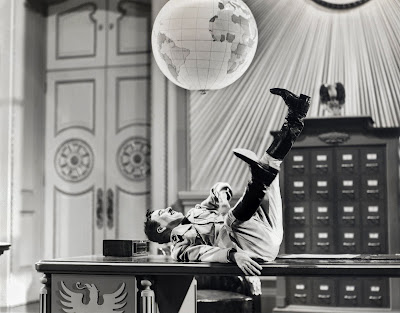 Released during the early days of World War II at a time when America remained stridently isolationist, Chaplin's spoof of Tramp-lookalike Adolf Hitler was also a commercially-risky exposé revealing the antisemitism at the heart of the Nazi regime. Overlong and a wee bit earnest for my tastes, Chaplin's first talkie nevertheless features some of his most imaginative work, including an ethereal sequence where the dictator Adenoid Hynkel cavorts with a globe of the world.
The film ends with a five-minute speech promoting peace and universal brotherhood, ideas apparently abhorrent to anti-Communists who later booted Chaplin out of the country—a conflict that dominates the Broadway play's second act.
Available on DVD and Blu-Ray from the Criterion Collection.
 Every time in the past two weeks I mentioned that Katie-Bar-The-Door and I were going to New York to see a stageplay called Chaplin the Musical, I got the same reaction—wasn't Charlie Chaplin a silent film star?
Why yes, yes he was, and for my money, the greatest of them all.
But aside from the fact that he was himself a gifted composer and musician—"Smile," anyone?—Chaplin's comedy often played with the pace and rhythm of a melody, building simple movements into complex ones, anticipating some payoffs, denying others, going off in unexpected directions, finally returning to the beginning and starting something new.
 Far from being an odd choice, Chaplin is an inspired subject for a musical.
If you've seen any of his movies (or read this blog), you're already acquainted with Chaplin the artist. If you've seen, say, the 1992 Robert Downey Jr. bio-pic Chaplin, you know something of the man. His onscreen alter ego, the Tramp, is the single most famous character of the silent film era—perhaps of any era—and for decades, audiences the world over laughed at his comic battles against poverty, hard work and the soulless machinery of a hostile society, longing, I suspect, to achieve the in-it-but-not-of-it insouciance with which the Tramp met his daily suffering. Oh, to relish the taste of the boot you've boiled for your Thanksgiving dinner the way the Tramp did—there's Chaplin's appeal reduced to a single scene.
 The question in my mind was whether the Broadway play would focus primarily on Chaplin the artist or Chaplin the man. As a devoted fan of the former and largely indifferent to the latter (I can't help it: celebrity gossip bores me), I went in hoping for the best and fearing the worst.
As it turns out, Chaplin is a mixture of both, examining the man to explain the artist. In and of itself, that's not unusual. Most dramatizations of an artist's life—think Ray, Pollock and Walk the Line—attempt something similar. But Chaplin aspires to more than just a rehash of gossip with some imitations of well-known performances thrown in, and instead relies on songs, scenes from his movies, and occasional flights of visual fancy to reveal how Chaplin's memories influenced his art—and vice versa.
The play begins with an early scene of Chaplin's childhood lifted straight from his autobiography. As his mother, a music-hall singer, descends into the madness that left her institutionalized for the rest of her life, the young Chaplin, age five, took to the stage to rescue her from a booing audience. He was such a natural performer that, as he put it, "half-way through, a shower of money poured on to the stage ... I was quite at home."
 A career was born but Chaplin was unable to rescue his mother in the long term. She wound up in an asylum and he wound up in Hollywood, but in a sense—at least as Chaplin tells it—he never really left that London music-hall stage. Throughout the play, Chaplin is only half living in the present, and in his movies and in his private life, Chaplin relives that moment over and over again.
The memory drives him to his greatest successes an artist and his greatest failures as a man.
The play drives the point home with both its casting and its staging. For example, one-time Tony nominee Christiane Noll, who plays Chaplin's mother, also plays Edna Purviance in The Kid and Paulette Goddard in The Great Dictator—two characters the Tramp struggles to rescue—while Zachary Unger plays both the young Chaplin and Chaplin's Kid co-star, child actor Jackie Coogan.
This isn't just a case of doubling up to save a bit of money. While filming the pivotal scene from The Kid—when a callous orphanage official rips the kid from the Tramp's arms—Unger morphs from Jackie Coogan into the young Chaplin and back again, as Chaplin the man forces himself to revisit his own childhood in order for Chaplin the artist to achieve the result he wants.
Yet later when Chaplin again remembers his childhood, it is the filmed clip from The Kid that plays on a large screen over the stage rather than the real life moment—a metaphor for how the memory becomes art and the art then supplants the memory.
Or to put it another way: how often has a song on the radio evoked the emotion of a time long past when the specific event has faded from memory?
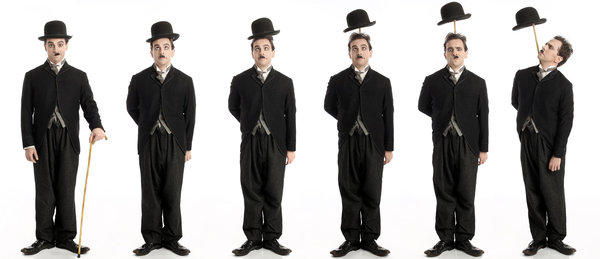
 Eventually, as it does for all great artists, Chaplin's creation takes on a life of its own, and Chaplin the man winds up performing with a chorus line of Tramp look-a-likes doing the dance of the dinner rolls from The Gold Rush.
For me, as a fan of Chaplin the artist, this is when the play is most interesting—and the most ambitious in its staging.
Given that Chaplin was a silent film star working exclusively in black-and-white, the costumes are appropriately muted shades of black, white and gray—which meant that the rare splashes of color, primarily red hair and red roses, really pop, not only visually but thematically as well.
It's no accident, I'm sure, that Chaplin's mother and his one great love, Oona O'Neill, are both played by redheads (the aforementioned Christiane Noll and Erin Mackey, respectively). And the red rose that passes from Chaplin's mother to the lapel of the Tramp's coat transforms from a symbol of loss to a symbol of love when by the play's end it finally passes from Oona back to Chaplin again.
 The second half of Chaplin the Musical focuses on Chaplin's life after the Tramp. In case you're somehow not aware of it, the 1940s and '50s, when Chaplin's career went into decline, was an era when a charge of being a communist, a "fellow traveler" or even "soft" on communism could end a career. Chaplin himself lost his visa and wound up living in exile for twenty years, before returning to the U.S. in 1972 to receive an honorary Oscar.
(As an aside, I was going to write that the subjects of tabloid slander and political fanaticism seem especially timely now with another closely-divided election season upon us, but then I remembered that in America, the subject is always timely, for if you know your history, you know that, politically-speaking, once every decade or so, we Americans feel compelled to throw reason to the wind and eat our young.)
Focusing as it does on tidbits from Chaplin's conflicts with gossip columnists, crusading anti-Communists, indifferent audiences and his own ego, this part of the production is more conventional than its first half.
 Ironically, though, as Chaplin's staging and storytelling become more typically "Broadway," the songs and the acting get better. Rob McClure who plays Chaplin—more about him in a moment—is terrific throughout, but of the supporting cast, it's Jenn Colella who stands out. Her turn as the (in)famous Hedda Hopper—a nationally-syndicated scandalmonger whose reach in the Hollywood of the '40s and '50s makes today's TMZ look like halfwits with a Twitter account—had the audience ready to charge the stage, and if you remember one song from the show, it'll be her paean to petty revenge, "All Falls Down."
But the key to the show is Rob McClure as Chaplin.
 Creating a character based on a public person is so much more difficult than working from a blank slate. The actor is competing against the audience's memories of the person, and what they think they know of his story. When that public figure was also a multi-talented actor himself—well, no wonder people had been trying for thirty years without success to write a musical about Chaplin's life.
Re-creating Chaplin on stage is necessarily a three-tier process—first, imitating the gags; second, imitating Chaplin doing those gags; and third, finding your own comedy in the gags. The first requirement is obvious and the second is probably obvious as well, but the third is the difference between the note-perfect but stilted piano recital of a well-rehearsed amateur and music.
To play the title role, McClure didn't just have to look like Chaplin, he had to talk like Chaplin, walk like Chaplin—both on the ground and on a tightrope—play the violin, rollerskate, recreate the dance of the dinner rolls, fall down, throw a pie, spoof Hitler, again, all like Chaplin, and then after the imitation was perfected, make an audience care about the result.
 "You do all the kind of concrete work that you can do," Philip Seymour Hoffman said of preparing to play his Oscar-winning role in Capote, "the documentaries or the audio tapes or the visuals or what you read, you interview people. ... But ultimately ... it wasn't just imitation, it wasn’t just mimicry, it was creating a character. A real guy and it was trial and error."
The question isn't whether McClure is as funny as Chaplin—I mean, are you going to judge The Last Temptation of Christ on whether the actor can divide the loaves and fishes?—but whether he brought a character named "Chaplin" to life in this play on this stage. The answer to the question is a definite yes.
 Indeed, McClure's impression of Chaplin is so good I wish there had been more of it. Three-time Tony Award winner Thomas Meehan (Hairspray, The Producers, Annie) (book), Christopher Curtis (music, lyrics and book) and Warren Carlyle (director) dip into Chaplin's comedy from time to time as a basis for staging events in his life—the boxing sequence from City Lights to represent his three divorces, for example—but too often "tell" the audience that Chaplin was great rather than allowing McClure to "show" them.
Judging from those bits McClure was allowed to recreate, I think he could carry a longer sequence lifted from one of Chaplin's movies just to allow the audience a moment to laugh like they would have nearly a hundred years ago. But I'm not a producer or a Tony Award-winning playwright, so I'll freely admit I could well be talking through my hat.
Still, with a likeable hero, a catchy tune or two, and a couple of great performances, I'd call Chaplin the Musical a success, and well worth the effort the next time you're in New York.
Chaplin The Musical is in previews now at the Barrymore Theater in New York. It officially opens on September 10, 2012. You can check out the official site here.
 Postscript: To give credit where credit is due, it was Katie-Bar-The-Door who made the observation about the relationship between the costumes and the thematic significance of the occasional splashes of red. You'd think as a devoted fan of redheads I might have noticed that myself. Well, nobody's perfect.
 I sure hope so because you'll be getting one of the Monkey's patented two thousand word essays on the subject a week from today ...








 Posts
Posts

