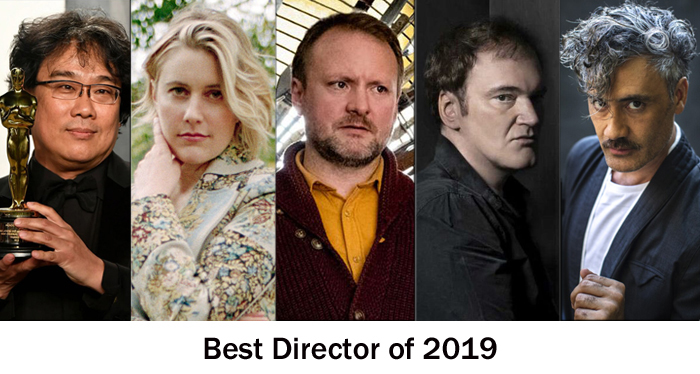
2019 was a strong year for movies led by three of my all-time favorites — Taika Waititi's Jojo Rabbit, a wildly-funny and deeply-moving comedy about a goofy ten year old Hitler Youth (and his imaginary pal, Adolf) who discovers the Jewish girl his mother is hiding in the attic and learns what it really means to be a Nazi; Little Women, Greta Gerwig's brilliant refashioning of the Louisa May Alcott classic; and Quentin Tarantino's last film to date, Once Upon a Time ... in Hollywood, a comedy about has-been actors and, sure, why not, the Manson family.
They were beautiful, funny, exciting ... and proof that Hollywood can make movies that are both wholly original works of genius and crowd-pleasing ticket-sellers.
You can rank them in whatever order you want.
And though this an alternate Oscar blog, for once the Academy's pick for best picture, Parasite — another wholly original crowd pleaser — is also a great movie. You can't go wrong there.
As for the rest, well, they're pretty great, too. The Avengers: Endgame, the final installment in the Avengers series, stuck the landing, and if Marvel had quit there, they would have gone out on top. Knives Out is a nifty whodunit comedy (I like its sequel, Glass Onion, even better). Ford v. Ferrari made me care deeply about a subject I really don't care about. 1917 is a taut action picture about World War I, one of the bloodiest and most meaningless armed conflicts in human history. And I love all John Wick movies.
Which leaves The Irishman by Martin Scorsese. Definitely not my cup of tea but it made your top ten so here it is.
But you can only pick one, right?
After a lot of to-ing and fro-ing, I went with Little Women, not only my favorite film of the year but my pick as the best movie of the decade.
In case you haven't read the novel or seen any of its many film or TV adaptations, Little Women is the story of the March sisters (Jo, Amy, Meg and Beth, played here by, respectively, Saoirse Ronan, Florence Pugh, Emma Watson and Eliza Scanlen) who come of age in Concord, Massachusetts during the American Civil War. The novel opens on Christmas day and follows the girls as they mature into young women, experiencing along the way love, tragedy and loads of comic misadventures.
It's a beloved tale and its film adaptations — particularly the 1933 version starring Katharine Hepburn and 1994's with Winona Ryder — have been commercial and critical hits. But let's be honest, the plot has problems that not even Louisa May Alcott was able to solve and I confess I wasn't exactly tingling with anticipation when I heard Greta Gerwig was taking yet another crack at this old chestnut.
Boy, was I wrong.
Five minutes into it, I was sold on Gerwig's time-shifting storyline. Ten minutes later (and many years earlier) — when the young Jo and neighbor Laurie (Timothée Chalamet) dance outside on the porch at a fancy ball — I was exhilarated. And by the final scene, when ... well, I won't spoil it for you ... I felt in my bones that Greta Gerwig had finally licked the unsatisfying ending that plagued the original novel.
I watch it every time it shows up on cable.
Gerwig drew on Alcott's journals and letters to flesh out the screenplay and reveal the frustrations and desires that drove Alcott to write Little Women in the first place.
"Women, they have minds, and they have souls, as well as hearts," Jo March says at one point. "And they've got ambition, and they've got talent, as well as beauty. I'm so sick of people saying that love is all a woman is fit for. I'm just so sick of it!
"But — I am so lonely."
It's a recurring theme in Gerwig's work: what is the role of an ambitious woman in a society that only values her for one thing? It's not an idle question — this is the central issue driving politics and dividing people all over the world.
I won't say Greta Gerwig's leap from first-time director to one of the all-time greats is the fastest on record — Orson Welles did after all direct Citizen Kane his first time out of the box — but still, the progression from Lady Bird to Little Women to the billion-dollar Barbie is astonishing. At this point she could direct a movie about the phone book and I'd be in line to buy a ticket.
Little Women is currently playing on Hulu. Seriously, see it. Today. Highly recommended.
A note before you vote: Brad Pitt won a well-deserved best supporting actor award for his work in Once Upon a Time ... in Hollywood. But in watching the movie again, I see that he was definitely a co-lead with Leonardo DiCaprio. Not to mention, Pitt did very good work that same year in Ad Astra, an outer space retelling of Heart of Darkness. So I bumped him up to the lead category where he belongs.
We occasionally do things like that here at the Monkey ...
In his stead, I voted Tom Hanks his second alternate Oscar (to go with two real ones) for his turn as Mister Rogers in A Beautiful Day in the Neighborhood. Tom Hanks can play anything — an astronaut, a soldier, a dying AIDS patient, a thirteen year old kid, a castaway, the lead in a rom-com, a pilot, a ship's captain, an FBI agent, a hard-drinking ballplayer, Forrest Gump, and a children's TV host in sneakers and a cardigan — and make you believe it. Yet somehow he's strangely underrated. A great actor.
My choices are noted with a ★. A tie is indicated with a ✪. Historical Oscar winners are noted with a ✔. Best foreign-language picture winners are noted with an ƒ. Best animated feature winners are noted with an @. A historical winner who won in a different category is noted with a ✱.
Tom Hanks has been my generation's Jimmy Stewart for more than forty years now but it was his performance in 1988's Big, dancing with Robert Loggia on that giant piano, that earned Hanks his first Oscar nomination. Here at the Monkey, it earns him an alternate Oscar.
By the way, today is the fifteenth anniversary of the beginning of this blog. Don't know what that signifies other than my own stubborn irrelevance but I'm having a good time ...
My choices are noted with a ★. A tie is indicated with a ✪. Historical Oscar winners are noted with a ✔. Best foreign-language picture winners are noted with an ƒ. A historical winner who won in a different category is noted with a ✱.
(Let's stagger on home to the end of the least read series in Mythical Monkey history.)
Best Appearance in Movie Where the Dog Dies
I'm sure she means best appearance by an actor in a movie where the dog dies—like, say, the kid in Old Yeller or something—but I'm more interested in the dog itself, which means I get to write about my favorite movie dog of all time, "Dog" in John Wayne's Big Jake.
In case you've never seen Big Jake—and unless you're a John Wayne fan of a certain age, there's no real reason to think you would have—the Duke's Jacob McCandles has the best trained dog in history. He says "Dog!" and that means maul the bad guy with the machete, and then he says "Dog!" and that means knock the hostage off the horse before the sniper can shoot him, and sometimes he says "Dog!" and that means "heel" or "sit" or pretty much whatever else Big Jake might be thinking at the moment. Very impressive. John Wayne makes Cesar Millan look like a crazy cat lady.
Best Making Way Too Big a Deal About Playing a Gay Character
Generally speaking, gays have not fared well on the big screen. For the first fifty years of movie history, they were comic relief; in the fifty that followed, tragic figures. Perhaps in the next fifty, the movies will depict them as they are—everyday people who just happen to be attracted to the same rather than opposite sex.
Well, maybe when society itself views the matter that way.
In the meantime, to answer the question, I'm going with Tom Hanks in Philadelphia. The performance won him an Oscar but, to my mind anyway, it has not aged well. If the film had been made in, say, 1983, at a time when seemingly respectable people were still saying out loud that AIDS was a "gay problem" and thus of no concern to the "rest of us," perhaps righteous anger alone might still carry the otherwise hackneyed storyline. But by 1993, the year of Philadelphia's release, we had all pretty much agreed—at least as a matter of public policy—both that AIDS was a national problem and that gays were people, too (well, you know, as long as they didn't want to marry or serve in the military or take part in any of the many other workaday activities that heterosexuals take for granted and gays couldn't and in many places still can't). Instead what seemed at the time brave and heart-rending has been revealed as what it always was: timid and cliched.
Unfortunately, that's almost always the case when Hollywood tackles anything even remotely controversial. Mainstream movies cost so much to make that no one is willing is write a check without at least some hope that they'll get their investment back, and to make something truly controversial is to run the risk of whittling your potential audience down to the point where a profit is no longer possible. And if there's one thing Hollywood is not, it's a philanthropic enterprise. So the people in charge wait until it's clear which way the wind is blowing, and then serve up a product, like Philadelphia, that is so bland and smugly certain of itself that what you hear at the end is not applause but the audience patting itself on the back.
There's more emotional power in one AIDS quilt than in this entire movie.
Best Acting on a Boat
If you've never seen Buster Keaton in The Navigator, you're in for a real treat. Released the same year as the better-known Sherlock, Jr., I think The Navigator is the funnier movie, one of Keaton's best.
Best Acting in Sandals
I assume this doesn't mean Katharine Hepburn in a pair of high heel sandals, but instead "sword and sandals" or "Shakespeare" or "Spartacus" or anything with men in togas. Now, I'm not 100% sure what he had on his feet during the "Toga Party" sequence, but I am sure that I'd rather watch John Belushi in Animal House than Marlon Brando in Julius Caesar, Laurence Olivier in Spartacus or Russell Crowe in Gladiator.
Best Performance in a Movie Parents Liked
I can't speak for parents in general, but the people who conceived, birthed and raised me were big fans of the movies and believed that there were certain films you had to see in order to be considered literate. Thus, they introduced me not just to Disney and the usual child-friendly suspects but to the Marx Brothers, Cary Grant, Gone with the Wind and a lot of other stuff, too. The best performance in a movie my parents liked enough to make me see? Jeepers. Let's go with the aforementioned Cary Grant in His Girl Friday, one of the funniest movies he ever did and one of the few movies of its era to suggest that a woman's place is not in the kitchen but in the office, if it turns out that's the work she was born for.
That's it. We're done. Be sure to come back Sunday morning to start voting in the Favorite Classic Movie Actress Tournament.
A great year for Japanese anime. In fact, I think the two best pictures of the year were both animated features from Japan—Grave of the Fireflies, Isao Takahata's wrenching story of a brother and sister orphaned by the Allies' relentless fire bombing at the tail end of World War II; and on the other end of the emotional spectrum, Hayao Miyazaki's My Neighbor Totoro, a magical tale about a girl and her not-so-imaginary imaginary friend.
If you don't know Miyazaki's work, you've really shortchanged yourself. His film Spirited Away deservedly won the first Oscar for best animated feature back when that category was introduced in 2002. In addition to Totoro and Spirited Away, check out any of the following: Princess Mononoke, Howl's Moving Castle, Nausicaä of the Valley of the Wind, Porco Rosso, Ponyo ... actually, it's a pretty long list. You really can't go wrong with any Miyazaki.
It was also a great year for comedy—we got Bull Durham, Who Framed Roger Rabbit, Beetlejuice, The Naked Gun, Big and my pick, A Fish Called Wanda. All of them are better than any film I have penciled in for best drama.
PICTURE (Drama) winner:Dangerous Liaisons (prod. Norma Heyman and Hank Moonjean)
PICTURE (Comedy/Musical) winner:A Fish Called Wanda (prod. Michael Shamberg)
Named for Katie-Bar-The-Door, the Katies are "alternate Oscars"—who should have been nominated, who should have won—but really they're just an excuse to write a history of the movies from the Silent Era to the present day.
To see a list of nominees and winners by decade, as well as links to my essays about them, click the highlighted links:
Remember: There are no wrong answers, only movies you haven't seen yet.
The Silent Oscars
And don't forget to check out the Silent Oscars—my year-by-year choices for best picture, director and all four acting categories for the pre-Oscar years, 1902-1927.
Look at me—Joe College, with a touch of arthritis. Are my eyes really brown? Uh, no, they're green. Would we have the nerve to dive into the icy water and save a person from drowning? That's a key question. I, of course, can't swim, so I never have to face it. Say, haven't you anything better to do than to keep popping in here early every morning and asking a lot of fool questions?











 Posts
Posts

