skip to main |
skip to sidebar
 The Monkey has been tagged as the next participant in what is being called "The Ten: Best Actresses of All Time Relay Race." Also known as "the meme with an oddly-placed colon in the middle." The idea being this: that the blog master at My Film Views came up with a list of those actresses he (and/or she, I'm not sure which) feels are the ten best ever.
 And then he tags some other blogger and says "take one name off the list and add one of your own and pass it on." Forever. Research reveals that this list originally started in 1927 and included such names as Sarah Bernhardt and Nefertiti.
Anyway, Natalie over at In The Mood has passed the baton on to me. Natalie, who is co-hosting the Great Recasting Blogathon on July 27-28, is currently responsible for my latest obsession, which is making posters for silent era "pre-makes" of post-1966 movies. I've done twenty-two so far, plus written a separate 1000+ word essay about a twenty-third movie.
 The good news is that as a result, I've really crawled inside Photoshop Elements and learned a lot. The bad news is that the human race will one day vanish from the universe like a soap bubble and I'll have done nothing much to stop that from happening.
Oh, well.
The list is currently as follows: 1.Barbara Stanwyck 2.Ingrid Bergman 3.Isabelle Huppert 4.Joan Crawford 5.Juliette Binoche 6.Maggie Cheung 7.Katharine Hepburn 8.Meryl Streep 9.Lillian Gish 10.Olivia de Havilland.
Okay, five of those names would be on my top ten, and three more are at least vaguely defensible.
 Which leaves Juliette Binoche and Maggie Cheung on my "to be booted" list. Both are fine actresses to be sure. Both have multiple international acting awards. And Binoche has won as Oscar.
But neither has had much of an impact in this country—Cheung's best known film according to Imdb.com is Hero, Binoche's is probably The English Patient, although she's better in Three Colors: Blue—and call me a parochial xenophobe (which I'm not, but you can call me whatever you want) (especially now that comment moderation has been activated), but I think it's hard to make a claim for the title of one of the ten best actresses in history if you've never penetrated the mainstream consciousness of the American movie-going public.
 To me, best implies not just talent, but impact and longevity. Binoche and Cheung have talent, and they've been around a while, but neither has had the impact necessary to qualify as great.
On the basis of having at least won an Academy Award, I'll let Binoche skate. Thus, so long Maggie Cheung. We hardly knew you. Which is the problem.
To be replaced by Bette Davis. Two-time Oscar winner. Kicked down doors in Hollywood that lots of actresses later filed through. Not to mention a song about her eyes was once a huge hit. That's good enough for me. Can't believe she wasn't on this list to begin with.
 So now I'm handing this on to the guy who invented the March Madness Best Actress Tournament and let me join in the fun this year, Monty at All Good Things. Take it away, Monty, if you feel up to it.
 Just to let you know, the blog has been getting spammed a lot recently, and not the good kind like Monty Python serves up. So I'll be approving comments in advance for a while at least.
Sorry for the inconvenience.
Love and kisses,
the Mythical Monkey
 The results are in from the latest Monkey poll. By a one vote margin, Charlie Chaplin's The Circus is your favorite movie set in a circus.
The Elephant Man was second, Disney's animated classic Dumbo was third, and Tod Browning's cult classic Freaks was fourth. The Greatest Show on Earth and the Marx Brother's At the Circus finished far behind.
 One commenter, however, "Anonymous," aka "my little brother," argues that the best circus movie of all time wasn't even in the poll: "I have a write-in candidate for greatest circus movie - "Big Top Bunny" - starring Bugs Bunny and Bruno, the high-flying trapeze artist bear - blessed with the gift of speech (with a Russian accent no less). Now THAT's quality my friends...."
As always, we here at the Monkey encourage you to judge for yourself:
Indeed, if you really want to judge for yourself, Erik Beck (of the Boston Becks) has alerted us to Turner Classic Movie's Sunday evening schedule which is devoted to circus-related movies. TCM kicks off the proceedings with none other than the Chaplin film that won our little poll.
From TCM's website:
Sunday, July 24, 2012
8:00 PM The Circus (1928)
In this silent film, the Little Tramp joins a circus to hide from the police.
Dir: Charles Chaplin Cast: Charles Chaplin, Merna Kennedy, Betty Morrissey. BW-72 mins
9:30 PM The Big Circus (1959)
A ringleader tries to keep his circus on the road despite the efforts of a saboteur.
Dir: Joseph M. Newman Cast: Victor Mature, Red Buttons, Rhonda Fleming. C-108 mins
11:30 PM The Circus Clown (1934)
A young man defies his father's wishes to join the circus.
Dir: Ray Enright Cast: Joe E. Brown, Patricia Ellis, Dorothy Burgess. BW-65 mins
12:45 AM Laugh, Clown, Laugh (1928)
In this silent film, a circus clown falls for a young innocent in love with another.
Dir: Herbert Brenon Cast: Lon Chaney, Bernard Siegel, Loretta Young. BW-74 mins
2:15 AM La Strada (1954)
A traveling strongman buys a peasant girl to be his wife and co-star.
Dir: Federico Fellini Cast: Anthony Quinn, Giulietta Masina, Richard Basehart. BW-108 mins
4:15 AM Merry Andrew (1958)
An archaeologist's search for Roman treasure gets him mixed up with a circus troupe.
Dir: Michael Kidd Cast: Danny Kaye, Pier Angeli, Baccaloni. C-103 mins Letterbox Format
 The three I'd really encourage you to see are The Circus, Laugh, Clown, Laugh and La Strada, classics all. Hey, and now that Mad Men is done for the season, you have no excuses, right?
 Not only is Bryce Harper quite possibly the greatest nineteen year old to ever play major league baseball (his current "On-base-plus-slugging" percentage of .938 would best Mel Ott's .921 if it holds up), but he also has gone viral with the best answer to a genuinely (and purposely provocative) stupid question in, well, a long, long time:
"That's a clown question, bro."
As they say: there are no stupid questions, only stupid people who ask questions. Which leads me to (nervously) ask, "Of these randomly selected movies set in a circus, which is your favorite?"
Your choices:
The Circus (1928)
 Freaks (1932)
 At The Circus (1939)
 Dumbo (1941)
 The Greatest Show On Earth (1952)
 The Elephant Man (1980)
 Yeah, yeah, I left off your favorite—Laugh, Clown, Laugh or La Strada or Big Top Pee-Wee. And I wanted to vote for Abraham Lincoln this November. Ain't gonna happen. I encourage you to vote anyway.
 Apropos of nothing: while researching a project unrelated to this blog, I read up on Lily Langtry ("Lillie" in Britain, usually; "Lily" in America), and without giving her the full-blown Monkey treatment, here's a bit of what I learned:
Born in 1853 the daughter of a disgraced Anglican minister, Emilie Charlotte Le Breton married the wealthy Irish landowner Edward Langtry at the age of twenty and entered London society after sitting for a portrait for painter Frank Miles.
 "I would rather have discovered Lillie Langtry than America," said Oscar Wilde. "I resent Mrs Langtry," added George Bernard Shaw. "She has no right to be intelligent, daring and independent, as well as lovely."
Known as "the Jersey Lily"—the official flower of her home island of Jersey—Langtry came to the attention of the Prince of Wales. "Bertie" to his friends, later King Edward VII, the Prince was overly fond of married women and made Langtry his unofficial official mistress, appearing publicly with her at Ascot and the theater, going so far as to introduce her to Queen Victoria.
Encouraged by the legendary actress Sarah Bernhardt, Langtry cashed in on her notoriety and launched a stage career. Although the critics were savage—"There was no denying it," wrote one, "Mrs. Langtry's legs were a total failure"—the public loved her. She toured America several times and acted more or less continuously until her retirement in 1915. Langtry made one movie, His Neighbors Wife, in 1913 (presumed lost).
 Langtry was apparently so beautiful, the notorious Judge Roy Bean fell in love with a picture of her, naming his saloon the Jersey Lily. "The purtiest woman in the world," he said.
 She and the Prince of Wales eventually had a falling out, according to legend because she dropped a piece of ice down the back of his shirt, but more likely because he couldn't afford her extravagant tastes. "I've spent enough on you to build a battleship," he once complained. "And you've spent enough in me," she allegedly replied, "to float one."
After that, Langtry broke a series of hearts. She became pregnant in 1880 and though it's unclear who the father was—although it certainly was not Edward Langtry—she convinced Prince Louis of Battenberg he was the father. Upon hearing the news, the queen had him assigned to the warship H.M.S. Inconstant. The royal family paid Langtry off and she moved to Paris with yet another man and gave birth to a daughter, Jeanne Marie.
Langtry eventually divorced and remarried, became an American citizen, invested in race horses and wineries, and settled in Monaco, living in a house a discreet distance from her husband, Sir Hugo Gerald de Bathe.
 As the man sang in the song, Lily died in 1929, but she still crops up periodically in the culture, most famously as played by Lillian Bond in the 1940 Oscar-winning film The Westerner. In addition, Ava Gardner played her in The Life and Times of Judge Roy Bean in 1972 and Stacy Haiduk portrayed her as the "immortal leader of a sect of vampires" in the, presumably, fictional 1996 television series, Kindred: The Embraced.
 Unsubstantiated are claims that Sir Arthur Conan Doyle based the character Irene Adler ("A Scandal in Bohemia") on Langtry, and that she inspired the Who's 1967 single "Pictures of Lily" about a teenage boy who, well, whatever to the pictures of Lily hanging on his bedroom wall. You can't prove it by me one way or the other. Sounds plausible, though.
Wait, what did I say about not giving her the full Monkey treatment?
 As has been the case with nearly every technical innovation in the visual arts since the first man painted pictures on a cave wall, sex proved to be a key selling point in the marketing of the new motion picture technology to curious audiences. In 1896, just six years after Thomas Edison began his experiments with film, William Heise recorded May Irwin and John C. Rice recreating the kiss from their Broadway hit, The Widow Jones.
The resulting twenty second clip—called, appropriately enough, The Kiss—was the first such act ever recorded on film. The moralizing classes reacted with outraged spluttering; the paying public made it Edison's top grossing film of the year.
 Other filmmakers quickly scrambled to sell their own take on this most important of human endeavors, as the resulting efforts serve as something of a Rorschach test for directors, writers, actors and the audiences themselves. Georges Méliès, for example, chose to titillate his audiences with suggestions of nudity. Russian, Italian, Swedish and Dutch directors offered up sex as a source of tragedy and misery. America's greatest director, D.W. Griffith, moralized, while his comic counterpart, Mack Sennett, guffawed. That Theda Bara—whose name was famously billed as an anagram of "Arab Death"—wound up representing both the allure and the danger of sex in the late 1910s tells you all you need to know about the state of the American psyche during the first world war.
But sex as something adults engage in without shame or embarrassment—well, not so much. We tend to assume, when think of it at all, that sophisticated sex in the cinema must have been the invention of Ernst Lubitsch. And while it's true Lubitsch was a master of the light touch when it came to the subject, he didn't really acquire that touch until 1924, with The Marriage Circle. Before that, he tended toward heavy costume dramas and broad farces.
 Instead, the sophisticated sex movie was a creation from the most unlikely of sources—cinema's most famous purveyor of Bible epics and historical dramas, Cecil Blount DeMille.
Some of my readers—those reared on The Ten Commandments and The Greatest Show On Earth—might guffaw to read his name in the same sentence with "sophisticated" and "sex," but the fact is, beginning in 1918 with Old Wives For New, DeMille reeled off a series of "nervously brilliant, intimate melodramas" and "sly marital comedies" (Scott Eyman, Empire of Dreams) centering on the notion that grown ups engage in sexual relations and are glad that they do.
The son of a playwright and an acting teacher, DeMille began acting in New York at the age of nineteen and in little more than a decade became a successful Broadway director and producer. He also wrote several one-act operettas for producer Jesse L. Lasky and it was this association that led him into motion pictures. Lasky aspired to combine what he saw as the "high art" of theater with the money-making potential of mass-produced movies, and with the reluctant financial backing of his brother-in-law, Samuel Goldfish (later Goldwyn), Lasky teamed up with DeMille to found the Jesse L. Lasky Feature Film Company.
 It was a grandiose gesture considering that neither man had ever made so much as a one-reel short before, but the two set off for the western United States to film a feature-length version of The Squaw Man, a popular stage play of the era. The two stopped first in Flagstaff, Arizona, but DeMille pictured wide open spaces rather than mountains for the wild west storyline, so they continued west until they settled in a sleepy village north of Los Angeles called "Hollywood."
Legend has it that they set up shop in a barn, but legend neglects to mention that L.L. Burns and Harry Reiver, a couple of established filmmakers with American Gaumont, had converted the barn into a studio nine months earlier. No matter. The Squaw Man was the first feature film ever made in Hollywood, and when it grossed $244,000 on an investment of $15,000, DeMille's future was assured.
 Although DeMille's education as a film director consisted of a day spent at the Edison studios to see how the cameras worked, and watching Oscar Apfel "co"-direct The Squaw Man, he quickly demonstrated a grasp of the film medium superior to all but a few of his peers. In his biography Cecil B. DeMille's Hollywood, Robert S. Birchard notes that within a half-dozen movies of his first one, DeMille had moved the camera closer to his actors, "showing a greater reliance on personality and subtlety of performance," had picked up the pace of both individual scenes and his films as a whole, and, by using light and shadow in a groundbreaking way to accent (or obscure) aspects of the production, "set a much-imitated standard for visual excellence."
I n all, DeMille directed thirty-seven movies between 1914 and early 1918, dipping into a variety of genres including Westerns, costume dramas and even a pair of Mary Pickford movies. The best of these early films was The Cheat, made in 1915 and featuring Sessue Hayakawa in a star-making role as an unscrupulous businessman who barters money for sex from a spoiled housewife and then brands her with an iron when she reneges on the deal.
As Simon Louvish notes in his biography Cecil B. DeMille: A Life in Art, The Cheat "electrified audiences, who were not accustomed to this degree of emotion in a tale dealing with rampant sexual desire ...."
 These early films demonstrated DeMille's interest in melodrama, spectacle and lurid romance, which perhaps explains his interest in the subject of his thirty-eighth film, a popular novel called Old Wives For New (available free online here). Business partner Jesse Lasky pushed this story of a marriage that disintegrates in boredom, adultery and divorce to get DeMille "away from the spectacle stuff for one or two pictures and try to do modern stories of great human interest."
And since Lasky was the one footing the bill, DeMille chose to follow his advice. The studio bought the film rights for $6,500.
 Although the novel's author, David Graham Phillips, was a pretty interesting character in his own right—a muckraking journalist who exposed the nexus between corporate money and the U.S. Senate, he was murdered by a man who believed Phillips had libeled his family—the novel itself was 495 pages of "clover" and "heaving bosoms," turning a tale that included adultery, murder, blackmail and skullduggery into something earnest and flowery and dull.
To adapt the novel, DeMille turned to his favorite writer—and favorite mistress—Jeanie Macpherson. During their long sexual and professional relationship, MacPherson worked on forty screenplays for DeMille, including such silent classics as The Cheat, Joan the Woman, Male and Female, The Affairs of Anatol, The Ten Commandments and The King of Kings.
 To condense the sprawling tale, Macpherson reduced an episodic narrative spread out over decades into three tight acts with a single flashback to explain how the bored husband had ever fallen for his plump, drab, dowdy wife in the first place. She also added witty intertitles that transformed the melodrama into a sharp satire of upper-class manners.
As the film begins, oil baron Charles Murdock (Elliott Dexter) is on the verge of what we now call a mid-life crisis. While he's respected as a "genius" in the world of business, at home he's little more than a cipher—a human ATM machine to his kids, a nursemaid to his hypochondriac wife. He sits alone in his study, dejected, depressed, with only his dog for companionship.
 Next, DeMille introduces us in shotgun fashion to the five supporting characters who will combine to remake Murdock's life—Sylvia Ashton as his not-so-pleasingly plump wife; Marcia Manon as a "painted lady;" Florence Vidor as Juliette Raeburn, a successful New York dressmaker, who, according to the intertitles, "was finally to cut the thread of his fate;" and two of the finest character actors of the silent era, Gustav von Seyffertitz as his "crafty" secretary; and Theodore Roberts as Murdock's dissolute business partner.
In each of these vignettes, DeMille shows a close-up of the character's hands—the wife picking through bon bons, the courtesan reaching for rouge—as if to say that a person is what he does not what he says, and no matter what he believes about himself or wants you to believe about him, his actions will always reveal his true character.
 After following Murdock through his frustrating morning routine, DeMille treats us to the most cleverly edited sequence of the film, a flashback to Murdock's initial courtship of his wife that cuts back and forth between the young couple and his present-day wife bursting in on her husband's reverie, as if she's catching them in flagrante delicto—a remarkable show of faith on DeMille's part that, even though the classical Hollywood "style" had only become the industry standard the year before, his audience would understand what's going on.
 Similarly, DeMille later uses lap dissolves and iris-shots-within-iris-shots to convey the content of Murdock's daydreams, trusting his audience to understand what he saying without spelling it out in clumsy intertitles or belabored scenes, a testament both to how quickly film had progressed in five years and how cutting edge DeMille really was. As a result, he's able to maintain a sprightly pace—and sweep past some of the story's more improbable twists.
Technical innovations aside, though, it was the substance of Old Wives For New that made the film so groundbreaking.
 The married Murdock meets Juliette, fools her into believing he's a much younger—and unattached—man, and falls in love with her. Attempting to drown both the memory of Juliette and the misery of his domestic situation, Murdock follows his business partner into the champagne-soaked fleshpots of New York City, an excursion that leads to murder, scandal and divorce (a sequence of events that must have reminded audiences in 1918 of Stanford White's murder during a musical revue on the roof of Madison Square Garden).
 In turning this set-up into a happy ending, DeMille essentially made a pre-Code film before there was a Code to subvert, dispensing with karma and moral judgment, and putting the fun back into sex, sin and every kind of bad behavior. People drink, lie, carouse and generally defy social mores, and not only suffer no consequences, they prosper. Murder goes unpunished, adultery is rewarded and divorce is presented as a sane and sophisticated solution to an unhappy marriage.
"In scene after scene," Birchard wrote, "Old Wives for New must have been startling for 1918 audiences." Photoplay condemned the film's "disgusting debauchery" and clucked that "Cecil B. DeMille, director, seemed to revel in the most immoral episodes."
 Adolph Zukor was so shocked by the film's suggestion that divorce might be the appropriate end for some marriages that he held up its distribution, only relenting after positive reactions during audience testing.
 Old Wives For New premiered on May 19, 1918, and Photoplay's sputtering outrage aside, the reviews were generally positive. "There are somewhat risqué situations in the story," The Motion Picture News wrote, "but these have been handled delicately. It is not a story that children will understand, and it is one that the prudes will consider a reflection on themselves. All in all, it is one of the most satisfactory pictures that has been shown on Broadway in months."
Variety praised DeMille's direction as "expert."
Financially, the picture did well, grossing nearly $300,000 on a budget of $66,000, but its impact on the culture was even greater, ushering in an era of adult-themed movies, including not only DeMille's own risque classics Male and Female and The Affairs of Anatol (adding Gloria Swanson to the mix), but also Chaplin's A Woman of Paris, Murnau's Sunrise and pretty much Lubitsch's entire oeuvre.
"Those who find it fashionable to denigrate [DeMille]," wrote Gene Ringgold and DeWitt Boden in The Films of Cecil B. DeMille, "ignore the high regard in which his work as a director was held by critics and film historians during those first years ... Among directors, only his name and those of D.W. Griffith and Alfred Hitchcock were really sufficient in themselves to attract top box-office trade."
 Maybe in the long run, DeMille's primary contribution was in figuring out how to sell sex to American audiences that were both curious and squeamish. Here, he hit it directly; later he dressed it up in historical and Biblical epics that allowed his audiences to piously condemned the sin while lingering over every salacious detail. He let the public have its cake and eat it too, and was rewarded with forty-two years of unbroken commercial success—one of the longest and most profitable careers in Hollywood history.
 His kind of films long ago went out of fashion, but don't kid yourself: DeMille was as instrumental during the silent era as Griffith and Chaplin in selling the habit of movie-going to American audiences, no small accomplishment.
 In case you're wondering why my review of Cecil B. DeMille's 1918 film Old Wives For New is taking so long, let me put it this way: I've polished up 1150 words so far and the next sentence starts "As the film opens ..."
Wordy or thorough? You decide ...
Anyway, I have to go cook dinner now.
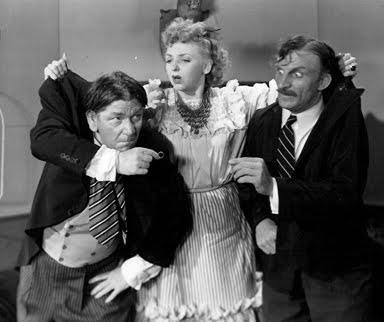 Blog pal Who Am Us Anyway said in a comment the other day "Now, it's a sad commentary on me—I mean, on people—but a compendium of Stooges bits followed by clips of their bits' origins might-could have the same effect the British blues bands had on 60s kids who otherwise might never have listened to Muddy Waters or Robert Johnson ..."
That is a great idea. And all it would require is a little effort on the part of yours truly. But as you can see, I've been making as little effort as possible recently, and there's a ballgame on at 1 p.m. to boot. So you'll have to wade through these unedited and draw your own conclusions.
 First up is Seven Chances, Buster Keaton's feature-length comedy in which the Great Stoneface must get married by the end of the day or lose a large inheritance. Hard on its heels are not one but two Three Stooges shorts, In the Sweet Pie and Pie (here it's three women who have to get married—to Moe, Larry and Curly) and Brideless Groom (a Shemp one where he's the one who must get married). That's six Stooges for the price of one!
Hold hands, you lovebirds!
Seven Chances (1925)
In The Sweet Pie and Pie (1941)
Brideless Groom (1947)
 This is my contribution to the Mary Pickford Blogathon, hosted by one of the Monkey's favorite bloggers, KC of Classic Movies.
Amarilly of Clothes-Line Alley was the second of five movies Mary Pickford made in 1918, and the first after the spectacular achievement of Stella Maris. Here, Pickford mines a familiar vein—the collision of the upper and lower classes told through the eyes of a spirited girl from the wrong side of the tracks—this time played mostly for comedy. Although not as iconic as Rebecca of Sunnybrook Farm or The Poor Little Rich Girl, Amarilly of Clothes-Line Alley is a prime example of Pickford's lasting appeal.
 Adapted from Belle K. Miniates's novel by Pickford's friend and favorite screenwriter, the legendary Frances Marion, Amarilly of Clothes-Line Alley is the story of Amarilly Jenkins, "a debutante" of the tenement slum known as "Clothes Line Alley." To support her brothers and sisters, Amarilly takes a job selling cigarettes in a dive bar and winds up falling for a rich, handsome swell out slumming with his rich, handsome pals. The comedy turns on Amarilly's battles with his snobbish family, with our Mary getting the best of them before finally realizing what she really wants in life.
Throughout her career, Pickford excelled at light comedy and Amarilly is no exception, turning a ride on the back of a motorcycle, a tumble through a doorway on the threshold of her first kiss, and her enthusiasm for a barroom brawl into nice bits of humor. But it was mostly her bright, searching eyes, her shy, knowing smile, and, above all, her plucky, indomitable spirit that made her so adorable. In fact, if one word could sum up Pickford's extraordinary appeal during the era, "plucky" would be it.
 As you might expect from a film written by Marion, the social observations are tart and biting without overwhelming the comedy. The rich are alternately portrayed as stuffy, lifeless bores and perfumed, pampered bums. Amarilly's love interest (Norman Kerry) is an effete drunk who ducks his work and his family with equal abandon. His best friend is a deadbeat trust fund baby who hogs the guest room and never picks up a check. And his mother is a pompous dowager who founds a charity that actively despises the objects of its care.
The resulting study of American social mobility is more Pygmalion than Cinderella and ends with a twist that thumbs its nose at both literary conventions. I quite can't tell if the film's politics are progressive or reactionary—maybe a bit of both—but no matter: Amarilly's happiness is the only item on the bipartisan agenda.
 To direct Amarilly, Pickford chose Marshall Neilan, who had overseen the hugely successful Stella Maris. This time around, Neilan required none of the special effects or camera tricks that made Pickford's dual role in Stella Maris possible, but his direction is a solid example of the classical Hollywood style then emerging. The pacing is nimble and assured, the acting solid, and the camera work as light on its feet as the story itself.
One shot in particular, that of Amarilly's steady boyfriend finding the new guy's top hat on the landing outside her door—when compared with, say, Mack Sennett's rather obvious and by then painfully dated park bench sex comedies—shows just how far the movies had come in the space of a couple of years.
 Look also for the way Neilan composes shots contrasting the worlds of the wealthy and the poor. In the former, Amarilly's beau is lost in vast expanses of sterile marble; in the latter, Amarilly's loving family is tucked into a warm, snug room. Neilan further underscores the divide by often framing Amarilly standing in doorways and perched on window sills, literally and symbolically straddling two worlds. Neilan's notions about poverty may be sentimental, but he's making his argument visually, cinematically, rather than spelling everything out with clumsy intertitles.
Despite the chronic alcoholism that made him unreliable and eventually ended his career, Pickford adored Neilan. "[T]o my way of thinking, he was the best director ever, better than the great D.W. Griffith."
 The admiration was mutual. "She has something," Neilan said, "that irrespective of looks or age or anything else, will live on. She has personality."
Amarilly of Clothes-Line Alley premiered on March 11, 1918, and to the surprise of no one, became one of the biggest hits of the year.
 "Mary Pickford," wrote Motion Picture Magazine, "has gone to an entirely different well of characterization for Amarilly and drawn up as full a pitcher of success as in the renowned Stella Maris."
After Amarilly, Pickford continued to play plucky young girls in films such as Daddy-Long-Legs, Pollyanna, Tess of the Storm Country and Sparrows. The range of her roles was narrow and often fit the star like a straightjacket. "I'm sick of Cinderella parts," she once admitted, "of wearing rags and tatters. I want to wear smart clothes and play the lover." But fed-up or not, Pickford was not one to trifle with the expectations of a fan base that had made her the most powerful woman in the history of Hollywood.
 "I am a servant of the people," she said, "and I have never forgotten that."
Only after the advent of sound made further little girl roles impossible did Pickford finally abandon the "Little Mary" persona for good. And as she feared, her audience abandoned her as well.

 The Monkey has been tagged as the next participant in what is being called "The Ten: Best Actresses of All Time Relay Race." Also known as "the meme with an oddly-placed colon in the middle." The idea being this: that the blog master at My Film Views came up with a list of those actresses he (and/or she, I'm not sure which) feels are the ten best ever.
 And then he tags some other blogger and says "take one name off the list and add one of your own and pass it on." Forever. Research reveals that this list originally started in 1927 and included such names as Sarah Bernhardt and Nefertiti.
 The good news is that as a result, I've really crawled inside Photoshop Elements and learned a lot. The bad news is that the human race will one day vanish from the universe like a soap bubble and I'll have done nothing much to stop that from happening.
 Which leaves Juliette Binoche and Maggie Cheung on my "to be booted" list. Both are fine actresses to be sure. Both have multiple international acting awards. And Binoche has won as Oscar.
 To me, best implies not just talent, but impact and longevity. Binoche and Cheung have talent, and they've been around a while, but neither has had the impact necessary to qualify as great.
 So now I'm handing this on to the guy who invented the March Madness Best Actress Tournament and let me join in the fun this year, Monty at All Good Things. Take it away, Monty, if you feel up to it.







 Posts
Posts

