Joan Crawford was a complicated woman—which is to say that like all of us, she had her good points and her bad points. She was catty and cruel, she was uneducated and insecure about it, she had the morals of an alley cat and her failures as a mother are legendary. But she also had a tremendous work ethic, always tried to improve herself, and as far as I can tell, she never phoned in a performance, not even in the execrable sci-fi horror flick, Trog, which proved to be her last.
And she was always willing to take a shot at Norma Shearer, which is a plus all by itself.
A lot has been written over the years about Joan Crawford's private life, particularly with regard to her sexuality and her parenting skills, so much so that the scandals have completely obscured her work as an actress. But if I were handing out awards based on people's private lives, we'd wind up with a roster full of nice people and very few good movies. Only to the extent that I can discern a clear relationship between a person's off-screen life and their on-screen work will I tend to dwell on the former. Beyond that, celebrity gossip bores me. In fact, as far as I can tell, when they're not working, most celebrities are actually pretty dull people.
Besides, in his biography Possessed: The Life of Joan Crawford, Donald Spoto states flatly that the infamous "No wire hangers!" incident never happened. But then a lot of famous incidents never happened—J. Edgar Hoover didn't wear dresses, Walt Disney wasn't cryogenically frozen, and the military-industrial complex didn't assassinate John F. Kennedy.
Fans of the novel might be tempted to complain that Hollywood sanitized and simplified James M. Cain's original vision. But let's face it, no novel ending with the line "Let's get stinko" was going to make it to the big screen intact in 1945. Besides, the final product is plenty violent for all but the most bloodthirsty among us and as cynical about human behavior as the darkest film noir. Mildred Pierce isn't a perfect movie, just a great one and Crawford gave her best performance in it.
What else do you need to know. Anchors Aweigh is the one where Gene Kelly dances with Jerry the Mouse, The Naughty Nineties is the one with the most complete (and best) version of Abbott and Costello's "Who's On First?" routine. And Children of Paradise is considered by many to be the best movie France has ever produced.
Have at it.
PICTURE (Drama) winner:Brief Encounter (prod. Noel Coward) nominees:And Then There Were None (prod. René Clair); Detour (prod. Leon Fromkess); The Lost Weekend (prod. Charles Brackett); Mildred Pierce (prod. Jerry Wald); The Southerner (prod. Robert Hakim and David L. Loew); They Were Expendable (prod. John Ford); A Tree Grows In Brooklyn (prod. Louis D. Lighton)
PICTURE (Comedy/Musical) winner:Anchors Aweigh (prod. Joe Pasternak) nominees:Blithe Spirit (prod. Noel Coward); I Know Where I'm Going! (prod. Michael Powell and Emeric Pressburger)
PICTURE (Foreign Language) winner:Les enfants du paradis (Children Of Paradise) (prod.Raymond Borderie and Fred Orain) nominees:Roma, città aperta (Rome, Open City) (prod. Giuseppe Amato, Ferruccio De Martino and Roberto Rossellini)
ACTOR (Drama) winner: Ray Milland (The Lost Weekend) nominees: Jean-Louis Barrault (Les enfants du paradis a.k.a. Children Of Paradise); Trevor Howard (Brief Encounter); James Mason (The Seventh Veil); Robert Montgomery (They Were Expendable); Edward G. Robinson (Scarlet Street)
ACTOR (Comedy/Musical) winner: Bud Abbott and Lou Costello (The Naughty Nineties) nominees: Rex Harrison (Blithe Spirit); Gene Kelly (Anchors Aweigh); Roger Livesey (I Know Where I'm Going!)
ACTRESS (Drama) winner: Joan Crawford (Mildred Pierce) nominees: Arletty (Les enfants du paradis a.k.a. Children Of Paradise); Joan Bennett (Scarlet Street); Peggy Anne Garner (A Tree Grows In Brooklyn); Celia Johnson (Brief Encounter); Anna Magnani (Roma, città aperta a.ka. Rome, Open City); Gene Tierney (Leave Her To Heaven)
ACTRESS (Comedy/Musical) winner: Wendy Hiller (I Know Where I'm Going!) nominees: Kay Hammond (Blithe Spirit); Barbara Stanwyck (Christmas In Connecticut)
DIRECTOR (Drama) winner: Marcel Carné (Les enfants du paradis a.k.a. Children Of Paradise) nominees: René Clair (And Then There Were None); Michael Curtiz (Mildred Pierce); John Ford (They Were Expendable); Elia Kazan (A Tree Grows In Brooklyn); Fritz Lang (Scarlet Street); David Lean (Brief Encounter); Jean Renoir (The Southerner); Billy Wilder (The Lost Weekend)
DIRECTOR (Comedy/Musical) winner: George Sidney (Anchors Aweigh) nominees: Michael Powell and Emeric Pressburger (I Know Where I'm Going!)
SUPPORTING ACTOR winner: Boris Karloff (The Body Snatcher) nominees: Jack Carson (Mildred Pierce); James Dunn (A Tree Grows In Brooklyn); Dan Duryea (Scarlet Street); Robert Mitchum (The Story Of G.I. Joe)
SUPPORTING ACTRESS winner: Margaret Rutherford (Blithe Spirit) nominees: Eve Arden (Mildred Pierce); Joan Blondell (A Tree Grows In Brooklyn); Ann Blyth (Mildred Pierce); Maria Casares (Les enfants du paradis a.k.a. Children of Paradise)
SCREENPLAY winner: Ted Slesinger and Frank Davis, from the novel by Betty Smith (A Tree Grows In Brooklyn) nominees: Anthony Havelock-Allan, David Lean and Ronald Neame; from a play by Noel Coward (Brief Encounter); Charles Brackett and Billy Wilder, from the novel by Charles R. Jackson (The Lost Weekend); Ranald MacDougall, from the novel by James M. Cain (Mildred Pierce); Frank Wead from a book by William L.White (They Were Expendable)
SPECIAL AWARDS Joseph H. August (They Were Expendable) (Cinematography); Val Lewton (Career Achievement Award)
I'm out of the office for a few days, so as Halloween approaches, I'm reposting some essays about classic horror films. I'll catch up on comments early next week.
I don't think I'm going out on much of a limb here to say that Frankenstein contains more iconic images than any other movie of the era, so many, in fact, I could probably name the scenes in order and you could skip the picture altogether—grave robbing, brain stealing, thunderstorms and monster making, "It's alive," the monster's first appearance, fire, the tragic death of the little girl, the villagers with torches and pitchforks. These scenes were so well established in our collective consciousness, in fact, that more than forty years later Mel Brooks and Gene Wilder could spoof it in Young Frankenstein without having to stop and explain anything to their audience.
What movie from 1967 (which like Frankenstein in 1974 is now forty-three years in our rearview mirror) could you spoof in a full-length feature without leaving your audience scratching its collective heads—The Graduate, maybe, but what fun would that be?
The story of a young scientist who soon regrets cracking the secret of creation had its genesis in the ghost stories nineteen year old Mary Wollstonecraft, her lover and soon to be husband Percy Shelley, and the poet Lord Byron told each other while vacationing together in Switzerland. In 1818, Wollstonecraft, now Mary Shelley, turned one of these stories, a combination of a nightmare she had about a lab experiment gone awry and conversations Shelley and Byron had about the origins of life, into her first novel, Frankenstein.
"Now I am become death, the destroyer of worlds," Robert Oppenheimer said to himself as he watched the first atomic bomb explode on the testing grounds of the New Mexico desert, and after the Second World War, a generations of science fiction writers made a cottage industry out of the question of whether we as human beings have the right to monkey around with things that before the advances of science had been the sole provence of God, and what moral culpability do we owe when our experiments go horribly awry—or worse, don't.
But Mary Shelley asked the question first and asked it so well that the phrase "Frankenstein's monster" has become shorthand for "unintended consequences."
The novel was an immediate sensation and spawned dozens of stage adaptations over the years. The earliest of these, Richard Peake's 1823 stageplay Presumption; or, the Fate of Frankenstein (read it here) introduced elements such as the elaborate creation scene, the mute monster and a lab assistant named Fritz that became as much a part of Frankenstein's literary tradition as the key elements of Shelley's original novel. Peggy Webling's 1927 stage version (credited as a source in the movie's titles) telescoped the time frame of the story, eliminated the Arctic chase that bookended the novel and, in the third act, added a bride for Frankenstein's monster which became the basis of the 1935 movie sequel. (Webling also, for the first time, named the monster itself "Frankenstein" after its creator.)
The success of Webling's stageplay caught the attention of Carl Laemmle, Jr., the head of production at Universal Studios and he bought the film rights for $20,000. The head of the studio, Carl Laemmle, Sr., wasn't keen to do Frankenstein, but Junior, who had been in charge of production since 1929, was enthusiastic and given the successes of All Quiet On The Western Front and Dracula, which he had previously produced, the father was inclined to give the son free reign. It was a good decision. The cycle of Universal horror movies that had begun with Lon Chaney during the silent era and which continues even to the present day with the studio's recent remake of The Wolfman, owes much to the enormous success of Frankenstein, which proved once and for all that the horror genre was viable box office.
James Whale, fresh off his successful screen adaptation of the play Waterloo Bridge, was slated to direct. For a man who had real reservations about the horror genre, he soon became its master—arguably the greatest director of horror in movie history.
In directing Frankenstein, Whale cast his gaze both to the past and to the future, drawing the movie's look from the German Expressionism of the 1920s—for example, in the graveyard sequence that opens the film—but using sound to generate fear and in the process, inventing many of the cliches of the horror genre we now take for granted. As British film historian David Thomson pointed out recently, Tod Browning's Dracula showed the potential that sound had for generating fear—"the wind in the trees, the wolves howling in the distance ... the women screaming in their sleep ... Lugosi's forbidding welcome, 'I am Drac-u-la'"—and then Whale took the ball and ran with it, giving us thunderstorms, shrieking laboratory equipment, groaning monsters, and a screaming Mae Clarke, that combine to keep the hair standing up on the back of our necks for an hour and ten minutes.
Although he began his career as a theater director, Whale took full advantage of the oppor- tunities film presented, using any number of techniques to distance Frankenstein from its literary and stage antecedents. In addition to the memorable use of sound effects, Whale abandoned the so-called proscenium arch—that is, the now long-forgotten habit of photographing a set from only one position, as if the camera had bought a ticket in the third row of a Broadway theater, that makes early sound movies feel so stagy—moving the camera around the room to get interesting angles, indeed, actually moving the camera, rather than leaving it bolted to the floor, such as for the long tracking shot of the father carrying his drowned daughter through the village square.
Whale also broke the rules of the early cinema with the introduction of Frankenstein's fiancee Elizabeth and the secondary character Victor. In this early scene, Whale shows us a series of quick close-ups and only then cuts to an establishing shot of the room, rather than the traditional approach which would have made clear where we were, that there were people in the room, and finally providing close-ups to introduce the characters, an effective bit of editing that further distances the film from the staginess of its contemporaries.
But the most effective sequence in the movie is the build-up to the introduction of the monster.
We're so familiar now with the look of Frankenstein's creation—the flat head, the hooded eyes, the bolts in his neck—that it's easy to forget that an audience in 1931 had no clear idea what the monster would look like and the final choice, which was critical to the movie's success, could have gone in any number of directions. The 1910 silent movie version of Frankenstein, a fifteen minute short which may have been the first horror movie ever made, presented the monster as a sort of Mr. Hyde to Frankenstein's Jekyll. On stage, the creature was a shaggy hunchback. And as conceived by the film's initial star, Bela Lugosi, the monster had a featureless face and wore a bushy fright wig. (Lugosi dropped out of the project shortly after the test footage was shot. Laemmle, Jr. thought Lugosi's choice of makeup, based on the clay monster in the 1920 silent film Der Golem was ridiculous and in any event Lugosi wasn't interested in playing a mute—and in the early versions of the script, wholly unsympathetic—monster.)
The monster as we know it was a collaboration between makeup expert Jack Pierce and the English actor chosen to replace Lugosi, Boris Karloff. Depending on who you believe, Whale cast Karloff (born William Henry Pratt) either after seeing Karloff brooding over lunch at the Universal commissary or at the suggestion of Whale's companion, David Lewis, who had seen Karloff in Howard Hawks's prison drama The Criminal Code. Either way, the choice was inspired. Karloff's tall, lean build (along with some very clunky shoes) allowed the monster to loom over the rest of the cast and Karloff accentuate his already thin features by removing a bridge of molars from the right side of his mouth and then sucking in his cheek. He also suggested the heavy eyelids made of wax that gave the creature a look of dim confusion.
"We had to surmise that brain after brain had been tried in that poor skull," Karloff said, "inserted and taken out again. That is why we built up the forehead to convey the impression of demoniacal surgery. Then we found the eyes were too bright, seemed too understanding, where dumb bewilderment was so essential. So I waxed my eyes to make them heavy, half-seeing."
It took three hours every day to put the makeup on and almost as long at the end of the day to take it off.
After an elaborate creation scene (Mary Shelley had summed up the entire creation sequence in a single paragraph) which Whale felt was essential to convincing the audience of the monster's reality, he then delays Karloff's first appearance until the moment just after Frankenstein learns for the first time that he's gifted his creation with a defective "criminal" brain (which along with the opening grave robbing scene was an addition of the screenplay). As Frankenstein (Colin Clive) and his colleague Dr. Waldman (Edward van Sloan) talk, we hear the sound of heavy footsteps coming up the stair—an early example of the role sound plays in horror—the characters at last react to the approaching footsteps and we know something important is about to happen. The door to the lab opens, the monster backs into the room, then turns, and at the speed of a tripping heartbeat, a pair of axial cuts—a jump cut directly along the line from the camera toward its subject—brings us eye to eye with the monster for the first time.
Thirty-one minutes into the picture, it's one of the greatest entrances in movie history, up there with that dolly shot that zooms in on John Wayne in 1939's Stagecoach.
Audiences of the time were completely sold. Frankenstein premiered on November 21, 1931, and immediately set box office records. Shot in thirty-five days at a cost of $291,000, Frankenstein grossed over $5 million in its initial run, despite hitting theaters at the depths of the Depression. The critical reception was just as enthusiastic and the movie made the New York Times top ten list for the year.
"Whale and I both saw the character of the monster as an innocent one," Karloff later said. "This was a pathetic creature who, like us all, had neither the wish nor the say in his creation, and certainly did not wish upon itself the hideous image which automatically terrified humans whom it tried to befriend."
And therein lies the lasting appeal of Mary Shelley's story, I think, and why we feel such empathy for the monster, because it dares to ask the question "Why, oh Lord, did you make us, as Frankenstein did his monster, so poor, so ugly and so ill-equipped to face a world that is so unforgiving of all but the rich, the beautiful and the talented?" It's a question many of us ask on a daily basis.
I've been re-reading Mary Shelley recently, and I think she was asking, albeit surreptitiously, a question even more fundamental than that of what duty scientists owe humanity, which is to say, What duty does the creator, i.e., God, owe his creation, us. That's a question religion doesn't usually ask; religions primarily concern themselves with the duties a man owes his god. To even ask the question the other way around (forget trying to formulate an answer) would have for centuries been to invite the stake as the penalty for blasphemy, and even in the nineteenth century such speculation meant financial ruin and social exile—afterall, Mary's own husband, Percy Shelley, was expelled from Oxford and became estranged from his family for touting atheism.
So I ask you, what duty does the creator owe his creation? Because let's face it, if I neglected my dog, say, the way God has neglected the earth, the SPCA would be on me so fast my head would swim.
But I digress.
Frankenstein was a huge hit but, of course, received no Oscar nominations. Admittedly, there were few technical awards in those days—no awards for special effects, costumes or makeup— but it was overlooked even in the categories of sound and set decoration, never mind screenplay, acting, directing and best picture.
And now for what I suspect is a key question for many: will Frankenstein scare you? Probably not, to be honest, but then again that depends on what scares you. I happened to catch a goodly chunk of some cable network's Saw marathon a few weekends ago (while Katie-Bar-The-Door was working ungodly hours keeping America safe for democracy) and to be honest with you, I wasn't just not scared, I was bored most of the time. For me, anyway, a good horror movie has to do more than simply test your gag reflex or your autonomic reactions to cats-jumping-out-of-closets kind of shocks, otherwise you might as well head on over to the supermarket and watch the butcher chop meat. Frankenstein is stylish, exciting, has a few genuinely disturbing moments, such as when the monster accidentally kills the little girl, and raises some fundamental questions about our role in the universe. For me, that's just about all I could ever want out of a horror movie—or any other kind of movie, for that matter.
Frankenstein is a fundamental building block, not just of movie literacy but of cultural literacy. Its look, its feel, its conventions and its concepts have so permeated the bedrock that even if you've never seen the 1931 version of Frankenstein, you've drunk from its well.
I'm out of the office for a few days, so as Halloween approaches, I'm reposting some essays about classic horror films. I'll catch up on comments early next week.
Although he directed all sorts of movies, including the musical Show Boat, the name James Whale will always be linked with horror. During an age characterized by great horror films, Whale directed four of the greatest—Frankenstein, The Old Dark House, The Invisible Man and Bride Of Frankenstein. If he didn't invent the genre, Whale redefined it so thoroughly that it's difficult, even now, to make a horror film without dipping into his bag of tricks.
Born in Worcestershire, England, in 1889, the son of a factory worker and a nurse, Whale discovered an interest in the theater while putting on productions for his fellow prisoners of war in a German POW camp during World War I. After the war, he worked as an actor and director in London, with his big break coming in 1928 when he directed Journey's End, R.C. Sherriff's anti-war play about life in the trenches. Starring Colin Clive, later the star of Frankenstein, the play ran on London's West End for two years and brought Whale to the attention of Hollywood. There, he directed a film version of Journey's End as well as an adaptation of Robert E. Sherwood's Waterloo Bridge, the latter starring Mae Clarke.
Seeking to cash in on the box office phenomenon of Dracula, the classic thriller about a vampire turned loose on Victorian England starring Bela Lugosi, Whale directed one of the most famous and influential movies ever made, a screen adaptation of Mary Shelley's horror novel Frankenstein. The story of a young scientist who soon regrets cracking the secret of creation, Frankenstein contains more iconic images than any other movie of the period and it made an international star of Boris Karloff, who was both menacing and sympathetic as the monster.
Although he began his career as a theater director, Whale took full advantage of the opportunities film presented, using any number of techniques to distance Frankenstein from its literary and stage antecedents. In addition to the memorable use of sound effects, Whale abandoned the so-called proscenium arch—that is, the now long-forgotten habit of photographing a set from only one position, as if the camera had bought a ticket in the third row of a Broadway theater, that makes early sound movies feel so stagy—moving the camera around the room to get interesting angles, indeed, actually moving the camera, rather than leaving it bolted to the floor, such as for the long tracking shot of the father carrying his drowned daughter through the village square.
Frankenstein was 1931's box office champ, grossing $5 million (with an additional $7 million overseas) on a budget of $291,000.
Producer Carl Laemmle, Jr., wanted a sequel to Frankenstein, but Whale resisted. Ironically, despite helping to define the genre, he didn't much care for horror, and would have preferred to direct more movies like Waterloo Bridge—dramas and romances with literary antecedents. Business, though, was business, and after directing The Impatient Maiden, a little-seen drama starring Mae Clark and Lew Ayres, Whale turned back to the horror genre with an adaptation of J.B. Priestley's novel, Benighted, retitled The Old Dark House for the U.S. market.
The plot is a staple of the horror genre—strangers forced to spend the night in a scary house—although the threat, in this case, is not supernatural but based in the psychotic behaviors of the people who live there. Raymond Massey and Gloria Stuart play a quarrelsome couple stranded by a storm in the mountains of Wales with Melvyn Douglas, their good-natured traveling companion. The three seek shelter in a nearby farmhouse belonging to Horace and Rebecca Femm, an elderly brother-sister couple played by Ernest Thesinger (later Dr. Pretorius in Bride Of Frankenstein) and a particularly belligerent Eva Moore.
"What are they doing here? What do they want? No beds! No beds!"
Upstairs is their crazy father and an even crazier brother.
Playing the Femm's mute butler is Boris Karloff, so heavily made up the producers added a note at the beginning of the movie to say that, yes, he was the same Karloff who had portrayed the monster in Frankenstein. Soon added to the mix are two more stranded travelers, Charles Laughton in his American film debut, and his mistress, played by Lilian Bond.
The fun lies in trying to decide who's merely eccentric and who's a homicidal maniac. Whale and cinematographer Arthur Edeson (All Quiet On The Western Front, Casablanca) do a wonderful job of creating a sense of foreboding with shadows and Expressionistic camera angles. Whale was also one of the first directors to grasp the possibilities of the sound medium, and rain, wind, creaking boards, screams and howls, contribute to the mood.
TV Guide also praised Whale's ability to "emphasize an actor's entrances and exits, or to delay them as needed (as in the case of Saul). His striking flair for composition and editing works an audience over thoroughly, and he adds to the film's impact by deliberately playing with the buildup of suspense."
And Nick Pinkerton in The Village Voice noted that Whale—who was born in a working class slum and invented for himself a cool, aristocratic bearing—was particularly sensitive to class distinctions, an awareness that shows in Laughton's character, "a knighted bigmouth industrialist, still smarting from slights before his social rise."
Despite a generally warm critical reception, The Old Dark House was a box office failure in the United States (it set records in Whale's native England). The film was thought lost for decades until it's rediscovery in the 1970s and its reputation has grown over the last few years until it is now regarded as one of Whale's best.
Although he directed all sorts of movies, including the musical Show Boat, the name James Whale will always be linked with horror. During an age characterized by great horror films, Whale directed four of the greatest—Frankenstein, The Old Dark House, The Invisible Man and Bride Of Frankenstein. If he didn't invent the genre, Whale redefined it so thoroughly that it's difficult, even now, to make a horror film without dipping into his bag of tricks.
Born in Worcestershire, England, in 1889, the son of a factory worker and a nurse, Whale discovered an interest in the theater while putting on productions for his fellow prisoners of war in a German POW camp during World War I. After the war, he worked as an actor and director in London, with his big break coming in 1928 when he directed Journey's End, R.C. Sherriff's anti-war play about life in the trenches. Starring Colin Clive, later the star of Frankenstein, the play ran on London's West End for two years and brought Whale to the attention of Hollywood. There, he directed a film version of Journey's End as well as an adaptation of Robert E. Sherwood's Waterloo Bridge, the latter starring Mae Clarke.
Seeking to cash in on the box office phenomenon of Dracula, the classic thriller about a vampire turned loose on Victorian England starring Bela Lugosi, Whale directed one of the most famous and influential movies ever made, a screen adaptation of Mary Shelley's horror novel Frankenstein. The story of a young scientist who soon regrets cracking the secret of creation, Frankenstein contains more iconic images than any other movie of the period and it made an international star of Boris Karloff, who was both menacing and sympathetic as the monster.
Although he began his career as a theater director, Whale took full advantage of the opportunities film presented, using any number of techniques to distance Frankenstein from its literary and stage antecedents. In addition to the memorable use of sound effects, Whale abandoned the so-called proscenium arch—that is, the now long-forgotten habit of photographing a set from only one position, as if the camera had bought a ticket in the third row of a Broadway theater, that makes early sound movies feel so stagy—moving the camera around the room to get interesting angles, indeed, actually moving the camera, rather than leaving it bolted to the floor, such as for the long tracking shot of the father carrying his drowned daughter through the village square.
Frankenstein was 1931's box office champ, grossing $5 million (with an additional $7 million overseas) on a budget of $291,000.
Producer Carl Laemmle, Jr., wanted a sequel to Frankenstein, but Whale resisted. Ironically, despite helping to define the genre, he didn't much care for horror, and would have preferred to direct more movies like Waterloo Bridge—dramas and romances with literary antecedents. Business, though, was business, and after directing The Impatient Maiden, a little-seen drama starring Mae Clark and Lew Ayres, Whale turned back to the horror genre with an adaptation of J.B. Priestley's novel, Benighted, retitled The Old Dark House for the U.S. market.
The plot is a staple of the horror genre—strangers forced to spend the night in a scary house—although the threat, in this case, is not supernatural but based in the psychotic behaviors of the people who live there. Raymond Massey and Gloria Stuart play a quarrelsome couple stranded by a storm in the mountains of Wales with Melvyn Douglas, their good-natured traveling companion. The three seek shelter in a nearby farmhouse belonging to Horace and Rebecca Femm, an elderly brother-sister couple played by Ernest Thesinger (later Dr. Pretorius in Bride Of Frankenstein) and a particularly belligerent Eva Moore.
"What are they doing here? What do they want? No beds! No beds!"
Upstairs is their crazy father and an even crazier brother.
Playing the Femm's mute butler is Boris Karloff, so heavily made up the producers added a note at the beginning of the movie to say that, yes, he was the same Karloff who had portrayed the monster in Frankenstein. Soon added to the mix are two more stranded travelers, Charles Laughton in his American film debut, and his mistress, played by Lilian Bond.
The fun lies in trying to decide who's merely eccentric and who's a homicidal maniac. Whale and cinematographer Arthur Edeson (All Quiet On The Western Front, Casablanca) do a wonderful job of creating a sense of foreboding with shadows and Expressionistic camera angles. Whale was also one of the first directors to grasp the possibilities of the sound medium, and rain, wind, creaking boards, screams and howls, contribute to the mood.
TV Guide also praised Whale's ability to "emphasize an actor's entrances and exits, or to delay them as needed (as in the case of Saul). His striking flair for composition and editing works an audience over thoroughly, and he adds to the film's impact by deliberately playing with the buildup of suspense."
And Nick Pinkerton in The Village Voice noted that Whale—who was born in a working class slum and invented for himself a cool, aristocratic bearing—was particularly sensitive to class distinctions, an awareness that shows in Laughton's character, "a knighted bigmouth industrialist, still smarting from slights before his social rise."
Despite a generally warm critical reception, The Old Dark House was a box office failure in the United States (it set records in Whale's native England). The film was thought lost for decades until it's rediscovery in the 1970s and its reputation has grown over the last few years until it is now regarded as one of Whale's best.
For the subject of Universal's next "monster" movie, producer Carl Laemmle, Jr., settled on the H.G. Wells novel The Invisible Man, and following the released of a mystery starring Paul Lucas called The Kiss Before The Mirror, Whale began production in June 1933.
The Invisible Man is the story of Dr. Jack Griffin who discovers a process that will render a man invisible, a secret he initially plans to sell to the highest bidder until he realizes to his horror that there's no way to reverse the process. Its screenplay proved to be a tough nut to crack—no less a writer than Preston Sturges tried and failed, as did Garrett Fort and John Balderson, who had successfully adapted Dracula. Ultimately it was playwright R.C. Sherriff, whose Journey's End had provided Whale's break, who figured it out. He focused on the practical problems of invisibility—for example, Griffin must hide for an hour after he eats while his meal digests. In addition, Sherriff and Whale agreed that since the film's audience would believe that "only a lunatic would want to make himself invisible anyway," the story would emphasize Griffin's descent into madness.
"We'll begin with a reign of terror," Griffin says as his megalomania takes hold, "a few murders here and there, murders of great men, murders of little men, just to show we make no distinction."
To play the invisible man, Whale had initially planned on Boris Karloff, who had been such a sensation in Frankenstein, but when he proved to be unavailable, Whale opted for Claude Rains, a veteran of the stage and an instructor at the Royal Academy where he counted both Laurence Olivier and John Gielgud among his students. Although he was reluctant to begin his movie career with a horror film, Rains proved to be an inspired choice. Since the audience can't see him until the final scene, Griffin's entire character must be conveyed through his voice—and Rains had one of the richest, most melodious voices in movie history.
The other key to the success of The Invisible Man was, of course, its special effects, and those concocted by John P. Fulton and Arthur Edeson are among the best of its era. To create the illusion of invisibility, Fulton clothed Rains from head to toe in black velvet and filmed him before a black background. The footage was then optically printed over the scenes filmed on the set. In addition, to cover imperfections, Edeson retouched over four thousand frames of film by hand.
The result is startlingly effective, especially when Rains unwinds the bandages that conceal his face to reveal first empty eye sockets, then holes where his mouth and nose should be, and finally, nothing at all.
But as convincing as the special effects were, the movie would have collapsed had Whale not known how to move the story along, pull memorable performances from his actors—Una O'Connor as a terrified bar maid is unforgettable—and ratchet up the tension as the film races toward its conclusion.
The film was the critical and commercial hit Laemmle had hoped for. The New York Times named it one of the year's ten best and Whale himself won the special recognition at the Venice Film Festival for his direction. Even more important to Universal, the box office appeal of Whale's films helped keep the studio afloat during the darkest days of the Depression.
In 2008, the Library of Congress added The Invisible Man to the National Film Registry.
Despite reaching such heights, though, glory proved to be fleeting for Whale. After 1935's Bride of Frankenstein—the sequel he had resisted making for as long as he could—he never again directed a horror picture, and although credited with directing Show Boat, he was actually fired before production ended, having uncharacteristically gone over budget. Afterwards, he directed a string of commercially unsuccessful pictures and was pretty much out of movies by 1941.
In 1957, after a series of strokes, Whale committed suicide by drowning himself in his swimming pool. One of the few openly-gay directors working in Hollywood, Whale's life was the subject of the 1998 film Gods and Monsters, starring Ian McKellen.
You know it's a great year in movies when these are the people who didn't get a Katie Award nomination ...
Clark Gable (actor) and Mary Astor (actress) (Red Dust) Gary Cooper (actor, A Farewell To Arms and Design For Living) Marlene Dietrich (actress, Blonde Venus) Dick Powell (supporting actor) and Ruby Keeler (supporting actress) (42nd Street, Gold Diggers Of 1933 and Footlight Parade) Boris Karloff (actor, The Mummy) Marion Davies (actress, Peg O' My Heart) Ginger Rogers (supporting actress, 42nd Street, Gold Diggers Of 1933 and Flying Down To Rio) William Powell (actor, Jewel Robbery and One Way Passage) Joan Crawford (actress, Rain) Clara Bow (actress, Call Her Savage) Jeanette MacDonald (actress) and Maurice Chevalier (actor) (Love Me Tonight) Irene Dunne (actress, Back Street) Ben Hecht (writer) (Design For Living) Glenda Farrell (actress, The Mystery Of The Wax Museum) Charlie Ruggles (supporting actor, Love Me Tonight and Trouble In Paradise) Ann Dvorak (supporting actress, Three On A Match)
Named for Katie-Bar-The-Door, the Katies are "alternate Oscars"—who should have been nominated, who should have won—but really they're just an excuse to write a history of the movies from the Silent Era to the present day.
To see a list of nominees and winners by decade, as well as links to my essays about them, click the highlighted links:
Remember: There are no wrong answers, only movies you haven't seen yet.
The Silent Oscars
And don't forget to check out the Silent Oscars—my year-by-year choices for best picture, director and all four acting categories for the pre-Oscar years, 1902-1927.
Look at me—Joe College, with a touch of arthritis. Are my eyes really brown? Uh, no, they're green. Would we have the nerve to dive into the icy water and save a person from drowning? That's a key question. I, of course, can't swim, so I never have to face it. Say, haven't you anything better to do than to keep popping in here early every morning and asking a lot of fool questions?

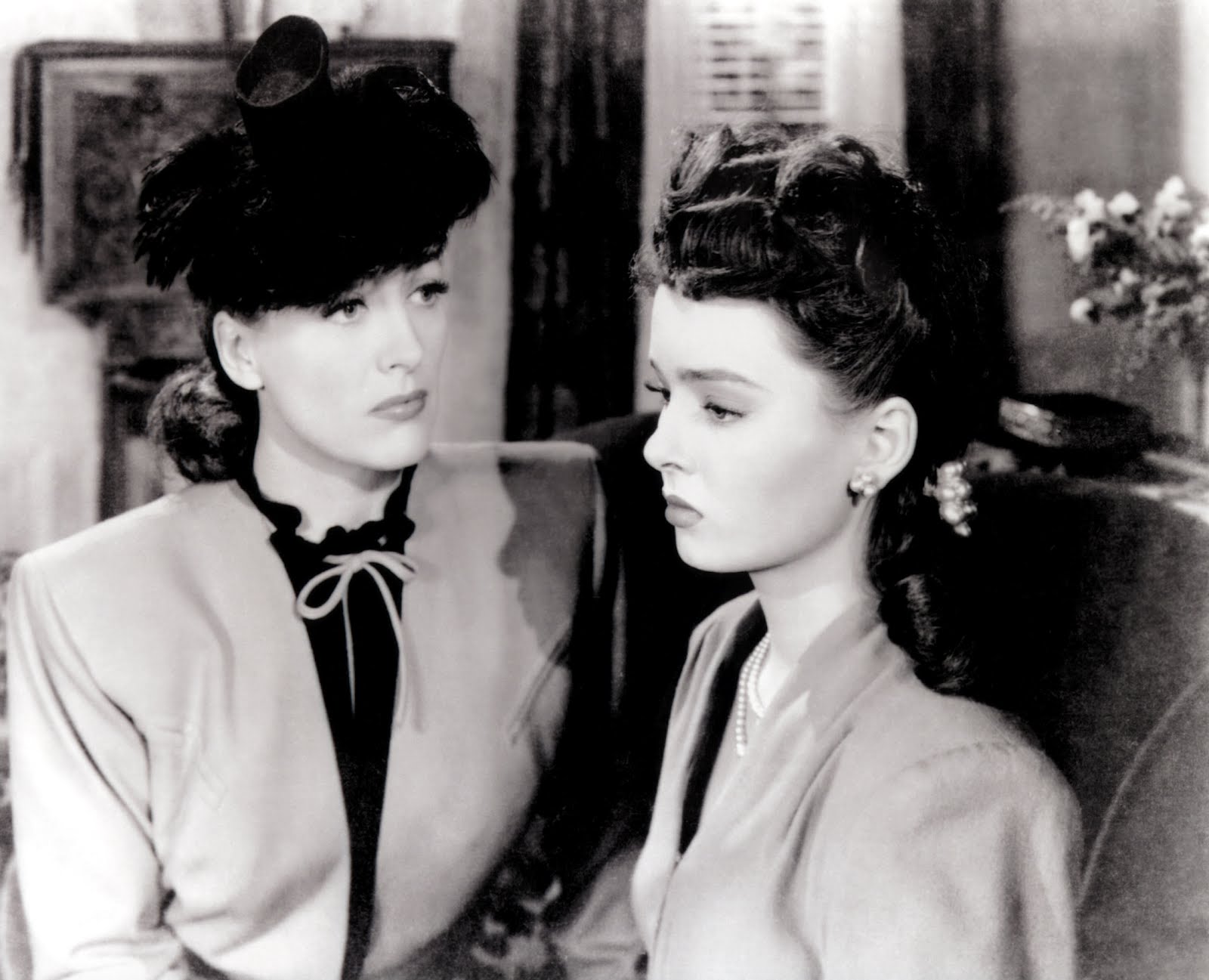 Joan Crawford was a complicated woman—which is to say that like all of us, she had her good points and her bad points. She was catty and cruel, she was uneducated and insecure about it, she had the morals of an alley cat and her failures as a mother are legendary. But she also had a tremendous work ethic, always tried to improve herself, and as far as I can tell, she never phoned in a performance, not even in the execrable sci-fi horror flick, Trog, which proved to be her last.
 A lot has been written over the years about Joan Crawford's private life, particularly with regard to her sexuality and her parenting skills, so much so that the scandals have completely obscured her work as an actress. But if I were handing out awards based on people's private lives, we'd wind up with a roster full of nice people and very few good movies. Only to the extent that I can discern a clear relationship between a person's off-screen life and their on-screen work will I tend to dwell on the former. Beyond that, celebrity gossip bores me. In fact, as far as I can tell, when they're not working, most celebrities are actually pretty dull people.
 Fans of the novel might be tempted to complain that Hollywood sanitized and simplified James M. Cain's original vision. But let's face it, no novel ending with the line "Let's get stinko" was going to make it to the big screen intact in 1945. Besides, the final product is plenty violent for all but the most bloodthirsty among us and as cynical about human behavior as the darkest film noir. Mildred Pierce isn't a perfect movie, just a great one and Crawford gave her best performance in it.






 Posts
Posts

