skip to main |
skip to sidebar

They didn't wait long to see the results of the new system, holding the next ceremony just seven months later, the only time in Oscar history awards were handed out twice in the same calendar year.
For a first exercise in democracy, the Academy did pretty well.
All Quiet On The Western Front — not just the best picture of the year, but one of the best pictures of any year — won both the top prize and an Oscar for its director, Lewis Milestone, the second Oscar of his career.
The Big House, a highly-regarded prison drama, nabbed a pair of awards, one for legendary screenwriter Frances Marion, the other for sound editor Douglas Shearer, the first of his fourteen career Oscars. And though I prefer Ronald Colman in his first talkie, George Arliss gave a solid performance in Disraeli, a role he had first crafted on Broadway.
The only controversy was generated by Norma Shearer's win for best actress in the movie The Divorcee.
"What do you expect," said Joan Crawford afterwards. "She sleeps with the boss," referring to Shearer's powerful husband, MGM producer Irving Thalberg.
Me, I like Norma. Well, pre-code Norma anyway. But more on that later ...
As I put together my own list of Katie Award winners, I realized that my only problem with All Quiet On The Western Front was that it was so good it obscured the fact that overall, 1929-30 was a very weak year for movies.
Silent films had all but disappeared from theaters, but unfortunately, the talkies that replaced them were saddled with a primitive technology that practically bolted the camera and the actors to the floor. Moreover, most directors clearly had no idea what to do with sound, treating it as a novelty rather than an opportunity, sticking in a song or two, or worse going overboard and cramming every nook and cranny with talk-talk-talk.
Things would get better ...
As always, click on the highlighted link to read more ...
1929-30
PICTURE (Drama)
winner: All Quiet On The Western Front (prod. Carl Laemmle, Jr.)
nominees: Anna Christie (prod. Clarence Brown); The Big House (prod. Irving Thalberg); Bulldog Drummond (prod. Samuel Goldwyn); City Girl (prod. William Fox); A Cottage On Dartmoor (prod. H. Bruce Woolfe)
PICTURE (Comedy/Musical)
winner: The Cocoanuts (prod. Monta Bella)
nominees: Applause (prod. Monta Bell); Hallelujah! (prod. King Vidor); The Love Parade (prod. Ernst Lubitsch); The Skeleton Dance (prod. Walt Disney)
PICTURE (Foreign Language)
winner: Pandora's Box (prod. Heinz Landsmann)
nominees: The Blood Of A Poet (prod. Le Vicomte de Noailles); The Blue Angel (prod. Erich Pommer); Diary Of A Lost Girl (prod. Georg Wilhelm Pabst); Earth (prod. VUFKU); Under the Roofs Of Paris (prod. Films Sonores Tobis)
ACTOR (Drama)
winner: Ronald Colman (Bulldog Drummond)
nominees: George Arliss (Disraeli); Lew Ayres (All Quiet On The Western Front); Charles Farrell (Lucky Star); Emil Jannings (The Blue Angel); Uno Henning (A Cottage On Dartmoor)
ACTOR (Comedy/Musical)
winner: Maurice Chevalier (The Love Parade)
nominees: Douglas Fairbanks (The Taming of the Shrew); William Haines (Speedway, Navy Blues and The Girl Said No); The Marx Brothers (The Cocoanuts); Albert Préjean (Under The Roofs Of Paris)
ACTRESS (Drama)
winner: Louise Brooks (Pandora's Box and Diary Of A Lost Girl)
nominees: Nora Baring (A Cottage On Dartmoor); Marlene Dietrich (The Blue Angel); Greta Garbo (Anna Christie); Norma Shearer (The Divorcee)
ACTRESS (Comedy/Musical)
winner: Jeanette MacDonald (The Love Parade)
nominees: Helen Morgan (Applause); Mary Pickford (The Taming of the Shrew)
DIRECTOR (Drama)
winner: Lewis Milestone (All Quiet On The Western Front)
nominees: Anthony Asquith (A Cottage On Dartmoor); Aleksandr Dovzhenko (Earth); F.W. Murnau (City Girl); G.W. Pabst (Pandora's Box and Diary Of A Lost Girl); Josef von Sternberg (The Blue Angel)
DIRECTOR (Comedy/Musical)
winner: King Vidor (Hallelujah!)
nominees: René Clair (Under The Roofs Of Paris); Ernst Lubitsch (The Love Parade); Rouben Mamoulian (Applause)
SUPPORTING ACTOR (Drama)
winner: Louis Wolheim (All Quiet On The Western Front)
nominees: Claud Allister (Bulldog Drummond); Wallace Beery (The Big House); Douglas Fairbanks, Jr. (Our Modern Maidens); Francis Lederer (Pandora's Box); Robert Montgomery (The Divorcee, The Big House and Our Blushing Brides)
SUPPORTING ACTOR (Comedy/Musical)
winner: Lupino Lane (The Love Parade)
nominees: Gaston Madot (Under the Roofs of Paris)
SUPPORTING ACTRESS (Drama)
winner: Anita Page (Our Modern Maidens and Our Blushing Brides)
nominees: Marie Dressler (Anna Christie); Leila Hyams (The Big House); Beryl Mercer (All Quiet on the Western Front); Seena Owen (Queen Kelly); Lilyan Tashman (Bulldog Drummond)
SUPPORTING ACTRESS (Comedy/Musical)
winner: Nina Mae McKinney (Hallelujah!)
nominees: Margaret Dumont (The Cocoanuts)
SCREENPLAY
winner: George Abbott, Maxwell Anderson and Del Andrews; from a novel by Erich Maria Remarque (All Quiet On The Western Front)
nominees: Frances Marion; additional dialogue by Joseph Farnham and Martin Flavin (The Big House); Elliott Lester; adaptation and scenario by Marion Orth and Gerthold Viertel; titles by H.H. Caldwell and Katherine Hilliker (City Girl); Rudolf Leonhardt, from the novel by Margarete Böhme (Diary of a Lost Girl)
SPECIAL AWARDS
"Swanee Shuffle" (Hallelujah!) (Best Song); Arthur Edeson (All Quiet On The Western Front) (Cinematography); C. Roy Hunter and Lewis Milestone (All Quiet On The Western Front) (Special Achievement In The Use Of Sound)
 Even if you don't know her name, chances are you know Anita Loos's work. Not only did she write the novel Gentleman Prefer Blondes and coin the phrase "Diamonds are a girl's best friend," she also shaped the careers of Douglas Fairbanks and Jean Harlow, wrote D.W. Griffith's epic masterpiece Intolerance, and in 1939 adapted The Women for the screen, the snarkiest chick flick ever produced.
Loos was born in 1888 to a pair of San Francisco newspaper publishers. "The family has always used the correct French pronunciation which is lohse. However, I myself pronounce my name as if it were spelled luce, since most people pronounce it that way and it was too much trouble to correct them."
 She began acting on the stage with her sisters at the age of nine, but always preferred writing and she not only wrote some of the plays she performed in, but also wrote a New York gossip column despite living in San Diego at the time. Loos broke into the movies in 1912 with the screenplay for The New York Hat, a D.W. Griffith short starring Mary Pickford in her last film for the Biograph Company. That same year she wrote The Musketeers of Pig Alley, which is now credited as the first gangster movie.
Over the next three years, she wrote more than fifty screenplays—including the titles to Griffith's masterpiece Intolerance—but made her biggest splash in 1916 when she wrote a series of screenplays for Douglas Fairbanks who was attempting to make the jump from Broadway to the movies. It was Loos who first saw the real-life Fairbanks as a born swashbuckler—fun, athletic and heroic—and screenplays such as American Aristocracy, The Matrimaniac and Wild and Woolly helped establish Fairbanks in the minds of the movie-going public as one of the silent era's greatest stars.
 Through this series of scripts, Loos (along with Mary Pickford's favorite writer, Frances Marion) turned movie intertitles—the dialogue and descriptions that pop up during silent movies—into an art form, transforming them from dull chapter titles into witty bon mots worth reading in their own right. When Fairbanks joined the Famous Players-Lasky film company, he brought Loos with him, paying her a salary of $500 a week.
It was on a trip west with Fairbanks and his entourage that Loos noticed the men on the train falling all over themselves to impress Fairbanks's latest costar, an empty-headed actress who was nevertheless blonde, a situation Loos (herself a brunette) deemed "palpably unfair." The novel inspired by the trip, Gentlemen Prefer Blondes, was a sensation, as were her stage and (1928) movie adaptations of it.
A fter a brief marriage in 1915, she married frequent writing partner John Emerson in 1919 and remained married to him until his death in 1956. Despite its longevity, the marriage was not a happy one. Not only was Emerson a chronic philanderer but even more dismaying to Loos, his dull exterior concealed an even duller mind. "I had set my sights on a man of brains, to whom I could look up, but what a terrible let down it would be to find out that I was smarter than he was."
It was Emerson who convinced Loos to largely abandon Hollywood for New York. There, Loos wrote such plays as The Whole Town's Talking, the aforementioned Gentlemen Prefer Blondes and an adaptation of Colette's novel Gigi.
Despite living in New York, Loos continued to pen screenplays on occasion, including a brilliant adaptation of Clare Boothe Luce's hit Broadway comedy, The Women, in 1939. The most important of her sound era screenplays, however, may well have been 1932's Red-Headed Woman, which starred Jean Harlow.
 Largely wasted up to that time in glamorous roles that required little acting skill, Harlow was a star without a screen persona, a situation producer Irving Thalberg was determined to remedy. Buying up Harlow's contract from Howard Hughes, Thalberg cast her in the screen adaptation of Red-Headed Woman, Katharine Brush's racy novel about a woman who sleeps her way into high society. F. Scott Fitzgerald took the first crack at the screenplay, but couldn't solve the puzzle of how to make the audience like a character he himself didn't approve of.
It was instead Loos who drafted the final screenplay.
 Although Harlow's Lillian Andrews is a manipulative gold digger—she seduces her married boss and breaks up his marriage—there was a sincerity to Lil's transparent scheming, and with Harlow serving up the brassier bits with humor and wounded pride, audiences found themselves rooting for her. The result was one of the biggest hits of 1932.
Harlow played variations of this character throughout the remainder of her tragically brief career.
In all Loos wrote five screenplays for Harlow including her last, Saratoga. She also wrote such screenplays as San Francisco, Susan and God and I Married an Angel.
Loos never retired and published her last book, a biograph of Norma and Constance Talmadge, in 1978. She died in 1981 at the age of 93.

Today is the centennial of Jean Harlow's birth. In her honor, I'm posting this Reader's Digest version of the four-part, 5000 word essay I wrote about her last year.
 If she'd just been another pretty face, she would have been forgotten long ago, one of the thousands of beauties who for a brief season capture the fancy of the paparazzi and the tabloids and the fickle paying public and then quickly fade from our memory. But more than just a platinum blonde beauty, Jean Harlow also possessed an unexpected gift for comedy and self-parody, and as the pre-Code era drew to a close, she became not only America's premier sex symbol but one of its premier actresses as well.
 Born to a Kansas City dentist and the daughter of a wealthy real estate developer, Harlean Harlow Carpenter tried out for the movies on a dare, got the job and later signed with the Hal Roach Studios. Working under her mother's maiden name, Jean Harlow played the "swanky blonde" in four Laurel and Hardy comedy shorts and appeared in uncredited bit roles in more than a dozen movies (including Chaplin's City Lights) before Howard Hughes cast her in Hell's Angels. Hughes epic about World War I flying aces proved to be Harlow's big break. Although she was as skittish as a newborn foal, barely able to speak her lines, the public immediately responded to her beauty—the expressions "platinum blonde" and "blonde bombshell" were coined to describe her—and she soon landed better parts, including that of James Cagney's love interest in William Wellman's gangster classic The Public Enemy, and the unobtainable society girl in Frank Capra's comedy Platinum Blonde.
Directors clearly had no idea what to do with Harlow in these early efforts and mostly she stood around, serving as a symbol of something the hero thinks he wants and learns the hard way that he doesn't. The bombshell image may have packed the theaters with the curious and the salivating, but it blinded directors and producers to her talent.
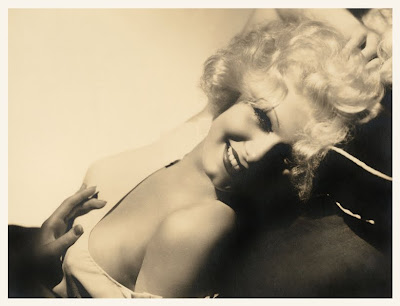 "The newspapers sure have loused me up," she complained cheerfully, "calling me a sexpot! Where'd they ever get such a screwy idea?"
It was MGM's legendary producer Irving Thalberg who determined to mold a screen image for Harlow beyond that of sex symbol. Thalberg bought Harlow's contract from Howard Hughes and cast her in the screen adaptation of Red-Headed Woman, Katharine Brush's racy novel about a woman who sleeps her way into high society. F. Scott Fitzgerald took the first crack at the screenplay, but couldn't solve the puzzle of how to make the audience like a character he himself didn't approve of, and it was instead Anita Loos, a veteran screenwriter and author of Gentlemen Prefer Blondes, who drafted the final screenplay.
 Although Harlow played a manipulative gold digger—she seduces her married boss and breaks up his marriage—there was a sincerity to her transparent scheming, and with Harlow serving up the brassy bits with humor and wounded pride, audiences found themselves rooting for her. The result was one of the biggest hits of 1932.
Variety summed up the general reaction: "Jean Harlow, hitherto not highly esteemed as an actress, gives an electric performance."
 Next up was an even better vehicle for Harlow, one that would both display her talent for comedy and pair her with fast-rising star Clark Gable. Based on a failed stageplay, Red Dust starred Gable as the overseer of a Vietnamese rubber plantation, Harlow as the "cute little trick" who falls for him, and Mary Astor as the wife of the plantation's latest hire, a woman Gable sets out to seduce.
"What a pleasant little house party this is going to be," Harlow quips. The women's rivalry is not just one of sex and love but of class, education and manners—everything Astor's Mrs. Willis takes for granted, everything Harlow's Vantine has struggled to survive without—and as the love triangle plays out, Harlow really hits her stride as an actress. As Vantine competes with Mrs. Willis (and Harlow with Astor), she is funny, bawdy, hurt, angry, and then as much as her Vantine wishes she weren't, compassionate, too, protecting her rival when she could just as easily destroy her.
 Harlow's "uniquely effortless vulgarity, humor and slovenliness," wrote Movie Diva in her review of Red Dust, "create the rarest of Hollywood goddesses, the beautiful clown."
It's one of the best performances of the pre-Code era.
The following year Harlow gave what may be her best-remembered performance, that of none-too-bright social climber Kitty Packard in the comedy-drama, Dinner At Eight.
A successful play by Broadway legends George S. Kaufman and Edna Ferber, Dinner At Eight is a loosely-connected series of vignettes about a group of wealthy Manhattanites preparing for a dinner party as their respective worlds fall down around their ears. For the movie adaptation, producer David O. Selznick assembled the brightest of MGM's stars, including the three male leads from Grand Hotel, and added America's most popular actress Marie Dressler as a faded Broadway star, Billie Burke as the twittery hostess of this train wreck, and Harlow as the spoiled young trophy wife of Wallace Beery's crooked businessman.
 Director George Cukor, fresh off Katharine Hepburn's successful debut in A Bill Of Divorcement, cast Harlow over the objections of Louis B. Mayer, who felt she wasn't actress enough to keep up with her more experienced co-stars. But Red Dust had convinced Cukor that Harlow had a gift for comedy and with the director's help, she wound up stealing the show. Harlow's Kitty manipulates her men, bullies her maid, and otherwise lazes around, eating bonbons and complaining of boredom. Yet because she hungers to improve herself (even if she seems to think the surest path to knowledge is to sleep with an educated man), we find ourselves cheering her on.
"I'm going to be a lady if it kills me," she vows.
 In terms of its complexity, the role of Kitty Packard was a leap for Harlow, but where she had been ill-equipped to handle early roles in Hell's Angels and Platinum Blonde, now she was ready. In Red-Headed Woman, she'd learned how to gain an audience's sympathy despite playing an unlikeable character. In Red Dust, she'd learned how to deliver tough wisecracks while conveying hurt and vulnerability. In Dinner At Eight, she found the last piece of the puzzle, "the ability," in the words of Frank Miller, writing for Turner Classic Movies, "to deliver lines as though she didn't quite know what they meant."
The result was the best performance of her career, and when Harlow finished her last scene for the movie, she went to her dressing room and cried, perhaps knowing that nothing she would ever do afterwards would top this performance.
"Harlow played comedy," said Cukor, "as naturally as a hen lays an egg."
 Movie-going audiences loved Dinner At Eight and loved Harlow in it, not only because she looked great in her backless evening gown (designed by Adrian, it was known as the "Jean Harlow dress" and was so tight she couldn't sit down in it), but also because she had proven herself once and for all as one of Hollywood's great comedic actresses.
"Acting honors," said Variety at the time, "probably will go to Dressler and Harlow, the latter giving an astonishingly well-balanced treatment of Kitty, the canny little hussy who hooks a hard-bitten and unscrupulous millionaire and then makes him lay down and roll over."
"I was not a born actress," Harlow confessed later. "No one knows it better than I. If I had any latent talent, I have had to work hard, listen carefully, do things over and over and then over again in order to bring it out."
After the critical and commercial successes of Red Dust and Dinner At Eight, Jean Harlow leapt to the top of her profession, surpassing Joan Crawford, Greta Garbo and Norma Shearer as the most popular actress at MGM. And although Hollywood began enforcing the Production Code in 1934 and as a result toned down the more explicit sexuality of her movies, Harlow remained an audience favorite. In fact, from 1932 until her untimely death in 1937, Harlow had at least one movie, and often two, finish among the top ten grossing films of the year.
 Despite her success with critics and audiences, Harlow was never nominated for an Academy Award—comedic performances rarely are—but she did rank twenty-second on the American Film Institute's list of the top 100 movie legends and forty-ninth on Entertainment Weekly's list of the all-time greatest movie stars. In his cult classic Alternate Oscars, Danny Peary chose her performance in the screwball comedy Libeled Lady as the best by an actress in 1936.
In contrast to her movie career, Harlow's personal life was marked by scandal and heartbreak. Harlow's mother was overbearing and controlling, living out dreams of movie stardom through her daughter. In 1932, Harlow's second husband Paul Bern died of a gunshot wound under mysterious circumstances. In 1933, MGM arranged a quick, short-lived marriage to cinematographer Harold Rosson to cover up Harlow's affair with a married man. Like her character Lola Burns in the 1933 comedy Bombshell, Harlow was hounded by greedy studio bosses, greedier family members, stalkers, fraudsters, slicky boys and the tabloid press, and treated more as a cash cow than a flesh and blood woman.
"She didn't want to be famous," said Clark Gable, "she wanted to be happy."
 In 1935, Harlow fell in love with William Powell, her co-star in the movie Reckless, and finally after years of turmoil, her personal life began to match the success of her professional one. The two secretly engaged although never married—in his early forties, Powell worried about being linked to such a young actress, and Harlow also claimed MGM studio chief Louis B. Mayer didn't approve of the union.
In 1937, during filming of her sixth movie with Clark Gable, Saratoga, Harlow fell ill with a serious kidney ailment and died before the end of production. The studio finished the film with long shots of a stand-in and released the film with much fanfare. It was the highest grossing film of 1937, a fitting tribute to her brief but brilliant career.
Postscript
 You can check out other tributes to Jean Harlow at the Kitty Packard Pictorial, a site devoted to all things Harlow. The Pictorial is also promoting a new biography, Harlow in Hollywood: The Blonde Bombshell in the Glamour Capital, 1928-1937 by Darrell Rooney and Mark A. Vieira.
[To read an eight-part biography of the Marx Brothers, click here. To read about Margaret Dumont, my choice for best supporting actress of 1932-33, click here. And to read about the drafting of Duck Soup's screenplay, click here.]
 The award year running from September 1, 1932 through the end of 1933 was an unusually rich one for both comedies and musicals with more than a dozen must-see movies, including a pair from Ernst Lubitsch, three by Busby Berkeley, comedies starring Mae West, Charles Laughton, Jean Harlow, Marie Dressler, Laurel and Hardy, and even a groundbreaking cartoon short from Walt Disney. But the best work of the year came from the Marx Brothers, who contributed two indispensable classics, Horse Feathers and my choice for the best comedy of the year—or indeed, any year—Duck Soup.
In case you don't know, the Marx Brothers—Julius, Leonard, Adolph and Herbert, better known to the world as Groucho, Chico, Harpo and Zeppo—were the premiere comedy team of an era that also boasted such classic acts as Laurel and Hardy, and the Three Stooges. Duck Soup was their fifth film and despite being delayed for nine months by a contract dispute with Paramount, proved to be the best of their career, featuring some of the funniest and most famous scenes in the Marx Brothers canon.
 Duck Soup is the story of a nation in crisis: Freedonia's economy is in shambles, with a prohibitive increase in taxes ("I've got an uncle in Taxes—Dollars, Taxes!") in the offing if the rich widow Mrs. Teasdale (Margaret Dumont) won't come through with another $20 million. And if that's not enough, Freedonia's bellicose neighbor, Sylvania, is massing troops on the border, threatening not only death and destruction, but also to introduce a plot into the picture's foreground, a development which in previous Marx Brothers movies tended to bring the comedy to a grinding halt.
With a month's rent already paid on the battlefield, war seems inevitable and the country teeters on the brink of anarchy. Desperate for a savior, Freedonia turns to that fearless man of the people, Rufus T. Firefly.
 "If you think this country's bad off now," he promises, "just wait 'til I get through with it!"
Playing Firefly is Groucho Marx, he of the lacerating wit, the greasepaint moustache and the most impeccable timing in the history of comedy. While the chief obstacle to achieving peace in our time is ostensibly Sylvania's conniving ambassador Trentino (Louis Calhern), in fact, it's Firefly himself—his temper, his paranoia, his inability to make heads or tails of things a four year old child would understand.
 "I'll be only too happy to meet Am- bassador Trentino, and offer him, on behalf of my country, the right hand of good fellowship. And I feel sure that he will accept this gesture in the spirit in which it is offered. But suppose he doesn't. A fine thing that'll be! I hold out my hand and he refuses to accept it! ... Why the cheap, four-flushing swine—so you refuse to shake hands with me!"
And thus just like that, Freedonia finds itself at war.
The humorist Roy Blount, Jr., in his recent book Hail, Hail, Euphoria!, called Duck Soup "the greatest war movie ever made," and while I wouldn't say Harpo carrying a sandwich board reading "Join the Army and See the Navy" around a battlefield is as harrowing as the Omaha Beach scene in Saving Private Ryan, I will agree that it's the best treatment ever of the causes of war. As a student of history, majoring in the subject in college and maintaining a lifelong interest in the to-ings and fro-ings of elected officials, I've concluded that nobody has ever launched a war thinking it was a bad idea, no matter how uninformed, misinformed or half-formed his reasons may have been for thinking so. (Yes, yes, I'm thinking of the War of Jenkins' Ear. Sue me.)
Don't get me wrong. Occasionally the world finds itself in a death match with, say, fascism, and it would be futile, not to mention suicidal, to sit on the sidelines, but more often than not, from the Crusades to Iraq's invasion of Iran and a hundred other major conflicts in between, the thinking leading to war is typically characterized by ego, paranoia, stupidity and shortsightedness, with very little afterwards to show for it but a pile of corpses, and when the smoke clears, everybody scratches their heads and promises to do better—until the next time, that is, when they go off and do it again.
 And thus I believe Rufus T. Firefly when he says, "There's no turning back now! This means war!" Or I believe he believes it anyway. But a classic movie, like a well-written history, strips away the comforting lies and the self-delusion and leaves only the truth—in this case, that Rufus T. Firefly might not have been, shall we say, the best choice to lead a country in crisis. (Filmed shortly after the Nazis seized power in Germany, Harpo said later he and his Jewish brothers listened to Hitler's speeches on the radio between scenes and were quite consciously targeting both him and his fascist ally Mussolini with their humor. Indeed, Mussolini banned the film in Italy as a personal attack.)
Egging Firely on are Chicolini and Pinky (Chico and Harpo), who serve not only as Secretary of War and chauffeur, respectively, but also as the most incompetent double agents in history, infiltrating Freedonia's government on behalf of Trentino only to get sidetracked by scissors, doorbells and a cantankerous lemonade vendor.
"Well, you remember you gave us a picture of this man and said follow him? Well, we get on the job right away and in one hour—even-a less than one hour—"
"Yes?"
"—we lose-a da picsh. That's-a pretty quick work, heh?"
 Providing brilliant support are Margaret Dumont and Edgar Kennedy. Kennedy was a veteran of the Hal Roach Studios, and a master of what is known as slow-burn comedy, with laughs derived from a gradually increasing show of anger. Dumont, simply put, was the most talented straight-(wo)man in the history of movie comedies.
In consciously setting out to make the best Marx Brothers movie ever, director Leo McCarey ruthlessly streamlined the story, eliminating every element not directly related to producing laughs. In addition to cutting the usual harp and piano solos, he also cut a scripted romance between Zeppo and Raquel Torres (who played dancer Vera Marcal) as well as Zeppo's number "Keep On Doin' What You're Doin'" (recycled a year later for the Wheeler and Woolsey comedy, Hips Hips Hooray), effectively reducing the youngest Marx Brother to a bit player in his own movie.
 McCarey also beefed up the supporting cast, calling in veteran actors Calhern and Kennedy for key parts, writing two classic sequences involving Harpo, Chico and a lemonade stand for the latter (it was Groucho himself who talked Margaret Dumont into playing Mrs. Teasdale). As a result, the Brothers finally found themselves working with a cast of expert straightmen whose set-up lines and reaction shots heightened the payoffs of the Brothers' already brilliant jokes.
In addition, McCarey's experience as a director of top comedy acts (Laurel and Hardy especially) shows in his ability to tether otherwise unrelated gags and one-liners to the framework of the story. On paper, Duck Soup is no more cohesive than Monkey Business or Horse Feathers, but McCarey is forever stitching scenes together with repeated dialogue, visual cues and recurring gags. $20 million is mentioned several times and many scenes are introduced with the Freedonian national anthem. Three times you see Groucho in bed, three times you see Chico or Harpo at the peanut stand.  Several scenes involve eating—peanuts, donuts, crackers, apples. We see Groucho at his desk more than once—first in the newspaper photo that introduces him, then for a cabinet meeting, then yet again for a conversation with Zeppo and a sequence involving Harpo and the telephone. For that matter, we see Harpo on the telephone in two scenes, and Chico once as well. And, of course, there are recurring gags involving Harpo and scissors, a blow torch, a motorcycle, an alarm clock and Edgar Kennedy's hat.
These links, though unobtrusive, satisfy the mind's instinctive need for order and create a resonance that keeps the momentum of the picture from jerking to a halt every time the story changes gears.
 "Duck Soup," wrote Roy Blount in Hail, Hail, Euphoria!, "is a seamless blend of just about every form of American comedy up to its time," and I attribute this versatility to Leo McCarey. As a source of inspiration for many of Duck Soup's gags, McCarey dipped into the bag of silent comedy tricks he had learned at the legendary Hal Roach Studios and came up with several scenes crucial to the film's success, including the three-hat gag, the break-in scene from Laurel and Hardy's Night Owls and most unforgettably, the mirror scene, which the Schwartz Brothers originated for the stage, and which showed up again in Charlie Chaplin's The Floorwalker and Max Linder's Seven Years' Bad Luck, but which was never essayed more brilliantly than by the Marx Brothers in Duck Soup.
Most importantly, McCarey provided visuals that for the first—perhaps, only—time in the Marx Brothers' career matched their subversive, surreal wit. I'm thinking particularly of the battle scenes at the tail end of the movie, when Groucho changes uniforms with every shot and the army of elephants, monkeys, dolphins, swimmers, fire engines, etc. that responds to his call for help. But there's also the scene where a dog emerges barking from Harpo's chest, and another scene where Harpo climbs out of Edgar Kennedy's bath in full-dress uniform. (That McCarey used these tricks to turn what in previous movies would have been a plot-heavy resolution into an surrealist's dream is just another reason why he was the best director the Marx Brothers ever worked with. In fact, I'm willing to bet all the surrealists' efforts combined had less impact on attitudes about war and authority than this one Marx Brothers movie. But I digress. Again.)
But of course ultimately Duck Soup is about the Marx Brothers and simultaneously reigned in and unleashed by an expert director of comedy, they were never better. Groucho was never more comfortable in front of the camera. Harpo, the act's unrestrained id, is not as wild as he was in such movies as Animal Crackers, but his bits are better integrated into the flow of the film than ever before. And Chico has the best role of his career, serving not just as a foil for Groucho's wit and Harpo's destructive impulses, but as a showcase talent in his own right. (If you want to read more about the Marx Brothers themselves, click here, but I'm warning you in advance, few who venture there ever return to talk about it.)
 In terms of box office, Duck Soup wasn't quite the flop of legend, turning a modest profit, but nevertheless grossing less than any of its predecessors. Ironically, we most desperately seek meaning at those moments when the world most forcefully reminds us that life has no meaning, and in 1933, as the world teetered at the edge of the abyss, audiences had no taste for Duck Soup's bitter recipe. Because let's face it, while at first blush Duck Soup is delightfully silly and absurdist, its underlying riff—that our leaders are fools, that our institutions are corrupt, that young men and women die in wars for no reason, and that, above all, people are born to torment each other without hope of ever getting along—is as bleak and jaundiced a world view as Hollywood ever committed to film. That's not a message a paying audience is prepared to receive on an empty stomach, and in 1933, there were plenty of empty stomachs to go around.
Fortunately, the Marx Brothers signed with Irving Thalberg shortly after Duck Soup's premiere and at MGM, the Brothers made two of their most successful movies, A Night At The Opera and A Day At The Races. Audiences were in the mood to laugh at the Marx Brothers again. They've been laughing ever since.
 I've been writing about him for six weeks. Might as well wish him a happy 120th birthday while I'm at it.
For those of you who didn't want to wade through the eight-part, 12,000 word essay about Groucho and his brothers, here's the nutshell version (the rest of you can safely skip it—but you might like the pictures):
Born in New York to Jewish immigrants Sam "Frenchy" Marx and Minnie nee Minna Schönberg, Leonard, Adolph, Julius Henry, Milton and Herbert Manfred—better known to the world as Chico, Harpo, Groucho, Gummo and Zeppo—the Marx Brothers first hit the vaudeville circuit as singer/musicians but quickly found their niche as masters of a unique brand of quick-witted improvisational comedy that bordered on anarchy.
 On stage and in the movies, Chico played an Italian immigrant (he copied the accent from his barber) whose fractured English was the source of many jokes. He also played the con man on stage, alternately sharp or dim depending on whether he was conning brother Groucho or someone else. In real life, he was also a compulsive gambler and womanizer who stuck with the act mostly to make enough money to gamble and chase women.
Chico's on-stage accomplice in crime, Harpo was the pure id of the act, a hyperactive puppy, as innocent as a child, as easily distracted and just as destructive. Although Harpo was a scene-stealing machine who would wreak havoc whenever he was on stage, off stage he was a gentle man with a serious passion for the harp, an instrument he worked hard to master and he admitted later that those moments playing the harp are when you see the real man.
 "Harpo was the solid man in the family," Groucho said. "He inherited all my mother's good qualities—kindness, understanding, and friendliness. I inherited what was left."
Groucho served to bridge the gap between the audience and his brothers. Where Chico and Harpo were usually off in their own worlds, motivated by impulses clear only to themselves (and often not even then), Groucho played recognizable members of society—teachers, lawyers, hotel owners, even petty dictators—who wanted the sorts of things the audience wanted, in Groucho's case, sex and money. Yet paradoxically, while acknowledging the world around him in ways his brothers rarely did, Groucho was the most hostile to the existing order, and he used his lacerating wit to keep the world—and the audience—at arm's length.
 "I do not care to belong to a club," he famously wrote to the Friar's of Los Angeles, "that accepts people like me as members."
As for Gummo and Zeppo, neither developed stage characters as well defined as their brothers. Gummo was a quiet man with a childhood stammer and was never much interested in performing; he left the act in 1917 to join the army and never appeared in a movie with his brothers. Zeppo replaced him, but being so much younger than his brothers and coming so late to such a well-established act, wound up as something of an afterthought, usually singing and sometimes playing the lead in a romantic subplot. In 1934, he also left the act.
 After nearly twenty years of honing their act in vaudeville venues all over the country, the Brothers finally broke into "legitimate" Broadway theater in May 1924 with the musical comedy I'll Say She Is! A blend of standard song-and-dance numbers and the Marx Brothers biting comedy, the play was an immediate sensation. The Brothers followed up a year later with an even more successful musical, The Cocoanuts. inspired by a speculative land boom then underway in Florida, The Cocoanuts was written by Pulitzer Prize-winning playwright George S. Kaufman and featured a song score by Irving Berlin, but primarily it proved to be another winning vehicle for some of the Brothers' best improvisational gags.
Such success quickly came to the attention of Paramount Pictures producer Adolph Zukor of who initially balked at the Brothers' asking price of $75,000, then wound up offering $100,000 after dinner with the always eloquent Chico Marx. The Brothers filmed a movie version of The Cocoanuts in New York even while performing their next play, Animal Crackers, on Broadway in the evening. Premiering just two years after Al Jolson had first spoken in a motion picture, The Cocoanuts was a smash hit at the box office.
The follow-up movie, Animal Crackers, was an even bigger hit and features the most quoted routines of Groucho's career.
"One morning I shot an elephant in my pajamas. How he got in my pajamas, I don't know."
 In 1931, with no Broadway commitment to keep them in New York, the Marx Brothers moved to Hollywood where they filmed their third movie, Monkey Business. Even for a Marx Brothers' movie, the story is tissue thin—four stowaways wreak havoc on an ocean liner, meet a couple of gangsters, go to work for them and wind up thwarting a kidnapping plot—but the first forty-five minutes of Monkey Business are as good as anything the Brothers ever did, sagging only once the Brothers leave their shipboard setting.
The idea of placing the Brothers in an academic setting for their fourth film, Horse Feathers, was an old one—twenty years before, Groucho had played a teacher to Gummo's and Harpo's students in the vaudeville show Fun In Hi Skule—and a team of writers led by ex-collegian S.J. Perelman set to work a script before Monkey Business was even in theaters.
 Here, Groucho plays Professor Wagstaff, the newly-appointed president of Huxley College. The school's in trouble—it's been neglecting football for education, or possibly the other way around—and at the urging of his son (Zeppo), Wagstaff sets out to get better football players, starting with the two who hang around a local speakeasy. Of course, he confuses Harpo and Chico for the star players, who proceed to turn Huxley College into chaos. Along the way, the Brothers butt heads with a gambler who's put his money on the opposing team, Harpo and Chico try to kidnap Darwin's star players only to get themselves kidnapped instead and everybody serenades the college widow with variations on "Everyone Says I Love You," but the real point of the movie is to serenade the audience with hilariously shameless wordplay and anti-social anarchy.
Randy Williams, writing for ESPN in 2008, ranked the film's finale as "the greatest scene in football movie history."
Their fifth film, delayed for nine months by a contract dispute with Paramount, proved to be the best of the Marx Brothers' career.
 Duck Soup is the story of a nation in crisis: its economy in a shambles and on the verge of war, Freedonia is desperate for a savior and riding to the rescue is that fearless man of the people, Rufus T. Firefly (Groucho). The film features some of the funniest and most famous scenes in the Marx Brothers canon. Many factors are responsible for Duck Soup's greatness, but primary among them are the performances of Groucho, Chico and Harpo themselves. Groucho, of course, was already without peer in terms of comic timing, and Harpo, though not quite as anarchic as in previous movies, is tighter here, with his antics leading directly to two of the movie's best moments—the mirror scene and Chico's trial for treason. And Chico, whose role had been limited largely to malapropisms, piano solos and translating for the silent Harpo, led entire sequences—the meeting with Louis Calhern, the peanut vendor scenes with Edgar Kennedy, the scene in Margaret Dumont's bedroom, and the trial for treason—showcasing a comic talent the equal of his brothers.
In terms of box office, Duck Soup wasn't quite the flop of legend, turning a profit, but nevertheless grossing less than any of its predecessors. Of course, Duck Soup's reputation as a masterpiece is now secure, consistently ranking as one of the greatest comedies ever made.
Soon after Duck Soup's premiere, the Marx Brothers and Paramount parted company. The Brothers signed with Irving Thalberg at MGM and made two of their best movies, A Night At The Opera and A Day At The Races, but after Thalberg's death in 1937, never again hit those heights. Groucho went on to success on television and the Marx Brothers experienced a revival of interest in their films in the 1960s.
 In 1974, the Academy finally acknow- ledged Groucho with a honorary award "In recog- nition of his brilliant creativity and for the unequaled achievements of the Marx Brothers in the art of motion picture comedy."
"I wish Harpo and Chico could be here to share it with me," he said.
In 1999, the AFI listed the Marx Brothers as one of the fifty greatest stars in the history of American cinema, the only group so honored.







 Posts
Posts

