skip to main |
skip to sidebar
 This afternoon, Katie-Bar-The-Door and I are going to see A Trip to the Moon and a documentary about its director, Georges Méliès, at the AFI Silver. This might be a good time to re-start the Silent Oscars, my ongoing project to write a history of silent movies, one made-up award at a time.
When I left off, we were up to 1918, but that was some time ago, so just as I did with the Katie-Bar-The-Door Awards earlier this year, I'll be recapping the awards to date, beginning with 1902, which is not the beginning of movie history, but it is the year of history's first great movie, Georges Méliès's Le Voyage Dans La Lune. A good place to (re)start.
KC at Classic Movies recently wrote a terrific series of posts about Méliès (beginning here) and I myself wrote about him on the 150th anniversary of his birth (here), so I won't repeat it all for you now, except to say, the image of a rocket hitting the moon splat! in the eye is one of the defining images of the silent era—indeed, of all time.
From 1902 to 1909, I'll only hand out awards for best picture and director—actors didn't begin to receive screen credit until 1910 and before the widespread use of the close-up, were largely unrecognizable anyway. Beginning in 1910, I'll add a best actor and actress award, in 1912 one for screenplay, and in 1914, awards for supporting actors.
Here we go:
PICTURE
winner: Le voyage dans la lune a.k.a. A Trip to the Moon (prod. Georges Méliès)
nominees: Jack and the Beanstalk (prod. The Edison Manufacturing Company); The Little Match Seller (prod. Williamson Kinematograph Company)
Must-See: Le voyage dans la lune a.k.a. A Trip to the Moon
DIRECTOR
winner: Georges Méliès (Le voyage dans la lune a.k.a. A Trip to the Moon))
nominees: George S. Fleming and Edwin S. Porter (Jack and the Beanstalk); James Williamson (The Little Match Seller)
 In what might be the most anticlimactic finish to a 2012 Favorite Classic Movie Actress Tournament ever, Ginger Rogers romped to the title over Natalie Wood in a contest that was one-sided from its opening moments.
The final total? 144 to 25. Hokey smoke, Bullwinkle!
Fred Astaire sums up the way all of Ginger's fans must be feeling at this moment (with Spanish subtitles for those who like their Astaire-Rogers dance numbers that way):
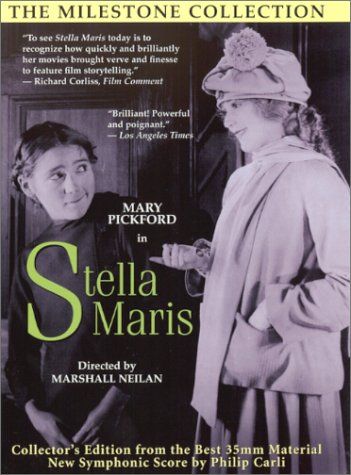
In honor of Mary Pickford's 120th birthday today, here is my long-delayed review of her masterpiece, Stella Maris.
 After the critical and commercial triumphs of 1917 made her the most popular—and most powerful—actress in the world (read the story here), Mary Pickford declined to rest on her laurels. Instead, she opted for an even more ambitious project, a dual role that would push the boundaries of both special effects technology and her talent as an actress. The resulting film, Stella Maris, the story of an orphan girl struggling to find love and acceptance in a cruel and indifferent world, was a resounding success with both audiences and critics, and ensured Pickford's place as the most popular actress of the silent era.
Based on a novel by William J. Locke, with a screenplay from the legendary Frances Marion, Stella Maris is a story very much in the tradition of Charles Dickens—and if you regard Dickens as highly as I do, you know that's not a bad thing—filled with melodrama, improbable coincidences, shameless moralizing, biting social commentary, and grim depictions of alcoholism, child abuse and grinding poverty.
Unlike most of Dickens, though, there's no happy ending, at least not for the character we care most about, and while some might call Stella Maris a hokey Victorian melodrama, it's a hokey Victorian melodrama of the first water, a riveting story from beginning to end, and featuring the best performance of Mary Pickford's career.
 The film opens on the first of Pickford's two roles, the eponymous Stella Maris. Orphaned in childhood and paralyzed by a mysterious ailment, the beautiful, cheerful Stella lives in a carefully-constructed fantasy world created by a wealthy aunt and uncle, "unaware of sorrow, poverty or death." Her aunt and uncle, a houseful of servants, a dog (played by "Teddy" courtesy of the Mack Sennett studios) and most importantly, a distant cousin, John Risca (Conway Tearle), attend to Stella's every need while cautiously sheltering her from life's harsh realities.
 Although Stella was a typical Pickford role—the plucky, perky girl with the curls that America had fallen in love with—the movie is really about Pickford's second character, Unity Blake, an "ugly duckling" with no swan in her future.
In stark contrast to Stella's life of sheltered luxury, Unity has grown up in a grim orphanage, unwanted and unloved, and inured to life's disappointments. She knows that, the old cliche notwithstanding, God frequently doles out more trouble than we can handle, and seemingly for no other reason than a perverse indifference to what human beings call fairness. Through the course of the story, Unity learns many of life's harshest lessons: pretty people flock together; character doesn't trump position, power or money; and regardless of how well we play the hand we're dealt, the game ends the same for everybody—just sooner for some than for others.
 From its earliest scenes, the film symbolically establishes Unity as a Christ-figure—note how she is photographed through a sanctuary rood screen, her praying figure framed by a cutout of the cross—and she is the essence of innocence and purity made to suffer for our sins. But if she were only an allegory, Unity would quickly become an insufferable bore. Instead, she's a heartbreakingly three-dimensional girl, hard-working but mischievous, an ugly duckling with a lovely soul, as hopeful as her situation is hopeless.
The lives of Unity and Stella intersect through the man they both come to love, John Risca, who is not only Stella's cousin but who also adopts Unity as a housemaid-servant for his abusive, alcoholic wife. Played with exquisite cruelty by Marcia Manon, Unity's new stepmother goes out of her way to snuff out what light remains in the orphan girl's eyes. Only John's kindness keeps her going.
 One of Unity's most poignant scenes is when caressing John Risca's hat and coat, she imagines a romance that will never be, a scene that the staff of the Mary Pickford Institute for Film Education compared to the famous "jacket scene" in the Oscar-winning The Artist. "Mary Pickford's moment is even more affecting, because we know that unlike Peppy Miller, little Unity's dream of romance is doomed from the start, and we fear she will never get her happy ending."
That the result is riveting and moving rather than dreary and overwrought is a testament to Pickford's performance.
To create the character of Unity, Pickford's teeth were darkened, her trademark curls slicked down and pulled into a tight bun, her clothes suitably drab and tattered. But it was the actress's body language and facial expressions that made the transformation from "Little Mary" to Unity so effective. Her back curved from malnourishment, Pickford's Unity carries herself like a dog who's been beaten too much. Her eyes are downcast and look at the world sidewise, and she flinches from very human contact, revealing the years of verbal and physical abuse, and the constant disappointment she has endured.
The transformation is complete yet subtle, and utterly convincing.
 "To test the Unity make-up," wrote Felicia Feaster for Turner Classic Movies, "Pickford wandered the studio under the pretense of finding work as a cleaning lady. She was delighted when she discovered that no one recognized her."
To allow Mary Pickford to appear on screen as Stella and Unity simultaneously, director Marshall Neilan and cinematographer Walter Stradling used a "split-screen" technique, exposing one side of the film then the other, to allow the same actor to play two roles in the same scene, a common enough technique now, but here one of the earliest examples if its use in a feature film. (Georges Méliès used both double exposure and matte shots to interact with himself in such early short films as Un homme de tête (1898), Le portrait mystérieux (1899) and L'homme orchestre (1900), while Lois Weber used split-screen in 1913's Suspense to show two people having a phone conversation at the same time.)
 For a tale with its feet planted so firmly in the 19th century, it's ironic that Stella Maris should rely so heavily on the most cutting-edge technology that the 20th century then had to offer.
Upon its release in January 1918, the film was an immediate hit with both critics and audiences. Variety called the performance "a revelation," the Los Angeles Times deemed it "brilliant, powerful and poignant" and studio chief Adolph Zukor, who was initially horrified when he visited the set, later called Stella Maris "the most remarkable thing which Mary Pickford has ever done for the screen."
More recently, Dean Thompson at Silents Are Golden wrote, "It is the valiant, hesitant, tender, scrappy figure of Unity Blake, played with truth and immediacy by the most famous and beautiful film star of her day, that stays with us, haunting us still. Mary Pickford, the actress occasionally hidden by the towering figure of 'America's Sweetheart,' could have no finer testimonial to her talent."
Stella Maris was the top grossing movie of 1918.
 For director, Marshall Neilan, Stella Maris represented something of a peak. Although he directed three more Pickford films and would continue to direct into the sound era, Neilan suffered from acute alcoholism that often left him unable to work. In fact, on at least one of their collaborations, Pickford is alleged to have directed the entire film (uncredited) while the chronically intoxicated Neilan watched in amusement. In 1933, she gave him one last chance to direct, Secrets which turned out to be her final film, but quickly replaced him with Frank Borzage when Neilan couldn't function on set. He died in 1958.
Pickford, meanwhile, followed up Stella Maris with an unbroken string of hits—Amarilly of Clothes-Line Alley, M'Liss, Daddy-Long-Legs, Pollyanna, Suds, a remake of Tess of the Storm Country, Sparrows (the last of her little girl roles and one of her best), and My Best Girl (which I wrote about here), before winning the Oscar as best actress for 1929's Coquette.
She retired in 1933, another silent victim of the sound era's changing tastes.
 As I recently wrote, Mary Pickford "was, pound-for-pound, the most powerful woman in Hollywood history, simultaneously an international superstar, a studio owner, a producer, a de facto director, an Oscar winner, and the queen of the Hollywood social scene." Stella Maris didn't feature Pickford most typical performance, but it was her greatest.
Stella Maris is my pick for the best movie of 1918.
Ginger Rogers has jumped out to an early 27-11 lead over Natalie Wood in the finale of Monty's 2012 Favorite Classic Movie Actress Tournament. You have until Tuesday evening to cast your vote.
We here at the Monkey asked for and received a little face time with each actress:
Ginger Rogers (and Cary Grant)
 Natalie Wood
 Click here to vote.
 Of those actresses who didn't make it out of the second round of Monty's Favorite Classic Movie Actress Tournament this year, five—Ingrid Bergman, Marlene Dietrich, Katharine Hepburn, Deborah Kerr and Vivien Leigh—have won multiple Katie-Bar-The-Door Awards here at the Monkey.
A little side poll reveals that the Great Kate is your favorite among them, making her, by my calculations, your 33rd favorite classic movie actress. If Hepburn were a state, she'd be Kansas.
Cary Grant, who was openly supporting Deborah Kerr, nevertheless stopped by to congratulate his co-star from The Philadelphia Story.
That's class!
The vote totals:
Katharine Hepburn - 26
Vivien Leigh - 20
Ingrid Bergman - 16
Deborah Kerr - 8
Marlene Dietrich - 6
Meanwhile, over at All Good Things, the final pairing is set for the conclusion of this year's tournament: Ginger Rogers versus Natalie Wood. Not exactly who I would have put my money on when this whole thing started, but that's democracy!
Voting starts tomorrow, I believe.
 Those of you who have been following the Monkey for a while might remember that one of my favorite ongoing projects is the quest to see all the available Douglas Fairbanks movies—in chronological order, no less. Why? you might ask. To which I say, Why?!? Because he's Douglas Fairbanks, of course, the most unabashedly joyful actor ever to make a series of really entertaining movies!
 So far, I've written thumbnail reviews of all his feature films from 1916 and 1917, his breakout years. You can read those reviews here and here.
Which brings us to 1918, and illustrates the single biggest problem with being a silent movie fan:
Swat the Kaiser (short)—presumed lost
Headin' South—presumed lost
Mr. Fix-It—print preserved at the George Eastman House; reportedly undergoing restoration, but otherwise currently unavailable.
Say! Young Fellow—presumed lost
Bound in Morocco—presumed lost
He Comes Up Smiling—presumed lost
Sic 'Em, Sam (short)—presumed lost
Arizona—presumed lost
That's quite a gap in the filmography of one of the silent era's biggest stars. You can only imagine what it's like trying to follow the careers of lesser known actors and actresses who didn't own their own studios.
 And then there's his wife, Mary Pickford, who I think was, pound-for-pound, the most powerful woman in Hollywood history, simultaneously an international superstar, a studio owner, a producer, a de facto director, a multi-millionaire, an Oscar winner, and the queen of the Hollywood social scene.
And yet just try to buy her movies on DVD. Sure, there are some available, and at one point, the Pickford estate released her best films on a series of DVDs as part of the Milestone Collection released through Image Studios. But those DVDs are out of print and are now selling for $50+ on the internet. Fortunately, I taped most of these movies off Turner Classic Movies a decade ago, and can watch them on an old VHS player—but who wants to do that if they don't have to?
And, you know, she's Mary Pickford! If you can't buy her DVDs, what chance do you have of finding a Norma Talmadge DVD, say, out there in the marketplace? Many of her films are preserved in archives around the country, but beyond a bare handful of fairly unrepresentative films, just try to see them.
It is said that those who forget the past are destined to repeat it, which isn't exactly true—more like, those who don't study human nature through concrete examples from the past are destined to be perpetually taken advantage of. But I think you can say that those who don't bother with the best that the past has to offer are doomed to live dull and flavorless lives.
Which leads me to a plea, contained in a recent comment, from David Feldman asking the Monkey to join the grassroots movement to save the historic Pickfair Studios from imminent destruction.
Yes, Pickfair Studios—as in Mary Pickford and Douglas Fairbanks—built in 1920 to serve as the filmmaking arm of United Artists, the independent film distribution company founded by Pickford, Fairbanks, Charlie Chaplin and D.W. Griffith the year before.
 This month, the current owner of the Pickfair Studios, CIM Group, plans to raze the site's historic buildings. As Fairbanks' granddaughter Daphne so eloquently and angrily puts it, "This is a sacrilege—do the greedy people threatening this not have any pride in the history of Hollywood? Do they not have any respect for the founders of motion pictures, Douglas Fairbanks, Sr. and Mary Pickford?"
Apparently not. But thousands of movie fans do. Will you count yourself among them?
Admittedly, there's a fine line between honoring one's history and fetishizing it, and I've been to places that were so keen on preserving their past that they left no room for a future. But I've also been to many, many more places that were in such a headlong pursuit of the new that there was no "there" there, just a carbon copy of every other bland, featureless place I've passed through and forgotten.
 With the possible exception of Las Vegas, I doubt there's a city in the United States more dedicated to the "now" than Hollywood. And I get that. Long-term memory loss allows studios to bill the latest Adam Sandler movie as "the #1 comedy of all time!" to a gullible audience despite the existence of Some Like It Hot, Duck Soup or City Lights. And business is business.
But at some point, Hollywood should also recognize that it's not just selling a disposable product, a can of beans, if you will, consumed today, forgotten tomorrow. It's also selling an emotional involvement—with the actors, the stories, the hopes and the dreams—without which movies are just flickering images projected through strips of celluloid. And a historic place such as Pickford Studios is a tangible representation of that emotional connection.
To erase the history of movies is to erase the essence of what makes movies a lucrative product in the present and future.
That, of course, has never stopped Hollywood before, and many of the decisions made there to erase movie history have proven, financially speaking, to be foolishly short-sighted: allowing thousands of movies, including many classics, to rot into dust, thereby spinning potential gold into dross; selling its film libraries to television in the 1950s at pennies on the dollar; and tearing down every vestige of the past so that the only landmark left for a visitor to see in Hollywood is the Hollywood sign itself.
 And you wonder why studio executives think the history of movies begins with Star Wars—Star Wars: The Phantom Menace, that is.
But here is an opportunity for Hollywood to step up and not only do the right thing, but also do the smart thing.
Join the movement to save Hollywood's history. Sign the petition urging the West Hollywood city council to block CIM's plan to destroy the Pickfair Studios.
Remember: preserve the past, ensure the future!
To sign the petition, click here.
Voting in the Final Four round of the 2012 Favorite Classic Movie Actress Tournament has started over at Monty's All Good Things. If you've made it this far, don't forget to finish the deal.
The contestants:
Ginger Rogers
 Birth Name: Virginia Katherine McMath
Bracket: Silent Era/1930s
Birth Date: July 16, 1911
Birthplace: Independence, Missouri
Height: 5' 4½"
Film Debut: A Day of a Man of Affairs (1929)
Academy Awards: 1 win, Best Actress (1940) (Kitty Foyle)
Katie Awards: Best Actress (Comedy/Musical) (1935) (Top Hat)
Three More To See: Swing Time, Stage Door, The Major and the Minor
versus
Grace Kelly
 Birth Name: Grace Patricia Kelly
Bracket: 1950s
Birth Date: November 12, 1929
Birthplace: Philadelphia, Pennsylvania
Height: 5'7"
Film Debut: Fourteen Hours (1951)
Academy Awards: 2 nominations, 1 win, Best Actress (1954) (The Country Girl)
Katie Awards: Best Actress (Drama) (1954) (Dial 'M' For Murder, Rear Window and The Country Girl)
Three More To See: Mogambo, To Catch A Thief, High Society
Judy Garland
 Birth Name: Frances Ethel Gumm
Bracket: 1940s
Birth Date: June 10, 1922
Birthplace: Grand Rapids, Minnesota
Height: 4' 11½"
Film Debut: Every Sunday (1936)
Academy Awards: 2 nominations, 0 wins; Juvenile Award (1940)
Katie Awards: Best Actress (Comedy/Musical) (1939) (The Wizard Of Oz); Best Actress (Comedy/Musical) (1954) (A Star Is Born)
Three More To See: Meet Me In St. Louis, Easter Parade, Judgment At Nuremberg
versus
Natalie Wood
 Birth Name: Natalia Nikolaevna Zakharenko
Bracket: 1960s
Birth Date: July 30, 1938
Birthplace: San Francisco, California
Height: 5'
Film Debut: The Moon Is Down (1943) (uncredited)
Academy Awards: 3 nominations, 0 wins
Katie Awards: Best Supporting Actress (1955) (Rebel Without A Cause)
Three More To See: Miracle On 34th Street, Splendor In The Grass, West Side Story
Click here to vote.
 And the Monkey is even slower—the question is, how patient are you?
After a long creative break, I'm getting back to work on my Silent Oscars series. Remember that? It's a history of silent movies, one made-up award at a time Up next, either something about Cecil B. DeMille, or Mary Pickford's Stella Maris or maybe a reposting of all the previous winners, or—well, we'll find out, won't we.
 By the way, the line "The ox is slow, but the earth is patient" is an ancient Buddhist proverb, made up, I believe, for the 1983 Tom Selleck movie High Road to China. A rip-snorting action-adventure rom-com about a World War I flying ace who ferries a rich, young, beautiful socialite to China to rescue her missing father, High Road to China was supposed to be Selleck's consolation prize for missing out on the starring role in Raiders of the Lost Ark.
Instead, critics mostly ripped it because it was clearly inferior to the aforementioned Raiders and it flopped at the box office.
Now we know, of course, that everything is inferior to Raiders of the Lost Ark, the best rip-snorting action-adventure rom-com ever made. High Road to China ain't Raiders, but it is entertaining: Selleck is appealing as always, Bess Armstrong as the socialite is the girl-next-door you wish lived next door, and John Barry's score is gorgeous, one of the best of an Oscar-winning career that included Dances with Wolves, Out of Africa and the James Bond movies.
 If you haven't seen it, don't blame yourself—the film's been tangled up in rights-litigation/bankruptcy hell for nearly thirty years and was never even released (in this country anyway) on VHS much less DVD. Until now, that is. Circle April 17 on your calendars for the release of the Blu-Ray edition. (It's available as a DVD as well.)
 And what does any of this have to do with silent movies? Um, well, Tom Selleck's character, Patrick O'Malley, owns two airplanes, "Dorothy" and "Lillian," a couple of French Stampes biplanes named for—yes, you guessed it—the Gish sisters, two of the silent era's greatest stars.
Whom I have also written about (here and here and here), and will be writing about again.
So there.

 This afternoon, Katie-Bar-The-Door and I are going to see A Trip to the Moon and a documentary about its director, Georges Méliès, at the AFI Silver. This might be a good time to re-start the Silent Oscars, my ongoing project to write a history of silent movies, one made-up award at a time.









 Posts

