skip to main |
skip to sidebar
 In case you haven't noticed, I'm mostly marking time in the month of September. Here was a 20-question quiz that showed up a while back at Cinemaniac Reviews.
You get the first ten questions today, the next ten tomorrow. If you answer them on your blog, leave a link in the comment section. Or just answer them in the comment section.
I live for this kind of stuff.
1. What’s your favorite movie?
Ostensibly, Casablanca, but in the past few years, Katie-Bar-The-Door and I are much more likely to watch The Thin Man, The Thing From Another World and Rio Bravo.
 2. Least favorite movie?
Endless Love, starring a young Brooks Shields. Worst. Movie. Ever. Or at least the worst I ever paid to see. I don't blame her though—I blame Franco Zeffirelli who despite helming this fiasco is somehow still allowed to direct.
 3. Name one movie you loved upon initial viewing but eventually grew to hate (or vice-versa).
From love to hate? The Big Chill. On repeat viewings, I realized I loved the soundtrack, hated the story and characters.
 From hate to love? Apocalypse Now. When I first saw it, I thought it a sprawling, self-indulgent mess with no ending. Maybe because I read and fell in love with the source novel, Joseph Conrad's Heart of Darkness (or maybe because I got smarter or maybe because I grew out of my teens), I came to love it (love it, I tells ya) as a commentary on just how thin the veneer of civilization really is.
 4. Name your biggest “guilty pleasure” film.
I guess some would feel guilty about loving Used Cars, but I never feel guilty about my film pleasure. Why should I? 5. Favorite quote from a favorite actor/actress (must be a line from a movie)?
I could literally, I think, spend an entire day relying on nothing but movie quotes to communicate meaningfully with my fellow human beings, but back in the day I always got the biggest laugh for my imitation of an S.Z. Sakall line in Casablanca—falling spectacles included—"Honest?! As honest as the day is long!" (Pardon the colorization.)
This, by the way, is the line Katie-Bar-The-Door mentioned at dinner:
6. Favorite quote from a favorite actor/actress (must NOT be a line from a movie)?
"Everyone wants to be Cary Grant. Even I want to be Cary Grant."—by who else, Cary Grant
 7. Three favorite movie scenes?
What, just three?
Off the top of my head:
The airport sequence at the end of Casablanca
The end of City Lights
The conclusion of the filibuster scene at the end of Mr. Smith Goes To Washington
But ask me tomorrow and I'll tell you something different.
8. Four films that should NOT have won Best Picture?
What, just four?
Here are four of the earliest that I wouldn't have even nominated for best picture, in chronological order:
a. The Broadway Melody (1928-29), which won over The Passion of Joan of Arc, The Wind and Steamboat Bill Jr..
b. Cimarron (1930-31), which won over City Lights, Dracula and The Public Enemy.
c. Cavalcade (1932-33), which won over Duck Soup, King Kong, Trouble in Paradise, Dinner at Eight, The Bitter Tea of General Yen and M.
d. The Great Ziegfeld (1936), which won over My Man Godfrey, Dodsworth and Modern Times.
 9. Top five of the year (currently)?
Well, I've only seen three movies released in 2012: Ted, Hit and Run and John Carter (of Mars). So Ted, Hit and Run and John Carter (of Mars).
 10. Bottom three of the year (currently)?
Ted, Hit and Run and John Carter (of Mars).
Apropos of nothing, lifelong pal Bellotoot sent this along and now I share it with you ...

Katie-Bar-The-Door is in Philadelphia visiting her mother, so I'm at home alone with the dog reading, what else, A Mythical Monkey Writes About The Movies. I stumbled across this essay of which I remembered not one word and thought (if I must say so myself), crickey, can I write!
 Ernst Lubitsch arrived at Paramount Pictures in 1928. Like Warner Brothers, Paramount gave the director complete creative control, but unlike Warners, Paramount's executives didn't care if his movies made money or not. As long as he delivered his pictures on time, stayed within his allotted budget and pleased the critics, the prestige his presence lent the studio was compensation enough.
Such latitude was virtually unheard of, then or now, and no artist could have taken wiser advantage of the opportunity. Although already established as one of the world's best directors (his silent Carmen, for example, made the New York Times top ten list in 1921), Lubitsch blossomed once he arrived at Paramount in 1928.
 So productive were Lubitsch's early years at Paramount that film historian James Harvey, in his study Romantic Comedy in Hollywood, called this period in movie history (1929-33) "The Lubitsch Era." He made full use of storytelling possibilities only just becoming apparent to a handful of directors as the new sound technology took hold in Hollywood, and in the process his films came to define the early romantic comedy.
It was during this period that Lubitsch turned an advertizing slogan—"The Lubitsch Touch"—into a very real style that filmmakers have been trying to define and emulate ever since.
The phrase "The Lubitsch Touch" has been associated with the man for so long, it's easy to forget it didn't just spontaneously attach itself to him sometime after birth. In fact, Hal Wallis, who years later would produce Casablanca, coined the phrase while working in the Warner brothers publicity department in the early '20s, but while Wallis may have only dreamed up the label to sell movie tickets, the tag wouldn't have stuck if it hadn't been founded on truth.
 In the silent era, what the "touch" mostly meant was that Lubitsch wasn't making D.W. Griffith pictures. Griffith, as you no doubt know, practically invented what we think of a "movie," and from 1915 to 1921, he was the most famous director in America. But while his technical expertise was sophisticated, Griffith's storytelling was not, with earnest tales of virginal heroines and cartoon villains. In lesser hands, these unfortunately are the kind of stories many people think of when they think of silent movies—Snidely Whiplash tying Penelope to the railroad tracks—and even as practiced by the talented Griffith, audiences during the Roaring Twenties were ready for something new.
Thus arrived Lubitsch to serve champagne to an audience raised on buttermilk and although some, such as author-activist Jim Tully, writing for Vanity Fair in 1926, criticized him for making "frothy films for sophisticated chambermaids and cinema critics," French director Jean Renoir later opined that by leading American tastes—or at least the studios' tastes—away from Griffith, Lubitsch had invented the modern Hollywood.
 Admittedly, I'm not sure Lubitsch in the silent era was doing anything all that different from Robert Weine, F.W. Murnau, Fritz Lang, Abel Gance and other European directors, but American audiences weren't seeing those films (Nosferatu, for example, wasn't released in the United States until 1929, seven years after its German premiere). The nearest thing to European sensibilities showing in American theaters in the '20s were the films of Erich von Stroheim, whose Foolish Wives and Greed were tough sledding indeed.
Later, though, once technical breakthroughs allowed him to add dialogue, songs, sound effects and a film score, Lubitsch really was doing something different, and when we speak of the "touch," it's most often the Paramount films we're talking about. He already had a sense of how to tell a story through visuals—for example, the way he established Irene Rich's character in Lady Windermere's Fan with just a shot of a man reaching for a checkbook while she bites her thumb—but with the coming of sound, he was able to draw deeper characters, sharpen the wit, speed the pace, and in the process, pull back the curtain on human behavior, particularly human sexuality, in a way no other director had managed before.
"He could do more to show the grace and humor of sex in a nonlustful way," said Charlie Chaplin, speaking years later, "than any other director I've ever heard of." He was "a man who was amused by sex rather than frightened of it," critic Michael Wilmington wrote, "and who taught a whole culture to be amused by it as well."
 After starting at Paramount with a historical drama, The Patriot, as much a part of his repertoire at the time as were his sophisticated comedies, Lubitsch commenced to make a series of "naughty operettas" (Harvey's phrase again), five of them altogether including The Merry Widow while on loan to MGM in 1934, and it was here that he mastered the art of talking about sex without talking about it at all.
"When I married her," says a cuckolded husband in One Hour With You, "she was a brunette. Now you can't believe a word she says."
"He created a style of sophisticated comedy peculiarly his own," said three-time Oscar winner William Wyler, "as well as a new style of musical, both unknown before his time. His films bore the recognizable and indelible stamp of the gay, clever, witty, mischievous master, whose delightful personality matched his work."
 Although nearly everyone agrees Lubitsch brought something unique to the screen, no two people can quite agree on what we mean when we speak of "the Lubitsch touch." For Orson Welles, it was his originality. For director-historian Peter Bogdanovich, it's "sophistication." For film critic Roger Ebert, it's "dialogue [that] shimmers like poetry." For director Cameron Crowe, it's the "elegant joke" followed by "an even funnier joke, which becomes the ultimate joke you never expected."
And on and on.
For me, the touch has come to be characterized by three things: elision, invention and exuberance—and by the latter, I mean both the joy Lubitsch took in his craft and the sense of euphoria I experience when I watch the best of his movies.
More than any other director before or after, maybe more than any artist not named Ernest Hemingway telling very different kinds of stories, Lubitsch relied on elision—omitting words, scenes and action—to tell his jokes and his stories. "He realized," Billy Wilder said, "that if you say two and two, the audience does not have to be told it's four." Give the audience the conspiratorial pleasure of finding the joke themselves, "and you were rewarded by the laugh of the people who added it up."
 Perhaps the most famous example of this was in The Merry Widow—a soldier (Maurice Chevalier) is guarding the door as the elderly, obese king leaves the queen's bedchamber. The camera follows the king down the hall until he realizes he's forgotten his saber. He returns, where we notice Chevalier is no longer standing. The camera lingers outside the door and a moment later, the king emerges with the forgotten sword. But as he attempts to buckle it on, the belt reaches only half way around his waist. And he and the audience arrive at a realization simultaneously.
Lubitsch was also obsessed with finding inventive ways to accomplish the otherwise mundane—"How can we do that without doing that?" was a question he was always asking of his writers. The answer was sometimes as simple as allowing the camera to linger on a vacated space when another director would have followed his actors; having a character enter the frame from an unexpected direction; editing out an actor's long walk from one part of a room to another; or, in a more complex sequence, the way he would establish a locale, eschewing the traditional long shot of a famous landmark, instead opening with something unexpected as in Trouble In Paradise where the focus is on an anonymous doorway, pulling back to reveal a garbage can, then following a trash collector until he reaches a gondola on the canals of what can only be Venice.
 The effect is cheerfully buoyant rather than coldly academic, and serves to create a sense that the characters are floating on air, and that even when ostensibly set in a real place, the events were happening in what biographer Scott Eyman called "Lubitschland."
"I've been to Paris, France," Lubitsch said, "and I've been to Paris, Paramount. Paris Paramount is better."
Sometimes this genius for invention represented the difference between a classic and a misfire. In Conversations With Wilder, director Billy Wilder described to Cameron Crowe how for Ninotchka Lubitsch solved the problem of how to show the transformation of Greta Garbo's character from an ardent communist to an equally ardent capitalist without writing pages and pages of turgid, political dialogue.
 "'The hat.' And we said, 'What hat?' He said, 'We build the hat into the beginning!' [Co-writer Charles] Brackett and I looked at each other—this is Lubitsch. The story of the hat has three acts. Ninotchka first sees it in a shop window as she enters the Ritz Hotel with her three Bolshevik accomplices. This absolutely crazy hat is the symbol of capitalism to her. She gives it a disgusted look and says, 'How can a civilization survive which allows women to wear this on their heads?' Then the second time she goes by the hat and makes a noise—tch-tch-tch. The third time, she is finally alone, she has gotten rid of her Bolshevik accomplices, opens a drawer and pulls it out. And now she wears it. Working with Lubitsch, ideas like that were in the air."
Working with Lubitsch, marveled Robert Stack after filming To Be Or Not To Be, was "like playing chess at ninety miles an hour."
"In an age in which machine-gun editing has replaced the cinematic equivalent of perfect pitch," Scott Eyman wrote in Laughter In Paradise, "Lubitsch might seem stodgy to a modern audience. If people lack the vocabulary to appreciate the beauty of this particular lost language, it's their loss. They'll never know the exhilaration of an impeccable artist."
 Lubitsch loved to work and took great pains to create precisely the right shot; he loved life, too, both its happy and its sad sides. He was funny, charming, exuberant, and forgiving of every human foible but mediocrity and sanctimony, and these aspects of the man show up in every frame of film he shot. Sometimes he's suggestive—shots of sounding artillery spliced into scenes of a wedding night in The Love Parade—and sometimes he playfully chides you for having your mind in the gutter—for example, in The Smiling Lieutenant when Chevalier suggests waggishly to Claudette Colbert that they could make beautiful music together, and then a cut to the two of them, what else, playing a duet on the piano.
"I let the audience use their imaginations," he said. "Can I help it if they misconstrue my suggestions?"
 I think more important is a reluctance on Lubitsch's part to judge others—Harvey calls it "moral grace"—that leaves us with the hope that despite all our human failings, love will ultimately win out. In the hands of another director, these stories of pleasure sought and found would curdle into something sour as the characters inevitably faced the consequences of their actions. But in Lubitschland, charm and good manners always prevail. Thus, in a tale such as Trouble In Paradise, thieves can steal and lovers can stray yet all involved can walk away unscathed if they can only conjure the appropriate elegant gesture. This is a fantasy to be sure, but one central to the human experience of longing.
That he could make Americans steeped in Puritan piety believe in the promise of guilt-free pleasure, if only for ninety minutes, is perhaps the most compelling proof of all that Lubitsch did indeed possess the "touch."
This is my contribution to the Universal Backlot Blogathon hosted by Kristen at Journeys in Classic Film.
 While many great films have come out of Universal Studios since its founding in 1912, the genre with it is most associated is and probably always will be horror. From silent era films starring Lon Chaney, to Bela Lugosi and Boris Karloff during the early sound era, right up to Drag Me To Hell and Shaun of the Dead in the 21st century, the Universal logo at the beginning of a film promises a viewer 90+ minutes of scary thrills and chills.
You no doubt have your own favorites, but I prefer the horror films of directors Tod Browning (Dracula) and James Whale (Frankenstein) who worked during the late silent and early sound eras. They didn't just work in the genre, they defined it, inventing many of the visual and narrative cliches we love and demand when we wait in the dark to be scared out of our wits.
As great and influential as those two directors were, however, it was their contemporary, the German Paul Leni, who might have been Universal's greatest director of horror. He was responsible for three of the best horror films of the silent era, Waxworks and The Man Who Laughed—both starring Conrad Veidt, who you may better know as Casablanca's Major Strasser—and this one, The Cat and the Canary, which like The Man Who Laughed was filmed on the Universal backlot.
The plot of The Cat and the Canary has been recycled so many times, I scarcely need describe it—an eccentric millionaire leaves a will stipulating it not be read until the twentieth anniversary of his death, a will which when read names his sweet niece Annabelle as sole heir, provided she survive a night in his spooky old mansion.
I spent a year in law school studying decedents' estates and trusts—wills, to you—and let me tell you, this is one nutty way to pass money from one generation to the next.
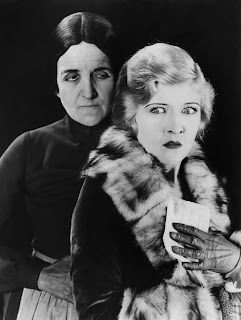 Add in a houseful of greedy relatives, a stormy night and the fact that the will itself has been tampered with—the old man's lawyer opens the safe for the first time in twenty years only to find a still-living moth flapping its wings inside—and you've got yourself the making of a nifty, old-fashioned ghost story.
The cast is populated with unknowns—other than Tully Marshall and Lucien Littlefield, I wasn't familiar with any of them—and the story itself is a hoary old chestnut, but with Leni's expert direction taking full advantage of Charles Hall's set design, the film is a treat from beginning to end, moving like lightning, and fun and spooky in a kids telling ghost stories on Halloween kind of way.
 The film is a fine example of what the Germans called "Expressionism"—an attempt to represent the world in subjective terms, that is to say, distorted to reflect an emotional state rather than an objective one—and as such films as The Cabinet of Dr. Caligari, Nosferatu and this one demonstrate, is well suited to evoking the heightened emotional state necessary for true horror.
 Working with Hall, who later created sets for Frankenstein, Dracula and Bride of Frankenstein, Leni designed a mansion that looks like a cross between Charles Foster Kane's Xanadu and Dracula's lair, a backlit castle more suited to Transylvania than the Hudson River valley, full of impossible corridors narrow yet three stories high with curtains billowing from open windows; massive doors that look like they were carved whole from ancient oaks; chairs big enough to seat Goliath; acres of cobwebs; hidden passages; secret panels; and all of it lit from below as if told by half-frightened, half-giggling kids with a flashlight during a sleepover.
 "I have tried to create sets so stylized that they evince no reality," Paul Leni explained in 1924. "[It] is not extreme reality that the camera perceives, but the reality of the inner event, which is more profound, effective and moving than what we see through everyday eyes."
Unfortunately, Leni died suddenly in 1929 at the age of forty-one, and his name and his films, along with most of the silent era, was quickly forgotten by a movie-going public hungry for the next big thing, talkies.
 But even if Leni himself has been forgotten, his influence hasn't. The film was a huge hit, critically and commer-cially, and has been remade at least five times, the best of them starring Bob Hope. It has also been copied and ripped off, in one form or another, too many times to count, including as The Old Dark House featuring Boris Karloff and Charles Laughton, The Laurel-Hardy Murder Mystery, with, yes you guessed it, Laurel and Hardy, and If a Body Meets a Body starring the Three Stooges.
But don't take my word for it—watch it here yourself, courtesy of the Internet Movie Database and Archive.org, and reflect as you do, just how many times you've seen it, even if you've never seen it.
 Art at Classic Cinema Gold has bestowed the 7x7 Award on the Mythical Monkey. Classic Cinema Gold is devoted to the Golden Age of Hollywood movies and if you aren't familiar with Art's blog, this post might be a good point of entry. Check it out!
Now, on to the Award. You know the drill—answer a set number of questions then bestow the award on the same number of blogs. In this case, seven.
1. Tell everyone something that no one else knows about you.
I have no hidden depths. Beneath the inane chatter about the Beatles, baseball and Buster Keaton is a man who thinks about the Beatles, baseball and Buster Keaton.
 2. Link to one of the posts that I think best fits the following categories:
a. Most beautiful piece: Let's face it: they're all beautiful. On history's list of blog-writing sock monkeys, I am the greatest. But this review of My Man Godfrey (with a Paul Robeson chaser) is sheer poetry.
 b. Most helpful piece: I had hoped this piece advocating the preservation of Pickfair Studios might do some good, but considering that they bulldozed the joint the very next day, I have my doubts.
 c. Most popular piece: This pair of posts (here and here) for the Great Recasting Blogathon proved popular—especially with me.
 d. Most controversial piece: Giving Shirley Temple a Katie Award for acting made some heads explode. And Shirley didn't even stop by to thank me for the effort!
 e. Surprisingly successful piece: I confess I never have any preconceived notions about what you'll like, but I am a bit surprised that I wound up writing this post about Chaplin The Musical at all.
 f. Most underrated piece: Although Jandy at Pretty Clever Films specifically recommended my pick for the Top Ten Films of All-Time to her readers, the fact that Sight & Sound didn't immediately dump their own list for mine was a disappointment.
 g. Most pride-worthy piece: Pride like a banana peel goeth before a fall, but this review of D.W. Griffith's Broken Blossoms is a pretty good measure of how much I've learned about movies in the last three years.
 3. Pass this award on to seven other blogs/bloggers:
Here are seven bloggers (and twitter-ers) who never seem to respond to this sort of thing and thus whose answers might prove interesting:
Mister Muleboy
Erik Beck of the Boston Becks
Peter Bogdanovich
Roger Ebert
Barack Obama
Kim Morgan
Plain Chicken
Eager to see Chaplin The Musical on Broadway but not sure you'll get all the references? Or perhaps you're finally willing to admit you've never seen a Chaplin movie and don't know where to begin. Well, have no fear, the Monkey is here to help you with a list of five Chaplin films that will get you up to speed.
The Gold Rush
 I start here rather than with The Kid because The Gold Rush is not only chock full of Chaplin's best bits, but it's also easier to get hold of. The story of a tramp who searches for gold—and love—in the frozen Klondike, this is the Chaplin movie that has it all: the dancing rolls, the edible boot, the hungry man who thinks his partner is a giant chicken. And rare for Chaplin, a truly happy ending.
Available on both DVD and Blu-Ray from the Criterion Collection, The Gold Rush comes in two versions—the original 1925 silent release and the 1942 release which replaced the intertitles with Chaplin's own voice-over narration. I prefer the original version, but if the thought of a silent movie absolutely positively scares the pants off you, the 1942 version is an acceptable alternative. Now you have no excuses.
The Kid
 Probably Chaplin's most personal work, The Kid—the story of a tramp who raises a foundling child as his own—provides the thematic framework for the Broadway play. And although it wasn't the first feature-length comedy (that was another Chaplin film, Tillie's Punctured Romance), it was the most influential, inspiring both Buster Keaton and Harold Lloyd to make feature-length comedies of their own.
Available for streaming from Hulu-Plus and Amazon-Prime. It's also available as a cheap DVD-R from such companies as Cobra Studios, public domain prints I can't vouch for since they likely don't include the music Chaplin himself scored for the picture in 1971. You can also find it on YouTube and at archive.org, but I can't swear that those aren't pirated copies—and you know how I feel about that sort of thing.
Twenty Minutes of Love
 The Broadway play conflates several of Mack Sennett's everybody-throw-a-pie-and-fall-down comedies into a single short it calls Mabel's Strange Predicament, but in fact, Chaplin made 34 films at Keystone, 17 of which he directed himself. The Rounders with Roscoe Arbuckle might be the best, but Twenty Minutes of Love—Chaplin's first directorial effort—is perhaps the most typical, centering on man, a woman and a bench in L.A.'s Westlake Park.
The best copy of this film is available as part of the magnificent four-disc box set Chaplin at Keystone from Flicker Alley, a collection I would highly recommend to the Chaplin fanatic and/or the silent film historian. For everybody else, public domain copies such as this one are floating around the Internet.
The Rink
 I've written at length (here) about the dozen short comedies Chaplin made for Mutual in 1916 and 1917. The Immigrant was the best, but The Rink—about a waiter who goes rollerskating—provides the basis for a long dance sequence during the Broadway play. That Chaplin could be both graceful and funny on roller skates prompted W.C. Fields to call him "the best ballet dancer that ever lived."
Available in a number of formats, The Rink is usually collected together with the other Mutual films. Unfortunately, the best print of The Rink (and the other Mutuals) is part of an out-of-print collection, The Chaplin Mutuals: The 90th Anniversary Edition but they are available for streaming from Amazon.com.
The Great Dictator
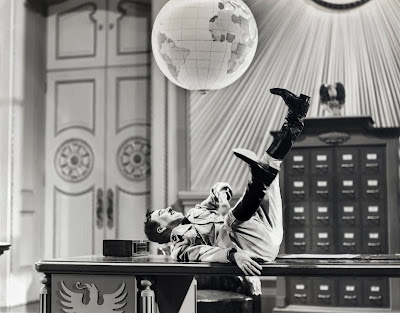 Released during the early days of World War II at a time when America remained stridently isolationist, Chaplin's spoof of Tramp-lookalike Adolf Hitler was also a commercially-risky exposé revealing the antisemitism at the heart of the Nazi regime. Overlong and a wee bit earnest for my tastes, Chaplin's first talkie nevertheless features some of his most imaginative work, including an ethereal sequence where the dictator Adenoid Hynkel cavorts with a globe of the world.
The film ends with a five-minute speech promoting peace and universal brotherhood, ideas apparently abhorrent to anti-Communists who later booted Chaplin out of the country—a conflict that dominates the Broadway play's second act.
Available on DVD and Blu-Ray from the Criterion Collection.

 In case you haven't noticed, I'm mostly marking time in the month of September. Here was a 20-question quiz that showed up a while back at Cinemaniac Reviews.








 Posts


