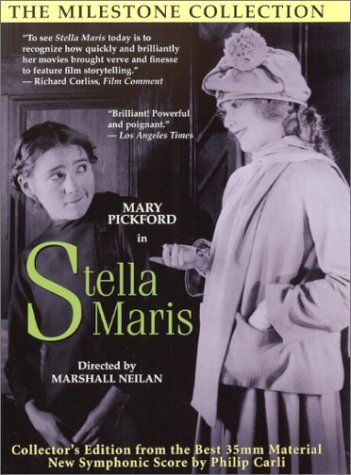
In honor of Mary Pickford's 120th birthday today, here is my long-delayed review of her masterpiece, Stella Maris.
After the critical and commercial triumphs of 1917 made her the most popular—and most powerful—actress in the world (read the story here), Mary Pickford declined to rest on her laurels. Instead, she opted for an even more ambitious project, a dual role that would push the boundaries of both special effects technology and her talent as an actress. The resulting film, Stella Maris, the story of an orphan girl struggling to find love and acceptance in a cruel and indifferent world, was a resounding success with both audiences and critics, and ensured Pickford's place as the most popular actress of the silent era.
Based on a novel by William J. Locke, with a screenplay from the legendary Frances Marion, Stella Maris is a story very much in the tradition of Charles Dickens—and if you regard Dickens as highly as I do, you know that's not a bad thing—filled with melodrama, improbable coincidences, shameless moralizing, biting social commentary, and grim depictions of alcoholism, child abuse and grinding poverty.
Unlike most of Dickens, though, there's no happy ending, at least not for the character we care most about, and while some might call Stella Maris a hokey Victorian melodrama, it's a hokey Victorian melodrama of the first water, a riveting story from beginning to end, and featuring the best performance of Mary Pickford's career.
The film opens on the first of Pickford's two roles, the eponymous Stella Maris. Orphaned in childhood and paralyzed by a mysterious ailment, the beautiful, cheerful Stella lives in a carefully-constructed fantasy world created by a wealthy aunt and uncle, "unaware of sorrow, poverty or death." Her aunt and uncle, a houseful of servants, a dog (played by "Teddy" courtesy of the Mack Sennett studios) and most importantly, a distant cousin, John Risca (Conway Tearle), attend to Stella's every need while cautiously sheltering her from life's harsh realities.
Although Stella was a typical Pickford role—the plucky, perky girl with the curls that America had fallen in love with—the movie is really about Pickford's second character, Unity Blake, an "ugly duckling" with no swan in her future.
In stark contrast to Stella's life of sheltered luxury, Unity has grown up in a grim orphanage, unwanted and unloved, and inured to life's disappointments. She knows that, the old cliche notwithstanding, God frequently doles out more trouble than we can handle, and seemingly for no other reason than a perverse indifference to what human beings call fairness. Through the course of the story, Unity learns many of life's harshest lessons: pretty people flock together; character doesn't trump position, power or money; and regardless of how well we play the hand we're dealt, the game ends the same for everybody—just sooner for some than for others.
From its earliest scenes, the film symbolically establishes Unity as a Christ-figure—note how she is photographed through a sanctuary rood screen, her praying figure framed by a cutout of the cross—and she is the essence of innocence and purity made to suffer for our sins. But if she were only an allegory, Unity would quickly become an insufferable bore. Instead, she's a heartbreakingly three-dimensional girl, hard-working but mischievous, an ugly duckling with a lovely soul, as hopeful as her situation is hopeless.
The lives of Unity and Stella intersect through the man they both come to love, John Risca, who is not only Stella's cousin but who also adopts Unity as a housemaid-servant for his abusive, alcoholic wife. Played with exquisite cruelty by Marcia Manon, Unity's new stepmother goes out of her way to snuff out what light remains in the orphan girl's eyes. Only John's kindness keeps her going.
One of Unity's most poignant scenes is when caressing John Risca's hat and coat, she imagines a romance that will never be, a scene that the staff of the Mary Pickford Institute for Film Education compared to the famous "jacket scene" in the Oscar-winning The Artist. "Mary Pickford's moment is even more affecting, because we know that unlike Peppy Miller, little Unity's dream of romance is doomed from the start, and we fear she will never get her happy ending."
That the result is riveting and moving rather than dreary and overwrought is a testament to Pickford's performance.
To create the character of Unity, Pickford's teeth were darkened, her trademark curls slicked down and pulled into a tight bun, her clothes suitably drab and tattered. But it was the actress's body language and facial expressions that made the transformation from "Little Mary" to Unity so effective. Her back curved from malnourishment, Pickford's Unity carries herself like a dog who's been beaten too much. Her eyes are downcast and look at the world sidewise, and she flinches from very human contact, revealing the years of verbal and physical abuse, and the constant disappointment she has endured.
The transformation is complete yet subtle, and utterly convincing.
"To test the Unity make-up," wrote Felicia Feaster for Turner Classic Movies, "Pickford wandered the studio under the pretense of finding work as a cleaning lady. She was delighted when she discovered that no one recognized her."
To allow Mary Pickford to appear on screen as Stella and Unity simultaneously, director Marshall Neilan and cinematographer Walter Stradling used a "split-screen" technique, exposing one side of the film then the other, to allow the same actor to play two roles in the same scene, a common enough technique now, but here one of the earliest examples if its use in a feature film. (Georges Méliès used both double exposure and matte shots to interact with himself in such early short films as Un homme de tête (1898), Le portrait mystérieux (1899) and L'homme orchestre (1900), while Lois Weber used split-screen in 1913's Suspense to show two people having a phone conversation at the same time.)
For a tale with its feet planted so firmly in the 19th century, it's ironic that Stella Maris should rely so heavily on the most cutting-edge technology that the 20th century then had to offer.
Upon its release in January 1918, the film was an immediate hit with both critics and audiences. Variety called the performance "a revelation," the Los Angeles Times deemed it "brilliant, powerful and poignant" and studio chief Adolph Zukor, who was initially horrified when he visited the set, later called Stella Maris "the most remarkable thing which Mary Pickford has ever done for the screen."
More recently, Dean Thompson at Silents Are Golden wrote, "It is the valiant, hesitant, tender, scrappy figure of Unity Blake, played with truth and immediacy by the most famous and beautiful film star of her day, that stays with us, haunting us still. Mary Pickford, the actress occasionally hidden by the towering figure of 'America's Sweetheart,' could have no finer testimonial to her talent."
Stella Maris was the top grossing movie of 1918.
For director, Marshall Neilan, Stella Maris represented something of a peak. Although he directed three more Pickford films and would continue to direct into the sound era, Neilan suffered from acute alcoholism that often left him unable to work. In fact, on at least one of their collaborations, Pickford is alleged to have directed the entire film (uncredited) while the chronically intoxicated Neilan watched in amusement. In 1933, she gave him one last chance to direct, Secrets which turned out to be her final film, but quickly replaced him with Frank Borzage when Neilan couldn't function on set. He died in 1958.
Pickford, meanwhile, followed up Stella Maris with an unbroken string of hits—Amarilly of Clothes-Line Alley, M'Liss, Daddy-Long-Legs, Pollyanna, Suds, a remake of Tess of the Storm Country, Sparrows (the last of her little girl roles and one of her best), and My Best Girl (which I wrote about here), before winning the Oscar as best actress for 1929's Coquette.
She retired in 1933, another silent victim of the sound era's changing tastes.
As I recently wrote, Mary Pickford "was, pound-for-pound, the most powerful woman in Hollywood history, simultaneously an international superstar, a studio owner, a producer, a de facto director, an Oscar winner, and the queen of the Hollywood social scene." Stella Maris didn't feature Pickford most typical performance, but it was her greatest.
Stella Maris is my pick for the best movie of 1918.
If Georges Méliès, the first truly great director in movie history, were alive today, he'd be celebrating his 150th birthday. Appropriately enough, Méliès is back in the national consciousness thanks to Martin Scorsese's latest film, Hugo, a 3D children's movie for adults, which I plan to see soon, maybe this weekend! In honor of the great Georges Méliès, here's a repost of my essay on the birth of cinema. Trying to say definitively who invented the movies is a little like trying to say who invented fire—the records are sketchy, everybody who knows for certain is dead, and what evidence that does remain comes largely from the self-serving accounts of Thomas Edison's patent lawyers.
And where do you start, which is to say, what was the first indispensable step toward what we now think of as motion pictures? If I knew his name, I'd say it was the first caveman who thought to entertain his neighbors with shadow puppets and firelight. In fact, two of the key elements of film, movement and representation, have been staples of art and entertainment since at least the ancient Greek stage.
Turner Classic Movie's recent documentary, Moguls and Movie Stars, began with seventeenth century Dutch mathematician Christiaan Huygens who in 1659 invented the magic lantern show—a process of projecting light through a painted slide onto a wall or screen—and in terms of being entertained while sitting in the dark looking at pictures on a wall, the magic lantern is a reasonable place to start a history of the movies. Over the course of the two hundred years that followed, these magic lantern shows became quite sophisticated—by stacking slides one in front of the other and manipulating them, a projectionist could create the illusion of movement—and were one of the most popular forms of entertainment during the 19th century.
And then there was Eadweard Muybridge, who on a bet took a series of photographs in 1872 of a galloping horse to prove that all four of its hooves leave the ground simultaneously when it runs. Strung together on a glass cylinder and spun quickly enough, this "magic lantern show gone mad" created the illusion of a horse in motion. Muybridge also had a fondness for photographing nude models performing mundane tasks and audiences had a fondness for paying to see them, proving once again that pornography often drives the acceptance of new media. (Also check out Étienne-Jules Marey who similarly used a "chronophotographic gun" to capture remarkable images of birds in flight.)
But if we think of movies as something involving a strip of film and a projector, then I think the history of movies starts with Louis Aimé Augustin Le Prince who in 1888 used a single-lens camera and paper film produced by George Eastman to film two seconds worth of fashionable men and women walking around a garden in Roundhay, England. Along with equally brief footage of horse and buggy traffic crossing a bridge in Leeds, Le Prince is generally credited with producing the first "films" in movie history.
Alas for Le Prince, while preparing for a cross-Atlantic trip to exhibit his invention in New York, he boarded a train bound for Paris in 1890 and literally vanished without a trace. Although theories abound—suicide, fratricide, assassination—his disappearance has never been explained. In fact, investigators turned up no leads at all and the case went cold until just seven years ago, when, while combing through its nineteenth century archives, Paris police found a photograph dating from 1890 of an unidentified drowning victim who bore a resemblance to Le Prince. But whether it was positively him or how he might have drowned on a moving train, no one can say.
After Le Prince, the story of film picks up with Charles-Émile Reynaud. A French science professor who directed and exhibited what may have been the world's first animated film, Pauvre Pierrot ("Poor Pete"), his most lasting contribution to film history was the invention of a camera that recorded images not on photographic plates but on perforated film advanced by sprockets, resulting in longer filmed sequences than a cylinder or drum would allow.
Reynaud demonstrated his camera-projector, which he called the Praxinoscope Théâtre, at the Paris Exposition Universelle in 1889 (the one with the Eiffel Tower). In the audience was the famed American inventor Thomas Alva Edison who had been struggling to come up with his own movie camera without much success. By his own admission, two of Edison's greatest inventions were credit stealing and patent lawyers, deploying armies of the latter to accomplish the former—along with the light bulb, his most lasting and influential contributions—but he later insisted that his epiphany that the future of motion pictures depended on perforated film on sprockets was purely coincidental. The U.S Patent Office agreed.
"Everyone steals in industry and commerce," he said later. "I've stolen a lot myself. The thing is to know how to steal." (An idea he no doubt stole from his attorneys.)
Reynaud died penniless, but Edison—or more precisely his assistant William K.L. Dickson—ran with Reynaud's ideas (and, I don't know, maybe some of his own), and by 1894 created what he called the Kinetoscope, essentially a "peepshow" housed in a bulky cabinet, whereby the bored and the curious could one at a time watch brief films for a nickle. The movies were neither artistic nor adventuresome—just brief scenes of men sneezing, couples dancing, Annie Oakley shooting—but for a time at least the paying public was enthralled.
It was two French brothers, however, Auguste and Louis Lumière, who first thought to exhibit movies not to one person at a time but to a theater full of paying customers. Starting their careers in film as assistants in their father's photographic firm, the brothers—Louis as the inventor, Auguste as the business manager—developed a new and improved camera-projector. Where Edison's Kinetoscope was bulky and hard to maintain, the Lumières' combination camera-projector, the cinématographe, was light and mobile and relatively easy to use. In December 1895, these two brothers rented a hall in Paris and charged the public admission to see their new invention—the first time in history an audience paid money to see a motion picture in a theater.
Here in its entirety is that groundbreaking film, Arrival of a Train at La Ciotat:
I've said it before and I'll say it again, the only proper way to study movie history is to watch movies, and when I sat down and watched a couple of dozen of the Lumière brothers' best-known movies (judging by the number of votes they've received on the Internet Movie Database), it quickly became clear that while the Lumières may have invented the camera, they didn't have a clue what to do with the camera. Their films never progressed beyond fifty-second home movies of whatever they happened to be standing near—trains entering a station, babies eating breakfast, etc.—audiences quickly grew jaded and early in the 20th century, the brothers famously concluded that "the cinema is an invention without any future." Instead, they turned their full attention to photography, finding their lasting success with a color photographic process, the Autochrome Lumière, which they patented in 1903.
It was instead another Frenchman, Georges Méliès, who was the first to grasp the unique potential of the new motion picture technology. A stage magician by trade, Méliès saw movies as a successor to the tradition of fanciful entertainments. Where Edison and the Lumière brothers used their cameras to record reality, Méliès realized that through editing and photographic trickery, film could be used to create a new reality, one that could never exist apart from film. It was perhaps the single greatest insight in movie history.
Among his many movies, one, Le Voyage Dans La Lune (A Trip To The Moon), from 1902, is perhaps the one indispensable film from the first quarter century of film history and gave us the single most famous movie image before Charlie Chaplin first donned his little tramp outfit.
I'll grant you, A Trip To The Moon is a relic by the standards even of the decade that followed it, but it was also wholly original, deriving from nothing before it, inspiring so much of what came after it, and containing images that are still unique and unforgettable despite the passage of a century's worth of filmmaking. Or to put it another way, that The Simpsons could spoof A Trip To The Moon as an Itchy and Scratchy cartoon (in French, no less) without the need to explain it, tells you all you need to know about how much a part of the culture Méliès really is.
Unfortunately, Méliès wasn't much of a businessman, and Edison and his lawyers were able to copy prints of A Voyage To The Moon and exhibit them in the United States without paying royalties. Too, Méliès stopped progressing as a filmmaker. His 1912 movie, The Conquest Of The Pole, for example, could have been made a decade earlier in terms of its sets, acting, storyline and editing, and while D.W. Griffith later said of Méliès "I owe him everything," Griffith and others quickly surpassed him in terms of artistry and technique.
Méliès went bankrupt in 1913 and wound up selling toys in Paris's Gare Montparnasse train station. He was awarded the Légion d'honneur in 1932 and died six years later.
Méliès's story is a none-too-subtle reminder that while movies are the greatest art form of the 20th century, they're also a business, and whatever else you can say about Thomas Edison, he did figure out how to make money from the movies and to popularize the medium. While men such as Le Prince and the Lumière brothers were more clever inventors and Méliès was a superior artist, it was Edison who made movies pay, and his realization that nobody was going to buy a film projector if there were no films to project on it may have been the second greatest insight in movie history. Certainly the most practical.
A variety of men made movies at Edison's behest, but the two most important were the aforementioned W.K.L Dickson and Edwin S. Porter. Dickson was primarily an inventor and his contributions as a filmmaker are largely those of a cinematographer recording his own experiments. His first works, the first American films, are simple scenes filmed in his own workshop—men blacksmithing, sneezing or shaking hands.
These snippets of life provided the content of Edison's peepshows and in the beginning were sufficient to satisfy the public's curiosity. But with more interesting films arriving from the Lumière brothers and especially Méliès, Edison realized he needed more substantial fare if his fledgling film company was to survive. Edison put Porter, who had formerly worked as a touring projectionist for a rival company, in charge of motion picture production at his New York studios, and there Porter set to work filming not just workplace scenes, but stories.
Porter directed more than one hundred eighty films between 1898 and 1915, but far away the most important and enduring of them is the 1903 western, The Great Train Robbery.
"In literature and music, as well as movies," Daniel Eagan wrote in America's Film Legacy, his collection of essays about the National Film Registry, "the past can seem slow, obvious and at times filled with odd, unexpected touches too far removed from our experiences to decipher easily—which makes The Great Train Robbery an even more remarkable achievement. The blockbuster of its time, it has lost none of its power to entertain over the past hundred years."
Put simply, The Great Train Robbery was the first great American film. Not only is the shot of Justus Barnes firing a Colt revolver directly at the camera one of the most indelible images in movie history, but Porter grasped that unlike with the stage, the "best seat in the house" was wherever the camera needed to be to show the action. Porter placed his camera on top of a movie train or riding along with the outlaws on horseback, a "conceptual leap" (Eagan again) that puts the film a decade ahead of its time.
Porter's use of jump-cuts, cross-cutting, matte shots and hand-tinted frames was equally cutting-edge, and that the film also established the narrative conventions for decades of westerns to come makes The Great Train Robbery the most important American film before The Birth Of A Nation a dozen years later.
Despite the commercial success of The Great Train Robbery, neither Porter nor his boss were comfortable with the film's technical and storytelling innovations, and thereafter, to the disappointment of the ticket-buying public, the studio's product reverted to more conventional forms. A Trip To The Moon notwithstanding, ultimately the one thing Thomas Edison couldn't steal was quality and within a few years, immigrant entrepreneurs such as Adolph Zukor and Carl Laemmle and directors such as D.W. Griffith equaled then surpassed Edison as a filmmaker. The company lost steam, Porter left Edison's employ in 1909 and an adverse ruling in an anti-monopoly case in 1915 exacerbated the decline. With the coming of World War I and the closing of the European market, Edison sold his studio and abandoned film altogether.
It was an ironic and somehow fitting end to the master inventor-thief's involvement in the history of motion pictures.
If you're only going to see one comedy about adulterous insects this year, make it The Cameraman's Revenge!
Seriously, it's one of the best short movies of the entire silent era.
1912 PICTURE winner:Mest kinematograficheskogo operatora a.k.a. The Revenge of a Kinematograph Cameraman, a.k.a. The Cameraman's Revenge (prod. Aleksandr Khanzhonkov)
nominees:How A Mosquito Operates (prod. Winsor McCay); The Land Beyond The Sunset (prod. Edison Company); The Musketeers Of Pig Alley (prod. Biograph Company); Richard III (prod. J. Stuart Blackton and M.B. Dudley)
ACTOR winner: Elmer Booth (The Musketeers of Pig Alley)
nominees: Martin Fuller (The Land Beyond The Sunset; Max Linder (The Pathé Frères Comedies)
ACTRESS winner: Dorothy Bernard (The Girl And Her Trust)
nominees: Lillian Gish (The Unseen Enemy and The Musketeers Of Pig Alley); Mary Pickford (The New York Hat); Ynez Seabury (The Sunbeam)
DIRECTOR winner: Wladyslaw Starewicz (Mest kinematograficheskogo operatora a.k.a. The Revenge of a Kinematograph Cameraman, a.k.a. The Cameraman's Revenge)
nominees: D.W. Griffith (The Biograph Shorts); Harold M. Shaw (The Land Beyond The Sunset)
SCREENPLAY winner: Dorothy G. Shore (The Land Beyond The Sunset)
nominees: D.W. Griffith and Anita Loos (The Musketeers Of Pig Alley); Wladyslaw Starewicz (Mest kinematograficheskogo operatora a.k.a. The Revenge of a Kinematograph Cameraman, a.k.a. The Cameraman's Revenge)
SPECIAL AWARDS G.W. "Billy" Bitzer (Cinematography) (The Musketeers Of Pig Alley)
Still expanding the Silent Oscars backwards—what can I tell you, I accidentally learned too much about old silent movies to keep my opinions to myself.
I'm not picking supporting actors for the years before 1914. Basically, the way movies were filmed in those days, with relatively simple stories and few close-ups, actors other than the stars were just props, no more three dimensional than some of the sets they stood in front of. Hell, three dimensional? They were barely two dimensional, mostly just standing there so the star wouldn't get lonely.
Oh, and when I say Fantômas, I mean the entire five film serial ... 1913 PICTURE winner:Fantômas (prod. Romeo Bosetti) nominees:Der Student von Prag (prod. Deutsche Bioscop GmbH); Sumerki zhenskoi dushi a.k.a. Twilight Of A Woman's Soul (prod. Aleksandr Khanzhonkov); Suspense (prod. Rex Motion Picture Company); Traffic In Souls (prod. Jack Cohn and Walter MacNamara)
ACTOR winner: Roscoe Arbuckle (The Keystone Comedies) nomiees: René Navarre (Fantômas); Paul Wegener (Der Student von Prag)
ACTRESS winner: Hilda Borgström (Ingeborg Holm) nominees: Lillian Gish (The Mothering Heart); Mabel Normand (The Keystone Comedies)
DIRECTOR
winner: Lois Weber and Phillips Smalley (Suspense) nominees: Yevgeni Bauer (Sumerki zhenskoi dushi a.k.a. Twilight Of A Woman's Soul); Louis Feuillade (Fantômas)
SCREENPLAY winner: Louis Feuillade, from the novels by Marcel Allain and Pierre Souvestre (Fantômas) nominees: Victor Sjöström, from a play by Nils Krok (Ingeborg Holm); Walter MacNamara, from a story by George Loane Tucker (Traffic In Souls)
SPECIAL AWARDS Nikolai Kozlovsky (Sumerki zhenskoi dushi a.k.a. Twilight Of A Woman's Soul) (Cinematography)
I'm back in my office after a week of nursing the family dog—we had the torn ligament in her knee surgically repaired—and I'm working away at my essay on the films of 1917.
In the meantime, why not check out this public domain copy of The Poor Little Rich Girl, arguably the most important film Mary Pickford ever made.
"Why is that, Monkey?"
Glad you asked:
● Her insistence that friend Frances Marion write it over Cecil B. DeMille's objection led to what may have been the first instance of a star firing a director.
● Despite the studio's certainty that it would flop, the film was a huge success and enable Pickford to renegotiate her contract, giving her $10,000 a week, 50% of her film's profits and complete creative control.
● And finally, Pickford also invented "indirect lighting" for this film—while putting on her makeup, she noticed that light shining from a hand-held mirror created a flattering effect, an effect she insisted director Maurice Tourneur recreate on the set. The technique soon became the industry standard and moviemakers have been lighting films in this manner ever since.
Well, at least that's what they tell me. In any event, without further ado, The Poor Little Rich Girl.
I'm racing along trying to finish Part Five of my essay covering the years 1906-1914, which I absolutely must post by tomorrow so I can post my essay about The Birth of a Nation on the 150th anniversary of the beginning of the American Civil War, which is Tuesday, in case you didn't know.
In the meantime, here's another short I think you should see, which unfortunately I'm only otherwise going to mention in passing. The Land Beyond The Sunset, written by Dorothy G. Shore and directed by Harold Shaw, is a touching tragedy that goes right to the heart of what storytelling is all about. It also boasts a couple of film techniques common today but nearly unheard of in 1912—the lap dissolve, which is where the end of one scene fades out as the next scene fades in; and the double exposure to show a character's thoughts.
At the time, these effects had to be created in the camera, by filming a scene then cranking the film back and double exposing it. The lap dissolve was especially difficult because the cameraman had to gradually close down the lens to create the fading out effect, and gradually open it up to fade in. And of course no one would know until the film was developed whether the effect had been successful.
Documentaries and Animation ● In the years between The Great Train Robbery (1903) and D.W. Griffith's first film in 1908, the most interesting films were documentaries. Although in form, they more resemble "newsreels" than what we now think of as documentaries, these short films provided audiences of the time a window into people and places they might otherwise have never seen and continue to offer an insight into the era for historians.
● The first great documentarians were the Lumière brothers, Auguste and Louis, who I wrote about at some length in a previous post. Their forays into documentary film making were more in the nature of experiments with their newly-invented camera, mostly recording scenes from the world around them although they did occasionally film newsworthy events, such as the arrival of delegates to a conference on photography in 1895. The Lumière brothers abandoned movies altogether in 1900, famously declaring "the cinema is an invention without any future."
● One of the first American docum- entarians was G.W. "Billy" Bitzer. Better known now as D.W. Griffith's cinematographer, Bitzer began his career making film shorts, first collaborating with W.K.L. Dickson after the latter left Thomas Edison's lab, then later at the American Mutoscope Company, the forerunner of Biograph. Bitzer filmed hundreds of shorts, such as Film Registry title Westinghouse Works and Arrival of Immigrants at Ellis Island. In 2003, the International Cinematographers Guild named Bitzer one of the ten most influential cinematographers of all time.
● Footage of the 1906 San Francisco earthquake proved once and for all the power of the new film medium. Perhaps the most interesting of the many shorts emerging from the disaster is A Trip Down Market Street Before The Fire, which by happenstance was filmed four days before the San Francisco earthquake. Coupled with footage shot at the same locations immediately after the earthquake, the devastation is still shocking. Imagine what it must have been like to see this footage in 1906, the first time in history the public could bear witness to a catastrophe that had happened a world away. (I encourage you to click the fullscreen function when you watch this.)
● A pair of feature-length documentaries from 1914 show the diverging approaches to the form. In the Land of the War Canoes, Edwin S. Curtis used staged re-enactments and fictional events to show the life of an aboriginal tribe in British Columbia, aiming more for entertainment than veracity. That same year Vilhjálmur Stefánsson brought back actual footage of his own disastrous expedition to the Arctic. (I'd tell you that the latter style of documentary eventually won out, but the fact is documentarians such as Michael Moore stage events for the camera to this day.)
● The fields of animation and stop-action photography also made significant strides during the pre-Griffith film era.
● Émile Cohl was a well-known caricaturist working in Paris who got into the motion picture business when he spotted a movie poster design obviously stolen from one of his drawings. To placate Cohl, the management of the Gaumont Film Company (the oldest studio in the world) offered him a job on the spot, mostly turning out short animation sequences for insertion into live-action films. In 1908, Cohl drew and directed a two-minute film, Fantasmagorie, believed to be the first all-animated film in history. [But see the discussion in the comments section where Matthew Blanchette and I agree that the distinction should go to Charles-Émile Reynaud's Pauvre Pierrot.] ● In America, J. Stuart Blackton took an early stab at animation with such shorts as The Enchanted Drawing and Humorous Phases of Funny Faces, a series of faces chalked up on a canvas and a blackboard, respectively, but it was Winsor McCay who earned the title as America's first great animator. Already a successful newspaper cartoonist, McCay was inspired by his son's cartoon "flip" book to turn four thousand ink drawings based on his comic strip "Little Nemo" into a film cartoon.
After the success of Little Nemo, McCay signed with the William Randolph Hearst newspaper chain where he continued with his work in the field of animation. In 1914, he produced his most famous character, Gertie The Dinosaur, often credited as the first anthropomorphic cartoon character. McCay toured with the country with the film, "interacting" with Gertie in front of the audience, using a whip to coax her out from behind an outcropping of rock and even feeding her an apple.
● Known as the "Spanish Méliès," Segundo de Chomón special- ized in surreal optical effects films. Working in France for Pathé, Chomón successfully combined miniatures and live-action, pioneered hand-tinted film and invented the "film dolly" which allowed complex tracking shots. As a director, he was known for his trick photography—for example, building one short (The Electric Hotel around a suitcase that unpacked itself, and another (Les Kiriki) around a troupe of Japanese acrobats who perform impossible stunts. Later he provided the special effects work in important feature-length films such as Cabiria (1914) and Abel Gance's Napoleon.
● For my money, though, the best of these early animation pioneers was Wladyslaw Starewicz (he later changed his name to Ladislas Starevich when he moved to France). Born in Moscow to Polish parents, Starewicz was the director of the Museum of Natural History in Lithuania when he inadvertently embarked on a film career. Attempting to document on film a fight between two male stag beetles, Starewicz was frustrated by the insect's nocturnal nature—whenever the camera's lights were turned on for filming, the bugs invariably rolled over and went to sleep—but rather than give up, Starewicz made two models of the beetles with wax and wire, and staged the fight using stop-motion photography.
The result, Lucanus Cervus, was a sensation and Starewicz became a full-time director. In 1912 he made his best film, The Cameraman's Revenge, in which an adulterous insect is captured on film by her cuckolded husband then invited with her unwitting lover to the film's premiere at the local cinema:
Starewicz was decorated by the czar and won the Gold Medal at an international film festival in Milan in 1914, but fled Russia after the October Revolution in 1917. He continued to make films for the rest of his life, dying in 1965 while working on the film Like Dog and Cat.
[To read the first entry in this series, The Silent Oscars: 1888-1905, click here.]
Must-See Movies:The Story of the Kelly Gang (1906);A Corner in Wheat (1909); The Country Doctor (1909); The Lonely Villa (1909);Winsor McCay, the Famous Cartoonist of the N.Y. Herald and His Moving Comics, a.k.a. Little Nemo (1911); The Land Beyond the Sunset (1912); Mest kinematograficheskogo operatora a.k.a. The Revenge of a Kinematograph Cameraman, a.k.a. The Cameraman's Revenge (1912); The Musketeers of Pig Alley (1912); An Unseen Enemy (1912); Suspense (1913); Cabiria (1914); Judith of Bethulia (1914); Tillie's Punctured Romance (1914) Recommended Films:Dream Of A Rarebit Fiend (1906); Le théâtre de Bob (1906); A Trip Down Market Street (1906); Fantasmagorie (1908); Moscou sous la neige a.k.a. Moscow Clad in Snow (1909); Afgrunden (1910); The Lonedale Operator (1911); Max Victime du Quinquina a.k.a. Max Takes Tonics (1911); The Battle at Elderbush Gulch (1913); Der Student von Prag (1913); Fantômas (1913-14); Ingeborg Holm (1913); Twilight of a Woman's Soul (1913); The Avenging Conscience: or "Thou Shalt Not Kill" (1914); The Rounders (1914) Of InterestLa vie du Christ a.k.a. The Birth, the Life and the Death of Christ (1906); Swords and Hearts (1911); Richard III (1912); The Bangville Police (1913); Traffic in Souls (1913); Gertie The Dinosaur (1914); The Squaw Man (1914)
● The twelve years between The Great Train Robbery (1903) and The Birth Of A Nation (1915)—what the blog Film: Ab Initio calls "cinema's forgotten decade"—might be the least known years in all of movie history. Yet it was during these years that movies developed from a novelty into the most popular art form of the 20th century:
» D.W. Griffith took basic techniques introduced by his contemporaries and used them in ways so imaginative, he virtually invented the "language" of film we now take for granted.
» Speaking of language, a new concept entered the lexicon—"movie star"—with audiences for the first time flocking to theaters to see specific performers, among them Charlie Chaplin, Mary Pickford, Roscoe "Fatty" Arbuckle, Mabel Normand and Lillian Gish.
» And the idea of what constituted a movie evolved from brief, simplistic snippets viewed through coin-operated "peep shows" to ambitious, feature-length projects with complex storylines and characters.
● It's often difficult to discern evolution as it is occurring. It's especially difficult to see when the evidence remained squirreled away in studio vaults for half a century while critics and public relations men spun up easy to grasp narratives of film's history that sold tickets but did little to describe the true events. Fortunately, historians such as Kevin Brownlow and David Bordwell, among others, have devoted their careers to setting the record straight; and blogs such as 100 Years of Movies, Alt Film Guide, the aforementioned Film: Ab Initio, and others, have taken on the task of watching these early films and reporting on their efforts in thoughtful essay form.
And then there are crazy people like me who try to swallow the entire decade in one, 170+ movie sitting and boil it all down to a single, indigestible post.
● All of the movies on my must-see list (and many, many more) are now readily available to view. (I've only seen the first episode of the twenty-part serial The Perils Of Pauline, else it would make the list as well.) I can tell you from personal experience, if you watch movies in chronological order starting with those two-second fragments from Louis Le Prince in 1888 and work your way forward, film techniques so commonplace now as to be invisible to a modern fan will jump off the screen and you'll find yourself saying aloud, "Thank you, D.W. Griffith, for rescuing me from yet another static, single-shot movie where the actors mill around like ants."
D.W. Griffith and the Invention of a Film Language
● Speaking of David Wark Griffith, he was born in Kentucky to Confederate colonel "Roaring Jake" Griffith and Mary Perkins. He had aspirations of being a Broadway playwright, took small acting parts in movies for the money then switched to directing when he discovered it paid better. He directed his first movie, the twelve-minute short The Adventures of Dollie, in 1908 working from instructions written out on a single sheet of shirt cardboard by his cinematographer G.W. "Billy" Bitzer.
Over the course of the following five years, Griffith directed just shy of five hundred movies, mostly for the Biograph Company located in New York City.
● Like every other director of that era, Griffith wrestled with the problem of narrative—how to tell a story in a silent medium—but whereas other directors simply parroted the techniques that worked on stage and wound up with actors in togas milling around in front of painted backdrops, Griffith seemed to understand from the outset that film presented its own unique set of problems and opportunities. By composing his actors within the frame, by relying on revealing actions rather than words and, especially, by juxtaposing images and events through editing, Griffith was able to create within his audience an emotional involvement in his stories.
● A trio of short films from 1909 illustrate Griffith's gift at composing the frame, staging action, and creating suspense with pacing and editing.
» One of five Griffith films preserved in the National Film Registry, A Corner In Wheat is overpraised (to my mind) for being the first "message" picture, but its use of composition is masterful. Lone figures confined to the corner of the screen, overwhelmed by empty vistas, conveying through image alone the desperation the characters feel, could have come straight from an Edward Hopper painting—except that A Corner In Wheat pre-dates Hopper's breakthrough as an artist by some fifteen years.
» The Country Doctor opens with a panning shot which if you'd just watched 100+ movies from the years that preceded it, believe me, jumps off the screen with its technical sophistication. Starting with a long shot of a valley, then panning to a house on a hill to focus on a family already emerging to walk forward until they stand in medium shot, Griffith establishes with a single uninterrupted camera movement both the story's setting and the identity and socio-economic status of its characters, the sort of camera shot we take for granted now but which pretty much didn't exist before him.
That only a year into his career as a director, he concluded the tragic story with a mirror of that opening shot, panning from the now-empty house as the film ends to that same long shot of the valley, underscores just how quickly he raced ahead of his competitors in using film to convey emotion.
» Griffith didn't invent intercutting (a.k.a. cross-cutting)—the use of editing to alternate between two locations, usually to show simultaneous action—but he took it farther than anyone before him, using it not just to, say, show a key prop or establish a location, but to create a narrative flow and a sense of anticipation that was sorely lacking in early movies. In the thriller The Lonely Villa thieves break into a secluded country home and terrorize a woman and her children while her husband and the police race to their rescue. Griffith cuts back and forth between three points of view to create genuine suspense—will the would-be rescuers arrive in time to save the day?—an editing technique still used to this day.
(Griffith would return to this theme time and again, most memorably in 1911 with The Lonedale Operator and in what is perhaps the most controversial sequence of The Birth Of A Nation, where the Ku Klux Klan rides to the rescue of Lillian Gish's virginity.)
● Griffith continued to develop new approaches to film storytelling throughout his career at Biograph.
» For example, in 1911's two-part short Enoch Arden—a wife stands on the shore waiting for her husband's return from the sea while at that moment the husband is shipwrecked and washed ashore on a tropic island—Griffith uses cutting not just to show the same action from different points of view as in The Lonely Villa, or even to establish that the action is simultaneous, but to show parallel storylines linked only by the emotional resonance between them. Griffith cuts back and forth between the two storylines—the shipwrecked sailor, the wife who waits—for the remainder of the film, showing the analogous plights of the castaway and his (presumed) widow as they each struggle to survive.
(By the way, I suggest that if you watch the copy of Enoch Arden I've embedded here, you mute the sound—the accompanying soundtrack doesn't fit the mood in the least.)
» The Musketeers Of Pig Alley (1912) (you can see it here) is credited with being the first gangster movie and while its story of a thug who robs the husband of the woman he fancies is well worth watching in its own right, the film is remarkable for another startling leap in film technique, in this case the likely invention of what is now called "follow-focus"—the practice of having the camera operator keeping moving actors in focus while allowing the background to go out of focus. At a time when cameramen prided themselves on keeping the entire frame in focus, Griffith's longtime cinematographer Billy Bitzer was reluctant to follow Griffith's direction in this instance and only acceded to his request after Griffith took him to an art museum to look at paintings where the foreground subjects were in sharper focus than the background. (Indeed, Griffith got many of his ideas while strolling through New York's museums.)
» Another of Griffith's innovations was the use of the iris shot, which Tim Dirks defines as "an earlier cinematographic technique or wipe effect, in the form of an expanding or diminishing circle, in which a part of the screen is blacked out so that only a portion of the image can be seen by the viewer." The iris shot was typically used to open or close scenes, and to focus the viewer's attention on a single character or action, but in more sophisticated instances (again, credit Griffith) it could be used to link characters thematically.
» Griffith also pushed his actors to adopt a more subtle acting style, eschewing the dramatic poses of the stage for something more reserved, which he thought played more effectively on the screen. The change was incremental, and sometimes you can see both styles in the same scene, but when compared to other films of the era, the difference is striking. Among those actors who worked with Griffith at Biograph were Mary Pickford, Lillian Gish, her sister Dorothy, Henry Walthall, Mae Marsh, Harry Carey, Mack Sennett, Donald Crisp, Robert Harron, Constance Talmadge and Florence Turner.
● That we take Griffith's storytelling techniques for granted now—that every movie made in the last one hundred years has repeated these same tricks as a matter of routine—is a testament to just how innovative and influential he really was.
● In 1914, Griffith made his first feature-length film, Judith of Bethulia. Based on a book from the biblical apocrypha, Judith is the story of a beautiful young widow who sacrifices her own sense of virtue to seduce the leader of an invading army and save her people. Aside from its place in film history as one of the earliest feature-length films produced in America (the rest of world had been producing feature films since 1906), Judith of Bethulia features an early example of what is known as "classical continuity editing" or "classical Hollywood narrative"—the practice of cutting within a scene to make clear to the viewer at all times where the characters are in relationship to each other and to their surroundings, both in terms of the physical space and the chronology of the film story.
A good example comes early in the film. Griffith starts with a wide shot of seated figures threshing wheat, holding on them until Robert Harron enters the screen from the left—
and crosses to the far right where he sees something in the distance.
Griffith then cuts to a medium shot of Mae Marsh at a well, back to a wide shot to establish where she is in relation to her surroundings, then to the medium shot again to show Marsh's face as she struggles with the water jug. Griffith cuts back to the wide shot as Robert Harron enters from the left then cuts on his act of helping Marsh to a medium two-shot so you can see Marsh's face as she reacts to his kindness—
then finishes the scene with a wide shot as the couple walks off the screen, holding on the empty screen until someone else enters to draw water at the well. (You can watch Judith of Bethulia in its entirety here.)
The use of classical continuity editing—as opposed to the then-typical practice of having all the actors remain on screen in the same full shot throughout the scene, what David Bordwell calls the "tableau" style—became the industry standard by 1917, but its use in Judith of Bethulia was very advanced for its day and, again, I have to tell you that after plowing through more than two hundred movies made before 1915, all of them using the same tableau set-up, to suddenly see such sophisticated compositions and editing, well, the effect is startling. And a relief.
Although a critical success, Judith of Bethulia was extremely expensive to film and Biograph declined to finance Griffith's further ambitions in this direction. As a result, Griffith struck out on his own, taking his film crew and troop of actors with him. Within a year, Griffith would film The Birth of a Nation, the most lucrative film of the early silent era; Biograph was out of the film business by 1916.
● By ignoring this era of film history, critics have wound up overstating the significance of The Birth Of A Nation as a revolution in film technique. Every technique Griffith supposedly invented in The Birth of a Nation, he had already developed and mastered during his years at Biograph Studios. Likewise, because that film's racism wound up overshadowing his entire career, casual film fans have undervalued Griffith's impact as an artist and innovator.
● Ultimately, Griffith's reward for showing the world how to tell stories on film was to find himself left behind by filmmakers who used his techniques to tell better stories. To a great degree, this was his own fault. As you watch Griffith develop a film language, you can also see him develop the bad habits that would ultimately cost him his audience—his reverence for an outdated Victorian value system, his obsession with female virtue, particularly when Lillian Gish takes over the lead acting chores from Mary Pickford, and an appalling tendency in his Civil War films to sentimentalize, or worse justify, America's brutal system of racial apartheid—vices which have not only dated badly in our 21st century eyes, but which began to alienate audiences as early as the end of the First World War.
Named for Katie-Bar-The-Door, the Katies are "alternate Oscars"—who should have been nominated, who should have won—but really they're just an excuse to write a history of the movies from the Silent Era to the present day.
To see a list of nominees and winners by decade, as well as links to my essays about them, click the highlighted links:
Remember: There are no wrong answers, only movies you haven't seen yet.
The Silent Oscars
And don't forget to check out the Silent Oscars—my year-by-year choices for best picture, director and all four acting categories for the pre-Oscar years, 1902-1927.
Look at me—Joe College, with a touch of arthritis. Are my eyes really brown? Uh, no, they're green. Would we have the nerve to dive into the icy water and save a person from drowning? That's a key question. I, of course, can't swim, so I never have to face it. Say, haven't you anything better to do than to keep popping in here early every morning and asking a lot of fool questions?

 After the critical and commercial triumphs of 1917 made her the most popular—and most powerful—actress in the world (read the story here), Mary Pickford declined to rest on her laurels. Instead, she opted for an even more ambitious project, a dual role that would push the boundaries of both special effects technology and her talent as an actress. The resulting film, Stella Maris, the story of an orphan girl struggling to find love and acceptance in a cruel and indifferent world, was a resounding success with both audiences and critics, and ensured Pickford's place as the most popular actress of the silent era.
 The film opens on the first of Pickford's two roles, the eponymous Stella Maris. Orphaned in childhood and paralyzed by a mysterious ailment, the beautiful, cheerful Stella lives in a carefully-constructed fantasy world created by a wealthy aunt and uncle, "unaware of sorrow, poverty or death." Her aunt and uncle, a houseful of servants, a dog (played by "Teddy" courtesy of the Mack Sennett studios) and most importantly, a distant cousin, John Risca (Conway Tearle), attend to Stella's every need while cautiously sheltering her from life's harsh realities.
 Although Stella was a typical Pickford role—the plucky, perky girl with the curls that America had fallen in love with—the movie is really about Pickford's second character, Unity Blake, an "ugly duckling" with no swan in her future.
 From its earliest scenes, the film symbolically establishes Unity as a Christ-figure—note how she is photographed through a sanctuary rood screen, her praying figure framed by a cutout of the cross—and she is the essence of innocence and purity made to suffer for our sins. But if she were only an allegory, Unity would quickly become an insufferable bore. Instead, she's a heartbreakingly three-dimensional girl, hard-working but mischievous, an ugly duckling with a lovely soul, as hopeful as her situation is hopeless.
 One of Unity's most poignant scenes is when caressing John Risca's hat and coat, she imagines a romance that will never be, a scene that the staff of the Mary Pickford Institute for Film Education compared to the famous "jacket scene" in the Oscar-winning The Artist. "Mary Pickford's moment is even more affecting, because we know that unlike Peppy Miller, little Unity's dream of romance is doomed from the start, and we fear she will never get her happy ending."
 "To test the Unity make-up," wrote Felicia Feaster for Turner Classic Movies, "Pickford wandered the studio under the pretense of finding work as a cleaning lady. She was delighted when she discovered that no one recognized her."
 For a tale with its feet planted so firmly in the 19th century, it's ironic that Stella Maris should rely so heavily on the most cutting-edge technology that the 20th century then had to offer.
 For director, Marshall Neilan, Stella Maris represented something of a peak. Although he directed three more Pickford films and would continue to direct into the sound era, Neilan suffered from acute alcoholism that often left him unable to work. In fact, on at least one of their collaborations, Pickford is alleged to have directed the entire film (uncredited) while the chronically intoxicated Neilan watched in amusement. In 1933, she gave him one last chance to direct, Secrets which turned out to be her final film, but quickly replaced him with Frank Borzage when Neilan couldn't function on set. He died in 1958.
 As I recently wrote, Mary Pickford "was, pound-for-pound, the most powerful woman in Hollywood history, simultaneously an international superstar, a studio owner, a producer, a de facto director, an Oscar winner, and the queen of the Hollywood social scene." Stella Maris didn't feature Pickford most typical performance, but it was her greatest.






 Posts
Posts

