skip to main |
skip to sidebar

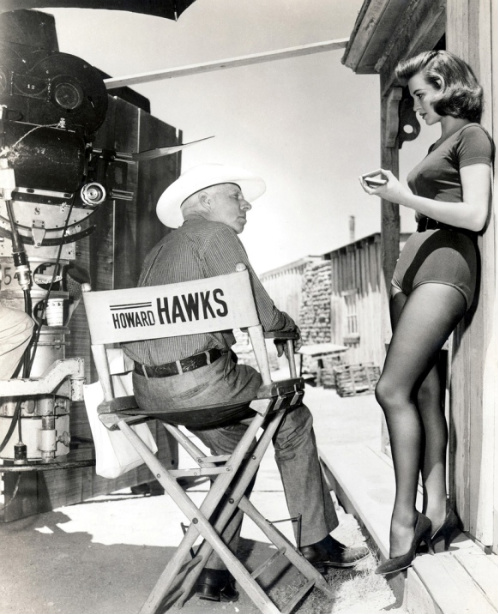
Me, I'd reserve room for a DVD on boat building and another on edible plants, but I understand the sentiment. Hawks, more than any other director, covered the waterfront — Westerns, comedies, crime, war, action, sci-fi, musicals, straight-up drama, and even silent movies. And he didn't just make entertaining movies, he made genre-defining classics.
Hawks gave John Wayne his first great acting showcase, taught Katharine Hepburn how to play comedy and Lauren Bacall how to whistle, helped define 1930s gangster movies, 1940s film noir, and 1950s sci-fi spectacles, and put Marilyn Monroe in a slinky pink dress as she sang her signature song, "Diamonds Are a Girl's Best Friend."
That he also directed two of the greatest Westerns in history, well, that's just showing off.
So what are my favorite Howard Hawks movies? Glad you asked.
In chronological order:
Scarface (1932) — Although Hawks had been directing since 1926 (including 1928's A Girl in Every Port, which put Louise Brooks on the map, and the first, best version of The Dawn Patrol in 1930), Scarface was the first indispensable movie of his career. I've written about Scarface at length (here, here and here) and I won't rehash any of that except to note that along with Little Caesar and The Public Enemy, this is one of the three great gangster pictures of its era. Brian De Palma remade it in 1983 with Al Pacino.
Bringing Up Baby (1938) — Some people, such as the aforementioned David Thomson, would include Hawks's 1934 comedy Twentieth Century here but although it made a star of Carole Lombard, to me it's more shrill than funny. Instead, I'll list Hawks's other screwball classic, Bringing Up Baby, in which a batty Katharine Hepburn and her pet leopard fall in love with a very goofy college professor played by Cary Grant. "Now it isn't that I don't like you, Susan, because, after all, in moments of quiet, I'm strangely drawn toward you, but, well, there haven't been any quiet moments." This was Hepburn's first comedy; it wouldn't be her last.
Only Angels Have Wings (1939) — Starring Cary Grant, Jean Arthur and a young Rita Hayworth, this one explores one of Hawks's favorite themes: men of action behaving according to a professional code, and the women who learn to love them. Grant plays a pilot trying to get a fledgling air mail service off the ground; Arthur is a showgirl stranded at his hotel. For fun, take a drink every time somebody says "Calling Barranca" — you'll be in the hospital by the end of the first act! A personal favorite.
His Girl Friday (1940) — A (superior) remake of the comedy The Front Page, this one stars Cary Grant as a hilariously ruthless newspaper editor, Rosalind Russell as his star reporter — and ex-wife — and Ralph Bellamy as the man she intends to marry. One look at Grant and Bellamy, and you know how this one's going to turn out but what a wild ride getting there with a very modern moral to boot: a woman's place is in the office, not the kitchen. Career best performances by all three leads. Holds the record for the fastest dialogue in movie history. Must see.
Ball of Fire (1941) — Another comedy. Typically, in Hawks's dramas, women must prove worthy of the men they love. In his comedies, the formula is reversed. Here, Barbara Stanwyck is a showgirl on the run from her gangster boyfriend. Gary Cooper is the virginal professor who gives her shelter. When the film's writer Billy Wilder (who would later win Oscars directing The Lost Weekend and The Apartment) confessed he didn't understand the plot, Hawks told him "It's a remake of Snow White and the Seven Dwarfs." Bingo!
To Have and Have Not (1944) — Set in French Martinique during World War II, Harry Morgan (Humphrey Bogart) has retreated from the messy political world into a cocoon of isolationism so complete he's willing to ignore the fascists in charge even as they are shooting his clients and pushing his friends around. Marie "Slim" Browning (Lauren Bacall in her first film role) teaches him how to whistle and forces him to realize that no matter how much he thinks he's successfully avoided sticking his neck out, his neck is out there. A loose adaptation of Ernest Hemingway's novel, the screenplay is by William Faulkner, to date the only time a Nobel Prize winner has written a screenplay based on the work of another Nobel Prize winner.
The Big Sleep (1946) — Bogart and Bacall again. This time, Bogart is Raymond Chandler's famous private detective, Philip Marlowe, while Bacall draws his eye as the beautiful, spoiled daughter of a rich client. The plot is incomprehensible (even Chandler didn't know whodunit) but the sparks fly and the dialogue sets some sort of record for sexual innuendo. Loads of fun.
Red River (1948) — One of the greatest Westerns ever made, John Wayne and his adopted son Montgomery Clift lead a cattle drive along the Chisholm Trail. Basically a retelling of Mutiny on the Bounty with Wayne as Captain Bligh. After seeing the movie, director John Ford (who had cast Wayne in the classic Stagecoach way back in 1939) exclaimed, "I didn't know the big son of a bitch could act!" Boy, could he.
The Thing from Another World (1951) — Based on John Campbell's classic novella "Who Goes There?" this is the story of soldiers and scientists in the Arctic Circle fighting an invader from outer space (and sometimes each other). Hawks is credited only as the film's producer but those who were there insisted he directed as well. Sure seems like it. Remade in 1982 by John Carpenter, this science fiction classic is full of danger and paranoia but also humor, camaraderie and a good-looking, no-nonsense Hawksian woman (Margaret Sheridan).
Gentlemen Prefer Blondes (1953) — Based on the novel by the immortal Anita Loos, gold digger Lorelei Lee (Marilyn Monroe) and her no nonsense pal Dorothy Shaw (Jane Russell in her best role) set sail for France with a boatload of handsome Olympians, a rich, eligible bachelor (aged seven) and a private eye determined to catch Lorelei in flagrante delicto. Features Marilyn Monroe's signature song "Diamonds Are a Girl's Best Friend." One of the best musicals of the 1950s, Gentlemen Prefer Blondes, as much as anything, proves Howard Hawks was the master of any genre.
Rio Bravo (1959) — Ostensibly the story of a border town sheriff (John Wayne) who squares off against a rich rancher and his army of hired goons, Rio Bravo is really a study of a professional doing his job and doing it well despite the imminent threat of death, an idealized code of conduct Hemingway called "grace under pressure." This is Hawks at his most compassionate, not an attribute I would always associate with his brusque heroes and no-nonsense women. But John Wayne watches over his ragged crew — a drunk, a cripple, and later a girl, a young gunslinger and even the manager of the local hotel — like a mother hen, with a love that is sometimes tough and sometimes tender, but always genuine. With Dean Martin, Walter Brennan and Angie Dickinson. The best Howard Hawks movie and my all-time favorite Western — and you know how much I love a good Western!
Man's Favorite Sport? (1964) — The least well-known of all the movies on this list, but a personal fave, this is a comedy about an expert fisherman (Rock Hudson) who confesses to the woman who's organized a tournament in his honor that he's never fished in his life — never even touched a fish! Paula Prentiss, in the best performance of her career, takes him in hand and teaches him everything he needs to know, some of it having to do with a rod and reel.
El Dorado (1966) — A loose comedic remake of Rio Bravo, with John Wayne again, Robert Mitchum as the drunk, and James Caan as a poetry-spouting gambler in a funny hat. Caan has the best line in the movie while wrasslin' the voluptuous Michele Carey in a hay barn. "Hey, you're a girl!" No kidding, Jimmy.
And if that's not enough, you might also try Sergeant York (1941) (which won Gary Cooper an Oscar), I Was a Male War Bride (1949) (with Ann Sheridan and Cary Grant in drag), Monkey Business (1952) (No, not the Marx Brothers — Cary Grant and Marilyn Monroe) and Hatari! (1962) (John Wayne basically playing a macho Marlin Perkins — and if you understand that reference, boy, are you old!).
In 1974, Hawks received an honorary Oscar as "a giant of the American cinema whose pictures, taken as a whole, represent one of the most consistent, vivid, and varied bodies of work in world cinema."
And that undersells him.
In 1996, Entertainment Weekly ranked Hawks fourth on the list of the 50 greatest directors of all time. In 2007, Total Film also ranked him fourth on its list of the 100 greatest directors of all-time.
And me? I have him on the Mount Rushmore of Hollywood film directors along with Alfred Hitchcock, Billy Wilder and Steven Spielberg, a first among equals in my book. Put that in your pipe and smoke it.
If I had to pick two actresses from the 1950s who best typified the decade's popular tastes, Doris Day and Marilyn Monroe would be it. They were both blondes, both comediennes, both singers, but they couldn't have been more different and at times they seemed to be leading the culture in opposite directions. They were both the best at what they did, though, and choosing between them is the toughest choice of the tournament so far. Indeed, as of lunchtime today, they are tied.
Still plenty of time to vote. Tell your friends, tell your co-workers, tell the stranger sitting next to you on the bus. Tell them to make their way over to the Monkey and cast what might very well be the deciding vote in a culture war that's been raging for more than fifty years.
Click here to vote.
 At the heart of every Howard Hawks action movie is the concept of the professional doing his job, and doing it well, despite the imminent threat of death, an idealized code of conduct Hemingway called "grace under pressure." We're all going to die sooner or later, Hawks seems to be saying, can't we at least do it with a bit of dignity and honor and laughter and good company?
After nearly three decades of genre defining action pictures—from Dawn Patrol to Only Angels Have Wings to Red River to The Thing From Another World—Hawks topped himself with Rio Bravo, if not the best Western ever made then certainly the most entertaining.
 It's also Hawks at his most compassionate, not an attribute I would always associate with his brusque heroes and no-nonsense women. But John Wayne watches over his ragged crew—a drunk, a cripple, and later a girl, a young gunslinger and even the manager of the local hotel—like a mother hen, with a love that is sometimes tough and sometimes tender, but always genuine.
There's a lesson here for purveyors of the modern summer blockbuster: don't confuse a slowing of the action with a flagging of the audience's interest. If you don't give us a reason to invest ourselves in the characters on the screen, the non-stop action, no matter how well choreographed, eventually becomes a tedious bore.
Hawks, for example, takes time after one character's particularly intense personal crisis for a trademark song (here, "My Rifle, My Pony and Me") which not only allows the audience to catch its breath, but also adds another dimension to the friendship between the four men involved that makes the final payoff (one of the greatest shootouts in movie history) so much more satisfying—because by then you really care.
I'll take Rio Bravo with its ups and downs of pacing and mood over all the empty, rote action movies ever made.
PICTURE (Drama)
winner: Rio Bravo (prod. Howard Hawks)
nominees: Anatomy of a Murder (prod. Otto Preminger); Ben-Hur (prod. Sam Zimbalist); Imitation of Life (prod. Ross Hunter); North By Northwest (prod. Alfred Hitchcock); Shadows (prod. Maurice McEndree); Room at the Top (James Woolf and John Woolf)
PICTURE (Comedy/Musical)
winner: Some Like It Hot (prod. Billy Wilder)
nominees: I'm All Right Jack (prod. Roy Boultin); The Mouse That Roared (prod. Walter Shenson); Our Man In Havana (prod. Carol Reed); Pillow Talk (prod. Ross Hunter and Martin Melcher); Sleeping Beauty (prod. Walt Disney)
PICTURE (Foreign Language)
winner: Les quatre cents coups (The 400 Blows) (prod. François Truffaut)
nominees: Apur Sansar (The World of Apu) (prod. Satyajit Ray); Ballada o soldate (Ballad of a Soldier) (prod. M. Chernova); Hiroshima mon amour (prod. Anatole Dauman and Samy Halfon); Ningen no jôken (The Human Condition) (prod. Shigeru Wakatsuki); Orfeu Negro (Black Orpheus) (prod. Sacha Gordine); Ukigusa (Floating Weeds) (prod. Masaichi Nagata)
ACTOR (Drama)
winner: Cary Grant (North By Northwest)
nominees: Peter Cushing (The Hound of the Baskervilles); Charlton Heston (Ben-Hur); Jean-Pierre Léaud (Les quatre cents coups a.k.a. The 400 Blows); Dean Martin (Rio Bravo); Paul Muni (The Last Angry Man); James Stewart (Anatomy of a Murder); John Wayne (Rio Bravo)
ACTOR (Comedy/Musical)
winner: Jack Lemmon (Some Like It Hot)
nominees: Tony Curtis (Some Like It Hot); Alec Guinness (Our Man In Havana); Rock Hudson (Pillow Talk); Peter Sellers (The Mouse That Roared and I'm All Right Jack)
ACTRESS (Drama)
winner: Simone Signoret (Room At The Top)
nominees: Audrey Hepburn (The Nun's Story); Katharine Hepburn (Suddenly Last Summer); Eva Marie Saint (North By Northwest); Lana Turner (Imitation Of Life)
ACTRESS (Comedy/Musical)
winner: Marilyn Monroe (Some Like It Hot)
nominees: Dorothy Dandridge (Porgy And Bess); Doris Day (Pillow Talk)
DIRECTOR (Drama)
winner: Howard Hawks (Rio Bravo)
nominees: John Cassavetes (Shadows); Alfred Hitchcock (North By Northwest); Masaki Kobayashi (Ningen no jôken a.k.a. The Human Condition); Otto Preminger (Anatomy of a Murder); Douglas Sirk (Imitation of Life); François Truffaut (Les quatre cents coups a.k.a. The 400 Blows); William Wyler (Ben-Hur)
DIRECTOR (Comedy/Musical)
winner: Billy Wilder (Some Like It Hot)
nominees: Marcel Camus (Orfeu Negro a.k.a. Black Orpheus); Michael Gordon (Pillow Talk); Yasujirô Ozu (Ohayô a.k.a. Good Morning); Carol Reed (Our Man In Havana)
SUPPORTING ACTOR
winner: Walter Brennan (Rio Bravo)
nominees: Joe E. Brown (Some Like It Hot); Ben Gazzarra (Anatomy of a Murder); Hugh Griffith (Ben-Hur); Martin Landau (North By Northwest); James Mason (North By Northwest); Arthur O'Connell (Anatomy of a Murder); Tony Randall (Pillow Talk); George C. Scott (Anatomy of a Murder); Orson Welles (Compulsion)
SUPPORTING ACTRESS
winner: Juanita Moore (Imitation Of Life)
nominees: Eve Arden (Anatomy of a Murder); Angie Dickinson (Rio Bravo); Susan Kohner (Imitation of Life); Jessie Royce Landis (North By Northwest); Lee Remick (Anatomy of a Murder); Shelley Winters (The Diary of Anne Frank)
SCREENPLAY
winner: Billy Wilder and I.A.L. Diamond, from the story by Robert Thoeren and Michael Logan (Some Like It Hot)
nominees: Karl Tunberg, from the novel by Lew Wallace (Ben-Hur); Ernest Lehman (North By Northwest); Graham Greene, from his novel (Our Man In Havana); François Truffaut (scenario and adaptation), Marcel Moussy (dialogue and adaptation) (Les quatre cents coups a.k.a. The 400 Blows); Jules Furthman and Leigh Brackett, from the short story by B.H. McCampbell (Rio Bravo)
SPECIAL AWARDS
Saul Bass (Career Achievement Award); Jazz on a Summer's Day (Documentary); William A. Horning and Edward Carfagno; Hugh Hunt (Ben-Hur) (Art Direction-Set Decoration); Franklin E. Milton (Ben-Hur) (Sound); Ralph E. Winters and John D. Dunning (Ben-Hur) (Film Editing); Elizabeth Haffenden (Ben-Hur) (Costumes); A. Arnold Gillespie, Robert MacDonald and Milo Lory (Ben-Hur) (Special Effects)
 We here at the Monkey pause to note the passing of one our favorite actresses, Jane Russell. As my big brother noted an e-mail, "in 'the day,' she was hot, hot, hot."
She was indeed.
I am of an age that my first introduction to Jane Russell was during her stint as a foundation undergarment spokesperson "for us full-figured gals," as she put it. I was a little too young to understand what part of her figure she was referring to. Later I figured it out. Hubba hubba.
 Probably her most famous role was her first, The Outlaw, in which she co-starred with a cantilevered bra designed by Howard Hughes and his team of aeronautical engineers. Truth be told, it's not a very good movie and she didn't wear the bra anyway. Filming was completed in 1941, but Hollywood's censors delayed its release until 1943, with a nationwide release not coming until 1946.
"They held up The Outlaw for five years," she said later. "And Howard Hughes had me doing publicity for it every day, five days a week for five years."
Russell didn't appear in another film until 1946.
 If you want to see her in something good, I'd recommend the two movies she made with Robert Mitchum, His Kind Of Woman (1951) and Macao (1952), and what I think is the best performance of her career, as a nightclub singer trying to keep her gold-digging pal Marilyn Monroe out of trouble in Howard Hawks' musical comedy Gentlemen Prefer Blondes (1953).
I know everybody remembers Marilyn Monroe's signature performance of "Diamonds Are a Girl's Best Friend," but personally, give me Jane Russell.
 The results are in on the latest Monkey survey, "What first brought you to the Mythical Monkey?" Not surprisingly, the majority of you said you first arrived here either while searching for a photo (22) or by way of a link from another blog (also 22). We here at the Monkey do tend to overstuff our posts with pictures. But what would you rather look at, Louise Brooks or a long gray block of impenetrable text? That's what I thought.
Among the other answers, five of you admitted to being a friend or family member, and six of you claimed brain damage—the latter of which strikes me as either way too many or not nearly enough. Three arrived here while searching for info or a movie-specific review, one got here by way of a review on the Internet Movie Database, and four chose "other."
 The one vote for "an interest in alternate Oscars" was cast by yours truly. Although I think many readers find the whole "alternate Oscar" concept, first championed by Danny Peary in his book of the same name, confusing or frankly irritating, the truth is, I wouldn't have started this blog at all except for my own obsession with "who should have won," and what little forward momentum this blog has comes strictly from my own desire to get to the next award. So I think for the time being, I'll stick with the current format even if I do wind up tweaking it a bit.
Amazingly, no one picked "word of mouth." I would have thought sitting around in a bar talking about movie blogs would rank higher, especially when "Lets go back to my place and read the Monkey together" is a proven pick-up line. (Proven in the same sense that many things on the internet are proven, which is to say I made it up.)
 Which reminds me of a true story from my law school days. At the end of one especially grueling semester, I held a film festival in my apartment—twenty-four consecutive hours of wholesome movie goodness, beginning at 11 in the morning and ending sometime after breakfast the following day. It turned into a bit of an event with something like fifty people showing up and camping out, including one woman I had never met who turned down a friend of mine for a date because she was "going to some guy's film festival."
There's a moral in there some place. I just don't know what it is.
[To read prior entries in this essay, click 1, 2, 3, 4, 5, 6, 7]
The MGM Years And Beyond
Their association with Paramount Pictures at an end, the Marx Brothers found themselves without a steady gig for the first time since vaudeville impresario E.F. Albee had blackballed them from the circuit over a decade before. Harpo traveled to the Soviet Union to commemorate the normalization of U.S.-Soviet relations, Groucho performed in a repertory production of Twentieth Century in Maine, and both Groucho and Chico starred briefly in a radio program called The Marx Of Time sponsored by American Oil.
 In the meantime, the Brothers (minus Zeppo, who officially left the act in March 1934 to form a talent agency) approached Samuel Goldwyn seeking a new film deal. Goldwyn wasn't interested, but suggested the Brothers try Irving Thalberg, the boy wonder producer who had enjoyed such success at MGM. Tired of life under Louis B. Mayer's thumb, Thalberg was looking to sign talent to personal contracts with the idea of forming his own studio.
Chico made the initial approach to Thalberg over a game of bridge. Groucho described the subsequent meeting in his autobiography, Groucho and Me:
 Thalberg said, "I would like to make some pictures with you fellows. I mean real pictures."
I flared up. "What's the matter with Cocoanuts, Animal Crackers and Duck Soup? Are you going to sit there and tell me those weren't funny?"
"Of course they were funny," he said, "but they weren't movies. They weren't about anything."
"People laughed, didn't they?" asked Harpo. "Duck Soup has as many laughs as any comedy ever made, including Chaplin's."
"That's true," he agreed, "it was a very funny picture, but you don't need that many laughs in a movie. I'll make a picture with you fellows with half as many laughs—but I'll put a legitimate story in it and I'll bet it will gross twice as much as Duck Soup."
 The result was A Night At The Opera, and Thalberg was right, it and its follow-up, A Day At The Races were smash hits, reestablishing the Marx Brothers as Hollywood's top comedy act. The former is preserved in the National Film Registry and ranked twelfth on the American Film Institute's list of the best American comedies of the 20th century. The latter received the only Oscar nomination in Marx Brothers history, in the short-lived category of dance direction. (I'll write more about A Night At The Opera when we reach 1935.)
Depending on your take, Thalberg either polished the Marx Brothers or neutered them—perhaps both. What can't be argued is that he rescued them from an early retirement and pointed them in a direction that kept them in the public eye for another decade, long enough for Groucho to land a television show and assure his role as a beloved icon, a role he relished and used as a platform to promote the Marx Brothers' films to a new generation of film fans. Perhaps audiences in the 1960s would have rediscovered their Paramount movies anyway, but the success of A Night At The Opera and A Day At The Races certainly helped.
 In any event, the Brothers adored Thalberg and showed it in their usual inimitable style—they barricaded themselves in his empty office, stripped naked and roasted potatoes in his fireplace. When Thalberg returned, he sent out for butter and joined the Brothers for a light repast.
After Thalberg's death in 1937, MGM lost interest in the act. A self-consciously glossy and high-toned studio, MGM's brass didn't know what to make of the Marx Brothers and put them in vehicles that didn't always suit their talents. First, the studio loaned the Brothers to RKO for Room Service, the first Marx Brothers movie based on a non-Marx Brothers stage play. Zeppo negotiated the deal, securing $250,000, a nice payday, but the movie was not a success and afterwards Groucho said only that Zeppo should have asked for more money.
 Afterwards, the Brothers made three more pictures for MGM—At The Circus, Go West and The Big Store—with diminishing results, then retired from movies altogether. Five years later when gangsters threatened Chico's life over a gambling debt, the Brothers abruptly unretired and made A Night In Casablanca. Perhaps the best film the Brothers made after Thalberg's death, A Night In Casablanca is remembered now primarily for a series of letters between Groucho Marx and Warner Brothers, with the latter (as makers of the classic film Casablanca) objecting to the use of the word "Casablanca" in the title of the film.
"You claim you own Casablanca," Groucho wrote in response, "and that no one else can use that name without your permission. What about 'Warner Brothers'? Do you own that, too? You probably have the right to use the name Warner, but what about Brothers? Professionally, we were brothers long before you were."
 Of the Brothers' last movie as a team, Love Happy, the less said the better. Remembered now for Marilyn Monroe's brief appearance, the film began as a vehicle for Harpo who wanted to film a Chaplinesque pantomime. Chico was added early in the process, again to fuel his gambling addiction, and Groucho was dragooned into filming a few scenes so that the studio could bill Love Happy as a Marx Brothers film. (The Brothers also appeared in the 1957 film The Story of Mankind, but had no scenes together.)
 After their film careers ended, only Groucho found real success, hosting a popular game show, You Bet Your Life, from 1950 to 1961. Although there were contestants, games and prizes, the real point of the show was Groucho's banter and he was very good at it. The show was nominated for an Emmy six times, and Groucho himself won the award in 1951 as "Most Outstanding Personality." He also made half a dozen movies without his brothers, including Copacabana, Double Dynamite and Skidoo (playing God in the latter).
The Marx Brothers never won a competitive Oscar—indeed, were never even nominated—but in 1974, the Academy finally recognized Groucho with a honorary award "In recognition of his brilliant creativity and for the unequaled achievements of the Marx Brothers in the art of motion picture comedy."
"I wish Harpo and Chico could be here to share it with me," he said.
In 1999, the AFI listed the Marx Brothers as one of the fifty greatest stars in the history of American cinema, the only group so honored.
Postscript: And that's all I'm writing about the Marx Brothers—well, this week anyway. After 12,000 words, I need a little break. I'll return next week with a post entitled "Who Says A Movie Can't Change Your Life?" then follow it with the nominees for best actor of 1932-33 in the category of drama.









 Posts
Posts

