In honor of his birthday today, here's a portion of my most popular post about Charlie Chaplin.
"I classify Chaplin as the greatest motion picture comedian of all time."—Buster Keaton, in a 1960 interview with Herbert Feinstein
After his apprenticeship with Mack Sennett at Keystone Studios in 1914, Chaplin signed a one-year deal with Essanay Studios where he directed fourteen shorts, including such films as The Tramp and Burlesque On Carmen. By the end of that year, Chaplin was the most famous entertainer in the world, and seeing his work in the context of its times, it's clear to me now he was to film comedy what D.W. Griffith was to film drama, establishing the rules and raising the bar.
After Chaplin's contract at Essanay expired, he signed with the Mutual Film Corporation to direct and star in a dozen two-reel comedies—known colloquially as "the Chaplin Mutuals"—for the then-unheard of sum of $670,000, the most any entertainer had been paid in history. "Next to the war in Europe," a Mutual publicist wrote, "Chaplin is the most expensive item in contemporaneous history." The deal with Mutual afforded Chaplin two luxuries he'd never had before as a director—time and money—and he took full advantage of the opportunity, not only re-shooting sequences that didn't match his vision, but also experimenting with the comedic form itself.
In support of this new venture, Chaplin gathered around him a team of familiar faces, recruiting a couple of friends from his days with the British music hall troupe. At 6'5" and 300 pounds, Eric Campbell was the most prominent of Chaplin's supporting players; a full foot taller and 175 pounds heavier than Chaplin, he made a good comic foil for the Tramp, and wound up playing his nemesis in eleven of the twelve Mutuals.
And wearing the ridiculously fake brush moustache known as a soup strainer was Albert Austin who performed mostly as the straight man on the receiving end of the Tramp's more destructive antics.
As his leading lady, Chaplin brought Edna Purviance with him from Essanay. Purviance (Purr-VYE-ance) had been working as a stenographer in San Francisco when she caught Chaplin's eye, who, either as a trite come-on or because he could more easily mold the novice actress to fit his ideas of comedy, asked her if she would like to be in pictures. "I laughed at the idea," she said later, "but agreed to try it."
Although their romantic relationship was brief, Purviance continued to play Chaplin's leading lady for nine years, appearing in approximately forty films (the exact number is in dispute), more than any other actress.
Chaplin began his career at Mutual in the spring of 1916 with a couple of formula comedies, The Floorwalker and The Fireman. In the former, the Tramp wanders into a department store and wreaks havoc—knocking over displays, playing hide and seek with detectives, trashing the wares—before trading places with a look-alike store manager (future director Lloyd Bacon) who unbeknownst to the Tramp has just embezzled the payroll. In the latter, Chaplin plays the world's laziest firefighter—the kind of guy who stuffs a rag in the alarm bell to keep it from ringing—but comes to the rescue of a pretty girl (Purviance) when a fire breaks out.
Each film is a loose collection of well-polished comic set-ups and payoffs, distinguishable from Chaplin's work at Keystone and Essanay only be the quality of their gags.
Chaplin's third film at Mutual, The Vagabond, starts with a typical slapstick set-up—the Tramp as traveling musician busking in a bar for handouts—but quickly turns into the stuff of Victorian melodrama with the story of a wealthy middle aged woman haunted by the memory of a kidnapped child converging in a series of coincidences worthy of Charles Dickens with the story of young woman (Purviance) held captive by a band of gypsies. Into that mix, Chaplin introduced several themes that would characterize his work forever after—the separation of parent from child, artistic insecurity, noble self-sacrifice, and especially the exquisite pain of unrequited love.
The attempt to wed slapstick to the dramatic form made The Vagabond Chaplin's most ambitious film to date, but result was the most disappointing. There's nothing wrong with sentimentality per se—The Kid, for example, was one of the era's best films—and viewed objectively, from the outside looking in, the Tramp's white knight complex can be hilarious (see, e.g., The Pawnshop, where an old con's tale leaves Chaplin sobbing), but here, having indulged his own insecurities simply as the default mode for a situation he hasn't fully worked out, the result is not moving but mawkish, and I imagine that those who complain that Chaplin is too sentimental for their tastes are really saying he too often fails to establish an emotional connection to the characters that would justify the Tramp's (and our) tears.
Chaplin returned to form with his next film, One A.M., which combined elements from a pair of Max Linder "drunk comedies," First Cigar and Max Takes Tonics, to create a one-man tour de force that plays a little like a wager that a single joke—a drunk fumbling his way up a flight of stairs to bed—can work for twenty uninterrupted minutes.
Chaplin plays variations on the gag the way a jazz virtuoso plays variations on a theme, building simple movements into complex ones, anticipating some payoffs, denying others, going off in unexpected directions, finally returning to the beginning and starting something new.
As in most of his films, the camera work is spare, the editing unobtrusive, with both focused on featuring the best available performance rather than solving technical problems such as continuity or matching edits. Like Fred Astaire, who insisted his dances be filmed in an uninterrupted take with an angle wide and long enough to show the performance from head to toe, Chaplin mostly used long shots and uninterrupted takes to show his audience that the dance-like rhythm of his intricate physical gags are not cheats conjured up in the editing room, but reflect his real abilities. Anyway, I'm no fan of fancy camera work that exists only to prove the director wasn't napping during that day's lecture at film school and though Chaplin's style remained primitive compared to his contemporaries, it was a conscious choice with a specific payoff in mind.
Chaplin finished out 1916 with four films—The Count, The Pawnshop, Behind The Screen and The Rink—that returned to familiar formulas, but the comedy was well thought out, as funny as anything he had ever done. Of the four, I'd rate The Pawnshop and especially Behind The Screen the most highly. In the former watch particularly for the Tramp's efforts to evaluate the alarm clock Albert Austin has brought into the shop to pawn—do I need to tell you how things work out for Austin and the clock?
The latter, the story of a much put-upon worker bee (Chaplin) in a studio full of lazy, incompetent bosses, was aimed squarely at Mack Sennett who was happy to spend the millions Chaplin generated for Keystone Studios while paying his star a pittance ($125 a week with a $25 bonus for each film he directed). Chaplin had mined a similar vein at Essanay with His First Job, also about the Tramp taking a job at a movie studio, but the barbs here are sharper, the comedy funnier.
Chaplin opened 1917 with one of the most beloved comedies of his career, Easy Street. Set in the slums of New York, the Tramp wanders into a Salvation Army style mission and falls instantly in love with the pianist (Edna Purviance, of course). Determined to redeem himself in her eyes, the Tramp volunteers for a job as a policeman with a beat on the notorious Easy Street (which is anything but). The Tramp's battles with the local bully—Campbell, who is a foot taller and a foot wider than Chaplin—provides the bulk of the comedy.
Easy Street is particularly harsh, populated with drug addicts, rapists, wife beaters, and hungry children, the sort of neighborhood Chaplin himself grew up in as the son of an alcoholic father and mentally-ill mother, yet the finished film is pure laughs and I never feel like Chaplin is lecturing or hectoring us.
He would return to this setting in 1921 for his first feature-length film, The Kid.
Typical of the Mutual era, Chaplin followed the personal with the formulaic, this time with The Cure, another drunk act reminiscent of One A.M. except this time with a sanitarium full of rich hypochondriacs instead of furniture to trip over. Again, Chaplin takes simple jokes, such as a man caught in a revolving door, and stretches them to unbelievable lengths, repeating them, adding new elements, changing payoffs. In one scene, Chaplin—here playing a rich alcoholic rather than the Tramp—attempts to drink from the health-giving spring that is the facility's main attraction, yet always winds up filling up his hat instead. Later, though, after the stash of booze he's smuggled in to tide him over during rehab winds up in the well, he of course doesn't spill a drop.
The film's structure is loose, and the basic plot is a staple of Chaplin's comedy dating back at least to The Rounders in 1914, but with time to work through his ideas, the individual pieces are polished gems.
Chaplin's next film, The Immigrant, his eleventh at Mutual, is not the funniest, but I would argue it was the most important—maybe the single most important development in movie comedy from any source to that time.
The Immigrant is the story of the Tramp's journey from Europe to America, starting in medias res on board an overcrowded ship and ending on the streets of New York. In the twenty minutes in between, Chaplin better captured the immigrant experience than all the "serious" films before or since, and in doing so succeeded at last in wedding the slapstick form to a dramatic subject.
In a short chock full of comedy, Chaplin managed to show the hardship's immigrants faced as they tried to reach America—intolerable shipboard conditions including overcrowding, theft, execrable food, illness; the humiliation of being herded like cattle through Ellis Island; and finally, after landing in New York, the linguistic, economic and cultural hurdles, as well as nativist hostility, involved in adapting to every day life in a foreign country, demonstrated in this case through an act as simple as ordering dinner in a restaurant.
Yet Chaplin also captures the hope and promise that America at that time represented to millions worldwide. The scene of hopeful passengers crowding the deck to watch in silence as the ship sails past the Statue of Liberty is justly one of the most famous of the silent era. And the giddiness with which the Tramp courts the Girl (Purviance) is a perfect expression of the indomitable human will to survive.
The Immigrant underscores the source of the Tramp's lasting appeal—the ability to handle even the most difficult situation with aplomb, a skill his audience no doubt envied as they met their daily suffering. As I once wrote in describing the most famous scene of Chaplin's 1925 triumph, The Gold Rush, "Oh, to relish the taste of the boot you've boiled for your Thanksgiving dinner the way the Tramp did—there's Chaplin's appeal reduced to a single scene."
If he wasn't already, Chaplin's Tramp was from this point forward identified with those first-generation immigrants then making up more than ten percent of America's population, as well as with those abroad who yearned to breathe free.
"The Immigrant," Chaplin said years later, "touched me more than any other film I made."
We take for granted now that film comedy can have a serious point to make, ala Dr. Strangelove or The Apartment, but that idea was still radical in an era when, as Roscoe Arbuckle explained to Buster Keaton while making their first film together, comedy was aimed at twelve year olds. The notion that comedy could offer up more than laughs comes largely from Chaplin.
The Immigrant is preserved in the National Film Registry.
Chaplin finished his contract at Mutual with a crowd-pleasing throwback to his earlier comedies. The Adventurer is the story of an escaped convict (Chaplin) who worms his way into the affections of a high society debutante (Purviance) only to discover that her dad is the judge who sent him up. Lowlifes wreaking havoc with the carefully-ordered lives of the aristocracy was a staple of slapstick comedy almost from the origins of film itself, and would later become the meat of such acts as the Marx Brothers and the Three Stooges. In that sense, The Adventurer isn't particularly original; it is funny, though, one of the best of the bunch, and with it, Chaplin left Mutual giving his employers and his audience their money's worth.
After Mutual, Chaplin scored his first million dollar payday, signing with First National, a association of independent theater owners seeking a cut of the lucrative film distribution pie. Under the terms of the contract, Chaplin was to direct eight two-reel comedies, but the twenty minute format could not longer satisfy his artistic ambitions. Before his deal with First National was done, Chaplin had directed, among other things, his first feature length film, The Kid, as well as the four-reel war comedy, Shoulder Arms.
In 1919, Chaplin would co-found his own distribution company, United Artists, teaming up with three of the greatest names of the silent era, Douglas Fairbanks, Mary Pickford and D.W. Griffith.
Despite reaching ever more dizzying heights of fame, fortune and artistic achievement, Chaplin later confessed his years at Mutual were the happiest of his life. "I was light and unencumbered," he wrote, "twenty-seven years old, with fabulous prospects and a friendly, glamorous world before me."
Years later, Chaplin's son Sydney found himself at the Silent Movie Theater in Hollywood enjoying a revival of Chaplin's Mutuals only to be out-laughed by an elderly gentleman a few rows behind him. Turning to investigate he discovered "[i]t was my father who was laughing the loudest! Tears were rolling down his cheeks from laughing so hard and he had to wipe his eyes with his handkerchief."
"Perhaps," wrote Chaplin biographer Jeffrey Vance, "[Chaplin] had great fondness for the Mutuals simply for the same reason that generations of audiences have as well—because of the sheer joy, comic inventiveness, and hilarity of this extraordinary series of films."
I confess, I've given most of this year's blogathons a miss, mostly because I'm working on a mammoth non-blog project that requires nearly all of my time and energy. But here's one that tickled my fancy and allowed me to write about silent movies at the same time.
It's called "The Great Recasting Blogathon" and it's hosted by In The Mood and Frankly My Dear, a couple of classic movie blogs you might want to check out on your own.
The rules are these:
1. Pick a movie that was made in between 1966 and today 2. Change the year of production 3. Choose new leads from Classic Hollywood 4. Choose a new director from Classic Hollywood 5. Explain why you think it would work
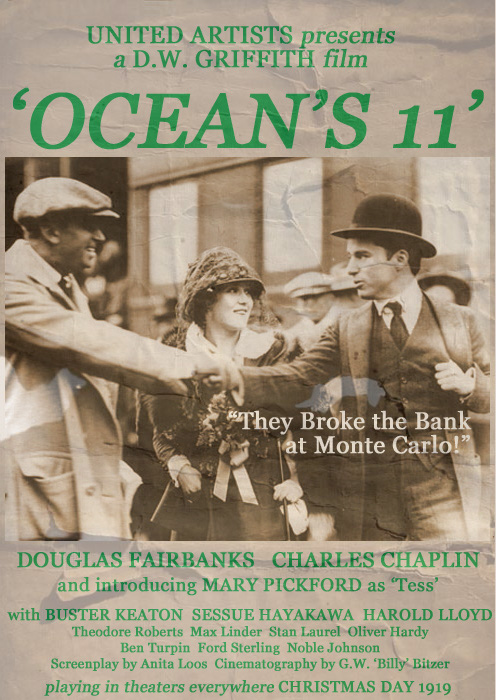
Well, I'm recasting the 2001 version of Ocean's Eleven—as a silent movie, of course. As you probably know, Ocean's Eleven was a remake of the 1960 Rat Pack film of the same name, which was itself a loose remake of the 1956 Jean-Pierre Melville caper classic, Bob le Flambeur.
But what isn't generally known—because I just this second made it up—is that Bob le Flambeur was itself a remake of one of the greatest silent films of all-time, the star-studded comedy Ocean's 11, starring Douglas Fairbanks, Charlie Chaplin and Mary Pickford.
Don't remember that one, you say? Well, here's the story:
It was 1919, and the world's three most popular movie stars—Douglas Fairbanks, Mary Pickford and Charlie Chaplin—had just joined forces with the world's most popular director—D.W. Griffith—to form a new distribution company they called "United Artists."
For years, studio middle men had charged exorbitant fees simply to send the quartet's films out to the nation's theaters, a service that required little more than a large envelope and a postage stamp. With the formation of United Artists, Fairbanks, Pickford, Chaplin and Griffith would henceforth lick their own stamps, and each entertained visions of vast sums of money rolling in as compensation for the effort.
There was only one problem: they had no new product to distribute.
"Hey, kids," suggested Fairbanks, "why don't we put on a show!"
A great idea, everyone agreed, but what kind of show? They hit upon the happy notion of a musical revue called The Jazz Singer until someone remembered that this was the silent era and they were going to look pretty silly belting out show tunes that no one could hear.
Next, Griffith proposed they do a variation on his usual storyline, which was to reduce a complex historical event to a question of who got into Lillian Gish's underpants first, à la The Birth of a Nation, Hearts of the World and Orphans of the Storm. The others were skeptical as it was, then vetoed the idea outright when they learned Gish wouldn't actually be in the movie—just her underpants.
"How about an adaptation of Little Women," said Pickford. "Of course, you three will have to play your parts in drag, but if I can play a twelve year old girl, surely you can, too."
"I've never done drag comedy," Chaplin lied, blushing, "and don't call me Shirley! Besides, I've got a great idea for a movie, a scathing indictment of capitalism and the industrial age I call Modern Times."
"Sounds fabulous," said Fairbanks. "When can you start production?"
"1936."
Reluctantly admitting they had no useable ideas, Fairbanks wired his old friend, writer Anita Loos. Loos had written a number of films for Fairbanks in 1916 and 1917, including the breakthrough hits The Matrimaniac and Wild and Woolly, and he was eager to work with her again. "She's busy writing a novel called Gentlemen Prefer Blondes," he reported the next day, "but for us, she's willing to set it aside for a percentage of the profits."
Griffith laughed. "Everybody knows movies never turn a profit! Why, even Gone with the Wind and Star Wars haven't turned a profit!"
Deluded by visions of great wealth, Loos cranked out one of her typically witty, fast-paced scripts, something she called United Artists Presents a D.W. Griffith Film Starring Douglas Fairbanks, Charlie Chaplin and Mary Pickford in a Story about a Team of Con-Artists who Break the Bank at the Gambling Casino in Monte Carlo so that One of Them (Fairbanks) Can Win Back his Ex-Wife (Pickford) While Making All His Pals (including Chaplin) Rich in the Process.
"The title's a bit unwieldy," Pickford said, "but otherwise, it's perfect."
"Yeah, well, to make it work you're gonna need a crew as nuts as you are!" Loos said. "So who have you got in mind?"
The top-billed talent was easy. Fairbanks would play the lead, a handsome con artist named Daniel Ocean, while Chaplin would play his sidekick, Rusty Ryan—an agreeable distribution of chores, as the former would require some vigorous stunt work while the latter entailed split-second comic timing.
Pickford would, of course, play the ex-wife, Tess. Chaplin was especially looking forward to getting out of the Tramp costume for once. "That character has run its course," he said flatly. "A hundred years from now, who'll even remember him?"
For the plum part of the man they set out to rob, casino owner Terry Benedict, Pickford suggested Sessue Hayakawa. Hayakawa had risen to stardom on the strength of his seductively handsome yet cruelly ruthless villain in Cecil B. DeMille's The Cheat, a rare feat in the deeply racist Hollywood of the day.
"If you've seen him in The Cheat," Pickford said, "you know he's perfect—hot and snaky and deliciously evil. You don't know whether to run away or cover him in whipped cream and eat him for dessert. Yummy!"
"Wait, what's this about whipped cream?" said Fairbanks.
In addition to a satisfying villain, the film also required an all-star cast of comedians to play a rogues gallery of crooks and con men—each with a specialized skill that would require careful casting.
For example, the part of "the grease man," a contortionist who opens the casino's safe from inside the vault, required not just a comedian but an acrobat of near superhuman athletic ability.
"Buster Keaton," Chaplin said immediately. "He's funnier than a locomotive, throws a pie faster than a speeding bullet, and can fall out of a building in a single bound. Not to mention his Twitter feed is a riot! He's playing second banana to Roscoe Arbuckle, but that's not going to last long. Offer him anything but top billing."
Keaton jumped at the offer when Fairbanks called. "I classify Chaplin as the greatest motion picture comedian of all time," he said. "Plus I need the money."
For one of two brothers who drive each other (and everybody else) crazy, Chaplin recommended his former British stage partner who was currently making comedy shorts for Bronco Billy Anderson. "Splendid chap named Stan Laurel."
For the other brother, D.W. Griffith suggested a fellow Southerner, a plump Georgian under contract at Vitagraph named Oliver Hardy. "I don't believe they've worked together before," Griffith said, "but something tells me Laurel and Hardy would make a sensational comedy team."
One of the film's pivotal roles was that of a high roller who would convince Hayakawa to open the casino's safe to him. "For this role, we need an older actor," Griffith said, "a twinkly-eyed ham who can get a laugh from a death scene."
"Theodore Roberts!!!" everyone said simultaneously.
Roberts had proven equally adept at drama and comedy during a run of highly-successful character parts in such films as Joan the Woman, Old Wives For New and The Roaring Road. Both Pickford and Fairbanks had worked with him before and would work with him again.
For another "older" part, that of a disgruntled ex-casino owner who would bankroll the caper, Chaplin suggested a colleague from his Mack Sennett days, Ford Sterling.
Audiences of the time would best remember Sterling as the first leader of the Keystone Kops. He had recently played the Kaiser in an oddball cross-dressing comedy, Yankee Doodle in Berlin, starring Bothwell Browne as an army officer who disguises himself as a woman to infiltrate enemy headquarters and enjoys the masquerade entirely too much.
"It'll be nice working with proper comedians again," he said after receiving Chaplin's offer. "Just give me a pie and tell me who to throw it at and I'm good to go."
For the role of the munitions expert, Chaplin suggested the legendary French comedian, Max Linder. Linder had been the biggest star in Europe prior to the Great War, and Chaplin had modeled his style after him, but Linder's career had gone into decline after the actor was injured by mustard gas on the Western Front.
"The notion of Max handling high explosives would get a terrific laugh in the overseas market," Chaplin said, "and I would like to help him revive his career."
To play the "inside man," an employee of the casino who could come and go without drawing attention to himself, they chose Noble Johnson, a talented character actor with an imposing physique and a gift for disguises. One of the few African-American actors working regularly in Hollywood, Johnson ran a studio of his own, the Lincoln Motion Picture Company, dedicated to producing high-quality "race films" (as they were then known) such as The Realization of a Negro's Ambition. Griffith knew him from Intolerance where he had cast him as a Babylonian soldier.
The part of the computer nerd who hacks the casino's security systems proved to be a head-scratcher.
"What's a nerd?" asked Pickford. "For that matter, what's a computer?"
But after further discussion revealed that what the part required was someone who was supposed to be a genius but was in fact a quirky, funny-looking goofball, they settled on Ben Turpin whose eyes had been insured for $25,000 in case of accidental uncrossing.
"He was just a funny-looking guy," Buster Keaton said later. "You know what I mean? We introduced his character as 'a man's man,' and Ben Turpin entered. That was the biggest laugh of the picture."
Over a late supper in a suite in the Hollywood Hotel, Fairbanks reviewed the cast list with Pickford. "Turpin makes ten," he said. "Ten oughta do it, don't you think? You think we need one more? You think we need one more. All right, we'll get one more."
"What we need," Fairbanks told Chaplin at lunch the next day, repeating a suggestion of Pickford's, "is an innocent, all-American boy type—but here's the catch: one who can match me move for move in the scene where I climb down the elevator shaft. Who you got?"
"That would be Harold Lloyd," Chaplin said. "He recently invented a boy-with-glasses character that I think is going to be a big hit. And he's handsome and can climb buildings even better than you can."
"Well, we'll use him anyway," Fairbanks said.
The film, now retitled Ocean's 11, began production in the summer of 1919. Griffith directed the action sequences with his usual flare, but Chaplin balked at taking comedy advice from a man who thought the sack of Babylon was a laugh riot. Although Griffith received sole directorial credit, scholars now believe Chaplin was responsible for most of the film's non-action sequences.
While the two men would remain partners in the United Artists venture, they de-friended each other on Facebook soon after filming was complete, and for years thereafter rang each other's doorbell late at night and ran away.
Less apparent on the set, but no less problematic, was the tension between Fairbanks' 100% irony-free acting style and Chaplin's compulsion to deflate all larger-than-life figures. The scene, for example, where Ocean talks Rusty into robbing the casino—"Why not do it?"—took over 400 takes alone, with either Fairbanks boisterously breaking character or Chaplin kicking him in the pants.
Still, film-industry insiders and the movie-going public alike were abuzz with anticipation of the picture's Christmas Day premiere, and the four co-founders of United Artists had high hopes for a commercial and critical success. "This is going to be bigger than The Birth of a Nation," Griffith boasted. "Funnier, too."
Then tragedy struck. While awaiting shipment to theaters across the country, the highly-combustible elements in the movie's silver nitrate film stock caught fire, destroying not only the warehouse where the film was stored, but also the original negative and every print.
In a moment, Ocean's 11 joined the long list of silent films lost forever. Only a few fragments remain:
Film fans can only dream of what might have been.
"We're ruined," Fairbanks sobbed, "ruined before we ever made a movie!"
"Hardly," said Pickford. "While you were busy buckling your swash, I had the foresight to insure the film for $10 million with Lloyds of London—which is $9 million more than it cost to make! Not only are we not ruined, we're richer than ever!"
"Mary, you're wonderful!" said Fairbanks, dropping to one knee. "Will you marry me?"
"You bet I will, you gorgeous hunk o' man, you! Come here and kiss me!"
"Rowr!"
Tomorrow: More posters from silent movies you will never see.
As I've mentioned before, the first international film star was the French comic, Max Linder. He was also the first true film comedian—the first to develop a "language" of gesture and expression that not only overcame the limitations of silent film but took advantage of the relative intimacy of the medium.
Thanks to the close-up, a storytelling device unique to film, an actor no longer had to play to the back row of the theater—the camera brought the back row to him. Whether intuitively or by design, Linder realized the broad gestures and inane dialogue of music hall comedy were largely devices for indicating to an audience what to pay attention to as the actors set up a gag. On film, simply lifting an eyebrow would suffice.
While situational comedy had been around since the theater of ancient Greece, until film allowed for recognizable settings, and more importantly, recognizable characters with recognizable needs and desires, film comedy was limited to the most simplistic gags. With a reel of film growing longer—around ten minutes rather than the 45-seconds of the Lumière brothers' standard offering—it became possible for filmmakers to put fully-realized characters and situations on the screen, and so far as I can tell, Linder's "Max" was the first three-dimensional character in the history of movie comedy. You can imagine "Max" existing before the cameras started rolling, continuing to exist after they stopped, and in between, behaving on screen the way a real person would, albeit at the heightened levels required of farce comedy.
With the elbow room to portray an actual character, Linder could derive laughs from the juxtaposition of this character—the dapper aristocrat—and the chaos he created around it, a welcome breakthrough, believe me, if you've suffered through more than a hundred comedy shorts featuring mischievous boys and one-note gags.
Not to mention he was just better at it than anybody else, until Charlie Chaplin came along in 1914 to raise the bar.
Because, as I mentioned before, Linder worked during a time when it was cheaper to buy a camera and steal an idea than to pay the rental fee on the original film, it's easy to compare and contrast the way different filmmakers handled the same comic idea—a laboratory experiment, if you will, in what is and isn't funny.
For example, one of the favorite props used to generate laughs in turn-of-the-century comedies was glue—apparently, a hundred years ago pots of the stuff just sat around waiting for people to fall in it. Alice Guy's La glu (The Glue) (1907) is typical of the era: a mischievous boy brushes glue on various surfaces—a staircase, a bicycle seat—much to the consternation of various adults. Basically a one-joke pony repeated over and over again to no great effect.
Linder, on the other hand, in the one-reeler Max ne se mariera pas (Max Is Stuck Up) (1910), built on the idea the way a classic comedian would. On his way to his fiancee's for dinner, Max stops at a bakery to conduct a little routine business and accidentally gets stuck to a sheet of flypaper. What begins as a minor inconvenience, shrugged off with bonhomie and good humor, becomes a minor annoyance, then becomes a potential source of embarrassment when he arrives for dinner only to find he's still stuck, and escalates into a full scale disaster as he and his future father-in-law wind up wrestling over a serving dish and destroying the entire set.
You've seen this sort of progression in a hundred comedies, from the Marx Brothers to Adam Sandler, but you didn't see it before Max Linder, not in a movie anyway.
And now because I love you, I present my favorite Max Linder short, Max victime du quinquina (Max Takes Tonics) (1911). He made it three years before Chaplin, but if I had told you Linder copied it move for move from the little Tramp, I dare say you'd believe me. The intertitles are in French (with a German translation!), but there are only a couple and the gist is easy enough to figure out—feeling rundown, Max visits a doctor who prescribes a tonic of red wine and quinine bitters. Soon roaring drunk, Max is mistaken for a big shot and helped "home" by a helpful policeman.
ACTRESS winner: Dorothy West (Swords And Hearts) nominees: Linda Arvidson (Enoch Arden Parts 1 & 2)
DIRECTOR winner:Francesco Bertolini, Adolfo Padovan and Giuseppe de Liguoro (L'inferno) nominees: D.W. Griffith (The Biograph Shorts); Max Linder (Max victime du quinquina a.k.a. Max Takes Tonics); Winsor McCay and J. Stuart Blackton (Winsor McCay, the Famous Cartoonist of the N.Y. Herald and His Moving Comics, a.k.a. Little Nemo)
SPECIAL AWARDS Francesco Bertolini and Sandro Properzi (L'inferno) (Art Direction-Set Decoration); Emilio Roncarolo (L'inferno) (Cinematography)
It's a busy day here at the Monkeyhouse—Katie-Bar-The-Door and I are celebrating our wedding anniversary, the dog is celebrating her fourth anniversary of being with us, and silent film comedian Max Linder is celebrating his birthday! Who was Max Linder? Why, the first international film superstar, that's who. If you've seen Martin Scorsese's recent movie Hugo, perhaps you spotted a couple of Max Linder posters in the background.
Anyway, in Max's honor, I've stitched together excerpts from three separate essays about silent film comedy into a single post focusing on his life and films.
The first international movie star was Max Linder, a French comedian not just in the style of Charlie Chaplin but the guy Chaplin was often imitating early in his career, a fact Chaplin himself freely acknowledged. Born to a family of vintners in the Bordeaux region of France, Gabriel-Maximilien Leuvielle joined a troupe of actors touring France. In Paris, he discovered motion pictures and signed with Pathé in 1905, changing his name at the same time. He made over two hundred movies in his career, most as the recurring character "Max," an upper class roué who is a bit baffled by practical matters.
Linder wrote and directed his own films and in the years before World War I, he was the biggest star in Europe.
Unlike most of the comics of this era, Linder largely eschewed the slapstick style of Mack Sennett's Keystone comedies in favor of gesture and reaction; and as film historian David Thomson points out, "there was little of the sentimentality that American comedians resorted to."
Thanks to the close-up, a storytelling device unique to film, an actor no longer had to play to the back row of the theater—the camera brought the back row to him. Whether intuitively or by design, Linder realized the broad gestures and inane dialogue of music hall comedy were largely devices for indicating to an audience what to pay attention to as the actors set up a gag. On film, simply lifting an eyebrow would suffice.
While situational comedy had been around since the theater of ancient Greece, until film allowed for recognizable settings, and more importantly, recognizable characters with recognizable needs and desires, film comedy was limited to the most simplistic gags. With a reel of film growing longer—around ten minutes rather than the 45-seconds of the Lumière brothers' standard offering—it became possible for filmmakers to put fully-realized characters and situations on the screen, and so far as I can tell, Linder's "Max" was the first three-dimensional character in the history of movie comedy. You can imagine "Max" existing before the cameras started rolling, continuing to exist after they stopped, and in between, behaving on screen the way a real person would, albeit at the heightened levels required of farce comedy.
With the elbow room to portray an actual character, Linder could derive laughs from the juxtaposition of this character—the dapper aristocrat—and the chaos he created around it, a welcome breakthrough, believe me, if you've suffered through more than a hundred comedy shorts featuring mischievous boys and one-note gags.
Not to mention he was just better at it than anybody else, until Charlie Chaplin came along in 1914 to raise the bar.
Because, as I mentioned before, Linder worked during a time when it was cheaper to buy a camera and steal an idea than to pay the rental fee on the original film, it's easy to compare and contrast the way different filmmakers handled the same comic idea—a laboratory experiment, if you will, in what is and isn't funny.
For example, one of the favorite props used to generate laughs in turn-of-the-century comedies was glue—apparently, a hundred years ago pots of the stuff just sat around waiting for people to fall in it. Alice Guy's La glu (The Glue) (1907) is typical of the era: a mischievous boy brushes glue on various surfaces—a staircase, a bicycle seat—much to the consternation of various adults. Basically a one-joke pony repeated over and over again to no great effect.
Linder, on the other hand, in the one-reeler Max ne se mariera pas (Max Is Stuck Up) (1910), built on the idea the way a classic comedian would. On his way to his fiancee's for dinner, Max stops at a bakery to conduct a little routine business and accidentally gets stuck to a sheet of flypaper. What begins as a minor inconvenience, shrugged off with bonhomie and good humor, becomes a minor annoyance, then becomes a potential source of embarrassment when he arrives for dinner only to find he's still stuck, and escalates into a full scale disaster as he and his future father-in-law wind up wrestling over a serving dish and destroying the entire set.
You've seen this sort of progression in a hundred comedies, from the Marx Brothers to Adam Sandler, but you didn't see it before Max Linder, not in a movie anyway.
My favorite Max Linder short is Max victime du quinquina (Max Takes Tonics), and his performance in it makes him my choice as the best actor of 1911. He made it three years before Chaplin, but if I had told you Linder copied it move for move from the little Tramp, I dare say you'd believe me. The intertitles are in French (with a German translation!), but there are only a couple and the gist is easy enough to figure out—feeling rundown, Max visits a doctor who prescribes a tonic of red wine and quinine bitters. Soon roaring drunk, Max is mistaken for a big shot and helped "home" by a helpful policeman.
It's in two parts:
Part One
Part Two
Linder's career came to a virtual end during World War I after he was injured by mustard gas while serving as a dispatch driver in the French army. He never fully recovered and although he later made films at Chaplin's United Artists, he never again regained his audience. In 1925, he and his wife killed themselves as part of a suicide pact.
Postscript: And for those of you who can't get enough of Max Linder, here are two more short comedies, Max reprend sa liberté (a.k.a. Troubles of a Grasswidower) (1912) and Le hasard et l'amour (Love Surprises) (1913).
Named for Katie-Bar-The-Door, the Katies are "alternate Oscars"—who should have been nominated, who should have won—but really they're just an excuse to write a history of the movies from the Silent Era to the present day.
To see a list of nominees and winners by decade, as well as links to my essays about them, click the highlighted links:
Remember: There are no wrong answers, only movies you haven't seen yet.
The Silent Oscars
And don't forget to check out the Silent Oscars—my year-by-year choices for best picture, director and all four acting categories for the pre-Oscar years, 1902-1927.
Look at me—Joe College, with a touch of arthritis. Are my eyes really brown? Uh, no, they're green. Would we have the nerve to dive into the icy water and save a person from drowning? That's a key question. I, of course, can't swim, so I never have to face it. Say, haven't you anything better to do than to keep popping in here early every morning and asking a lot of fool questions?

 After his apprenticeship with Mack Sennett at Keystone Studios in 1914, Chaplin signed a one-year deal with Essanay Studios where he directed fourteen shorts, including such films as The Tramp and Burlesque On Carmen. By the end of that year, Chaplin was the most famous entertainer in the world, and seeing his work in the context of its times, it's clear to me now he was to film comedy what D.W. Griffith was to film drama, establishing the rules and raising the bar.
 In support of this new venture, Chaplin gathered around him a team of familiar faces, recruiting a couple of friends from his days with the British music hall troupe. At 6'5" and 300 pounds, Eric Campbell was the most prominent of Chaplin's supporting players; a full foot taller and 175 pounds heavier than Chaplin, he made a good comic foil for the Tramp, and wound up playing his nemesis in eleven of the twelve Mutuals.
 And wearing the ridiculously fake brush moustache known as a soup strainer was Albert Austin who performed mostly as the straight man on the receiving end of the Tramp's more destructive antics.
  Chaplin began his career at Mutual in the spring of 1916 with a couple of formula comedies, The Floorwalker and The Fireman. In the former, the Tramp wanders into a department store and wreaks havoc—knocking over displays, playing hide and seek with detectives, trashing the wares—before trading places with a look-alike store manager (future director Lloyd Bacon) who unbeknownst to the Tramp has just embezzled the payroll. In the latter, Chaplin plays the world's laziest firefighter—the kind of guy who stuffs a rag in the alarm bell to keep it from ringing—but comes to the rescue of a pretty girl (Purviance) when a fire breaks out.
 Chaplin's third film at Mutual, The Vagabond, starts with a typical slapstick set-up—the Tramp as traveling musician busking in a bar for handouts—but quickly turns into the stuff of Victorian melodrama with the story of a wealthy middle aged woman haunted by the memory of a kidnapped child converging in a series of coincidences worthy of Charles Dickens with the story of young woman (Purviance) held captive by a band of gypsies. Into that mix, Chaplin introduced several themes that would characterize his work forever after—the separation of parent from child, artistic insecurity, noble self-sacrifice, and especially the exquisite pain of unrequited love.
 The attempt to wed slapstick to the dramatic form made The Vagabond Chaplin's most ambitious film to date, but result was the most disappointing. There's nothing wrong with sentimentality per se—The Kid, for example, was one of the era's best films—and viewed objectively, from the outside looking in, the Tramp's white knight complex can be hilarious (see, e.g., The Pawnshop, where an old con's tale leaves Chaplin sobbing), but here, having indulged his own insecurities simply as the default mode for a situation he hasn't fully worked out, the result is not moving but mawkish, and I imagine that those who complain that Chaplin is too sentimental for their tastes are really saying he too often fails to establish an emotional connection to the characters that would justify the Tramp's (and our) tears.
 Chaplin plays variations on the gag the way a jazz virtuoso plays variations on a theme, building simple movements into complex ones, anticipating some payoffs, denying others, going off in unexpected directions, finally returning to the beginning and starting something new.
 The latter, the story of a much put-upon worker bee (Chaplin) in a studio full of lazy, incompetent bosses, was aimed squarely at Mack Sennett who was happy to spend the millions Chaplin generated for Keystone Studios while paying his star a pittance ($125 a week with a $25 bonus for each film he directed). Chaplin had mined a similar vein at Essanay with His First Job, also about the Tramp taking a job at a movie studio, but the barbs here are sharper, the comedy funnier.
 The film's structure is loose, and the basic plot is a staple of Chaplin's comedy dating back at least to The Rounders in 1914, but with time to work through his ideas, the individual pieces are polished gems.
 The Immigrant is the story of the Tramp's journey from Europe to America, starting in medias res on board an overcrowded ship and ending on the streets of New York. In the twenty minutes in between, Chaplin better captured the immigrant experience than all the "serious" films before or since, and in doing so succeeded at last in wedding the slapstick form to a dramatic subject.
 The Immigrant underscores the source of the Tramp's lasting appeal—the ability to handle even the most difficult situation with aplomb, a skill his audience no doubt envied as they met their daily suffering. As I once wrote in describing the most famous scene of Chaplin's 1925 triumph, The Gold Rush, "Oh, to relish the taste of the boot you've boiled for your Thanksgiving dinner the way the Tramp did—there's Chaplin's appeal reduced to a single scene."
 We take for granted now that film comedy can have a serious point to make, ala Dr. Strangelove or The Apartment, but that idea was still radical in an era when, as Roscoe Arbuckle explained to Buster Keaton while making their first film together, comedy was aimed at twelve year olds. The notion that comedy could offer up more than laughs comes largely from Chaplin.
 Chaplin finished his contract at Mutual with a crowd-pleasing throwback to his earlier comedies. The Adventurer is the story of an escaped convict (Chaplin) who worms his way into the affections of a high society debutante (Purviance) only to discover that her dad is the judge who sent him up. Lowlifes wreaking havoc with the carefully-ordered lives of the aristocracy was a staple of slapstick comedy almost from the origins of film itself, and would later become the meat of such acts as the Marx Brothers and the Three Stooges. In that sense, The Adventurer isn't particularly original; it is funny, though, one of the best of the bunch, and with it, Chaplin left Mutual giving his employers and his audience their money's worth.
 In 1919, Chaplin would co-found his own distribution company, United Artists, teaming up with three of the greatest names of the silent era, Douglas Fairbanks, Mary Pickford and D.W. Griffith.








 Posts
Posts

