skip to main |
skip to sidebar
 The other day, FlickChick noted in a comment that she'd hoped to see a mention of Miriam Cooper somewhere in my write-up of D.W. Griffith's epic masterpiece Intolerance, but alas, it was a short review and I was destined to disappoint her.
Like most silent performers whose careers didn't stretch into the sound era, Cooper is nearly forgotten today, with her reputation resting on the handful of surviving films, most made for Griffith. She was born in Baltimore in 1891 to affluent parents, but slid into poverty and then an orphanage after her father abandoned the family and her mother took ill.
 Cooper made her film debut in the Griffith short The Duke's Plan, but really established herself in a series of short Civil War pictures made at Kalem Studios. "I was a stunt girl; I didn't do any acting."
Her first real picture with Griffith was Home, Sweet, Home, an early attempt to stitch four separate narratives together using a common theme (John Howard Payne's song "Home, Sweet, Home"). Cooper's role wasn't much—just a bit part in the second story as a woman who briefly catches Robert Harron's eye—but Griffith must have seen something because the following year he cast her as Mae Marsh's older sister in The Birth of a Nation.
In his book Silent Players, film historian Anthony Slide praised Cooper's acting as "modern" and "naturalistic."
"I think I must have been some sort of a natural actress," Cooper said later while cheerfully admitting to having no real formal technique or clear idea how to create the effect she wished to achieve.
 "I couldn't cry to save my soul," she said of one scene played for Griffith. "He pulled a chair up [and said] 'Miss Cooper, I didn't want to tell you this, but your mother has just died.'" She cried buckets.
Cooper's best surviving performance was as "the Friendless One" in the Modern sequence of Intolerance. After murdering her philandering boyfriend, a slum gangster, Cooper played her grief and guilt so realistically, she bit her lower lip hard enough to draw blood. (In a later film, she permanently damaged her eyes by staring soulfully into a Klieg light.)
 During the filming of Intolerance, Cooper and Raoul Walsh (who would later direct such films as White Heat and High Sierra) married—secretly, since Griffith was himself romantically interested in the actress. Not until after Walsh moved over to Fox studios did they make their marriage known.
Cooper made 100 movies in her career, but largely abandoned acting after her marriage, working only for her husband after they left Griffith. She made her last movie in 1923.
 Cooper and Walsh had two children together but she divorced the chronically philandering director in 1925 and never remarried. She invested her movie money well, however, and lived comfortably until her death in 1976, touring the country as a golf enthusiast and playing well enough to sink holes-in-one in three different states—no doubt some sort of record among golfing ex-silent film actresses!
 Forget auteur theory, formalism, genre studies or any of that other film school claptrap, the unifying thread running through any well-rounded and not so well-rounded film education is Oscar trivia. People who wouldn't know Follow Focus from the French New Wave can tell you every Oscar winner from the first ceremony to the present day; fanatics have known for years that Citizen Kane should have won best picture of 1941; and even the most casual filmgoers will fight ninety-nine rounds over the latest Oscar snub.
But when it comes to movies made before the Oscars were invented, well, for most of us, they might as well have never been made at all.
 And why? Because we like a winner and even more, we like crabbing about our favorite loser. The Academy of Motion Picture Arts and Sciences didn't start handing out awards until 1929, and no movie made before August 1, 1927, was eligible. If the Academy had come up with the Oscars in, say, 1924, we'd all have an opinion about whether Greed should have won best picture over Sherlock Jr. or The Thief of Bagdad. But the Academy didn't and even lifelong film buffs will cheerfully shrug and admit they've never seen any of those pictures, much less have an opinion about them.
Without winners and losers, there's no controversy—and in America, at least, no controversy means nothing to talk about. I tell you, silent movies will never be as popular as they ought to be until we have something to argue about.
So I'm starting the argument, here, now.
The "Silent Oscars" are my choices for best picture, director, screenplay and all four acting categories for the years before the Academy began handing out awards, beginning with 1915 and running through July 31, 1927. I might get every single pick wrong, but you've got start somewhere—and besides, based on past history, getting it wrong is what the Oscars are all about.
Let the argument begin.
PICTURE
winner: Les Vampires (prod. Société des Etablissements L. Gaumont)
nominees: The Birth Of A Nation (prod. D.W. Griffith); The Cheat (prod. Cecil B. DeMille); The Italian (prod. Thomas H. Ince); Regeneration (prod. William Fox)
Must-See Movies: The Birth Of A Nation; Les Vampires
Recommended Films: Assunta Spina;The Cheat; Fatty's Tintype Tangle; His New Job; The Italian; Posle Smerti a.k.a. After Death; Regeneration; The Tramp
Of Interest: Alice in Wonderland; The Coward; A Fool There Was
 ACTOR
ACTOR
winner: George Beban (The Italian)
nominees: Roscoe Arbuckle (The Keystone Comedies); Charles Chaplin (The Essanay Comedies)
 ACTRESS
winner: Francesca Bertini (Assunta Spina and La signora delle camelie)
nominees: Theda Bara (A Fool There Was); Geraldine Farrar (Carmen)
 DIRECTOR
winner: Louis Feuillade (Les Vampires)
nominees: D.W. Griffith (The Birth of a Nation); Raoul Walsh (Regeneration)
 SUPPORTING ACTOR
winner: Sessue Hayakawa (The Cheat)
nominees: Marcel Lévesque (Les Vampires); Henry B. Walthall (The Birth of a Nation)
 SUPPORTING ACTRESS
winner: Musidora (Les Vampires)
nominees: Anna Q. Nilsson (Regeneration); Clara Williams (The Italian)
 SCREENPLAY
winner: Raoul Walsh and Walter C. Hackett, from the autobiography My Mamie Rose by Owen Frawley Kildare (Regeneration)
nominees: Louis Feuillade (Les Vampires); Thomas H. Ince and C. Gardner Sullivan (The Italian)
 SPECIAL AWARDS: G.W. "Billy" Bitzer (The Birth Of A Nation) (Cinematography); D.W. Griffith, Joseph Henabery, James Smith, Rose Smith and Raoul Walsh (The Birth Of A Nation) (Film Editing); Robert Goldstein and Clare West (The Birth Of A Nation) (Costumes); Frank Wortman (The Birth Of A Nation) (Set Design)
Boy, what an obscure bunch of winners, you're no doubt thinking, and I agree with you. Two years ago, I doubt I had heard of any of them except Sessue Hayakawa and Raoul Walsh—the former you may remember for his Oscar-nominated performance as the commandant of the Japanese POW camp in The Bridge on the River Kwai, the latter for directing such films as White Heat and The Roaring Twenties. The rest of them? Not a chance.
But let's face it, other than Charlie Chaplin, The Birth of a Nation and maybe Theda Bara, all of 1915's potential choices are pretty obscure.
 If the Silent Oscars were simply about trying to predict what the Academy might have chosen in 1915, then The Birth of a Nation would be the big winner, taking home awards for best picture, director, cinematography, editing, set design, costumes and acting awards for Lillian Gish and maybe Henry B. Walthall, making it the early silent era's equivalent of Gone With The Wind, which cleaned up at the Oscars a quarter of a century later.
But that's not quite what the Silent Oscars are all about. Aside from the fact that the Academy wasn't founded until 1927, its rather conventional wisdom is wrong more often than it's right. The Academy over the years has shown a real prejudice against comedies, commercial flops, foreign films and "mere" entertainment—which explains why Cary Grant and Alfred Hitchcock never won competitive Oscars—and there's no reason to think it would have done any better just because the films were silent.
The Birth of a Nation, the story of two families torn apart by the American Civil War and its aftermath, has some extraordinary sequences, particularly the battle scenes and the assassination of Abraham Lincoln, but ultimately director D.W. Griffith's heedless devotion to the historical myths underlying the movie's source material—an unapologetically racist novel called The Clansman—renders the movie nearly unwatchable to a modern audience.
Even the most charitable reading of the movie, that it is a Faulkneresque tragedy about American apartheid told through the eyes of a triumphant white supremacist, can't explain away the tedious romance that dominates the film's second half. For all its importance to film history—its box office success pretty much guaranteed the future of the motion picture—The Birth of a Nation is a deeply-flawed, would-be masterpiece. (Read more about it here.)
Besides, just because you may not have heard of my choices doesn't mean that an audience in 1915 wouldn't have. Les Vampires was a huge hit in France, Francesca Bertini was Italy's most famous actress during the silent era, The Cheat and Regeneration were big hits in the U.S., and while The Italian flopped at the box office, it proved to be a major influence on directors of the time, with specific shots echoed in such films as The Immigrant, 7th Heaven and The Cameraman.
 My choice for best picture, Les Vampires, you're familiar with, if only because I wrote 2000 words about it (here) last week. The ten-part, seven hour serial written and directed by Louis Feuillade tells the story of a criminal organization, The Vampires, that terrorizes Belle Époque Paris, corrupting those it can, murdering those it can't. Feuillade's serials, which both glamorized crime and anticipated the anxieties that came to define the 20th century—violence, paranoia, alienation, conspiracy, terrorism— influenced directors as diverse as Luis Buñuel, Fritz Lang and Alfred Hitchcock.
"All the roots of the thriller and suspense genres," David Thomson has written, "are in Feuillade's sense that evil, anarchy and destructiveness speak to the frustrations banked up in modern society."
Although she doesn't show up until the serial's third chapter, Musidora as the sinister, seductive Irma Vep is the real star of the show, robbing, murdering and kidnapping her way into the hearts of a generation of Frenchmen. The surrealists worshiped her amoral sexuality," Tom Gunning wrote, "and the revolutionary poet Louis Aragon later claimed that Irma Vep's dark bodysuit inspired the youth of France with fantasies of rebellion."
Musidora also starred in Feuillade's next serial, Judex, and later produced and directed her own films.
The serial has a wonderfully nutty quality, showing us a simultanously whimsical and dangerous Paris where you can lean out a second-story window and wind up with a lasso around your neck, where every cupboard hides a body, every hatbox a head, and your neighbor's loft conceals a cannon. "[T]he orginality of Lang and Hitchcock" (Thomson again) "fall into place when one has seen Feuillade: Mabuse is the disciple of Fantômas; while Hitchcock's persistent faith in the man who wears high heels, in the crop-spraying plane that will swoop down to kill, and in a world mined for the complacent is inherited from Feuillade."
Simply put, despite being a product of the early silent era, Les Vampires more than any other work from the first thirty years of film history (1888-1918) feels like it was written for a 21st century audience and is my choice for best picture of 1915.
 Francesca Bertini, my choice as 1915's best actress in a leading role, was Italy's first great star and inspired one of the two significant genres that characterized silent Italian cinema, the "diva" film. Similar to Hollywood's film noir of the post-war era, diva films told tales of beautiful, aristocratic women who destroy men as a sort of bloodsport.
In Assunta Spina, Bertini's seemingly trivial attempt to provoke her fiance to jealousy leads to a brutal beating, and her seduction of a corrupt judge to secure preferential treatment for her imprisoned fiance leads to disaster. Rather than playing a cartoonish vamp, however, Bertini's characterization is heartbreakingly three dimensional.
Likewise, her performance in La signora delle camelie, an early adaptation of the Dumas novel Camille, is both intimate and deeply-felt, and the anguish she conveys as she juggles true love, tuberculosis and the demands of her crass profession, rivals anything the great Greta Garbo managed in the 1936 version of the same story.
In her essay "Naturalism and the Diva: Francesca Bertini in Assunta Spina," Lea Jacobs argues that Bertini's "pictorial" style of acting—the broad, stylized gestures that modern audiences find so off-putting—is not so much representational as akin to a dance, with a rhythm and use of space reminiscent of Sarah Bernhardt. "An appreciation of this kind of acting," she writes, "involves not only an attention to the grace and aptness of the gestures employed, but also, how they mobilize the space of the set and exhaust the range of emotional possibilities of the situation. Rather than being 'read' for their meaning, they should be savored like a jazz musician's improvisations on a well known theme."
(The other Italian genre was the "Maciste" film, named for the heroic strongman at the center of Giovanni Pastrone's 1914 classic, Cabiria. Also known as "swords and sandals" cinema, the Maciste films focused on Italy's glorious past, a subject of particular interest at a time when the unified nation of Italy was only fifty-five years old and still groping for a national identity. After the debacle of World War I, Mussolini and his fascist supporters rode a wave of "strongman" sentiment to power.)
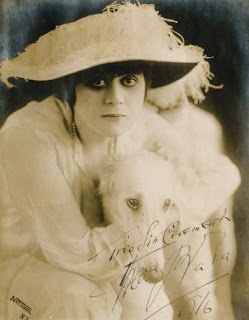 You might also want to check out Theda Bara in A Fool There Was. Bara was one of Hollywood biggest stars during this era, playing the original "vamp," a seducer and destroyer of men (in real life, she was a devoted wife and ardent feminist). The story of woman who seduces a married man and slowly destroys him, A Fool There Was serves as a reminder of just how long the plot of Fatal Attraction has been kicking around—since the Garden of Eden, I'm thinking.
Unfortunately, this Victorian morality tale doesn't answer the question of whether Bara's fame was based on talent or the notoriety of the roles she played. Nearly everything else she ever did, including her triumph, 1917's Cleopatra, was destroyed in a studio fire in 1937, so this is pretty much all you get. (Dawn at Noir and Chick Flicks posted a nice review of A Fool There Was yesterday. Check it out here.)
The best performance by an actor in 1915 was given by Sessue Hayakawa. The Cheat, directed by Cecil B. DeMille, is the story of a rich, spoiled housewife (Fanny Ward) whose profligate spending is driving her husband to financial ruin. Rather than give up her lavish lifestyle, she embezzles a charity's funds then turns to an Asian businessman (Hayakawa) for an emergency loan. Long on the receiving end of Ward's flirtatious attentions, and impatient to consummate their emotional affair, Hayakawa gives her the money but insists she sleep with him in lieu of payment.
 When she takes the money but reneges on her end of the bargain, Hayakawa brands her flesh with a heated iron—one of the most startling scenes of this or any other era.
Like Francesca Bertini, however, Hayakawa elevated this potentially trashy material with a terrific performance.
At a time when The Birth of a Nation could play on Americans' fears of interracial sex to sell $16 million worth of tickets, DeMille no doubt intended the explicit attraction between Hayakawa and Ward as a means to provoke the xenophobic passions of his audience. But Hayakawa brings such elegance and subtlety to the role that, prior to his brutal act of violence, a modern audience is likely to find him the only sympathetic character on the screen.
The years before the United States' entry into World War I represented a brief moment of acceptance for Asians in the American film industry and with the box office success of The Cheat, Hayakawa became a major star. Later, he and his wife, actress Tsuru Aoki, formed their own production company and made several films together, most of which are now lost.
Rising anti-Asian sentiment in the early 1920s, however, put an end to Hayakawa's Hollywood career. After failing to find work in his native Japan, Hayakawa moved to France and launched a second film career. After World War II, he returned to Hollywood and earned an Oscar nomination for his supporting performance in The Bridge on the River Kwai.
 An even bigger sensation at the box office was Raoul Walsh's film of crime and redemp- tion, Regeneration. Based on Owen Kildare's autobiography My Mamie Rose, Regeneration is the story of a small-time hood who meets a social worker and fights to go straight. The film is even-handed in its portrayal of Kildare, showing his suffering as a child at the hands of abusive stepparents, but not flinching from his crimes as an adult.
Walsh must have liked the basic story—a violent man goes potty over a dame—because he directed variations of it for the rest of his career, including High Sierra and The Strawberry Blonde.
Walsh filmed most of Regeneration on location in New York's slums and saloons, lending the film a documentary feel. His real coup, though, was the casting of veteran actress Anna Q. Nilsson, whom Walsh later accurately described as "ravishing." (You may remember her, along with Buster Keaton and H.B. Warner, as one of the "waxworks" who plays bridge with Norma Desmond in Sunset Boulevard.)
With the Progressive politics of Teddy Roosevelt and Woodrow Wilson in full flower, films with a social message were almost a cliche during this era. In addition to Regeneration, you might also check out A Corner in Wheat (1909), Traffic in Souls (1913), Where Are My Children? (1916) and the last film I'll mention in this post, Thomas H. Ince's The Italian, all of which are preserved in the National Film Registry.
 While my other choices for the best films and perform- ances of 1915 are obscure by the standards of today, my choice for best actor in a lead role, George Beban in The Italian, is obscure by any standard. Although the film has been deemed worthy for inclusion in the Film Registry, it was not a box office success in 1915 and Beban himself appeared in only twenty films during his career. Still, it's one of the best films and best performances of the year and worth the effort to track down.
The Italian was one of several films about immigrants to emerge from this period of history, an issue understandably of interest to audiences since immigration from Europe to the U.S. had recently reached its peak of more than a million persons a year, with more than 13.5 million first-generation immigrants living in the U.S. The story of an immigrant who arrives in New York with the American Dream of prosperity and upward mobility in his heart only to find poverty, crime and disillusionment must have been a familiar one.
Despite a successful career on Broadway—Beban was able to command a salary of $7000 and percentage of the profits—The Italian was his first film and it takes him a few scenes to find his legs. In fact, I got the sense while watching the film that most everybody was learning on the job—and maybe they were—but by the time the film kicks into gear, with Beban's Beppo Donnetti traveling steerage from Italy to New York, Beban is in complete command of his craft.
"The actor's style is boisterous but grounded in psychological truth," wrote Daniel Eagan in America's Film Legacy. "He is also an astute judge of his audience. He knows when to appeal to viewers' sympathies and when to pull back, something that could not always be said about his contemporaries."
Beban's descent into despair as his child falls ill and then his icy rage at the politician who used him then spit him out in his hour of need is moving, and his planned revenge chilling—a terrific performance in a small, but unforgettable movie.
 Even More Trivia: Lastly I want to mention Frank Keenan who played a supporting role as the father in another highly-touted movie, The Coward. Keenan isn't good in this or any other movie but I bring him up because in my researches I discovered that in his day he was known as a "furniture actor," which turns out to be an old theater term meaning an actor who habitually turns up for work drunk and has to lean on the furniture to keep from falling down
You learn something new every day.
 The results are in from this week's Monkey Movie poll, Who would you choose as best director of 1930-31?
Fritz Lang who directed Peter Lorre in the serial killer classic, M, ran away with it, receiving 6 of the 10 votes cast. The immortal Charlie Chaplin picked up 2 for directing City Lights and René Clair (Le Million) and Luis Buñuel (L'Âge d'Or) received one vote each.
Tod Browning who directed Dracula had admitted last week in a interview conducted strictly between the left and right lobes of my cerebral cortex that he feared he was just in this poll to round out the field and this proved to be the case.
Raoul Walsh, William A. Wellman and Josef von Sternberg were annoyed not to be in the poll at all and called for an investigation.
After the win, Lang and his (alleged) mistress, actress Joan Bennett, shared a celebratory cigarette on the set of their current movie project, the film noir thriller Scarlet Street.
 "Winning this poll," said Lang at a hastily-arranged press conference, "means as much to me as winning the Katie Award itself. Well, almost. I mean, I'm not crazy. The Katie Award is big and will provide some real leverage at contract time. But this is nice, too."
By the way, perhaps I'm telling stories out of school, but the vote for René Clair came from none other than our own beloved Katie-Bar-The-Door. She felt Clair's work on Le Million was innovative, clever and warm, not to mention it's her favorite movie of the five listed here. She's right, of course. Le Million is on the short list for most pleasant surprises I've received while working on this blog and I give it my highest recommendation. But, well, I went with Lang for the reasons I've previously stated at length.
In any event, whoever you voted for, you're right, their work was the best of the year. A good year for directors all the way around.
 Although Cimarron won the Oscar for best picture of 1931, the Western that garners the most attention now was a little-seen, big-budget flop called The Big Trail. Directed by veteran Raoul Walsh and starring John Wayne, I almost nominated this one for best picture because of its historical significance as the first big budget widescreen movie. That, and because I like Westerns.
Raoul Walsh was one of the Fox Film Corporation's hardest working directors when he was tapped in 1930 to helm The Big Trail. Best known for directing the James Cagney classic White Heat (or, if you're a fan of this blog, Douglas Fairbanks's best movie, 1924's The Thief of Bagdad), Walsh worked in Hollywood for more than fifty years, racking up nearly 140 directing credits, including as an assistant director on The Birth of a Nation in 1915. He received his last film credit (as a writer) in 1970.
Walsh had also worked as an actor, appearing in forty films, and was set to star as the Cisco Kid in the Western In Old Arizona when his car struck a jackrabbit, shattering the windshield and costing Walsh his right eye. (After the accident, he opted to wear what became a trademark eye patch, reasoning that with a glass eye, "Every time I'd get in a fight, I'd have to put it in my pocket.") (Warner Baxter, incidentally, went on to win an Oscar in the role.)
 Shot on location in Fox's new 70 mm Grandeur process, The Big Trail was one of the first feature-length widescreen movies and the first big budget one. Its $2 million budget was enormous at the time and represented something of a gamble for the studio during the early days of the Depression. Walsh spotted a young unknown named Marion Morrison working with director John Ford and, renaming Morrison "John Wayne," cast him in the lead.
The Big Trail is the story of a young wagon master (Wayne, just 23 at the time) who leads a band of settlers across the frontier while battling Indians, weather and a murderous gambler. It's a beautiful film to look at and if I were handing out awards for cinematography, Arthur Edeson (All Quiet On The Western Front, Casablanca) would certainly have received a nomination.
 That said, The Big Trail suffers from the same problem all Westerns of that era suffered from—simplistic storylines and characterizations—and it flopped at the box office. It took John Ford and his 1939 masterpiece Stagecoach to turn the Western into adult fare.
It didn't help that few theaters were able to exhibit a widescreen movie and most theaters received the inferior 35 mm print, filmed at the same time as the 70 mm version (actually, five versions were shot on location, with French, Spanish and German language editions, filmed mostly with different casts, accounting for the other three). After its premiere, a half hour was reportedly trimmed from its run time, but the changes made no difference—audiences just weren't interested in The Big Trail.
 John Wayne took most of the blame for the failure and was relegated to low budget B-Westerns for the rest of the decade. Though gifted, he was raw and maybe his long exile in the cinematic wilderness was just what he needed. By the time Ford fought to cast him as the Ringo Kid in Stagecoach, Wayne was a screen veteran with sixty movies under his belt. Though still unbelievably young, by 1939 he knew how to carry a movie—and if you think there's no skill involved in commanding the screen, that it's just a matter of a movie star with looks and charisma "playing himself," then you should compare The Big Trail to, say, The Searchers or Rio Bravo.
Widescreen movies took even longer than John Wayne to catch on. As a cost-cutting move during the Depression, studios abandoned the effort to convert movie houses to widescreen which audiences had never been much interested in anyway. It would be more than twenty years before Hollywood took another crack at a widescreen movie.
In 2006, the National Film Preservation Board included The Big Trail in the National Film Registry. If you're going to watch it, make you sure you get hold of the widescreen version. It is available as part of a two-disc set from Fox and shows up on the Fox Movie Channel from time to time.
No time for blogging today. Busy doing something close to nothing. Here's a look at those who almost got a Katie nomination for 1930-31 ... but didn't.
Jackie Cooper (actor, Skippy)

Bela Lugosi (actor, Dracula) (almost forgot him—MM, 11/2/09)
 Irene Dunne (actress, Cimarron)

Louise Brooks (actress, Prix de Beauté)

Mary Astor (actress, Other Men's Women)

William A. Wellman (director, The Public Enemy)

Raoul Walsh (director, The Big Trail)

Luis Buñuel (director, L'Age d'Or)

Dwight Frye (supporting actor, Dracula)

Harry Myers (right, with Charles Chaplin) (supporting actor, City Lights)

Paul Ollivier (left) (supporting actor, Le Million)

Mae Clarke (supporting actress, The Front Page)

Virginia Cherrill (supporting actress, City Lights)

Marjorie Rambeau (supporting actress, Min and Bill)

John Monk Saunders (with wife Fay Wray) (screenplay, The Dawn Patrol)

The first in a series of essays about the Katie winners of the pre-Oscar era.
 He was called "The King of Hollywood" and if any actor during the Silent Era might credibly have claimed to be more popular than Charlie Chaplin, it was Elton Thomas Ullman, better known to his adoring public as Douglas Fairbanks.
The star of forty-eight movies, including some of the greatest action films of all time, he was, along with Chaplin and his wife Mary Pickford, one of the three highest-paid and most-popular actors of his day. On his honeymoon with Pickford, Fairbanks and his bride drew crowds of 300,000 in Paris and London. At home in their mansion, dubbed "Pickfair," the two threw lavish parties and routinely entertained the world's most sought-after celebrities. To receive an invitation to Pickfair was to receive the social blessing of Hollywood royalty.
But Fairbanks was more than just a regular feature of the gossip columns and party circuit. He was also a fine actor and virtually created the modern action hero in a series of swashbuckling adventures that showcased an infectious joie de vivre and an extraordinary flare for stuntwork.
His lead performance in The Mark of Zorro, for which I awarded him a Katie as best actor of 1920, was his first foray into the genre of the period-costume action-adventure. Already a star of comedies, audiences responded with such enthusiasm to Fairbanks's new role that he cheerfully ended up playing variations on it for the rest of his career.
 The per- formance was both ground- breaking and one of the most influential in movie history, esta- blishing many of the superhero and action hero conventions we now take for granted. His physique later served as the model for the comic hero Superman and the mask, secret hideaway and foppish alter ego inspired the creators of Batman.
As a co-founder of United Artists, Fairbanks had complete creative control over his pictures and he produced a string of action-adventure classics—The Mark of Zorro, The Three Musketeers, Robin Hood, The Thief of Bagdad, Don Q Son of Zorro, The Black Pirate, The Gaucho—before saying farewell to the genre with The Iron Mask. On each of these movies, he worked not just as an actor but also as a writer (under the name Elton Thomas) and a producer.
The Thief of Bagdad was the best of these movies, one of the finest of its type ever made. Loosely based on stories from One Thousand and One Nights, The Thief of Bagdad is the tale of a pickpocket who falls in love with a princess and who then sets off on a fantastic adventure to prove himself. With the graceful and athletic Fairbanks at its heart, The Thief of Bagdad is as fluid as a ballet while at the same time serving up a rip-snorting yarn filled with the best special effects 1924 could offer.
 I selected it as the best picture of 1924 over such classics as Greed, The Last Laugh, The Navigator and Sherlock, Jr. and feel completely justified in doing so. The American Film Institute voted The Thief of Bagdad the ninth best fantasy movie of all time, the only silent film on the list, and along with City Lights, one of only two silent movies on any of the AFI Top Ten lists. In my opinion, it was the best fantasy movie made before The Wizard of Oz in 1939, and was probably the best action-adventure movie before 1938's The Adventures of Robin Hood.
Fairbanks continued making swashbuckling adventures until the dawn of the Early Sound Era when he put down his foil and returned to the genre that had given him his start, comedy. He made four movies, including one, The Taming of the Shrew, with his by-then estranged wife, Mary Pickford, then retired from acting altogether.
He later received a commemorative Oscar in recognition of his work as the first president of the Academy of Motion Picture Arts and Sciences and his "outstanding contribution ... to the international development of the motion picture."
Douglas Fairbanks died of a heart attack in 1939 at the age of fifty-five. His last words were "Never felt better."

 The other day, FlickChick noted in a comment that she'd hoped to see a mention of Miriam Cooper somewhere in my write-up of D.W. Griffith's epic masterpiece Intolerance, but alas, it was a short review and I was destined to disappoint her.
 Cooper made her film debut in the Griffith short The Duke's Plan, but really established herself in a series of short Civil War pictures made at Kalem Studios. "I was a stunt girl; I didn't do any acting."
 "I couldn't cry to save my soul," she said of one scene played for Griffith. "He pulled a chair up [and said] 'Miss Cooper, I didn't want to tell you this, but your mother has just died.'" She cried buckets.
 During the filming of Intolerance, Cooper and Raoul Walsh (who would later direct such films as White Heat and High Sierra) married—secretly, since Griffith was himself romantically interested in the actress. Not until after Walsh moved over to Fox studios did they make their marriage known.
 Cooper and Walsh had two children together but she divorced the chronically philandering director in 1925 and never remarried. She invested her movie money well, however, and lived comfortably until her death in 1976, touring the country as a golf enthusiast and playing well enough to sink holes-in-one in three different states—no doubt some sort of record among golfing ex-silent film actresses!






 Posts
Posts

