I confess, I've given most of this year's blogathons a miss, mostly because I'm working on a mammoth non-blog project that requires nearly all of my time and energy. But here's one that tickled my fancy and allowed me to write about silent movies at the same time.
It's called "The Great Recasting Blogathon" and it's hosted by In The Mood and Frankly My Dear, a couple of classic movie blogs you might want to check out on your own.
The rules are these:
1. Pick a movie that was made in between 1966 and today 2. Change the year of production 3. Choose new leads from Classic Hollywood 4. Choose a new director from Classic Hollywood 5. Explain why you think it would work
Well, I'm recasting the 2001 version of Ocean's Eleven—as a silent movie, of course. As you probably know, Ocean's Eleven was a remake of the 1960 Rat Pack film of the same name, which was itself a loose remake of the 1956 Jean-Pierre Melville caper classic, Bob le Flambeur.
But what isn't generally known—because I just this second made it up—is that Bob le Flambeur was itself a remake of one of the greatest silent films of all-time, the star-studded comedy Ocean's 11, starring Douglas Fairbanks, Charlie Chaplin and Mary Pickford.
Don't remember that one, you say? Well, here's the story:
It was 1919, and the world's three most popular movie stars—Douglas Fairbanks, Mary Pickford and Charlie Chaplin—had just joined forces with the world's most popular director—D.W. Griffith—to form a new distribution company they called "United Artists."
For years, studio middle men had charged exorbitant fees simply to send the quartet's films out to the nation's theaters, a service that required little more than a large envelope and a postage stamp. With the formation of United Artists, Fairbanks, Pickford, Chaplin and Griffith would henceforth lick their own stamps, and each entertained visions of vast sums of money rolling in as compensation for the effort.
There was only one problem: they had no new product to distribute.
"Hey, kids," suggested Fairbanks, "why don't we put on a show!"
A great idea, everyone agreed, but what kind of show? They hit upon the happy notion of a musical revue called The Jazz Singer until someone remembered that this was the silent era and they were going to look pretty silly belting out show tunes that no one could hear.
Next, Griffith proposed they do a variation on his usual storyline, which was to reduce a complex historical event to a question of who got into Lillian Gish's underpants first, à la The Birth of a Nation, Hearts of the World and Orphans of the Storm. The others were skeptical as it was, then vetoed the idea outright when they learned Gish wouldn't actually be in the movie—just her underpants.
"How about an adaptation of Little Women," said Pickford. "Of course, you three will have to play your parts in drag, but if I can play a twelve year old girl, surely you can, too."
"I've never done drag comedy," Chaplin lied, blushing, "and don't call me Shirley! Besides, I've got a great idea for a movie, a scathing indictment of capitalism and the industrial age I call Modern Times."
"Sounds fabulous," said Fairbanks. "When can you start production?"
"1936."
Reluctantly admitting they had no useable ideas, Fairbanks wired his old friend, writer Anita Loos. Loos had written a number of films for Fairbanks in 1916 and 1917, including the breakthrough hits The Matrimaniac and Wild and Woolly, and he was eager to work with her again. "She's busy writing a novel called Gentlemen Prefer Blondes," he reported the next day, "but for us, she's willing to set it aside for a percentage of the profits."
Griffith laughed. "Everybody knows movies never turn a profit! Why, even Gone with the Wind and Star Wars haven't turned a profit!"
Deluded by visions of great wealth, Loos cranked out one of her typically witty, fast-paced scripts, something she called United Artists Presents a D.W. Griffith Film Starring Douglas Fairbanks, Charlie Chaplin and Mary Pickford in a Story about a Team of Con-Artists who Break the Bank at the Gambling Casino in Monte Carlo so that One of Them (Fairbanks) Can Win Back his Ex-Wife (Pickford) While Making All His Pals (including Chaplin) Rich in the Process.
"The title's a bit unwieldy," Pickford said, "but otherwise, it's perfect."
"Yeah, well, to make it work you're gonna need a crew as nuts as you are!" Loos said. "So who have you got in mind?"
The top-billed talent was easy. Fairbanks would play the lead, a handsome con artist named Daniel Ocean, while Chaplin would play his sidekick, Rusty Ryan—an agreeable distribution of chores, as the former would require some vigorous stunt work while the latter entailed split-second comic timing.
Pickford would, of course, play the ex-wife, Tess. Chaplin was especially looking forward to getting out of the Tramp costume for once. "That character has run its course," he said flatly. "A hundred years from now, who'll even remember him?"
For the plum part of the man they set out to rob, casino owner Terry Benedict, Pickford suggested Sessue Hayakawa. Hayakawa had risen to stardom on the strength of his seductively handsome yet cruelly ruthless villain in Cecil B. DeMille's The Cheat, a rare feat in the deeply racist Hollywood of the day.
"If you've seen him in The Cheat," Pickford said, "you know he's perfect—hot and snaky and deliciously evil. You don't know whether to run away or cover him in whipped cream and eat him for dessert. Yummy!"
"Wait, what's this about whipped cream?" said Fairbanks.
In addition to a satisfying villain, the film also required an all-star cast of comedians to play a rogues gallery of crooks and con men—each with a specialized skill that would require careful casting.
For example, the part of "the grease man," a contortionist who opens the casino's safe from inside the vault, required not just a comedian but an acrobat of near superhuman athletic ability.
"Buster Keaton," Chaplin said immediately. "He's funnier than a locomotive, throws a pie faster than a speeding bullet, and can fall out of a building in a single bound. Not to mention his Twitter feed is a riot! He's playing second banana to Roscoe Arbuckle, but that's not going to last long. Offer him anything but top billing."
Keaton jumped at the offer when Fairbanks called. "I classify Chaplin as the greatest motion picture comedian of all time," he said. "Plus I need the money."
For one of two brothers who drive each other (and everybody else) crazy, Chaplin recommended his former British stage partner who was currently making comedy shorts for Bronco Billy Anderson. "Splendid chap named Stan Laurel."
For the other brother, D.W. Griffith suggested a fellow Southerner, a plump Georgian under contract at Vitagraph named Oliver Hardy. "I don't believe they've worked together before," Griffith said, "but something tells me Laurel and Hardy would make a sensational comedy team."
One of the film's pivotal roles was that of a high roller who would convince Hayakawa to open the casino's safe to him. "For this role, we need an older actor," Griffith said, "a twinkly-eyed ham who can get a laugh from a death scene."
"Theodore Roberts!!!" everyone said simultaneously.
Roberts had proven equally adept at drama and comedy during a run of highly-successful character parts in such films as Joan the Woman, Old Wives For New and The Roaring Road. Both Pickford and Fairbanks had worked with him before and would work with him again.
For another "older" part, that of a disgruntled ex-casino owner who would bankroll the caper, Chaplin suggested a colleague from his Mack Sennett days, Ford Sterling.
Audiences of the time would best remember Sterling as the first leader of the Keystone Kops. He had recently played the Kaiser in an oddball cross-dressing comedy, Yankee Doodle in Berlin, starring Bothwell Browne as an army officer who disguises himself as a woman to infiltrate enemy headquarters and enjoys the masquerade entirely too much.
"It'll be nice working with proper comedians again," he said after receiving Chaplin's offer. "Just give me a pie and tell me who to throw it at and I'm good to go."
For the role of the munitions expert, Chaplin suggested the legendary French comedian, Max Linder. Linder had been the biggest star in Europe prior to the Great War, and Chaplin had modeled his style after him, but Linder's career had gone into decline after the actor was injured by mustard gas on the Western Front.
"The notion of Max handling high explosives would get a terrific laugh in the overseas market," Chaplin said, "and I would like to help him revive his career."
To play the "inside man," an employee of the casino who could come and go without drawing attention to himself, they chose Noble Johnson, a talented character actor with an imposing physique and a gift for disguises. One of the few African-American actors working regularly in Hollywood, Johnson ran a studio of his own, the Lincoln Motion Picture Company, dedicated to producing high-quality "race films" (as they were then known) such as The Realization of a Negro's Ambition. Griffith knew him from Intolerance where he had cast him as a Babylonian soldier.
The part of the computer nerd who hacks the casino's security systems proved to be a head-scratcher.
"What's a nerd?" asked Pickford. "For that matter, what's a computer?"
But after further discussion revealed that what the part required was someone who was supposed to be a genius but was in fact a quirky, funny-looking goofball, they settled on Ben Turpin whose eyes had been insured for $25,000 in case of accidental uncrossing.
"He was just a funny-looking guy," Buster Keaton said later. "You know what I mean? We introduced his character as 'a man's man,' and Ben Turpin entered. That was the biggest laugh of the picture."
Over a late supper in a suite in the Hollywood Hotel, Fairbanks reviewed the cast list with Pickford. "Turpin makes ten," he said. "Ten oughta do it, don't you think? You think we need one more? You think we need one more. All right, we'll get one more."
"What we need," Fairbanks told Chaplin at lunch the next day, repeating a suggestion of Pickford's, "is an innocent, all-American boy type—but here's the catch: one who can match me move for move in the scene where I climb down the elevator shaft. Who you got?"
"That would be Harold Lloyd," Chaplin said. "He recently invented a boy-with-glasses character that I think is going to be a big hit. And he's handsome and can climb buildings even better than you can."
"Well, we'll use him anyway," Fairbanks said.
The film, now retitled Ocean's 11, began production in the summer of 1919. Griffith directed the action sequences with his usual flare, but Chaplin balked at taking comedy advice from a man who thought the sack of Babylon was a laugh riot. Although Griffith received sole directorial credit, scholars now believe Chaplin was responsible for most of the film's non-action sequences.
While the two men would remain partners in the United Artists venture, they de-friended each other on Facebook soon after filming was complete, and for years thereafter rang each other's doorbell late at night and ran away.
Less apparent on the set, but no less problematic, was the tension between Fairbanks' 100% irony-free acting style and Chaplin's compulsion to deflate all larger-than-life figures. The scene, for example, where Ocean talks Rusty into robbing the casino—"Why not do it?"—took over 400 takes alone, with either Fairbanks boisterously breaking character or Chaplin kicking him in the pants.
Still, film-industry insiders and the movie-going public alike were abuzz with anticipation of the picture's Christmas Day premiere, and the four co-founders of United Artists had high hopes for a commercial and critical success. "This is going to be bigger than The Birth of a Nation," Griffith boasted. "Funnier, too."
Then tragedy struck. While awaiting shipment to theaters across the country, the highly-combustible elements in the movie's silver nitrate film stock caught fire, destroying not only the warehouse where the film was stored, but also the original negative and every print.
In a moment, Ocean's 11 joined the long list of silent films lost forever. Only a few fragments remain:
Film fans can only dream of what might have been.
"We're ruined," Fairbanks sobbed, "ruined before we ever made a movie!"
"Hardly," said Pickford. "While you were busy buckling your swash, I had the foresight to insure the film for $10 million with Lloyds of London—which is $9 million more than it cost to make! Not only are we not ruined, we're richer than ever!"
"Mary, you're wonderful!" said Fairbanks, dropping to one knee. "Will you marry me?"
"You bet I will, you gorgeous hunk o' man, you! Come here and kiss me!"
"Rowr!"
Tomorrow: More posters from silent movies you will never see.
Today is Sessue Hayakawa's birthday. You remember Sessue Hayakawa, don't you? I wrote this about him last month:
The best performance by an actor in 1915 was given by Sessue Hayakawa. The Cheat, directed by Cecil B. DeMille, is the story of a rich, spoiled housewife (Fanny Ward) whose profligate spending is driving her husband to financial ruin. Rather than give up her lavish lifestyle, she embezzles a charity's funds then turns to an Asian businessman (Hayakawa) for an emergency loan. Long on the receiving end of Ward's flirtatious attentions, and impatient to consummate their emotional affair, Hayakawa gives her the money but insists she sleep with him in lieu of payment.
When she takes the money but reneges on her end of the bargain, Hayakawa brands her flesh with a heated iron—one of the most startling scenes of this or any other era.
Like Francesca Bertini, however, Hayakawa elevated this potentially trashy material with a terrific performance.
At a time when The Birth of a Nation could play on Americans' fears of interracial sex to sell $16 million worth of tickets, DeMille no doubt intended the explicit attraction between Hayakawa and Ward as a means to provoke the xenophobic passions of his audience. But Hayakawa brings such elegance and subtlety to the role that, prior to his brutal act of violence, a modern audience is likely to find him the only sympathetic character on the screen.
The years before the United States' entry into World War I represented a brief moment of acceptance for Asians in the American film industry and with the box office success of The Cheat, Hayakawa became a major star. Later, he and his wife, actress Tsuru Aoki, formed their own production company and made several films together, most of which are now lost.
Rising anti-Asian sentiment in the early 1920s, however, put an end to Hayakawa's Hollywood career. After failing to find work in his native Japan, Hayakawa moved to France and launched a second film career. After World War II, he returned to Hollywood and earned an Oscar nomination for his supporting performance in The Bridge on the River Kwai.
Let's celebrate by watching his performance in The Cheat, which is available for a limited time thanks to the Internet Movie Database:
Forget auteur theory, formalism, genre studies or any of that other film school claptrap, the unifying thread running through any well-rounded and not so well-rounded film education is Oscar trivia. People who wouldn't know Follow Focus from the French New Wave can tell you every Oscar winner from the first ceremony to the present day; fanatics have known for years that Citizen Kane should have won best picture of 1941; and even the most casual filmgoers will fight ninety-nine rounds over the latest Oscar snub.
But when it comes to movies made before the Oscars were invented, well, for most of us, they might as well have never been made at all.
And why? Because we like a winner and even more, we like crabbing about our favorite loser. The Academy of Motion Picture Arts and Sciences didn't start handing out awards until 1929, and no movie made before August 1, 1927, was eligible. If the Academy had come up with the Oscars in, say, 1924, we'd all have an opinion about whether Greed should have won best picture over Sherlock Jr. or The Thief of Bagdad. But the Academy didn't and even lifelong film buffs will cheerfully shrug and admit they've never seen any of those pictures, much less have an opinion about them.
Without winners and losers, there's no controversy—and in America, at least, no controversy means nothing to talk about. I tell you, silent movies will never be as popular as they ought to be until we have something to argue about.
So I'm starting the argument, here, now.
The "Silent Oscars" are my choices for best picture, director, screenplay and all four acting categories for the years before the Academy began handing out awards, beginning with 1915 and running through July 31, 1927. I might get every single pick wrong, but you've got start somewhere—and besides, based on past history, getting it wrong is what the Oscars are all about.
Let the argument begin.
PICTURE winner:Les Vampires (prod. Société des Etablissements L. Gaumont) nominees:The Birth Of A Nation (prod. D.W. Griffith); The Cheat (prod. Cecil B. DeMille); The Italian (prod. Thomas H. Ince); Regeneration (prod. William Fox) Must-See Movies:The Birth Of A Nation; Les Vampires Recommended Films:Assunta Spina;The Cheat; Fatty's Tintype Tangle; His New Job; The Italian; Posle Smerti a.k.a. After Death; Regeneration; The Tramp Of Interest:Alice in Wonderland; The Coward; A Fool There Was ACTOR winner: George Beban (The Italian) nominees: Roscoe Arbuckle (The Keystone Comedies); Charles Chaplin (The Essanay Comedies) ACTRESS winner: Francesca Bertini (Assunta Spina and La signora delle camelie) nominees: Theda Bara (A Fool There Was); Geraldine Farrar (Carmen) DIRECTOR winner: Louis Feuillade (Les Vampires) nominees: D.W. Griffith (The Birth of a Nation); Raoul Walsh (Regeneration) SUPPORTING ACTOR winner: Sessue Hayakawa (The Cheat) nominees: Marcel Lévesque (Les Vampires); Henry B. Walthall (The Birth of a Nation) SUPPORTING ACTRESS winner: Musidora (Les Vampires) nominees: Anna Q. Nilsson (Regeneration); Clara Williams (The Italian) SCREENPLAY winner: Raoul Walsh and Walter C. Hackett, from the autobiography My Mamie Rose by Owen Frawley Kildare (Regeneration) nominees: Louis Feuillade (Les Vampires); Thomas H. Ince and C. Gardner Sullivan (The Italian) SPECIAL AWARDS: G.W. "Billy" Bitzer (The Birth Of A Nation) (Cinematography); D.W. Griffith, Joseph Henabery, James Smith, Rose Smith and Raoul Walsh (The Birth Of A Nation) (Film Editing); Robert Goldstein and Clare West (The Birth Of A Nation) (Costumes); Frank Wortman (The Birth Of A Nation) (Set Design)
Boy, what an obscure bunch of winners, you're no doubt thinking, and I agree with you. Two years ago, I doubt I had heard of any of them except Sessue Hayakawa and Raoul Walsh—the former you may remember for his Oscar-nominated performance as the commandant of the Japanese POW camp in The Bridge on the River Kwai, the latter for directing such films as White Heat and The Roaring Twenties. The rest of them? Not a chance.
But let's face it, other than Charlie Chaplin, The Birth of a Nation and maybe Theda Bara, all of 1915's potential choices are pretty obscure.
If the Silent Oscars were simply about trying to predict what the Academy might have chosen in 1915, then The Birth of a Nation would be the big winner, taking home awards for best picture, director, cinematography, editing, set design, costumes and acting awards for Lillian Gish and maybe Henry B. Walthall, making it the early silent era's equivalent of Gone With The Wind, which cleaned up at the Oscars a quarter of a century later.
But that's not quite what the Silent Oscars are all about. Aside from the fact that the Academy wasn't founded until 1927, its rather conventional wisdom is wrong more often than it's right. The Academy over the years has shown a real prejudice against comedies, commercial flops, foreign films and "mere" entertainment—which explains why Cary Grant and Alfred Hitchcock never won competitive Oscars—and there's no reason to think it would have done any better just because the films were silent.
The Birth of a Nation, the story of two families torn apart by the American Civil War and its aftermath, has some extraordinary sequences, particularly the battle scenes and the assassination of Abraham Lincoln, but ultimately director D.W. Griffith's heedless devotion to the historical myths underlying the movie's source material—an unapologetically racist novel called The Clansman—renders the movie nearly unwatchable to a modern audience.
Even the most charitable reading of the movie, that it is a Faulkneresque tragedy about American apartheid told through the eyes of a triumphant white supremacist, can't explain away the tedious romance that dominates the film's second half. For all its importance to film history—its box office success pretty much guaranteed the future of the motion picture—The Birth of a Nation is a deeply-flawed, would-be masterpiece. (Read more about it here.)
Besides, just because you may not have heard of my choices doesn't mean that an audience in 1915 wouldn't have. Les Vampires was a huge hit in France, Francesca Bertini was Italy's most famous actress during the silent era, The Cheat and Regeneration were big hits in the U.S., and while The Italian flopped at the box office, it proved to be a major influence on directors of the time, with specific shots echoed in such films as The Immigrant, 7th Heaven and The Cameraman.
My choice for best picture, Les Vampires, you're familiar with, if only because I wrote 2000 words about it (here) last week. The ten-part, seven hour serial written and directed by Louis Feuillade tells the story of a criminal organization, The Vampires, that terrorizes Belle Époque Paris, corrupting those it can, murdering those it can't. Feuillade's serials, which both glamorized crime and anticipated the anxieties that came to define the 20th century—violence, paranoia, alienation, conspiracy, terrorism— influenced directors as diverse as Luis Buñuel, Fritz Lang and Alfred Hitchcock.
"All the roots of the thriller and suspense genres," David Thomson has written, "are in Feuillade's sense that evil, anarchy and destructiveness speak to the frustrations banked up in modern society."
Although she doesn't show up until the serial's third chapter, Musidora as the sinister, seductive Irma Vep is the real star of the show, robbing, murdering and kidnapping her way into the hearts of a generation of Frenchmen. The surrealists worshiped her amoral sexuality," Tom Gunning wrote, "and the revolutionary poet Louis Aragon later claimed that Irma Vep's dark bodysuit inspired the youth of France with fantasies of rebellion."
Musidora also starred in Feuillade's next serial, Judex, and later produced and directed her own films.
The serial has a wonderfully nutty quality, showing us a simultanously whimsical and dangerous Paris where you can lean out a second-story window and wind up with a lasso around your neck, where every cupboard hides a body, every hatbox a head, and your neighbor's loft conceals a cannon. "[T]he orginality of Lang and Hitchcock" (Thomson again) "fall into place when one has seen Feuillade: Mabuse is the disciple of Fantômas; while Hitchcock's persistent faith in the man who wears high heels, in the crop-spraying plane that will swoop down to kill, and in a world mined for the complacent is inherited from Feuillade."
Simply put, despite being a product of the early silent era, Les Vampires more than any other work from the first thirty years of film history (1888-1918) feels like it was written for a 21st century audience and is my choice for best picture of 1915.
Francesca Bertini, my choice as 1915's best actress in a leading role, was Italy's first great star and inspired one of the two significant genres that characterized silent Italian cinema, the "diva" film. Similar to Hollywood's film noir of the post-war era, diva films told tales of beautiful, aristocratic women who destroy men as a sort of bloodsport.
In Assunta Spina, Bertini's seemingly trivial attempt to provoke her fiance to jealousy leads to a brutal beating, and her seduction of a corrupt judge to secure preferential treatment for her imprisoned fiance leads to disaster. Rather than playing a cartoonish vamp, however, Bertini's characterization is heartbreakingly three dimensional.
Likewise, her performance in La signora delle camelie, an early adaptation of the Dumas novel Camille, is both intimate and deeply-felt, and the anguish she conveys as she juggles true love, tuberculosis and the demands of her crass profession, rivals anything the great Greta Garbo managed in the 1936 version of the same story.
In her essay "Naturalism and the Diva: Francesca Bertini in Assunta Spina," Lea Jacobs argues that Bertini's "pictorial" style of acting—the broad, stylized gestures that modern audiences find so off-putting—is not so much representational as akin to a dance, with a rhythm and use of space reminiscent of Sarah Bernhardt. "An appreciation of this kind of acting," she writes, "involves not only an attention to the grace and aptness of the gestures employed, but also, how they mobilize the space of the set and exhaust the range of emotional possibilities of the situation. Rather than being 'read' for their meaning, they should be savored like a jazz musician's improvisations on a well known theme."
(The other Italian genre was the "Maciste" film, named for the heroic strongman at the center of Giovanni Pastrone's 1914 classic, Cabiria. Also known as "swords and sandals" cinema, the Maciste films focused on Italy's glorious past, a subject of particular interest at a time when the unified nation of Italy was only fifty-five years old and still groping for a national identity. After the debacle of World War I, Mussolini and his fascist supporters rode a wave of "strongman" sentiment to power.)
You might also want to check out Theda Bara in A Fool There Was. Bara was one of Hollywood biggest stars during this era, playing the original "vamp," a seducer and destroyer of men (in real life, she was a devoted wife and ardent feminist). The story of woman who seduces a married man and slowly destroys him, A Fool There Was serves as a reminder of just how long the plot of Fatal Attraction has been kicking around—since the Garden of Eden, I'm thinking.
Unfortunately, this Victorian morality tale doesn't answer the question of whether Bara's fame was based on talent or the notoriety of the roles she played. Nearly everything else she ever did, including her triumph, 1917's Cleopatra, was destroyed in a studio fire in 1937, so this is pretty much all you get. (Dawn at Noir and Chick Flicks posted a nice review of A Fool There Was yesterday. Check it out here.)
The best performance by an actor in 1915 was given by Sessue Hayakawa. The Cheat, directed by Cecil B. DeMille, is the story of a rich, spoiled housewife (Fanny Ward) whose profligate spending is driving her husband to financial ruin. Rather than give up her lavish lifestyle, she embezzles a charity's funds then turns to an Asian businessman (Hayakawa) for an emergency loan. Long on the receiving end of Ward's flirtatious attentions, and impatient to consummate their emotional affair, Hayakawa gives her the money but insists she sleep with him in lieu of payment.
When she takes the money but reneges on her end of the bargain, Hayakawa brands her flesh with a heated iron—one of the most startling scenes of this or any other era.
Like Francesca Bertini, however, Hayakawa elevated this potentially trashy material with a terrific performance.
At a time when The Birth of a Nation could play on Americans' fears of interracial sex to sell $16 million worth of tickets, DeMille no doubt intended the explicit attraction between Hayakawa and Ward as a means to provoke the xenophobic passions of his audience. But Hayakawa brings such elegance and subtlety to the role that, prior to his brutal act of violence, a modern audience is likely to find him the only sympathetic character on the screen.
The years before the United States' entry into World War I represented a brief moment of acceptance for Asians in the American film industry and with the box office success of The Cheat, Hayakawa became a major star. Later, he and his wife, actress Tsuru Aoki, formed their own production company and made several films together, most of which are now lost.
Rising anti-Asian sentiment in the early 1920s, however, put an end to Hayakawa's Hollywood career. After failing to find work in his native Japan, Hayakawa moved to France and launched a second film career. After World War II, he returned to Hollywood and earned an Oscar nomination for his supporting performance in The Bridge on the River Kwai.
An even bigger sensation at the box office was Raoul Walsh's film of crime and redemp- tion, Regeneration. Based on Owen Kildare's autobiography My Mamie Rose, Regeneration is the story of a small-time hood who meets a social worker and fights to go straight. The film is even-handed in its portrayal of Kildare, showing his suffering as a child at the hands of abusive stepparents, but not flinching from his crimes as an adult.
Walsh must have liked the basic story—a violent man goes potty over a dame—because he directed variations of it for the rest of his career, including High Sierra and The Strawberry Blonde.
Walsh filmed most of Regeneration on location in New York's slums and saloons, lending the film a documentary feel. His real coup, though, was the casting of veteran actress Anna Q. Nilsson, whom Walsh later accurately described as "ravishing." (You may remember her, along with Buster Keaton and H.B. Warner, as one of the "waxworks" who plays bridge with Norma Desmond in Sunset Boulevard.)
With the Progressive politics of Teddy Roosevelt and Woodrow Wilson in full flower, films with a social message were almost a cliche during this era. In addition to Regeneration, you might also check out A Corner in Wheat (1909), Traffic in Souls (1913), Where Are My Children? (1916) and the last film I'll mention in this post, Thomas H. Ince's The Italian, all of which are preserved in the National Film Registry.
While my other choices for the best films and perform- ances of 1915 are obscure by the standards of today, my choice for best actor in a lead role, George Beban in The Italian, is obscure by any standard. Although the film has been deemed worthy for inclusion in the Film Registry, it was not a box office success in 1915 and Beban himself appeared in only twenty films during his career. Still, it's one of the best films and best performances of the year and worth the effort to track down.
The Italian was one of several films about immigrants to emerge from this period of history, an issue understandably of interest to audiences since immigration from Europe to the U.S. had recently reached its peak of more than a million persons a year, with more than 13.5 million first-generation immigrants living in the U.S. The story of an immigrant who arrives in New York with the American Dream of prosperity and upward mobility in his heart only to find poverty, crime and disillusionment must have been a familiar one.
Despite a successful career on Broadway—Beban was able to command a salary of $7000 and percentage of the profits—The Italian was his first film and it takes him a few scenes to find his legs. In fact, I got the sense while watching the film that most everybody was learning on the job—and maybe they were—but by the time the film kicks into gear, with Beban's Beppo Donnetti traveling steerage from Italy to New York, Beban is in complete command of his craft.
"The actor's style is boisterous but grounded in psychological truth," wrote Daniel Eagan in America's Film Legacy. "He is also an astute judge of his audience. He knows when to appeal to viewers' sympathies and when to pull back, something that could not always be said about his contemporaries."
Beban's descent into despair as his child falls ill and then his icy rage at the politician who used him then spit him out in his hour of need is moving, and his planned revenge chilling—a terrific performance in a small, but unforgettable movie.
Even More Trivia: Lastly I want to mention Frank Keenan who played a supporting role as the father in another highly-touted movie, The Coward. Keenan isn't good in this or any other movie but I bring him up because in my researches I discovered that in his day he was known as a "furniture actor," which turns out to be an old theater term meaning an actor who habitually turns up for work drunk and has to lean on the furniture to keep from falling down
Named for Katie-Bar-The-Door, the Katies are "alternate Oscars"—who should have been nominated, who should have won—but really they're just an excuse to write a history of the movies from the Silent Era to the present day.
To see a list of nominees and winners by decade, as well as links to my essays about them, click the highlighted links:
Remember: There are no wrong answers, only movies you haven't seen yet.
The Silent Oscars
And don't forget to check out the Silent Oscars—my year-by-year choices for best picture, director and all four acting categories for the pre-Oscar years, 1902-1927.
Look at me—Joe College, with a touch of arthritis. Are my eyes really brown? Uh, no, they're green. Would we have the nerve to dive into the icy water and save a person from drowning? That's a key question. I, of course, can't swim, so I never have to face it. Say, haven't you anything better to do than to keep popping in here early every morning and asking a lot of fool questions?

 I confess, I've given most of this year's blogathons a miss, mostly because I'm working on a mammoth non-blog project that requires nearly all of my time and energy. But here's one that tickled my fancy and allowed me to write about silent movies at the same time.
 It's called "The Great Recasting Blogathon" and it's hosted by In The Mood and Frankly My Dear, a couple of classic movie blogs you might want to check out on your own.
 Well, I'm recasting the 2001 version of Ocean's Eleven—as a silent movie, of course. As you probably know, Ocean's Eleven was a remake of the 1960 Rat Pack film of the same name, which was itself a loose remake of the 1956 Jean-Pierre Melville caper classic, Bob le Flambeur.
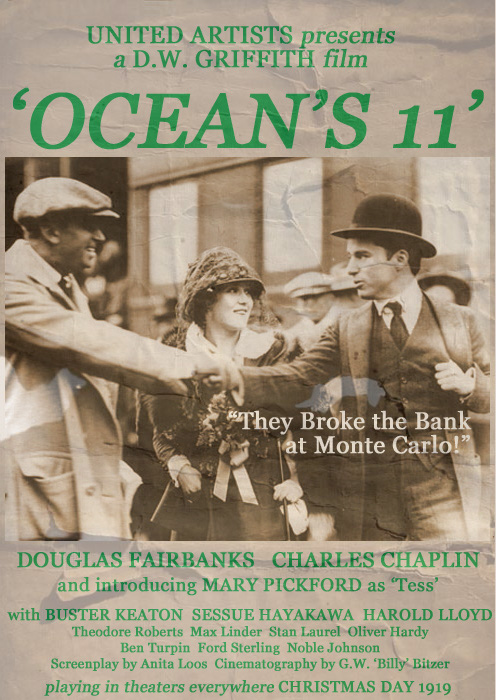 But what isn't generally known—because I just this second made it up—is that Bob le Flambeur was itself a remake of one of the greatest silent films of all-time, the star-studded comedy Ocean's 11, starring Douglas Fairbanks, Charlie Chaplin and Mary Pickford.
 For years, studio middle men had charged exorbitant fees simply to send the quartet's films out to the nation's theaters, a service that required little more than a large envelope and a postage stamp. With the formation of United Artists, Fairbanks, Pickford, Chaplin and Griffith would henceforth lick their own stamps, and each entertained visions of vast sums of money rolling in as compensation for the effort.
 A great idea, everyone agreed, but what kind of show? They hit upon the happy notion of a musical revue called The Jazz Singer until someone remembered that this was the silent era and they were going to look pretty silly belting out show tunes that no one could hear.
 Next, Griffith proposed they do a variation on his usual storyline, which was to reduce a complex historical event to a question of who got into Lillian Gish's underpants first, à la The Birth of a Nation, Hearts of the World and Orphans of the Storm. The others were skeptical as it was, then vetoed the idea outright when they learned Gish wouldn't actually be in the movie—just her underpants.
 "I've never done drag comedy," Chaplin lied, blushing, "and don't call me Shirley! Besides, I've got a great idea for a movie, a scathing indictment of capitalism and the industrial age I call Modern Times."
 Deluded by visions of great wealth, Loos cranked out one of her typically witty, fast-paced scripts, something she called United Artists Presents a D.W. Griffith Film Starring Douglas Fairbanks, Charlie Chaplin and Mary Pickford in a Story about a Team of Con-Artists who Break the Bank at the Gambling Casino in Monte Carlo so that One of Them (Fairbanks) Can Win Back his Ex-Wife (Pickford) While Making All His Pals (including Chaplin) Rich in the Process.
 The top-billed talent was easy. Fairbanks would play the lead, a handsome con artist named Daniel Ocean, while Chaplin would play his sidekick, Rusty Ryan—an agreeable distribution of chores, as the former would require some vigorous stunt work while the latter entailed split-second comic timing.
 For the plum part of the man they set out to rob, casino owner Terry Benedict, Pickford suggested Sessue Hayakawa. Hayakawa had risen to stardom on the strength of his seductively handsome yet cruelly ruthless villain in Cecil B. DeMille's The Cheat, a rare feat in the deeply racist Hollywood of the day.
 In addition to a satisfying villain, the film also required an all-star cast of comedians to play a rogues gallery of crooks and con men—each with a specialized skill that would require careful casting.
 Keaton jumped at the offer when Fairbanks called. "I classify Chaplin as the greatest motion picture comedian of all time," he said. "Plus I need the money."
 One of the film's pivotal roles was that of a high roller who would convince Hayakawa to open the casino's safe to him. "For this role, we need an older actor," Griffith said, "a twinkly-eyed ham who can get a laugh from a death scene."
 "Theodore Roberts!!!" everyone said simultaneously.
 Audiences of the time would best remember Sterling as the first leader of the Keystone Kops. He had recently played the Kaiser in an oddball cross-dressing comedy, Yankee Doodle in Berlin, starring Bothwell Browne as an army officer who disguises himself as a woman to infiltrate enemy headquarters and enjoys the masquerade entirely too much.
 "The notion of Max handling high explosives would get a terrific laugh in the overseas market," Chaplin said, "and I would like to help him revive his career."
 To play the "inside man," an employee of the casino who could come and go without drawing attention to himself, they chose Noble Johnson, a talented character actor with an imposing physique and a gift for disguises. One of the few African-American actors working regularly in Hollywood, Johnson ran a studio of his own, the Lincoln Motion Picture Company, dedicated to producing high-quality "race films" (as they were then known) such as The Realization of a Negro's Ambition. Griffith knew him from Intolerance where he had cast him as a Babylonian soldier.
 But after further discussion revealed that what the part required was someone who was supposed to be a genius but was in fact a quirky, funny-looking goofball, they settled on Ben Turpin whose eyes had been insured for $25,000 in case of accidental uncrossing.
 Over a late supper in a suite in the Hollywood Hotel, Fairbanks reviewed the cast list with Pickford. "Turpin makes ten," he said. "Ten oughta do it, don't you think? You think we need one more? You think we need one more. All right, we'll get one more."
 "That would be Harold Lloyd," Chaplin said. "He recently invented a boy-with-glasses character that I think is going to be a big hit. And he's handsome and can climb buildings even better than you can."
 The film, now retitled Ocean's 11, began production in the summer of 1919. Griffith directed the action sequences with his usual flare, but Chaplin balked at taking comedy advice from a man who thought the sack of Babylon was a laugh riot. Although Griffith received sole directorial credit, scholars now believe Chaplin was responsible for most of the film's non-action sequences.
 Less apparent on the set, but no less problematic, was the tension between Fairbanks' 100% irony-free acting style and Chaplin's compulsion to deflate all larger-than-life figures. The scene, for example, where Ocean talks Rusty into robbing the casino—"Why not do it?"—took over 400 takes alone, with either Fairbanks boisterously breaking character or Chaplin kicking him in the pants.
 Still, film-industry insiders and the movie-going public alike were abuzz with anticipation of the picture's Christmas Day premiere, and the four co-founders of United Artists had high hopes for a commercial and critical success. "This is going to be bigger than The Birth of a Nation," Griffith boasted. "Funnier, too."
 "Mary, you're wonderful!" said Fairbanks, dropping to one knee. "Will you marry me?"






 Posts
Posts

