

Friday, July 10, 2009


Happy Birthday, John Gilbert!
 Matinee idol John Gilbert would be a spritely 112 today—if he hadn't dropped dead of a heart attack in 1936.
Greta done wore him out.
But he was one of the good guys and he did some very under-appreciated work in such films as The Big Parade and Flesh and the Devil. Check out his work if you have time.
Thursday, July 9, 2009
Wednesday, July 8, 2009
A Recap Of The Katie Award Winners For 1928-29, A List Of Must-See Movies And A Word About Erich von Stroheim
 The last of the Katies for 1928-29 have been awarded—and it only took six weeks! At this rate, I'll reach the present day in, hmm, let's see, nine years.
Well, better get to it.
In case you've forgotten who won Katies for 1928-29, here's a recap of the year's winners:
Picture: The Passion of Joan of Arc (prod. Société générale des films)
Actor: Buster Keaton (Steamboat Bill, Jr.)
Actress: Lillian Gish (The Wind)
Director: Carl Theodor Dreyer (The Passion of Joan of Arc)
Supporting Actor: Ernest Torrence (Steamboat Bill, Jr.)
Supporting Actress: Anita Page (Our Dancing Daughters)
Screenplay: Frances Marion (The Wind)
Special Award: Walt Disney and Ub Iwerks (the creation and marketing of Mickey Mouse); Steamboat Bill, Jr. (prod. Joseph M. Schenck) (Best Picture-Comedy); Erich von Stroheim (The Wedding March) (Best Actor-Drama); Marion Davies (Show People) (Best Actress-Comedy); Douglas Shearer (The Broadway Melody) (Special Achievement In The Use Of Sound); "The Broadway Melody" (The Broadway Melody) (Best Song); Un Chien Andalou (prod. Luis Buñuel) (Best Short Subject); John Arnold (The Wind) (Cinematography)
And because a list of awards doesn't tell the whole story, here's another list, this time my selections for the "must-see" movies of the year:
Must-See Movies Of 1928-29: The Cameraman; Un Chien Andalou; The Docks Of New York; The Iron Mask; Our Dancing Daughters; The Passion Of Joan Of Arc; Show People; Steamboat Bill, Jr.; Steamboat Willie; The Wedding March; The Wind
 I've written about each of the listed Katie Award winners and in doing so I've also written about each of the must-see movies—except The Wedding March, the last movie directed by Erich von Stroheim that can be reasonably said to work. It's the story of a young aristocrat forced to marry for money rather than love. Von Stroheim was surprisingly sympathetic in the lead role, reminding you, as he would again in Sunset Boulevard, that he wasn't just a pretty face in a monocle. For his performance in The Wedding March, I nominated him for a Katie (he lost to Buster Keaton).
Like most of his work (see, e.g., Greed and Queen Kelly), the version of The Wedding March that wound up on the screen was quite a bit less than what von Stroheim had envisioned. Most film buffs have heard tales of von Stroheim's nine (nine, Mrs. Bueller!) hour cut of Greed that the studio whittled down to 130 minutes. In this case, The Wedding March is only the first third of what von Stroheim, who was not one to learn a lesson, conceived of as a six-plus hour movie tracing the reluctant courtship and subsequent marriage of the young aristocrat and a rich industrialist's crippled daughter (Zasu Pitts). The studio shut down the production after nine months and ordered von Stroheim to split the film as conceived into three parts, with The Wedding March at two hours to be followed by its sequel, The Honeymoon, and an unnamed third film to complete the trilogy. The Honeymoon was started but apparently never completed; its elements were destroyed by fire in the 1950s.
Contrary to conventional wisdom, I suspect the studio's intervention, rather than destroying a work of art, may well have saved von Stroheim from himself.
 In retro- spect, I think it's clear that von Stroheim was attempt- ing, with all these six and nine hour cuts of his movies, to invent the HBO miniseries. And he was absolutely right that there is artistic merit to taking time to tell a nine-hour story—I mean, think of The Sopranos reduced from a thirteen-hour season to a two-hour movie. Instead of having a deeply-layered, nuanced story, you would wind up with the same slam-bang surface-level gangster fluff that routinely shows up in the theaters, here for a disappointing opening weekend and then gone forever.
But unfortunately for von Stroheim, HBO and the miniseries hadn't been invented yet. Hell, they hadn't invented television yet. He was stuck with what he had, silent movies, a brevity-is-the-soul-of-wit medium. And while I support an artist's right to chase a vision no matter how impractical, there is no way von Stroheim could have expected in his wildest fantasies that an audience was going to sit still for nine hours while he threw shadows on a screen. In that context of the world he worked in, von Stroheim was not so much an artist pushing the edge as a gasbag who couldn't get to the point. (Or in his case, most likely a pompous poseur with a pathological need to prove himself superior to a public he regarded as rabble. But I digress.)
 But let's say for the sake of argument that von Stroheim was a genius and further that some scientist somewhere is working on a time machine that would bring von Stroheim, contract and camera in hand, to the home offices of HBO. The fact is, he still couldn't make a miniseries for HBO because he'd insist on a $100 million budget. Need to film a scene in a nondescript San Francisco boarding house? Go to San Francisco! Have a desert scene in the screenplay? Move your entire company to the desert for months to shoot a scene that winds up looking like something shot on a Hollywood backlot. He was extravagant beyond all reason, insisting on a fidelity to realism that didn't translate to the screen. With the way he spent money, on what in the end were tiny little art films, he never had a hope of turning a profit. No wonder he drove people like Irving Thalberg nuts.
"What's that about?" Thalberg asked von Stroheim as they watched the rushes from the director's 1925 movie, The Merry Widow, referring to one of the odder scenes in a movie heavily censored before its release.
"That is a foot fetish," von Stroheim said.
"You, Von," replied Thalberg, "have a footage fetish."
In all fairness, I should point out that Cecil B. DeMille routinely spent more money than von Stroheim. But I also have to point out that DeMille routinely made more money than von Stroheim. And as nasty a notion as that is to an artist, when you're making pictures with somebody else's money, you have to create the possibility that the guy writing the check will turn a profit or he's soon going to stop writing those checks.
 Which really brings me to the most important point, that what survives of von Stroheim's work really isn't that pretty. Von Stroheim's characters may have indulged a wide variety of fetishes—the panty sniffing of Queen Kelly, the foot fondling of The Merry Widow—but von Stroheim himself had a fetish for the grotesque, grotesque in the true sense of the word, "characterized by the fanciful," distorting "the natural into absurdity, ugliness or caricature." For all his blather about realism, von Stroheim was attracted to the fantastic, and the problem with a fetish is that it is inaccessible to anyone who doesn't share the fetish, a serious problem if you're looking for an audience of millions to defray the cost of your particular brand of lunacy.
I'm willing to concede that it's possible that the nine (nine!) hour version of, say, Greed was subtle and brilliant and absorbing (that is, if you didn't have to watch it in a single sitting). As I said, The Sopranos whittled down to two hours would never have had the same impact that the full series had. We'll never know.
But I think it's more likely that von Stroheim needed someone to rein him in, control his impulses, find the movie buried within the miles of footage. The director needed direction.
In any event, von Stroheim only directed nine movies (two of which he didn't finish; five others were heavily cut). His last movie, 1933's Hello, Sister, was mostly reshot after the studio fired von Stroheim. I think to a degree his reputation is based on a sense of what-might-have-been rather than on what-was, the romantic cliche of the great artist with the corporate boot on his neck; but I think based on the what-was I've seen, the-what-might-have-been is a bit overblown.
All of which is an appropriately long-winded way of saying that The Wedding March might be the best movie Erich von Stroheim ever accidentally made.
Tuesday, July 7, 2009
Best Picture Of 1928-29: The Passion Of Joan Of Arc
 Of my nominees for best picture of 1928-29, I've had three of them—Steamboat Bill, Jr.; The Wind; and my eventual choice, The Passion of Joan of Arc—penciled in for the award at one time or another, trying each on for size. Any one of them would have been a good choice and I'll bet if you looked at enough Alternate Oscar-type lists, you'd find all three of these as somebody's choice for the top prize.
Steamboat Bill, Jr. was 1928's best comedy and one of the best features Buster Keaton ever made. The Wind was the capstone of Lillian Gish's long and justly-celebrated silent film career. But it was something Chicago Sun-Times critic Roger Ebert said the other day in his blog that tipped the balance in favor of Carl Dreyer's film of the trial and execution of Joan of Arc.
Ebert was writing about how he tries to keep an open mind when approaching a new movie and had this to say about Pauline Kael's own philosophy of watching movies: "Take everything you are, and all the films you've seen, into the theater. See the film, and decide if anything has changed." That's what I find I have done with my first three best picture winners, The General (best of the silent era), Sunrise: A Song of Two Humans (1927-28) and now The Passion of Joan of Arc (1928-29): each has changed the way I feel about some aspect of movies and, on a good day, of life itself.
The General, aside from being a great comedy, probably did more to inspire this sudden mad interest in silent movies I've been riding for three months now than any other movie. For Katie-Bar-The-Door, too. Our trip down to the Kennedy Center to see The General presented with a live orchestra did more to make her an enthusiastic champion of this blog than did even the irresistible clarity of my sparkling prose. And Sunrise, a touching story of marital discord and reconciliation, showed me that my pre-conceived notions about film history—that Orson Welles singlehandedly invented modern movies—were flat out wrong.
 The Passion of Joan of Arc, with its tightly-framed close-ups and unadorned emotions, is quite frankly something I'd never seen before in a silent movie—or any other movie, for that matter—an impossible, anachronistic artifact that proves once again that our forefathers were much more modern that we currently dream of being.
More importantly, though, the movie reminded me that telling a story in such a simple and straightforward manner, letting the chips fall where they may, can uncover truths about human nature so eternal that even an eighty year old film based on a nearly six hundred year old historical event can be as relevant and timely as this morning's news. That, I think, is one of the hallmarks of true art, an ability to speak across generations in a unique and unforgettable way.
Or leaving all that aside, it's just a great, very watchable movie.
Writer-director Carl Dreyer was all set to film a conventional telling of Joan of Arc's story when he ran across the transcripts of her trial in an archive in Paris . Reading the transcript prompted Dreyer to throw out his first screenplay and focus strictly on the trial and subsequent execution.
 Now I've read a lot of trial tran- scripts in my time, first as a judicial clerk for a here- unnamed state's Court of Criminal Appeals then later as an appellate litigator for the federal government, and I can tell you, that while it's often difficult to discover justice in the cold written record of a trial, it's almost impossible not to discern the caliber of the trial's participants—their prejudices, their passions, their (very) occasional brilliance, their (much) more common incompetence. What I'm sure came across in startling clarity to Dreyer as he read the transcripts of Joan's trial was that her judges were motivated not by a search for the truth but by, first, cold calculations of national interest (Joan was the leader of France's military rebellion against an English occupation), and then, more interestingly, by the unsettling fear that Joan might be exactly what she purported to be, a saint working at the behest of God.
Dreyer dispenses with the usual exposition, stories of Charles VII, Henry VI and the last decade of the Hundred Years' War, and begins instead with the prisoner being led in chains through a makeshift courtroom into the witness dock. After the swearing in and some preliminary verbal fencing, the judges get down to it: "You claim to be sent by God?" a notion that elicits their scorn and amusement.
 The nineteen year old peasant girl is seemingly no match for a roomful of learned scholars, but as the inquisition fails to trap Joan into a fatal misstatement or contradiction, the judges' derision gradually turns to frustration, anger, and eventually fury. They hammer at her relentlessly on the issue of whether she expects some sort of reward from God for her sacrifice—a sacrifice, Dreyer implies, the judges themselves would not have dreamed of making without assurances of more earthly rewards.
But this all for show. The presence of heavily-armed soldiers makes clear, both to the audience and to the judges, that the verdict is pre-ordained. As the troop's commander puts it, "Not for anything in the world do I want her to die a natural death."
Unless you skipped your high school history altogether, you know how this is going to end.
Finally, to move the proceedings along, the unyielding Joan is led to the torture chamber and given the option of renouncing her claim to being "a daughter of God" or suffering the excruciating consequences.
 If Dreyer had filmed this sequence in 2008, I would say it was a fairly obvious commentary on Guantanamo Bay, waterboarding, military tribunals and the like. But he filmed it in 1928 based on the transcripts of a fifteenth century trial, and it serves as a simple statement of fact, that torture is designed not to find the truth but to extract compliance, conformity and an affirmation of a narrative the torturer already has convinced himself of. I doubt it even occurred to Dreyer that anyone in the civilized world had a different opinion of the matter.
As a general rule, I'm quite tolerant of a filmmaker's point of view (political and otherwise) regardless of what it is—unless we're talking about, say, Leni Riefenstahl's pro-Nazi propaganda—as long as (1) said filmmaker is as hard on his own beliefs as the beliefs he's attacking and (2) the politics are well-integrated into the story. Sometimes it works, more often it doesn't. For example, Katie-Bar-The-Door and I were in D.C. this weekend watching a production of King Lear at the Shakespeare Theater—Stacy Keach as Lear—and the director managed to shoe-horn in some action that was clearly a comment on our current wars in the Middle East. Quite frankly, it felt about as organic to Lear as a coconut does to a bowl of chili and we both left after the final curtain more than a little annoyed. But here, Dreyer let the action speak for itself without seeing any need to gild the lily, and the truths emerge on their own quite effectively.
 When you sit down to watch this movie (if you sit down to watch this movie), how you choose to watch it may affect your reaction to it. At the time the original film was discovered in 1981, Richard Einhorn wrote a choral and orchestral accompaniment that gives the film an elegiac feel, spiritual, meditative, like praying in a cathedral as the shadows lengthen on a late-autumn day.
Dreyer himself though preferred the movie to be shown completely silent; and watching it that way, the feel is much more like the intense white light of an operating theater, with everything on the line and nowhere to hide. Without the accompanying choral score, the film is no longer a prayerful meditation on saintly virtue but an uncompromising look at the naked exercise of power and the ability of the state to pervert justice and destroy an individual for its own ends.
The DVD from the Criterion Collection gives you the option of watching it either with the score or without, and I've watched it both ways. Dreyer's choice may not be as pleasant but it's a lot closer to the truth.
Sunday, July 5, 2009
Best Fun-Stupid Movies Of 1928-29: The Cameraman And The Iron Mask
Actually the best Fun-Stupid movie of 1928-29 is Buster Keaton's Steamboat Bill, Jr. But since this classic comedy has already won a couple of Katies (for actor and supporting actor) and I've written two compelling essays about it, you've by now no doubt already tracked down a copy and watched it—a couple of times if you're anything like me.
Okay, so nobody's anything like me.
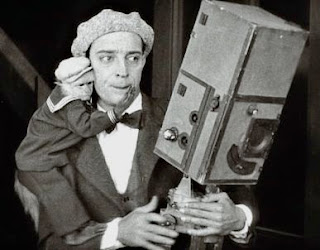 Anyway, there's another Keaton comedy from 1928 you don't want to miss. The Camera- man is the story of a tintype operator who aspires to become a newsreel photographer for the same reason a Buster Keaton character usually aspires to do anything, to impress a woman, in this case, Marceline Day. There are great scenes involving a gang war in Chinatown, an oversize pair of swim trunks at a public pool and an organ grinder's monkey that not only saves the day but proves to be a better filmmaker than Keaton.
The Cameraman doesn't include the death-defying physical stunts that marked most of Keaton's comedies, and for that reason alone I'd say if you've never seen a Buster Keaton movie, don't start with this one, but it is chock full of great gags and also works quite well as a commentary on the experimental cinema of the era. Not to mention Keaton plays perhaps the most appealing character of his career.
On the other hand, if Buster Keaton isn't your porkpie hat full of tea, I suggest you check out the Douglas Fairbanks swashbuckler The Iron Mask. Based on a pair of novels by Alexandre Dumas père, Twenty Years After and The Man in the Iron Mask, it's a sequel to Fairbanks's 1921 hit The Three Musketeers and features the return of D'Artagnan and his three compadres, Athos, Porthos and Aramis.
 Fairbanks nabbed a well-deserved Katie nomination for his performance as the larger-than-life D'Artagnan, and as you would expect when the name Douglas Fairbanks appears above the title, the movie features plenty of action and swordplay. But it's also a great buddy movie and surprisingly touching. This was Fairbanks's last silent movie: I think he knew that his days as an action star were numbered and he wanted to go out on a high note. That he does.
Both movies (plus Steamboat Bill, Jr.) are available on DVD.
Okay, so nobody's anything like me.
 Anyway, there's another Keaton comedy from 1928 you don't want to miss. The Camera- man is the story of a tintype operator who aspires to become a newsreel photographer for the same reason a Buster Keaton character usually aspires to do anything, to impress a woman, in this case, Marceline Day. There are great scenes involving a gang war in Chinatown, an oversize pair of swim trunks at a public pool and an organ grinder's monkey that not only saves the day but proves to be a better filmmaker than Keaton.
The Cameraman doesn't include the death-defying physical stunts that marked most of Keaton's comedies, and for that reason alone I'd say if you've never seen a Buster Keaton movie, don't start with this one, but it is chock full of great gags and also works quite well as a commentary on the experimental cinema of the era. Not to mention Keaton plays perhaps the most appealing character of his career.
On the other hand, if Buster Keaton isn't your porkpie hat full of tea, I suggest you check out the Douglas Fairbanks swashbuckler The Iron Mask. Based on a pair of novels by Alexandre Dumas père, Twenty Years After and The Man in the Iron Mask, it's a sequel to Fairbanks's 1921 hit The Three Musketeers and features the return of D'Artagnan and his three compadres, Athos, Porthos and Aramis.
 Fairbanks nabbed a well-deserved Katie nomination for his performance as the larger-than-life D'Artagnan, and as you would expect when the name Douglas Fairbanks appears above the title, the movie features plenty of action and swordplay. But it's also a great buddy movie and surprisingly touching. This was Fairbanks's last silent movie: I think he knew that his days as an action star were numbered and he wanted to go out on a high note. That he does.
Both movies (plus Steamboat Bill, Jr.) are available on DVD.
Saturday, July 4, 2009
As American As The Fourth Of July: Walt Disney, Mickey Mouse And Steamboat Willie
 In the summer of 1928, around the time Buster Keaton's latest comedy, Steamboat Bill, Jr., hit theaters, a young animator named Walt Disney was looking for a vehicle to launch his struggling studio's latest creation, a cartoon mouse by the name of Mickey. On November 18, 1928, the animated short Steamboat Willie premiered at New York's 79th Street Theater.
The rest, as they say, is history. Mickey Mouse soon eclipsed Felix the Cat as the movies' most popular cartoon character, appearing in hundreds of shorts, feature-length films and television shows over the next eighty years, as well as serving as the corporate symbol of the largest media conglomerate in the world. But if Disney had had his way, the famous mouse would have been a rabbit and history's most beloved pants-wearing rodent might never have made it off the drawing board.
 Disney had only just launched his own studio when he and his chief animator, Ub Iwerks, created a series of animated cartoons centered around a character named Oswald the Lucky Rabbit. The series was a smash hit but unfortunately for Disney, distributor Universal Studios wound up owning the character. Universal hired away most of Disney's animators (all but the loyal Iwerks), wrested control of Oswald from Disney and left his fledgling studio on the verge of bankruptcy.
Desperate for a new franchise to fill the gap, Disney and Iwerks quickly came up with an animated mouse they dubbed Mortimer—soon changed to Mickey at the insistence of Disney's wife, Lillian. After two silent Mickey Mouse shorts, Plane Crazy and The Gallopin' Gaucho, failed to find a buyer, Disney produced a short with sound, a loose parody of Keaton's latest film.
Steamboat Willie was an immediate hit and is still considered one of the most important cartoons ever produced. In 1994, a group of one thousand animators chose it as the thirteenth greatest cartoon of all time and four years later, the National Film Registry selected Steamboat Willie for preservation in the Library of Congress.
 Walt Disney, by the way, was nominated for fifty-nine Oscars, winning twenty-six of them, including four in one year, all records. Ironically, though, he didn't win for Steamboat Willie, one of the most important works of his career—there simply was no category of "cartoon short" at that time.
We'll correct that oversight now. For creating Mickey Mouse in 1928, I'm giving Walt Disney and Ub Iwerks honorary Katie Awards.
Make a little more room on the mantlepiece, fellas.
Trivia: Maybe you knew this, but I didn't: Walt Disney himself provided the voice of Mickey Mouse until 1946.
Thursday, July 2, 2009

Wednesday, July 1, 2009
Best Actor Of 1928-29: Buster Keaton (Steamboat Bill, Jr.)
 If I found the choice between Lillian Gish and Maria Falconetti for the best actress of 1928-29 nearly impossible to make, the choice for best actor is a no-brainer: Buster Keaton may well have been the best actor of the Silent Era and Steamboat Bill. Jr. rivals The General as the best movie of his career. I had this pick ready to go months ago when I started this blog and watching Keaton's movies again has only deepened my regard for this wonderful talent.
Born Joseph Frank Keaton VI into a family of traveling vaudeville performers, legend has it he was dubbed "Buster" when escape artist Harry Houdini saw the infant Keaton take a fall down a flight of stairs and bounce up unharmed. Whether he was born with it, or developed it doing "knockabout" routines on stage with his father, if Keaton wasn't the most talented pratfall artist in movie history, I'd like to see the guy who survived long enough to be a better one. He did stunts that rivaled those of Douglas Fairbanks, and when he was done, he doubled for his co-stars and did their stunts, too.
"The secret," he once said, "is in landing limp and breaking the fall with a foot or a hand. It's a knack. I started so young that landing right is second nature with me. Several times I'd have been killed if I hadn't been able to land like a cat."
Keaton made the leap from stage to screen in 1917 after meeting Roscoe "Fatty" Arbuckle who invited Keaton to shoot a scene with him in an upcoming short, The Butcher Boy. The rotund, expressive Arbuckle and the slender, deadpan Keaton proved to be a highly-successful team, making more than a dozen films together before Keaton struck out on his own, directing himself in the classic short One Week, which was just last year included in the National Film Registry.
 Soon after, Keaton formed his own production company, and in 1923 made his first feature-length film, Three Ages, beginning a run of classic comedies that included Our Hospitality, Sherlock Jr., The Navigator, The General, Steamboat Bill, Jr. and The Cameraman, a body of work that for pure laughs—no song, no dance, no sentimentality—surpasses even Charles Chaplin, the Marx Brothers and the Three Stooges. Which is saying something considering the number of Katie Awards I see in the future for each of those acts.
Like Chaplin, Keaton in the Silent Era was virtually a one-man act, writing, producing, directing, editing and starring in all his movies. One difference between Keaton and Chaplin, however, was Keaton's very un-modern reluctance to take credit where credit was due, often as with Steamboat Bill, Jr., slapping names like Carl Harbaugh on movies that he had, in fact, written and directed himself. (Of Harbaugh, Keaton later said, "He didn't write nothing. He was one of the most useless men I ever had on the scenario department." When asked why Harbaugh then received sole credit for writing Steamboat Bill, Jr., Keaton said, "Well, we had to put somebody's name up that wrote 'em ...")
I'm afraid this reticence cost Keaton Katie nominations for writing and directing this year. Somehow, though, I suspect his reputation will survive.
 Steamboat Bill, Jr. is a classic fish-out-of-water story, the reunion of a ukelele-playing, college-educated fop (Keaton) with his strapping, working class father (Katie winner Ernest Torrence). The son soon becomes a pawn in his father's battle with the town banker for control of the local riverboat trade. In the course of the seventy-minute story, Keaton contends with shipwrecks, hurricanes and an unreasoning prejudice against French berets to win over his father and get the girl.
Keaton conjures up an endlessly inventive series of gags—involving hats, collisions, chewing tobacco, a baby stroller, a jailbreak, an umbrella on a windy day, and many more—mostly turning on his misfit persona, his odd-couple relationship with his dad and his cheerful determination to succeed despite a preternatural inability to understand what it takes to do so.
One of my favorite early bits centers on the father's effort to give his son a makeover. After two deft flicks of a barber's razor remove Keaton's pencil-thin moustache, the father marches his son into a hatters to replace Keaton's beret with something he deems more suitable for a steamboat captain's son.
 Keaton tries on a number of hats, including his own trademark pork pie (which he immediately rejects) before settling on an overly-large Panama. He and his father step into the street, a gust of wind blows the new hat into the river, and when his father turns around, Keaton is again wearing that same silly beret. (The Three Stooges later recycled the scene to great effect for their 1936 short, 3 Dumb Clucks, with Curly Howard and a touring cap substituting for Keaton and the beret.)
Keaton delivers all of these comic moments with the understated deadpan style that made him famous and earned him the nickname "The Great Stone Face."
"I developed the 'Stone Face' thing quite naturally," Keaton said later. "[E]ven as a small kid, I happened to be the type of comic that couldn't laugh at his own material. I soon learned at an awful early age that when I laughed the audience didn't. So, by the time I got into pictures, that was a natural way of working."
It's this understated approach to comedy coupled with an utter lack of sentimentality that makes Keaton seem so modern.
 The most unfor- gettable sequence of Steam- boat Bill, Jr., maybe the most famous single sequence of Keaton's career, is the one where a cyclone blows a house over onto Keaton, who only misses being killed because he miraculously happens to be standing right where an open attic window allows him to pass right through.
 "First I had them build the frame- work of this building and make sure that the hinges were all firm and solid," Keaton explained. "Then you lay this framework down on the ground, and build the window around me. We built the window so that I had a clearance of two inches on each shoulder, and the top missed my head by two inches and the bottom my heels by two inches. We mark the ground out and drive big nails where my two heels are going to be. Then you put that house back up in position while they finish building it."
 It was actually a gag he'd first used in the short One Week but in this case, not only were they dropping a finished wall (rather than an open frame) on top of him, they were doing it during a simulated cyclone using six wind machines that proved powerful enough to accidentally blow a truck into the Sacramento River.
Most of the crew walked off in the set in protest, certain the stunt would kill him. Keaton himself declined to practice the stunt first, saying he knew it would work. "You don't do those things twice."
 This attitude was in keeping with Keaton's standing order to his cinema- tographer to keep the camera rolling until he said cut or was killed. But it also gave his stunts a realism that puts your heart in your throat even as you're laughing at the gags.
Keaton always dismissed talk of his greatness—"How can you be a genius in slapshoes?"—but there's no doubt in my mind, or anyone else's these days, that a genius is exactly what he was. Chicago Sun-Times film critic Roger Ebert calls him simply "the greatest actor-director in the history of the movies."
Despite his legendary prowess as a stuntman, Keaton landed wrong when after the release of Steamboat Bill, Jr. he jumped from producing his own films to signing on as a contract player at Metro-Goldwyn-Mayer. It was a move that pretty much wrecked his career.
"[T]hey were picking stories and material without consulting me," he said, "and I couldn't argue them out of it. They'd say, 'This is funny,' and I'd say, 'I don't think so.' They'd say, 'This'll be good.' I'd say, 'It stinks.' It didn't make any difference; we did it anyhow. I'd only argue about so far, and then let it go."
After a promising start at MGM with The Cameraman, which I have nominated for best picture, the studio forced Keaton into a series of second-rate productions. Always the perfectionist, Keaton drowned his frustrations in alcohol, a habit which soon became a problem in and of itself. Always an acquired taste, what little popularity Keaton had soon faded and MGM released him from his contract in 1934.
 The same story, incidentally, played out for any number of directors and actors at more studios than just MGM. The money men who ran the studios didn't seem to grasp that sound movies were something other than just silent movies with a song and a little talking thrown in. Care was needed to create a new medium—talking pictures—that was the equal to what directors such as Keaton, Chaplin, F.W. Murnau and Fritz Lang had created during the Silent Era. Care was something few producers were willing to invest.
Keaton continued to work after leaving MGM, most memorably in Chaplin's 1952 comedy Limelight, but he never again reached the heights he'd attained during the Silent Era. He did live long enough to see a revival of interest in his career and was directly involved in the restoration and re-release of his silent comedies. He was awarded an honorary Oscar in 1960 in recognition of "his unique talents which brought immortal comedies to the screen." His last movie appearance, a supporting role in A Funny Thing Happened On The Way To The Forum, was released eight months after his death in 1966.
A Personal Note: Many years ago, when video tape was expensive and DVDs were non-existent, Katie-Bar-The-Door bought me a box set of Buster Keaton movies for $75. That was back when we could still afford both Christmas presents and the mortgage. Adjusted for inflation, those $75 would now buy you all of General Motors with enough left over to pick up your neighbor's house at foreclosure.
 "Did you ever watch those Buster Keaton movies?" she once asked me.
Yes. Yes, I did. But I can see on the horizon hundreds of movies I haven't. What have I been doing with my time?
By the way, if you're wondering where the quotes for this essay came from, many of them came from a book I ran across while I was on the road this last weekend, Buster Keaton Interviews, edited by Kevin M. Sweeney. I highly recommend it if you're at all interested in Keaton.
Subscribe to:
Posts (Atom)





 Posts
Posts

