skip to main |
skip to sidebar
 I confess, I've given most of this year's blogathons a miss, mostly because I'm working on a mammoth non-blog project that requires nearly all of my time and energy. But here's one that tickled my fancy and allowed me to write about silent movies at the same time.
 It's called "The Great Recasting Blogathon" and it's hosted by In The Mood and Frankly My Dear, a couple of classic movie blogs you might want to check out on your own.
The rules are these:
1. Pick a movie that was made in between 1966 and today
2. Change the year of production
3. Choose new leads from Classic Hollywood
4. Choose a new director from Classic Hollywood
5. Explain why you think it would work
 Well, I'm recasting the 2001 version of Ocean's Eleven—as a silent movie, of course. As you probably know, Ocean's Eleven was a remake of the 1960 Rat Pack film of the same name, which was itself a loose remake of the 1956 Jean-Pierre Melville caper classic, Bob le Flambeur.
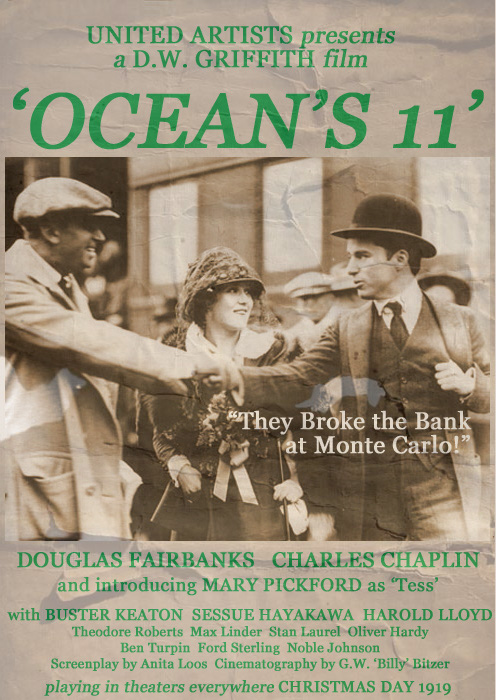
 But what isn't generally known—because I just this second made it up—is that Bob le Flambeur was itself a remake of one of the greatest silent films of all-time, the star-studded comedy Ocean's 11, starring Douglas Fairbanks, Charlie Chaplin and Mary Pickford.
Don't remember that one, you say? Well, here's the story:
It was 1919, and the world's three most popular movie stars—Douglas Fairbanks, Mary Pickford and Charlie Chaplin—had just joined forces with the world's most popular director—D.W. Griffith—to form a new distribution company they called "United Artists."
 For years, studio middle men had charged exorbitant fees simply to send the quartet's films out to the nation's theaters, a service that required little more than a large envelope and a postage stamp. With the formation of United Artists, Fairbanks, Pickford, Chaplin and Griffith would henceforth lick their own stamps, and each entertained visions of vast sums of money rolling in as compensation for the effort.
There was only one problem: they had no new product to distribute.
"Hey, kids," suggested Fairbanks, "why don't we put on a show!"
 A great idea, everyone agreed, but what kind of show? They hit upon the happy notion of a musical revue called The Jazz Singer until someone remembered that this was the silent era and they were going to look pretty silly belting out show tunes that no one could hear.
 Next, Griffith proposed they do a variation on his usual storyline, which was to reduce a complex historical event to a question of who got into Lillian Gish's underpants first, à la The Birth of a Nation, Hearts of the World and Orphans of the Storm. The others were skeptical as it was, then vetoed the idea outright when they learned Gish wouldn't actually be in the movie—just her underpants.
"How about an adaptation of Little Women," said Pickford. "Of course, you three will have to play your parts in drag, but if I can play a twelve year old girl, surely you can, too."
 "I've never done drag comedy," Chaplin lied, blushing, "and don't call me Shirley! Besides, I've got a great idea for a movie, a scathing indictment of capitalism and the industrial age I call Modern Times."
"Sounds fabulous," said Fairbanks. "When can you start production?"
"1936."
Reluctantly admitting they had no useable ideas, Fairbanks wired his old friend, writer Anita Loos. Loos had written a number of films for Fairbanks in 1916 and 1917, including the breakthrough hits The Matrimaniac and Wild and Woolly, and he was eager to work with her again. "She's busy writing a novel called Gentlemen Prefer Blondes," he reported the next day, "but for us, she's willing to set it aside for a percentage of the profits."
Griffith laughed. "Everybody knows movies never turn a profit! Why, even Gone with the Wind and Star Wars haven't turned a profit!"
 Deluded by visions of great wealth, Loos cranked out one of her typically witty, fast-paced scripts, something she called United Artists Presents a D.W. Griffith Film Starring Douglas Fairbanks, Charlie Chaplin and Mary Pickford in a Story about a Team of Con-Artists who Break the Bank at the Gambling Casino in Monte Carlo so that One of Them (Fairbanks) Can Win Back his Ex-Wife (Pickford) While Making All His Pals (including Chaplin) Rich in the Process.
"The title's a bit unwieldy," Pickford said, "but otherwise, it's perfect."
"Yeah, well, to make it work you're gonna need a crew as nuts as you are!" Loos said. "So who have you got in mind?"
 The top-billed talent was easy. Fairbanks would play the lead, a handsome con artist named Daniel Ocean, while Chaplin would play his sidekick, Rusty Ryan—an agreeable distribution of chores, as the former would require some vigorous stunt work while the latter entailed split-second comic timing.
Pickford would, of course, play the ex-wife, Tess.
Chaplin was especially looking forward to getting out of the Tramp costume for once. "That character has run its course," he said flatly. "A hundred years from now, who'll even remember him?"
 For the plum part of the man they set out to rob, casino owner Terry Benedict, Pickford suggested Sessue Hayakawa. Hayakawa had risen to stardom on the strength of his seductively handsome yet cruelly ruthless villain in Cecil B. DeMille's The Cheat, a rare feat in the deeply racist Hollywood of the day.
"If you've seen him in The Cheat," Pickford said, "you know he's perfect—hot and snaky and deliciously evil. You don't know whether to run away or cover him in whipped cream and eat him for dessert. Yummy!"
"Wait, what's this about whipped cream?" said Fairbanks.
 In addition to a satisfying villain, the film also required an all-star cast of comedians to play a rogues gallery of crooks and con men—each with a specialized skill that would require careful casting.
For example, the part of "the grease man," a contortionist who opens the casino's safe from inside the vault, required not just a comedian but an acrobat of near superhuman athletic ability.
"Buster Keaton," Chaplin said immediately. "He's funnier than a locomotive, throws a pie faster than a speeding bullet, and can fall out of a building in a single bound. Not to mention his Twitter feed is a riot! He's playing second banana to Roscoe Arbuckle, but that's not going to last long. Offer him anything but top billing."
 Keaton jumped at the offer when Fairbanks called. "I classify Chaplin as the greatest motion picture comedian of all time," he said. "Plus I need the money."
For one of two brothers who drive each other (and everybody else) crazy, Chaplin recommended his former British stage partner who was currently making comedy shorts for Bronco Billy Anderson. "Splendid chap named Stan Laurel."
For the other brother, D.W. Griffith suggested a fellow Southerner, a plump Georgian under contract at Vitagraph named Oliver Hardy. "I don't believe they've worked together before," Griffith said, "but something tells me Laurel and Hardy would make a sensational comedy team."
 One of the film's pivotal roles was that of a high roller who would convince Hayakawa to open the casino's safe to him. "For this role, we need an older actor," Griffith said, "a twinkly-eyed ham who can get a laugh from a death scene."
 "Theodore Roberts!!!" everyone said simultaneously.
Roberts had proven equally adept at drama and comedy during a run of highly-successful character parts in such films as Joan the Woman, Old Wives For New and The Roaring Road. Both Pickford and Fairbanks had worked with him before and would work with him again.
For another "older" part, that of a disgruntled ex-casino owner who would bankroll the caper, Chaplin suggested a colleague from his Mack Sennett days, Ford Sterling.
 Audiences of the time would best remember Sterling as the first leader of the Keystone Kops. He had recently played the Kaiser in an oddball cross-dressing comedy, Yankee Doodle in Berlin, starring Bothwell Browne as an army officer who disguises himself as a woman to infiltrate enemy headquarters and enjoys the masquerade entirely too much.
"It'll be nice working with proper comedians again," he said after receiving Chaplin's offer. "Just give me a pie and tell me who to throw it at and I'm good to go."
For the role of the munitions expert, Chaplin suggested the legendary French comedian, Max Linder. Linder had been the biggest star in Europe prior to the Great War, and Chaplin had modeled his style after him, but Linder's career had gone into decline after the actor was injured by mustard gas on the Western Front.
 "The notion of Max handling high explosives would get a terrific laugh in the overseas market," Chaplin said, "and I would like to help him revive his career."
 To play the "inside man," an employee of the casino who could come and go without drawing attention to himself, they chose Noble Johnson, a talented character actor with an imposing physique and a gift for disguises. One of the few African-American actors working regularly in Hollywood, Johnson ran a studio of his own, the Lincoln Motion Picture Company, dedicated to producing high-quality "race films" (as they were then known) such as The Realization of a Negro's Ambition. Griffith knew him from Intolerance where he had cast him as a Babylonian soldier.
The part of the computer nerd who hacks the casino's security systems proved to be a head-scratcher.
"What's a nerd?" asked Pickford. "For that matter, what's a computer?"
 But after further discussion revealed that what the part required was someone who was supposed to be a genius but was in fact a quirky, funny-looking goofball, they settled on Ben Turpin whose eyes had been insured for $25,000 in case of accidental uncrossing.
"He was just a funny-looking guy," Buster Keaton said later. "You know what I mean? We introduced his character as 'a man's man,' and Ben Turpin entered. That was the biggest laugh of the picture."
 Over a late supper in a suite in the Hollywood Hotel, Fairbanks reviewed the cast list with Pickford. "Turpin makes ten," he said. "Ten oughta do it, don't you think? You think we need one more? You think we need one more. All right, we'll get one more."
"What we need," Fairbanks told Chaplin at lunch the next day, repeating a suggestion of Pickford's, "is an innocent, all-American boy type—but here's the catch: one who can match me move for move in the scene where I climb down the elevator shaft. Who you got?"
 "That would be Harold Lloyd," Chaplin said. "He recently invented a boy-with-glasses character that I think is going to be a big hit. And he's handsome and can climb buildings even better than you can."
"Well, we'll use him anyway," Fairbanks said.
 The film, now retitled Ocean's 11, began production in the summer of 1919. Griffith directed the action sequences with his usual flare, but Chaplin balked at taking comedy advice from a man who thought the sack of Babylon was a laugh riot. Although Griffith received sole directorial credit, scholars now believe Chaplin was responsible for most of the film's non-action sequences.
While the two men would remain partners in the United Artists venture, they de-friended each other on Facebook soon after filming was complete, and for years thereafter rang each other's doorbell late at night and ran away.
 Less apparent on the set, but no less problematic, was the tension between Fairbanks' 100% irony-free acting style and Chaplin's compulsion to deflate all larger-than-life figures. The scene, for example, where Ocean talks Rusty into robbing the casino—"Why not do it?"—took over 400 takes alone, with either Fairbanks boisterously breaking character or Chaplin kicking him in the pants.
 Still, film-industry insiders and the movie-going public alike were abuzz with anticipation of the picture's Christmas Day premiere, and the four co-founders of United Artists had high hopes for a commercial and critical success. "This is going to be bigger than The Birth of a Nation," Griffith boasted. "Funnier, too."
Then tragedy struck. While awaiting shipment to theaters across the country, the highly-combustible elements in the movie's silver nitrate film stock caught fire, destroying not only the warehouse where the film was stored, but also the original negative and every print.
In a moment, Ocean's 11 joined the long list of silent films lost forever. Only a few fragments remain:
Film fans can only dream of what might have been.
"We're ruined," Fairbanks sobbed, "ruined before we ever made a movie!"
"Hardly," said Pickford. "While you were busy buckling your swash, I had the foresight to insure the film for $10 million with Lloyds of London—which is $9 million more than it cost to make! Not only are we not ruined, we're richer than ever!"
 "Mary, you're wonderful!" said Fairbanks, dropping to one knee. "Will you marry me?"
"You bet I will, you gorgeous hunk o' man, you! Come here and kiss me!"
"Rowr!"
Tomorrow: More posters from silent movies you will never see.
 I've been so long in responding to the comment Who Am Us Anyway left the other day that I thought I'd just turn it into a short, blabbery post.
"You know, Who, I read a throwaway line in this week's New Yorker magazine that serves as the antithesis of the movie reviewing philosophy we adhere to here at the Monkey. In an article called "Tune In Next Week," Emily Nussbaum wrote:
 As viewers, we rely on hierarchies to govern our notion of television ambition: cable trumps network, drama is better than sitcom, adult is worthier than teen, realistic is more grownup than sci-fi, grim beats sunny, PBS documentary tops Bravo reality show, and 'as good as Dickens' is superior to anything resembling a soap opera.
I don't know that Nussbaum meant that seriously Nussbaum doesn't believe in those hierarchies any more than I do, but I do know plenty of people who would take it seriously, especially if you substitute 'film' for 'television' and 'Erich von Stroheim' and 'Douglas Fairbanks' for, respectively, "PBS documentary" and 'Bravo reality show.' And I'm just telling you, Who, I'm not buying it.
This is my aesthetic criteria for judging a movie: does it move me (to laugh, to cry, to think, to leer at my wife lasciviously)? and does it do so in a memorable way, despite the passage of time and with it, the hype, buzz or cultural relevance surrounding the film's initial release?
 Some movies you forget before you've even left the theater, some fade within a few years, but some are as fresh and exciting as the day they were made, maybe even more so.
Thus, as you scroll through the Silent Oscars and on to the Katie Awards, you'll see Chuck Jones next to Ingmar Bergman, Shirley Temple next to Alfred Hitchcock, and yes, even a grim, grownup head-scratcher like Abel Gance sharing the stage with Harold Lloyd. If it's good, it's good, and if it's not—at least in my often-wrong opinion—you probably won't find it here."
 You'd never know it, but I've been busy updating my stand-alone Silent Oscars page (here)—it now comes complete with nominees in each category as well as winners all the way through July 31, 1927, the last day of the "pre-Oscar" era.
 I've also expanded the best picture category, starting with 1914, to name the best drama, comedy and foreign language film of each year. If nothing else, the exercise underscored for me just how much the Big Three of Charlie Chaplin, Buster Keaton and Harold Lloyd dominated comedy in the silent era—with three exceptions, they swap the award for best comedy back and forth from Chaplin's debut in 1914 to the beginning of the sound era.
 As you look at my choices (you will look at my choices, right?), keep in mind the point of the Silent Oscars is not to prove that I'm right and you're wrong, or that I'm smarter than you are or have better taste than you do or have seen more obscure movies than you have, but to point you toward the kinds of movies and performances that may spark in you a love of silent movies equal to the one I've developed over the last three-plus years.
At the very least, if you skim the top off these awards, watching, say, just the best picture winners, you'd still wind up with a pretty good feel for the silent era. That's worth something, isn't it?
Now back to "writing the great American novel ..."

 Vaguely in honor of the 43rd anniversary of Neil Armstrong and Buzz Aldrin walking on the moon.
In lieu of actual content.
 In how many Laurel and Hardy shorts did Jean Harlow act?
A. 2
B. 3
C. 6
D. 8
In lieu of actual content.
 How many times was Carole Lombard married?
A. 1
B. 2
C. 3
D. 4
And no, they don't count "in your dreams," thus, no "E. 30 million."
 Our Modern Maidens was the second leg of Joan Crawford's "flapper trilogy," sandwiched in between Our Dancing Daughters (1928) and Our Blushing Brides (1930). Like its predecessor, Our Modern Maidens centers on girl-gone-wild Joan Crawford, this time playing Billie Brown, a rich, spoiled, Jazz addict. She's engaged to marry Gil Jordan (Crawford's real-life fiance, Douglas Fairbanks, Jr.), but keeps the relationship a secret until he can secure a diplomatic post worthy of her ambitions.
"It's got to be Paris!" she tells him. "The big brass band for me!"
 Meanwhile, her school chum, Anita Page as the hopelessly naive Kentucky, dreams of romance—and more.
"Love! Beautiful love!" she writes in her diary. "Will it sweep me away in a cloud of glory or steal upon me ... gently?"
Unfortunately for her, the man she dreams of is none other than Billie's beau, Gil.
When Billie takes up with a powerful Washington insider—ostensibly to help Gil's career, but really to help herself—Gil consoles himself with Kentucky's virginity. When she gets pregnant, things get complicated.
 Yes, this is definitely pre-Code. With its emphasis on fast cars, bathtub gin and Jazz music, the film serves as a time capsule, if not of the reality of the Jazz Age then of how America perceived it. Unfortunately, the stock market would crash just two months after the film's release. By the time its follow-up, Our Blushing Brides, hit theaters in 1930, the fun was over and Crawford's carefree flapper had become a careworn shopgirl.
While Our Dancing Daughters was Anita Page's most famous role, and best, this one is her most adorable, and the one I imagine that drove her fans—including fascist dictator Benito Mussolini—to write her mash notes by the bushel-basketful.
 Equally fine is Douglas Fairbanks, Jr., in one of his best silent performances, worth seeing, if for nothing else, for his spot-on impressions of John Barrymore, John Gilbert and his own father, Douglas Fairbanks, Sr.
 Ironically, the least convincing performance in Our Modern Maidens is Crawford's own. Personally, I find it disconcerting to see her so wide-eyed and overeager, much preferring the world-weary cynicism of her best-known work. Although already a big star—a well-publicized marriage to Fairbanks, Jr. during filming didn't hurt—she wouldn't really hit her stride as an actress for another couple of years with such films as Dance, Fools, Dance and Grand Hotel.
Still, Our Modern Maidens is a frothy bit of fun and highly recommended for fans of Jazz Age frivolity. Mix yourself a gin rickey and enjoy.
Postscript: Our Modern Maidens was Crawford's last silent film, and if you haven't seen a silent film from this period, you may be surprised to discover it featured a synchronized score, sound effects and even some incidental dialogue.








 Posts
Posts

